




8 min read
Great Sculptor
Phidias
author: High Priest Zevios Metathronos
The Craftsman's Service to Divine Majesty
Dates: Active in the 5th century BCE, especially its middle and later decades.
Period: Classical (500–334 BCE).
Phidias of Athens made the gold-and-ivory cult statues of Athena Parthenos on the Acropolis, dedicated in 438 BCE, and of the seated Zeus at Olympia, finished around 430 BCE and counted among the Seven Wonders of the ancient world. The Athena alone stood about 40 feet high.1
He also directed the building programme of Periclean Athens. Plutarch says that under Pericles “his general manager and general overseer was Pheidias.”2
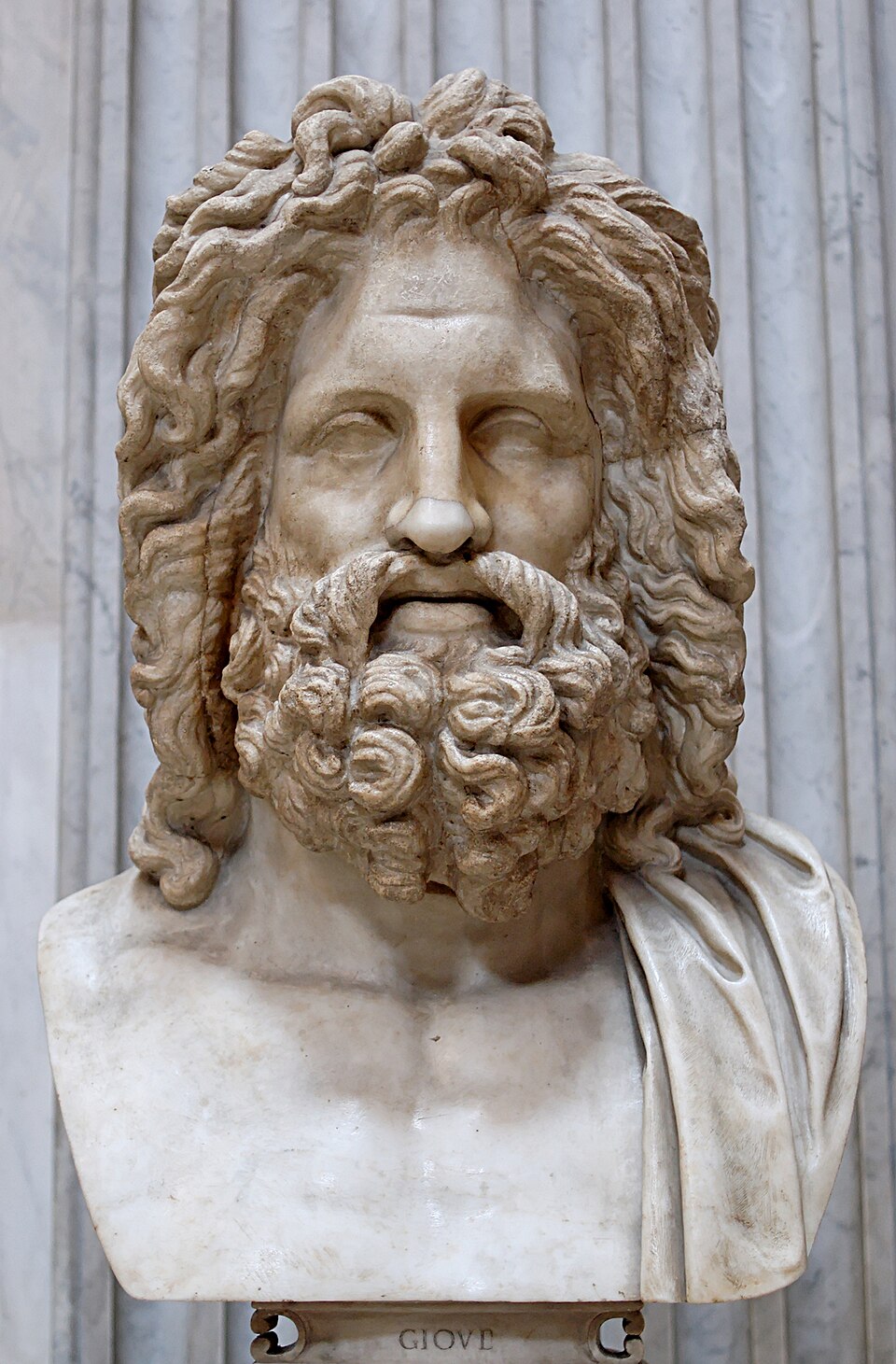
Zevism honours him as the sculptor of Zeus. He took the form of his Zeus from Homer's lines on the nod of the Sovereign of the Cosmos, and ancient writers said the finished image added to the awe in which the God was held.
LIFE AND CONTEXT
Phidias was an Athenian, the son of Charmides. The inscription beneath the feet of his Zeus at Olympia spoke for the statue: “Pheidias, son of Charmides, an Athenian, made me.”3 His exact dates aren't known, and his datable work falls in the middle and later decades of the 5th century BCE.4
One of his public commissions answered the Persian invasion. On the Acropolis stood “a bronze Athena, tithe from the Persians who landed at Marathon,” and Pausanias calls it “the work of Pheidias.” Its spear point and helmet crest could be seen from the sea “as soon as Sunium is passed.”5
Under Pericles he oversaw the whole building programme, “although the several works had great architects.” The cult image for the Parthenon was his own: “it was Pheidias who produced the great golden image of the goddess, and he is duly inscribed on the tablet.”6
Pausanias saw the Athena whole. “The statue itself is made of ivory and gold,” with a sphinx on the helmet and griffins on either side. She held “a statue of Victory about four cubits high” in one hand and a spear in the other; her shield lay at her feet beside a serpent, and the birth of Pandora ran across the base.7
The gold was part of the city's treasury. When war with Sparta came, Pericles reminded the Athenians that “the statue contained forty talents of pure gold and it was all removable,” and that if used, “every penny of it” must be restored.8
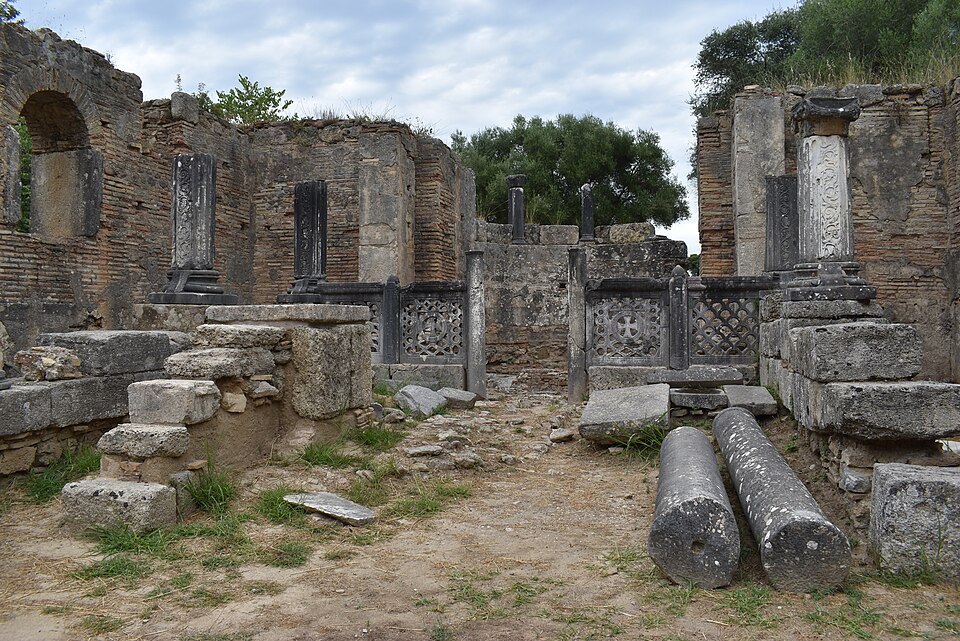
At Olympia he built a workshop outside the sacred precinct and made the Zeus there in sections.9 German excavations of 1954–1958 found the building, and with it moulds for the God's drapery, matrices for glass ornaments, tools and waste from the work.10
The finished God sat on a throne. “On his head lies a garland which is a copy of olive shoots. In his right hand he carries a Victory, which, like the statue, is of ivory and gold.” An eagle perched on the sceptre in his left hand, and his golden robe carried “figures of animals and the flowers of the lily.” Pausanias knew the statue's measurements and wouldn't repeat them, “for even their records fall far short of the impression made by a sight of the image.”11
ATTAINMENTS
- He made the Athena Parthenos, a standing image of gold and ivory about 40 feet tall, dedicated on the Acropolis in 438 BCE.12
- He fitted the Athena with 40 talents of pure gold, built so that every piece could be removed and weighed.13
- He made the seated Zeus at Olympia, finished about 430 BCE and counted among the Seven Wonders of the ancient world. The God held a Victory of ivory and gold in his right hand and a sceptre topped by an eagle in his left.14
- He cast the bronze Athena on the Acropolis from the tithe of the Marathon spoils, tall enough for sailors to see its spear point from beyond Sunium.5
- He directed the building works of Periclean Athens as “general manager and general overseer.”15
- His workshop at Olympia, excavated in 1954–1958, still holds the evidence of his method: drapery moulds, glass matrices and tools.16
- His family became hereditary keepers of the Zeus. The Eleans gave his descendants, “called Cleansers,” the right to clean the image.17
KEY STORIES
The Model in Homer's Lines
The Zeus at Olympia was enormous. Strabo writes that “although the temple was very large, the artist is thought to have missed the proper symmetry,” since the seated God almost touched the roof with his head. It looked as if “if Zeus arose and stood erect he would unroof the temple.” Phidias didn't work alone: “Panaenus the painter, who was the nephew and collaborator of Pheidias, helped him greatly in decorating the image, particularly the garments, with colours.”18
Panaenus asked him what model he meant to follow for the likeness of the God. Phidias “replied that he was going to make it after the likeness set forth by Homer.” Then he quoted the lines from the 1st book of the Iliad: “Cronion spake, and nodded assent with his dark brows, and then the ambrosial locks flowed streaming from the lord's immortal head, and he caused great Olympus to quake.”19
So the Zeus of Olympia began with 3 lines of verse. Phidias went back to Homer's description of the God and gave it gold and ivory, at a scale that nearly filled the temple.
A Thunderbolt on the Temple Floor
The statue was finished. Pausanias heard at Olympia what Phidias did next. “When the image was quite finished Pheidias prayed the god to show by a sign whether the work was to his liking.”20
The answer came at once. “Immediately, runs the legend, a thunderbolt fell on that part of the floor where down to the present day the bronze jar stood to cover the place.” The jar was still there when Pausanias visited, marking the spot where the God had struck.
The care of the image passed to Phidias's own line. The ivory needed oil, because “it is olive oil that keeps the ivory from being harmed by the marshiness of the Altis.” His Athena at Athens needed different care: there “the ivory of the image they call the Maiden is benefited, not by olive oil, but by water.”21 The Cleansers, his descendants, kept that duty, and “they sacrifice to the Worker Goddess before they begin to polish the image.”17 In Zevist terms, Zeus accepted the work, and Athena Ergane was honoured each time it was tended.
Gold That Could Be Weighed
At Athens the enemies of Pericles struck at him through his friend. Plutarch says they persuaded “one Menon, an assistant of Pheidias, to take a suppliant's seat in the market-place” and to accuse his master of stealing gold from the Athena.22
The theft charge couldn't survive the scales. “The gold of the statue, from the very start, had been so wrought upon and cast about it by Pheidias, at the wise suggestion of Pericles, that it could all be taken off and weighed.” Pericles ordered the accusers to do exactly that.23
His enemies turned to the shield. “When he wrought the battle of the Amazons on the shield of the goddess, he carved out a figure that suggested himself as a bald old man” lifting a stone with both hands, and he “also inserted a very fine likeness of Pericles fighting with an Amazon.” For this, Plutarch says, “Pheidias, accordingly, was led away to prison, and died there of sickness; but some say of poison.” The informer got his reward: “the people gave immunity from taxation” to Menon.24
THE ZEVIST READING
Phidias's Zeus began with a return to the source. Asked for his model, he named Homer, and he built the nod that shakes Olympus into gold and ivory.19 Zevism holds that the source has priority over what later hands add, and here a later hand made the source visible to everyone who entered the temple.
The ancients said the image deepened worship itself. Quintilian wrote that its beauty “is said to have added something even to the awe with which the god was already regarded: so perfectly did the majesty of the work give the impression of godhead.”25 Dio Chrysostom went further. Even a man “sore distressed in soul, having in the course of his life drained the cup of many misfortunes and griefs,” would, “if he stood before this image, forget all the terrors and hardships that fall to our human lot.”26
Dio also let Phidias explain the God's bearing: “our god is peaceful and altogether gentle, such as befits the guardian of a faction-free and concordant Hellas.”27 It's Zeus as the Temple knows him, the Sovereign who holds Ma'at, the order of the cosmos, and gives Greece its peace.
The thunderbolt on the floor completes the reading. A craftsman finished his work, asked the God for judgment and received it. Zevism counts such work as theurgy: human skill and intelligence joined to the intelligence of the Gods, under Athena, the Worker Goddess, whom his descendants honoured each time they polished the ivory.
NOTES
1 Karoglou, “Ancient and Modern Colossal Statues,” Metropolitan Museum of Art.
2 Plutarch, Pericles 13.4, tr. Perrin.
3 Pausanias 5.10.2, tr. Jones.
4 Karoglou, Metropolitan Museum.
6 Plutarch, Pericles 13.4, 13.9.
8 Thucydides 2.13.5, tr. Crawley.
10 Mallwitz and Schiering, Die Werkstatt des Pheidias in Olympia, DAI.
12 Metropolitan Museum, Karoglou; Pausanias 1.24.5.
13 Thucydides 2.13.5; Plutarch, Pericles 31.3.
14 Metropolitan Museum, Karoglou; Pausanias 5.11.1.
16 DAI, Die Werkstatt des Pheidias.
17 Pausanias 5.14.5.
19 Strabo 8.3.30.
20 Pausanias 5.11.9.
25 Quintilian, Institutio Oratoria 12.10.9, tr. Butler.
26 Dio Chrysostom, Discourse 12.51, tr. Cohoon.
BIBLIOGRAPHY
Pausanias, Description of Greece, tr. W. H. S. Jones and H. A. Ormerod, Theoi Classical Texts Library: 1.24.5–7 and 1.28.2; 5.10.2, 5.11.1, 5.11.9–10, 5.14.5 and 5.15.1.
Plutarch, Pericles 13.4, 13.9 and 31.2–5, tr. B. Perrin, Loeb Classical Library; LacusCurtius.
Thucydides, History of the Peloponnesian War 2.13.5, tr. Richard Crawley, Internet Classics Archive, MIT.
Strabo, Geography 8.3.30, tr. H. L. Jones, Loeb Classical Library; LacusCurtius.
Quintilian, Institutio Oratoria 12.10.9, tr. H. E. Butler, Loeb Classical Library; LacusCurtius.
Dio Chrysostom, Discourse 12 (Olympic Discourse) 51 and 74, tr. J. W. Cohoon, Loeb Classical Library; LacusCurtius.
Kiki Karoglou, “Ancient and Modern Colossal Statues: From Athena Parthenos to the Statue of Liberty”, Metropolitan Museum of Art, 1 July 2016.
Alfred Mallwitz and Wolfgang Schiering, Die Werkstatt des Pheidias in Olympia: Erster Teil, German Archaeological Institute; publication synopsis on the excavations of 1954–1958 and the workshop finds.
CREDIT
Picture: The workshop site associated with Phidias at Olympia, with remains of its later use. Photograph by Annatsach, 2019.
Annatsach; CC BY-SA 4.0; Wikimedia Commons. Image record, CC BY-SA 4.0.

The round picture in the lists of the personalities is cropped from it.