





10 min read
Last of the Greeks
Philopoemen of Megalopolis
author: High Priest Zevios Metathronos
Courage Answerable to the Community
Dates: c. 250s–183/182 BCE
Period: Hellenistic period
Philopoemen of Megalopolis was the leading general of the Achaean League in its last decades of independent strength. Plutarch counts 8 terms as the League's general. He rearmed its infantry on the Macedonian model, killed the Spartan tyrant Machanidas with his own spear at Mantinea in 207 BCE and brought Sparta into the League in 192 BCE.1
The ancient writers measured him against the whole of Greek history. Plutarch reports that a Roman, praising him, “called him the last of the Greeks.” Pausanias ranked him beside the victor of Marathon: Miltiades was “the first benefactor of all Greece, just as Philopoemen, the son of Craugis, was the last.”2
Zevism reads his life under Dike, the daughter of Zeus, whose order he defended against tyrants and whose measure his own anger later broke. His strength served the freedom of the Greek cities, and the record keeps both the service and the failure.
LIFE AND CONTEXT
Philopoemen was born at Megalopolis in Arcadia. His father Craugis “was as nobly born as any Arcadian of Megalopolis,” Pausanias writes, but he died while the boy was still a baby, and Cleander of Mantinea became his guardian.3 His teachers were 2 Megalopolitans, Ecdemus and Megalophanes, who had been “comrades of Arcesilaüs at the Academy.” Plutarch says that they, beyond all men of their day, “had brought philosophy to bear upon political action.”4
He read military writers and “wished to model his whole life on Epaminondas, his wisdom and his achievements.”5 He also kept a farm, and Plutarch says he'd go out to it every day after dinner or supper and sleep on “an ordinary pallet-bed, like anyone of his labourers.”6
His youth fell in the war with Cleomenes III of Sparta, who beat the Achaeans near Megalopolis in 227 BCE.7 When Spartan troops later seized the city itself, Philopoemen “led safely to Messene about two-thirds of the men of military age, along with the women and children.”8 Antigonus III of Macedon crushed Cleomenes at Sellasia in 222 BCE, and the young Megalopolitan rode in his line.9
After Sellasia he sailed to Crete and fought there as a mercenary commander. Britannica puts the stay at “some 10 years.” He came home to rebuild the League's cavalry, was elected its cavalry commander for 210/209 BCE, and held the generalship for the first time in 208/207 BCE.10
The next enemy was Nabis of Sparta. Philopoemen drove him out of Messene and routed him at Tegea, and after a failure at sea he nearly destroyed the tyrant's army near Gythium. When Nabis was assassinated in 192 BCE, Philopoemen took Sparta into the League.11 His later settlement of Sparta was harsh: Pausanias says he expelled 300 men, “sold some three thousand Helots, razed the walls of Sparta” and abolished the Lycurgan training of the young. Plutarch blamed the measures on his anger.12
He died a prisoner of the Messenians. The year is disputed: Britannica gives 182 BCE, a note in the LacusCurtius edition of Plutarch also places his last command in 182, and the older tradition gives 183.13
ATTAINMENTS
- He was elected general of the Achaean League 8 times. The 8th term came when he was “seventy years of age.”14
- He rebuilt the Achaean infantry. Its narrow bucklers and short spears gave way to breastplates, greaves, “Argolic shields and long spears,” and the men learned to fight as a Macedonian phalanx.15
- He turned the Achaeans' taste for fine clothes toward fine arms. Polybius says he told them to take more care that his greaves fitted and shone than about his “shoes and boots,” while he himself was “plain and simple” in dress and living.16
- He won the battle of Mantinea in 207 BCE. Polybius records that the Achaeans killed “as many as four thousand Lacedaemonians” and captured still more, and that Philopoemen killed Machanidas “hand to hand.”17
- He saved about 2/3 of the fighting men of Megalopolis, with the women and children, when Cleomenes took the city, and led them to Messene.8
- He brought Sparta into the Achaean League after the assassination of Nabis in 192 BCE.11
- He refused a gift of 120 talents raised from the confiscated house and property of Nabis. He told the Spartans to leave good men alone, since their virtues came “without payment of money,” and to “buy up and corrupt the bad men who were ruining the city.”18
KEY STORIES
The General at the Woodpile
Plutarch tells of a visit to a house in Megara. The hostess learned that “the general of the Achaeans was coming to her house” and, in great confusion, set about preparing supper. Philopoemen walked in “wearing a simple soldier's cloak.” She took him for one of the general's servants and asked him to help with the housework.
“So Philopoemen at once threw off his cloak and fell to splitting wood.” Then the host came in and found the commander of the League bent over the woodpile. “What does this mean, Philopoemen?” he asked. The answer came in broad Doric: “What else than that I am paying a penalty for my ill looks?”
Plutarch adds that he wasn't in fact ugly, and that a statue of him could still be seen at Delphi. The joke was at his own expense, and the wood got split.19
The Javelin at Sellasia
At Sellasia in 222 BCE the young Philopoemen was posted among the Macedonian cavalry with the men of his own city. Their orders were to lie quietly in reserve until the king signalled from the other wing. The Illyrians beside them pushed forward against the Spartans, and the Achaeans kept waiting. Philopoemen saw that the enemy's light troops lay open, and he didn't wait for the signal. He “formed his fellow-citizens into a wedge, and charged upon the enemy,” and the light troops broke with heavy losses.20
In the charge “he had both his thighs pierced through by a thonged javelin.” The wound wasn't fatal, but the thong's fastening made it hard to draw the weapon back through it. Plutarch says that “by moving his legs backward and forward he broke the shaft of the weapon in two in the middle,” drew his sword and pushed through the front ranks.
After the victory Antigonus asked his Macedonians why they'd brought the cavalry into action without his orders. They said they'd been forced to attack “because a young man of Megalopolis had first led a charge against them.” Antigonus laughed. “Well, then, that young man behaved like a great commander.”20
The Tyrant at the Ditch
At Mantinea in 207 BCE the Achaean phalanx stood behind a ditch. Polybius, the historian who would one day carry Philopoemen's funeral urn, tells the end of the battle: “When Machanidas, on reaching a place where the ditch was easily passable, set spurs to his horse and forced it across, Philopoemen turned to meet him.” He gave the tyrant a mortal wound with his spear, struck again with the butt, and “slew the tyrant hand to hand.”17
Plutarch adds the men at his side. Simmias and Polyaenus, who always covered him with their shields, levelled their spears at the horse, but Philopoemen reached Machanidas first. Seeing the horse's head rise in front of its rider, he swerved, and “clasping his spear firmly in the middle, pushed it home with all his weight.” The Achaeans set up a bronze statue at Delphi showing him in that attitude.21
At the next Nemean Games he paraded his phalanx before the assembled Greeks. Then, while the singers competed for the prize, he came into the theatre with his young men in their soldiers' cloaks and purple tunics. Just as they entered, the singer Pylades was chanting the opening verse of the Persians of Timotheus: “Glorious the crown of freedom which he fashioneth for Hellas.” Plutarch says “all the spectators turned their eyes upon Philopoemen and gave him glad applause.”22
The Cup in the Treasury
In his 8th generalship Philopoemen lay sick with fever at Argos when news came that Deinocrates had brought Messene out of the League. He rode for Megalopolis and then against the rebels. In a skirmish his horse stumbled and threw him, and the Messenians took him alive. They carried him into “the Thesaurus, as it was called, a subterranean chamber which admitted neither air nor light from outside and had no door.”23
When night came and the crowds of Messene had gone home, Deinocrates had the prison opened and sent in a public official with poison. Philopoemen lay “wrapped with his soldier's cloak,” awake. He took the cup and asked whether the man had heard anything of the horsemen, and “particularly about Lycortas.” Told that most of them had escaped, he nodded and said: “That is good news, if we have not wholly lost.” Then he drained the cup and lay down again.24
The Achaeans chose Lycortas as general and invaded Messenia. The Messenians went over to them, and the men behind the killing were caught and punished, all except Deinocrates, who died by his own hand. The Arcadians carried the bones home to Megalopolis.25 In the funeral procession the urn, almost hidden under fillets and wreaths, “was borne by Polybius, the son of the Achaean general.”26
THE ZEVIST READING
Hesiod gives the measure for a life like this. “Virgin Justice, the daughter of Zeus,” sits beside her father when anyone wrongs her and tells him of princes who “pervert judgement and give sentence crookedly.”27 Hesiod's Dike acts: she reports the crooked judge to Zeus, and the people pay for their princes' folly. Philopoemen spent his life in that order's service: against Cleomenes, Machanidas and Nabis, men who held Greek cities by force.
Zevism names that order Ma'at, held by Zeus as Sovereign of the Cosmos, and names its collapse Izfet.28 The flight from Megalopolis shows the order in its plainest form. The walls had fallen, and Philopoemen saved the people, who were the city's substance. He then drilled and armed a league of free cities so that no tyrant could take them city by city. In Zevist terms that league restored Ma'at in the Peloponnese.
The Good in Zevism asks for 2 things together: right order, and right act from right will. Philopoemen's will passed the test at the house of Nabis, where 120 talents couldn't buy him. His acts at Sparta failed it. Razing walls and selling some 3,000 Helots answered Spartan unrest with anger, and Plutarch himself censured it.
The last scene shows the aim of the path. Plato set it as ὁμοίωσις θεῷ κατὰ τὸ δυνατόν, likeness to the divine “as far as possible.”29 A 70-year-old man in a dark cell, holding poison, asked first whether his young horsemen had got away. Zevism reads that question as the last act of a life spent in service, and the likeness Plato asked for appears in it.
NOTES
1 Plutarch, Philopoemen 9–10, 18; Britannica, “Philopoemen”.
2 Plutarch, Philopoemen 1; Pausanias 8.52.1.
7 Britannica, “Cleomenes III”.
9 Britannica, “Cleomenes III”; Plutarch, Philopoemen 6.
10 Plutarch, Philopoemen 7; Britannica, “Philopoemen”.
12 Pausanias 8.51.3; Plutarch, Philopoemen 16.
13 Britannica, “Philopoemen”; Plutarch, Philopoemen, note 30.
15 Pausanias 8.50.1; Plutarch, Philopoemen 9.
16 Polybius 11.9–10.
17 Polybius 11.18.
23 Plutarch, Philopoemen 18–19.
25 Pausanias 8.51.8.
27 Hesiod, Works and Days 256–262.
BIBLIOGRAPHY
Plutarch, Life of Philopoemen, tr. Bernadotte Perrin, Loeb Classical Library, Plutarch's Lives vol. 10, 1921; LacusCurtius; chapters 1–2, 4, 6–7, 9–11, 15–16, 18–21, and editorial note 30 on the date of the last command.
Pausanias, Description of Greece 8.49–52, tr. W. H. S. Jones, Loeb Classical Library; Theoi Classical Texts Library; 8.49.2–4, 8.50.1, 8.51.3, 8.51.5–8, 8.52.1.
Polybius, Histories 11, tr. W. R. Paton, Loeb Classical Library, vol. 4, 1925; LacusCurtius; 11.9–10, 11.18.
Encyclopaedia Britannica, “Philopoemen”: Crete, generalships, Mantinea, Nabis, Sparta's entry into the League in 192 BCE, death in 182 BCE.
Encyclopaedia Britannica, “Cleomenes III”: defeat of the Achaeans near Megalopolis in 227 BCE; Sellasia in 222 BCE.
Hesiod, Works and Days 256–262, tr. H. G. Evelyn-White; Theoi Classical Texts Library.
Encyclopaedia Britannica, “Maat”.
Plato, Theaetetus 176a–b, Greek text, Perseus Digital Library.
CREDIT
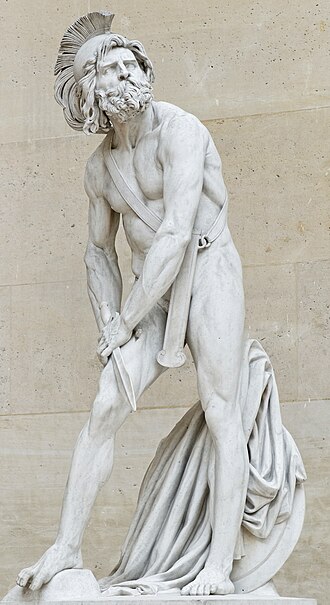
Picture: Philopoemen wounded, an imagined representation by David d’Angers, 1837; Louvre, LP 1556.
Pierre Jean David d’Angers; photograph Marie-Lan Nguyen, 2011; Wikimedia Commons; Public domain; photographer explicitly dedicates the photograph to the public domain. Image record, Public domain; photographer explicitly dedicates the photograph to the public domain.

The round picture in the lists of the personalities is cropped from it.