




9 min read
Great Lyric Poet
Pindar
author: High Priest Zevios Metathronos
Excellence Illuminated by the Gods
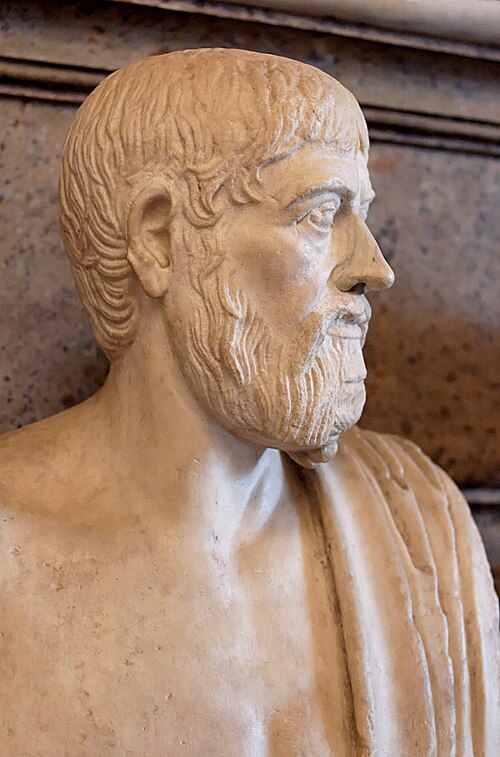
Dates: Approximately 518–438 BCE.
Period: Classical (500–334 BCE).
Pindar of Thebes made choral songs for the winners of the great Greek games, and antiquity ranked him above every other lyric poet. Quintilian said it flatly: “Of the nine lyric poets Pindar is by far the greatest.”1
His largest surviving achievement is concrete: 45 complete victory odes in 4 books, written for victors at Olympia, Delphi, Nemea and the Isthmus.2 His patrons ranged from the lords of Thessaly to the tyrants of Sicily and the wrestling families of Aegina.
Zevism reads Pindar as the poet of Zeus and Apollo. Every ode sets a single day's win inside the order of the Gods, and his last dated poem names the brightness “given by Zeus” as what lifts a mortal out of shadow.
LIFE AND CONTEXT
Pindar was born near Thebes, at the village of Kynoskephalai, and Thebes stayed his home for life.3 The Suda names his father as Daiphantes and calls him a pupil of the poet Myrtis, born in the 65th Olympiad and 40 years old when Xerxes invaded.4
Pausanias preserved the Theban story of how it began. “When Pindar was a young man he was once on his way to Thespiae in the hot season.” About noon he grew tired and lay down above the road, and “bees alighted on him and plastered his lips with their wax.” Pausanias adds: “Such was the beginning of Pindar's career as a lyric poet.”5
His earliest victory ode, Pythian 10, dates to 498 BCE. It celebrated Hippocleas, a boy who'd won the double footrace, and it wasn't the boy's father who paid for it: Thorax, of the powerful Aleuad family of Thessaly, commissioned the song.6
When Xerxes invaded, Thebes took the Persian side, a record Myers called “the shameful part taken by Thebes in the Persian war.” Pindar still praised Athens as the city that at Artemision laid “the foundation of freedom.” Myers reports that the Thebans fined him for it, and that the Athenians paid the fine, made him their proxenos and raised his statue at public cost.7
The great patrons were the Sicilian tyrants. For Hieron of Syracuse and Theron of Akragas, Myers notes, Pindar “wrote five of the longest of his extant odes, and probably visited them in Sicily.”7 Delphi honoured him as well. The Pythian priestess “bade the Delphians give to Pindar one half of all the first-fruits they offered to Apollo,” and an iron chair stood near the temple hearth. On it, the Delphians said, he sat whenever he came and “composed his songs to Apollo.”8
He was still composing in 446 BCE, when Pythian 8 celebrated the wrestler Aristomenes of Aegina.9 The Suda says he'd asked for the best gift in life and died at once in the theatre, leaning on the knees of his beloved Theoxenos. Thebes buried him in the hippodrome.10
ATTAINMENTS
- His collected work filled 17 books in the Doric dialect. The Suda lists the kinds: Olympian and Pythian victory odes, processionals, maiden songs, paeans, hymns, dithyrambs, drinking songs, encomia and laments.4
- Of those books, the 4 of victory odes survive whole: 45 poems for winners at the Olympic, Pythian, Nemean and Isthmian games, the 4 Panhellenic festivals.11
- His career as a victory poet lasted 52 years, from Pythian 10 for a Thessalian boy in 498 BCE to Pythian 8 for Aristomenes of Aegina in 446.12
- He wrote 5 of his longest odes for the rulers of Syracuse and Akragas, among them Olympian 1 for Hieron's racehorse Pherenikos and Olympian 2 for Theron's chariot victory of 476 BCE.13
- Athens paid him for a single phrase. Isocrates records that he was so honoured for calling Athens “the bulwark of Hellas” that “he was made ‘proxenos’ and given a present of ten thousand drachmas,” and Pausanias saw the statue Athens gave him.14
- Apollo's sanctuary gave him a share of its own offerings, half the first fruits by order of the Pythia, and kept his iron chair beside the hearth.8
- Quintilian ranked him first of the 9 canonical lyric poets for his “inspired magnificence” and “rolling flood of eloquence,” qualities which, “as Horace rightly held, make him inimitable.”1
KEY STORIES
Corinna and the Whole Sack
Plutarch tells how the young Pindar learned his trade from a rival. He “prided himself on his felicitous use of words,” and the Boeotian poet Corinna told him his writing lacked refinement, “since he did not introduce myths, which are the proper business of poetry.” He leaned on rare words and rhythms, she said, which were only ornaments.15
Pindar took the lesson and overdid it. “Giving all heed to her words,” he composed a lyric that packed a whole Theban mythology into its opening lines: “Ismenus, or Melia of the golden distaff, / Or Cadmus, or the holy race of men that were sown,” then Heracles, then Dionysus.
He showed it to Corinna. She laughed and told him “one should sow with the hand, not with the whole sack.” Plutarch explains the joke: Pindar had “confused and jumbled together a seed-mixture, as it were, of myths, and poured them into his poem.”16
The Banquet Pindar Refused to Tell
Hieron of Syracuse won the single-horse race at Olympia with Pherenikos, and Pindar's ode for him opened on water and gold: “Best is Water of all, and Gold as a flaming fire in the night shineth eminent amid lordly wealth.”17
Its myth was Pelops, son of Tantalus, and an ugly tale went with him: that the Gods had eaten the boy at his father's table. Pindar turned on it openly: “Of thee, son of Tantalos, I will speak contrariwise to them who have gone before me.” In his version Poseidon, “his heart vanquished by love,” snatched the boy up at the feast and carried him behind golden horses “to the house of august Zeus.”
The cannibal story, he said, began with a neighbour's gossip after the boy vanished. The neighbour claimed the Gods had cut up his limbs over boiling water and “eaten sodden fragments of thy flesh.” Pindar refused it outright: “But to me it is impossible to call one of the blessed gods cannibal; I keep aloof; in telling ill tales is often little gain.”17
Myers credits Aristophanes the grammarian with setting this ode at the head of Pindar's works. In Zevist terms it's a return to the source: Pindar measured the myth against the nature of the Gods and threw out what didn't fit.
Persephone's Hymn
Pausanias heard the Theban account of Pindar's last days. In old age Persephone stood by him in a dream and “declared that she alone of the deities had not been honored by Pindar with a hymn.” He would compose an ode to her too, she told him, “when he had come to her.”18
“Pindar died at once, before ten days had passed since the dream.” The story went on past his death. An old woman of Thebes, “related by birth to Pindar,” had “practised singing most of his odes.” One night Pindar stood beside her in a dream “and sang a hymn to Persephone.”19
“Immediately on waking out of her sleep she wrote down all she had heard him singing in her dream.” In the Theban telling, that was how Persephone received her hymn, from a poet who had already gone down to her.
The Roof Alexander Spared
About a century after Pindar's death, Thebes rose against the young Alexander of Macedon. He stormed the city and destroyed it. Plutarch gives the count: after “separating out the priests, all who were guest-friends of the Macedonians, the descendants of Pindar,” and those who'd voted against the revolt, he sold the rest, “more than thirty thousand,” and more than 6,000 lay dead.20
Dio Chrysostom tells what happened to a single building. Alexander “left only that poet's house standing,” and had a notice fixed to it: “Set not on fire the roof of Pindar, maker of song.” The reason lay in an older poem: Pindar had praised the king's namesake and ancestor, “Alexander, nicknamed the Philhellene.”21
Centuries later Pausanias crossed the river at Thebes and found “the ruins of the house of Pindar, and a sanctuary of the Mother Dindymene,” the image the poet had dedicated still in place.22
THE ZEVIST READING
Olympia belonged to Zeus, and Pindar's odes never let the victor forget it. Olympian 2 answers its own opening question in that order: “Verily of Zeus is Pisa the abode,” then Heracles, founder of the games, and only then Theron and his chariot.23 His patrons understood the order too. Hieron sent Etruscan spoils from Cumae to the sanctuary, and a bronze helmet still carries the inscription “Hieron, son of Deinomenes, and the Syracusans, [dedicated] to Zeus Etruscan [spoils] from Cumae.”24
The Pelops ode shows the 2nd element. Myers observed that Pindar “ignores or flatly denies tales that bring discredit on the gods.”7 Zevism holds that the source has priority over what transmission adds to it, and a tale that turns the Gods into cannibals is a corruption of the source. Pindar judged the myth by the nature of the Gods, and he corrected it in public, before a king.
Pythian 8 opens on Hesychia, Tranquillity, the “Daughter of Dikē,” Justice.25 Zevism names that order Ma'at: the structured order that Zeus holds as Sovereign of the Cosmos, against Izfet, dissolution. Pindar's victor wins inside that order, and the ode's first word calls on it.
The same ode ends on the path itself. “Creatures of a day. What is a someone, what is a no one? Man is the dream of a shade. But when the brightness given by Zeus comes, there is at hand the shining light of men.”26 Plato named the aim ὁμοίωσις θεῷ κατὰ τὸ δυνατόν, likeness to the divine as far as possible.27 Pindar gives both halves: alone, a shadow's dream; lit by Zeus, a shining light. The Temple reads each crown he sang as a moment of that likeness.
NOTES
1 Quintilian, Institutio Oratoria 10.1.61.
2 Harvard University Press, Pindar I, ed. and tr. W. H. Race.
3 Myers, The Extant Odes of Pindar, introduction.
6 Pavlou, “Localizing Pindar's Pythian 10,” Mnemosyne 76 (2023).
9 Nagy, Pythian 8, introduction.
10 Suda, pi 1617; Pausanias 9.23.2.
11 Harvard University Press, Pindar I.
12 Pavlou, Mnemosyne 76; Nagy, Pythian 8.
13 Myers, prefatory notes to Olympian 1 and 2.
14 Isocrates, Antidosis 166; Pausanias 1.8.4.
15 Plutarch, De gloria Atheniensium 4, 347f–348a.
16 Plutarch, De gloria Atheniensium 4.
18 Pausanias 9.23.3.
21 Dio Chrysostom, Discourse 2.33.
22 Pausanias 9.25.3.
24 British Museum, 1823,0610.1.
BIBLIOGRAPHY
Pindar, Olympian 1 and Olympian 2, with the translator's introduction and prefatory notes; Ernest Myers, The Extant Odes of Pindar, Project Gutenberg.
Pindar, Pythian 8, introduction, lines 1–2 and 95–97; translation and notes by Gregory Nagy, Center for Hellenic Studies, Harvard University.
Maria Pavlou, “Localizing Pindar's Pythian 10”, Mnemosyne 76.3 (2023), 375–393.
Harvard University Press, Pindar I: Olympian Odes. Pythian Odes, ed. and tr. William H. Race, Loeb Classical Library 56, 1997; publisher's description.
Suda, pi 1617, “Pindaros”, tr. Catharine Roth, Suda On Line.
Pausanias, Description of Greece, tr. W. H. S. Jones, Theoi Classical Texts Library: 1.8.4; 9.23.2–4 and 9.25.3; 10.24.5.
Plutarch, De gloria Atheniensium 4, 347f–348a, tr. F. C. Babbitt, and Alexander 11.6, tr. B. Perrin; Loeb Classical Library, LacusCurtius.
Dio Chrysostom, Discourse 2 (Second Discourse on Kingship) 33, tr. J. W. Cohoon, Loeb Classical Library, 1932; LacusCurtius.
Isocrates, Antidosis (15) 166, tr. George Norlin, Perseus Digital Library.
Quintilian, Institutio Oratoria 10.1.61, tr. H. E. Butler, Loeb Classical Library; LacusCurtius.
British Museum, bronze helmet dedicated at Olympia by Hieron and the Syracusans, about 474 BCE, registration number 1823,0610.1.
Plato, Theaetetus 176a–b, Greek text, Perseus Digital Library.
CREDIT
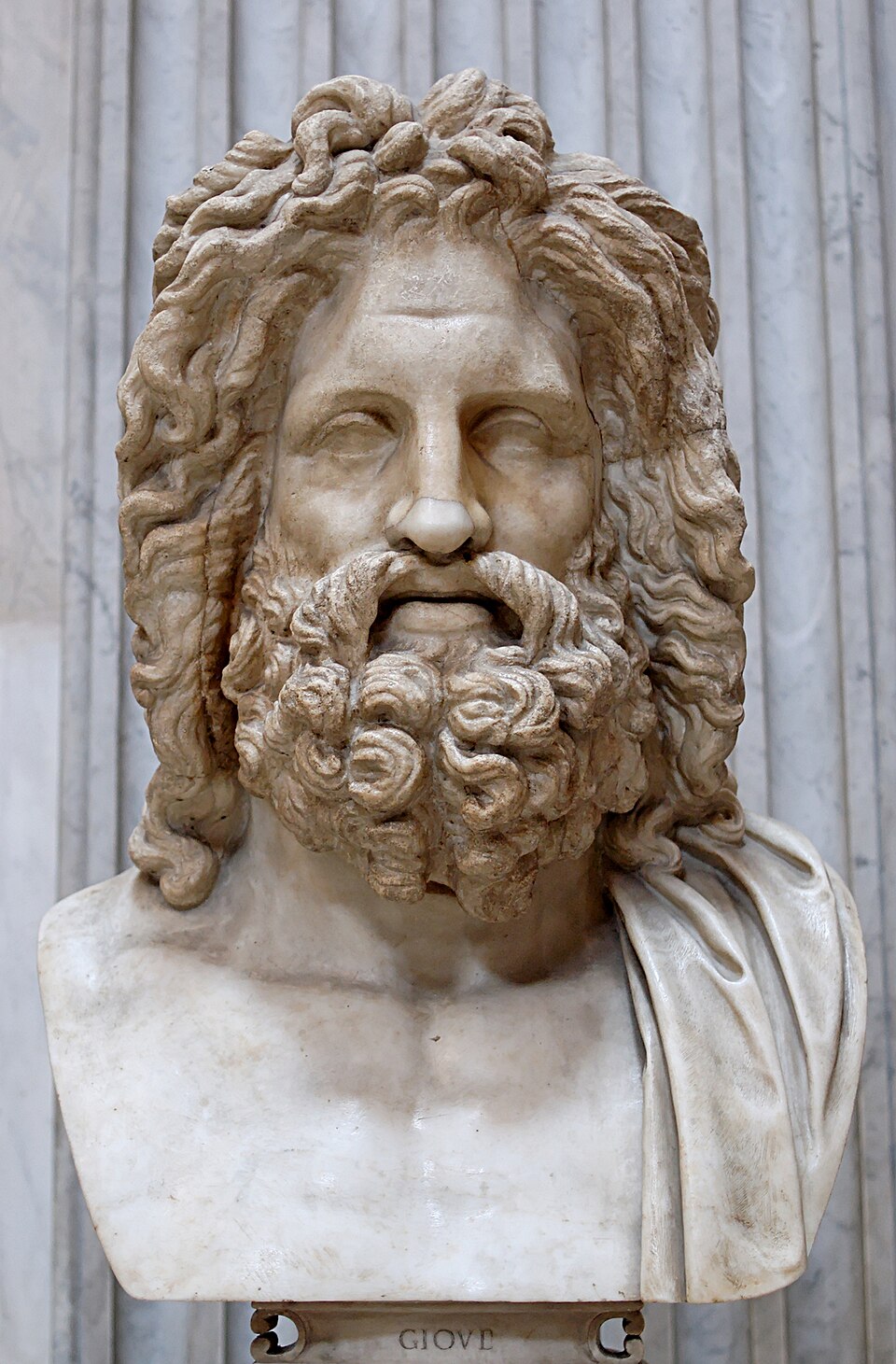
Picture: Marble bust identified as Pindar, Roman copy after a Greek original; Capitoline Museums, MC 586.
Jastrow, 2006; Public domain (photographer release); Wikimedia Commons. Image record, Public domain (photographer release).

The round picture in the lists of the personalities is cropped from it.