



9 min read
Philosopher of Tyre
Porphyry of Tyre
author: High Priest Zevios Metathronos
Dates: c. 234–c. 305 CE
Period: Roman period (30 BCE–800 CE)
Porphyry was born at Tyre in Phoenicia, probably in 234 CE, and studied in Rome with the philosopher Plotinus. He arranged his teacher's 54 treatises into the 6 Enneads. His Isagoge became “a standard introductory text in Byzantium, the Arabic world and in the Latin West.” Some 60 works were attributed to him.1
Eunapius, the biographer of the later Platonists, caught his gift in 1 image. Plotinus “seemed austere and hard to listen to,” he wrote. “But Porphyry, like a chain of Hermes let down to mortals, by reason of his many-sided culture expounded all subjects so as to be clear and easy of comprehension.”2
Zevism honours him under Hermes, as a keeper of the source who carried a master's words into a form that others could enter. He also left one of antiquity's rare first-person records of union with the divine, and the Temple reads it as ὁμοίωσις θεῷ reached in old age.
LIFE AND CONTEXT
His Phoenician name was Malchos, like his father's. “‘Malchos’ would give ‘Basileus’ in Greek,” he explained, a king's name.3 He studied in Athens with the Middle Platonist Longinus, and Eunapius says it was Longinus who renamed him Porphyry, “thus making it indicate the colour of imperial attire.”4
In 263 he came to Rome. “I myself arrived from Greece in the tenth year of Gallienus' reign,” he wrote later. Plotinus was about 59 and Porphyry was 30, and by then the master had composed 21 treatises.5
He stayed some 5 years. In 268 he left for Sicily “to recover from a bout of depression,” and he was at Lilybaeum when Plotinus died.6 The edition of the treatises was his charge: “This task he himself had imposed upon me during his lifetime and I had pledged myself to him and to the circle to carry it out.”7
The rest of his life is thinly recorded. Emilsson writes that “we do not know anything with certainty about where he lived in the latter half of his life.”8 He married Marcella, a widow and “the mother of five daughters and two sons,” and left her after 10 months on a journey, “the affairs of the Greeks requiring me, and the gods too urging me on.”9 Eunapius says he “attained to an advanced old age” and died in Rome.10
He also quarrelled over theurgy. Porphyry raised his doubts in a Letter to Anebo, and Iamblichus, “his presumably former student,” wrote a Reply to Porphyry that scolded him “for his skeptical attitude towards theurgy.” Most of his books, among them Against the Christians and Philosophy from Oracles, survive only in fragments.11
ATTAINMENTS
- He edited Plotinus. He divided the 54 treatises “into six sets of nine, an arrangement which pleased me by the happy combination of the perfect number six with the nines,” opened with ethics, and ended by checking punctuation and correcting verbal errors.12
- He wrote the Life of Plotinus, which dates his teacher's work: 21 treatises were already written when Porphyry arrived in 263.5
- He wrote the Isagoge for Chrysaorius, a short introduction to “genus, difference, species, property, and accident.” Through Boethius's translations and commentary it became the standard introduction to logic in the Latin West.13
- He set aside the hard question of universals in 1 sentence: whether genera and species “subsist (in the nature of things) or in mere conceptions only.” Emilsson credits these non-committal formulations with making his logic “the most lasting part of his legacy in West.”14
- He wrote the Sententiae, which Emilsson calls “the only extant work in which he lays out his basic philosophical views that is with certainty attributable to him.”15
- He argued that Plato and Aristotle can be harmonized, and “just about all subsequent ancient Platonists” followed him.16
- He wrote On Abstinence from Animal Food for a friend, Firmus, who had “again returned to animal food,” and argued for the meatless diet his friend had given up.17
KEY STORIES
The Pupil Who Recanted
Porphyry didn't arrive in Rome as a disciple. He came from the school of Longinus and wrote a paper against Plotinus, arguing that the objects of thought exist outside the Intellect. Amelius, a member of the circle, read it to the master, and Plotinus said: “You must clear up these difficulties, Amelius: Porphyry doesn't understand our position.”18
Amelius wrote a long reply, In Answer to Porphyry's Objections. Porphyry answered it, Amelius answered again, and only then did the newcomer give way. “Then only, I was converted, wrote a recantation, and read it before the circle.”
He kept asking questions. “At one time I myself kept interrogating him during three days as to how the soul is associated with the body,” he wrote. A visitor named Thaumasius complained that he'd rather hear Plotinus lecture “as he would in a set treatise.” Plotinus answered: “But if we cannot first solve the difficulties Porphyry raises what could go into the treatise?”19
The Road to Lilybaeum
Porphyry told this story against himself. “I myself at one period had formed the intention of ending my life. Plotinus discerned my purpose; he came unexpectedly to my house where I had secluded myself, told me that my decision sprang not from reason but from mere melancholy and advised me to leave Rome.”20
He obeyed. He chose Sicily “because I heard that one Probus, a man of scholarly repute, was living there not far from Lilybaeum.”20
Eunapius tells it with more colour. Porphyry sailed through the straits past Charybdis, “along the route where Odysseus is said to have sailed,” and at Lilybaeum he lay groaning, taking no food. Plotinus “either followed in his footsteps or inquired for the youth who had fled, and so found him,” and spoke until the words “recalled to life his soul.” “So Porphyry breathed again and arose,” and Plotinus wrote the arguments into 1 of his books.10
The Sacred Marriage on Plato's Feast
The circle of Plotinus kept a feast in honour of Plato. “Once on Plato's feast I read a poem, ‘The Sacred Marriage,’” Porphyry recalled. Someone in the room called out, “Porphyry has gone mad.” Plotinus answered “so that all might hear: ‘You have shown yourself at once poet, philosopher and hierophant.’”21
The same chapter records a harder evening. The orator Diophanes read a defence of the Alcibiades of Plato's Banquet and argued that a pupil should submit to his teacher in everything, “even to the extent of carnal commerce.” Plotinus “started up several times to leave the room but forced himself to remain.” When the company broke up, he told Porphyry to write a refutation.
Diophanes wouldn't lend him the text, so Porphyry worked from memory. He read his answer to the same audience, and Plotinus was so delighted that during the reading he kept quoting a verse: “So strike and be a light to men.”21
The Letter from the Road
Marcella had 7 children, and when Porphyry was called away she couldn't follow him with so many daughters at home. He wrote to her instead, and the Letter to Marcella teaches philosophy to a reader who can't travel to a school.22
It gives her a temple she can carry: “let your temple be the mind that is within you. This must you tend and adorn, that it may be a fitting dwelling for God.” It also gives her a rule in 4 words: “There are four first principles that must be upheld concerning God,” and they are faith, truth, love and hope. Faith turns the soul toward God, and knowledge of the truth follows; then love of the God one knows, and last the good hopes that, Porphyry says, set good men above bad.23
THE ZEVIST READING
Zevism holds that one must return to the source, and it honours those who keep the source whole. Porphyry did that work for Plotinus. He grouped the treatises by subject, set the easiest first, and promised the reader he'd “see to the punctuation, and correct any verbal errors.”24 He also showed the honesty that such keeping needs: when Amelius proved he'd misread Plotinus, he wrote a recantation and read it aloud to the circle. Eunapius's chain of Hermes is the right image for the whole labour: the God of language let down a line by which mortals could climb.
The line Plotinus quoted, “So strike and be a light to men,” states the Zevist teaching on Light and Darkness. An argument like the one Diophanes made is darkness left unexamined. Porphyry walked into it with reasons and brought it back into the light, which is what discovery means in Zevist terms.
His own summit came late. “To this God, I also declare, I Porphyry, that in my sixty-eighth year I too was once admitted and I entered into Union.” He adds that Plotinus reached the same goal 4 times while Porphyry was with him.25 Plato named the aim ὁμοίωσις θεῷ κατὰ τὸ δυνατόν, likeness to the divine “as far as possible.”26
On Abstinence describes the offering that fits that aim. To the highest God nothing material is offered; “being conjoined with and assimilated to him, we should offer to him, as a sacred sacrifice, the elevation of our intellect.”27 Zevism names that act Σοφία, the theurgic dimension of the path, where human intelligence joins the intelligence of the Gods. Porphyry and Iamblichus argued over the means, and both stand in the chain.
NOTES
1 Eyjólfur Kjalar Emilsson, “Porphyry,” SEP, §§1–2, 3.4; Porphyry, Life of Plotinus 24.
2 Eunapius, Lives of the Philosophers, Porphyry.
4 Emilsson, §1; Eunapius.
6 Emilsson, §1; Life of Plotinus 2.
8 Emilsson, §1.
9 Porphyry, Letter to Marcella 1, 4.
10 Eunapius.
11 Emilsson, §§1–2.
13 Porphyry, Isagoge 1; Emilsson, §3.4.
14 Isagoge 1; Emilsson, §3.4.
15 Emilsson, §2.
16 Emilsson.
17 Porphyry, On Abstinence 1.1.
BIBLIOGRAPHY
Eyjólfur Kjalar Emilsson, “Porphyry”, Stanford Encyclopedia of Philosophy, revised 2021; §§1–2 and 3.4.
Porphyry, On the Life of Plotinus and the Arrangement of His Work, tr. Stephen MacKenna; §§2, 4, 11, 13, 15, 17, 18, 23–26.
Porphyry, Letter to His Wife Marcella, tr. Alice Zimmern, 1896; §§1, 4, 19, 24.
Porphyry, Introduction (Isagoge), tr. Octavius Freire Owen, in The Organon, or Logical Treatises of Aristotle, vol. 2, Bohn, 1853; ch. 1.
Porphyry, On Abstinence from Animal Food, tr. Thomas Taylor, Book 1, §1, and Book 2, §34.
Eunapius, Lives of the Philosophers and Sophists, tr. W. C. Wright, Loeb Classical Library, 1921; life of Porphyry.
Plato, Theaetetus 176a–b, Greek text, Perseus Digital Library.
CREDIT
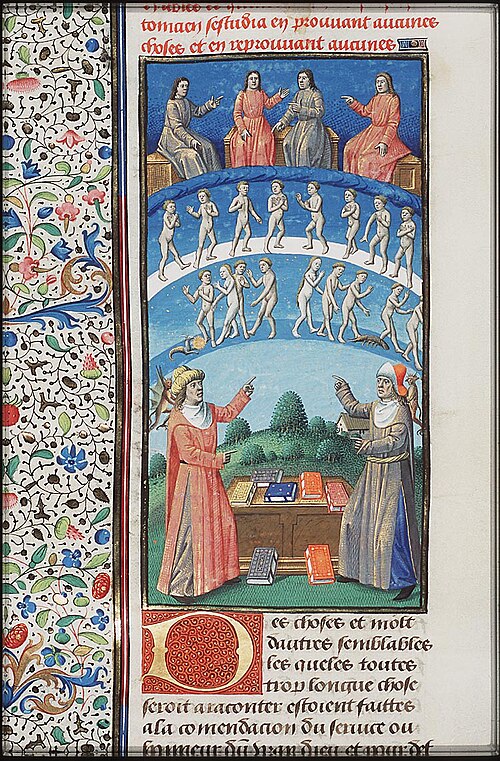
Picture: Porphyry and Plotinus in a later manuscript illumination, c. 1475–1480. An imagined medieval representation, not contemporary portraits.
Maître François; Wikimedia Commons; Public domain; faithful reproduction of a public-domain artwork. Image record, Public domain; faithful reproduction of a public-domain artwork.

The round picture in the lists of the personalities is cropped from it.