




9 min read
Great Pontiff
Vettius Agorius Praetextatus
author: High Priest Zevios Metathronos
Dates: Born in the early 4th century; died 384 CE
Period: Roman period (30 BCE–800 CE)
Vettius Agorius Praetextatus held the highest offices of Rome and the highest priesthoods of its Gods at the same time. His funerary monument names him augur, pontifex of Vesta and of Sol, hierophant of the Eleusinian mysteries and pater patrum, and then lists his career from quaestor to prefect of the city, praetorian prefect and consul designate.1
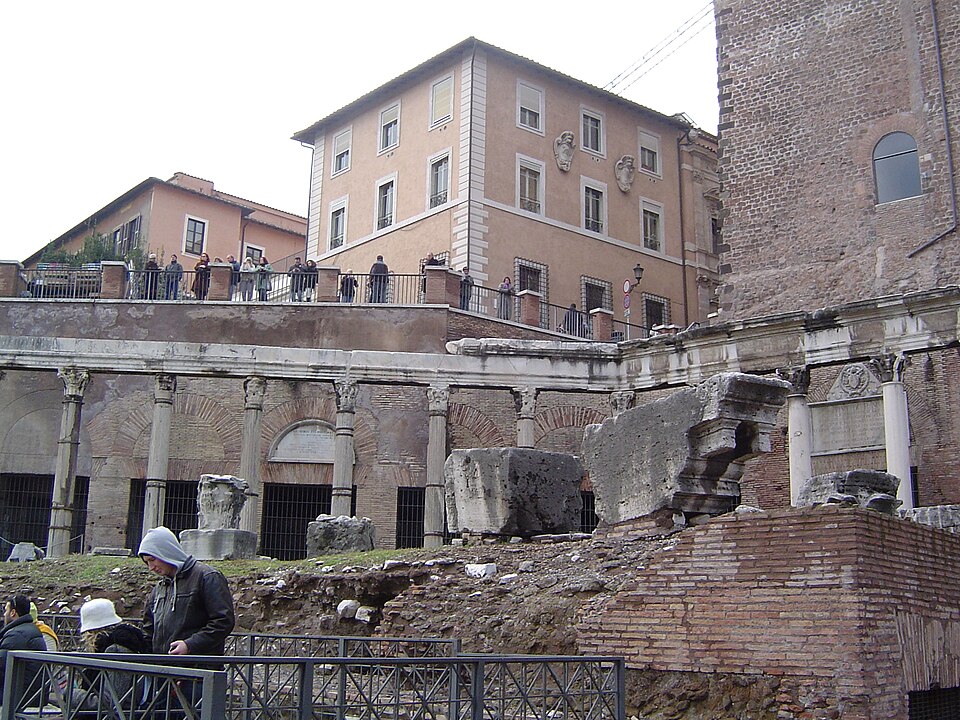
As prefect of Rome in 367 he restored the Portico of the Consenting Gods, the colonnade below the Capitol that honoured the 12 principal Gods of the city.2 The same prefecture cleared private walls off the temples and gave every quarter of the city honest weights.
Zevism reads him as a magistrate in the service of Zeus the lawgiver and of Ma'at, the right order of things. He kept the Gods' houses standing and the scales true, and he argued an emperor into sparing the mysteries of Greece.
LIFE AND CONTEXT
Praetextatus was born early in the 4th century into the senatorial aristocracy of Rome, and he climbed its ladder of offices in full.3 The inscription lists him as quaestor, urban praetor, governor of Tuscia and Umbria, governor of Lusitania, proconsul of Achaia, prefect of the city, 5 times envoy of the senate, and praetorian prefect of Italy and Illyricum.4
Greece came to him by chance. Ammianus Marcellinus says the emperor Julian had “chanced to find” this “senator of noble character and old-time dignity” at Constantinople on private business and, on his own initiative, made him governor of Achaia with proconsular authority.5 He was still proconsul of Greece when Valentinian I began to issue his laws.6
His prefecture of Rome followed a season of blood. The rival bishops Damasus and Ursinus had fought for the see, and the prefect Viventius had withdrawn to the suburbs. Ammianus judged that Praetextatus governed well: “although he was feared by his fellow-citizens, he did not lose their love.”7
His religious life ran alongside the public one. The monument names 10 sacred titles: augur, pontifex of Vesta, pontifex of Sol, quindecemvir, curialis of Hercules, initiate of Liber and of Eleusis, hierophant, neocorus, tauroboliatus and pater patrum. The first 4 were public priesthoods of the Roman state, while Eleusis, the taurobolium and the rank of pater patrum belonged to mysteries of Greek and eastern origin.4
Macrobius later set his dialogue Saturnalia in Praetextatus's house. There the Roman nobility and other learned men gather for the festival of Saturn, and Praetextatus gives the first great speech, on Saturn and his feast.8
He married Aconia Fabia Paulina, and the monument records that they lived together 40 years. Designated consul, he died in 384 before he could take office.9 Their marble funerary monument, dated after 384, stands today in the Capitoline Museums.10
ATTAINMENTS
- He held 10 priesthoods and initiations at once, from the state colleges of augurs and pontiffs to the Eleusinian and Mithraic mysteries, as his monument lists them.4
- As proconsul of Achaia he persuaded Valentinian I to let the Greeks celebrate their night-time mysteries despite a new imperial ban.6
- As prefect of Rome he restored the Portico of the Consenting Gods in 367. The dedication records the return of the sacred images, the adornment of the site and its cult to their former condition.11
- In the same office he pulled down the balconies known as maeniana and separated from the temples the private walls “irreverently built against them.”12
- He “established standard weights in every quarter of the city” to stop traders who rigged their balances.12
- He ended the disorder left by the contest for the see of Rome, after which, Ammianus writes, “profound quiet reigned.”13
- He rose to praetorian prefect of Italy and Illyricum and was designated consul.4
KEY STORIES
The Night Rites of Greece
Valentinian I came to the throne and set about making new laws. Zosimus, the Greek historian of the empire's decline, says he began “by prohibiting the nocturnal sacrifices,” meaning to prevent vicious actions.6
The ban reached Greece, where the great mysteries were held at night. The proconsul was Praetextatus, himself a hierophant of Eleusis. He put the case to the emperor and, in Zosimus's words, “represented to him that the Greeks could not subsist under such a law, by which they were withheld from the performance of those sacred mysteries, which were to them the great bond of society.”14
Valentinian gave way. He allowed the mysteries to go on in the usual manner, without regard to his own edict, and took care that everything was done according to the ancient custom of the country.15 In Greece the night rites went on.
Blood in the Basilica, a Joke for the Bishop
Before Praetextatus came to office, Rome fought over a bishop. Damasus and Ursinus, Ammianus writes, were “burning with a superhuman desire of seizing the bishopric.” The quarrel turned to bloodshed, and the prefect Viventius, who couldn't stop it, “retired to the suburbs.” In the basilica of Sicininus “in a single day a hundred and thirty-seven corpses of the slain were found.”16
Ammianus explained the prize. Once in office, the bishops of Rome were “enriched from the offerings of matrons,” rode in carriages and gave banquets that “outdo the tables of kings.”17
Praetextatus took over the city. “Through his authority and his decisions based upon justice and truth,” Ammianus says, the outbreak “was quelled,” and after Ursinus was banished “profound quiet reigned, which most suited the wish of the citizens of Rome.”13
He didn't forget what the see was worth. Jerome, who had no love for him, recalled that Praetextatus “was wont in sport to say” to Damasus: “Make me bishop of Rome, and I will at once be a Christian.”18
The Walls Against the Temples
Private building had crept onto Rome's sacred ground. Householders had run the walls of their houses up against the temples. Praetextatus removed all the balconies known as maeniana and “separated from the sacred buildings the walls of private houses, which had been irreverently built against them.”12
Then he went to the markets. He “established standard weights in every quarter of the city, since otherwise the greed of many, who rigged up their balances after their own inclination, could not be dealt with.”12
At the foot of the Capitol stood the Portico of the Consenting Gods, a Corinthian colonnade over a row of small rooms; the statues of the 12 Gods probably stood between its columns. Varro, 4 centuries earlier, had seen gilded statues of these 12 Gods standing in the Forum itself. Praetextatus restored the portico in 367, and his name as prefect went on the architrave.19 His wasn't the only name on it: the dedication also names the official who supervised the work.20
A Triumph to the Capitol
In 384 Praetextatus, consul designate, died. Jerome was in Rome that year, and in a letter to Marcella he set the pagan's last public glory against the death of Lea, the head of a religious community in the city.21
His description is hostile, yet it keeps the scene. “A few days ago the highest dignitaries of the city walked before him as he ascended the ramparts of the capitol like a general celebrating a triumph.” Jerome goes on: “the Roman people leapt up to welcome and applaud him, and at the news of his death the whole city was moved.”22
Jerome put the consul-elect in Tartarus, though by his own report the whole city had mourned him. Paulina gave her own verdict in marble. She raised a marble monument carved with every priesthood and office he'd held, and with verses in both their voices.4
THE ZEVIST READING
Hesiod sets Justice beside the throne of Zeus. Whenever anyone hurts her, “she sits beside her father, Zeus the son of Cronos, and tells him of men's wicked heart,” and the poet warns the princes: “make straight your judgements.”23 Ammianus praised Praetextatus for “decisions based upon justice and truth.” Zevism reads such a prefecture as service to Zeus the lawgiver, carried out in streets and markets.
Egypt gave the same principle a picture. The judgement of the dead, Britannica notes, turned on “the weighing of the heart of the deceased in a scale balanced by Maat (or her hieroglyph, the ostrich feather).”24 A rigged balance in a Roman market is Izfet in small change. A standard weight in every quarter puts Ma'at back on the counter, where ordinary people meet it every day. Britannica adds that in setting maat in place of isfet the Egyptian king “played the role of the sun god.” Praetextatus, a pontifex of Sol, did that work at the scale of a city.
The Portico carries the doctrine of the source. Zevism holds that knowledge evolves in transmission and the source keeps priority. Praetextatus didn't build a new shrine to his own taste, and his inscription doesn't claim he did. He returned the images, the adornment and the cult of an old one to their former condition, and he did it in the Forum, beside the Capitol.
His plea for Eleusis completes the picture. Zosimus reports him calling the mysteries “the great bond of society” for the Greeks. The Temple reads initiation as a step on the path toward likeness to the divine “as far as possible,” ὁμοίωσις θεῷ κατὰ τὸ δυνατόν.25 A hierophant who kept those nights open for a whole province kept that path open for every initiate in it.
NOTES
2 Platner and Ashby, “Porticus Deorum Consentium”.
3 Kahlos, “The Restoration Policy,” p. 39.
4 CIL VI 1779.
8 Macrobius, Saturnalia 1.1–2, 1.7.18.
11 Platner and Ashby; Kahlos, pp. 41–43.
12 Ammianus 27.9.10.
13 Ammianus 27.9.9.
14 Zosimus 4.3; CIL VI 1779.
15 Zosimus 4.3.
17 Ammianus 27.3.14.
18 Jerome, Against John of Jerusalem 8.
23 Hesiod, Works and Days 256–262.
BIBLIOGRAPHY
CIL VI 1779, Latin transcription, funerary monument of Praetextatus and Paulina, from the Clauss–Slaby database on the CIMRM 420 record; titles, offices and the 40 years of marriage. The record's older suggestion that Praetextatus remained alive in 387 is not adopted.
Maijastina Kahlos, “The Restoration Policy of Vettius Agorius Praetextatus”, Arctos 29 (1995), pp. 39–47; CIL VI 102 reproduced at p. 41 n. 8.
Ammianus Marcellinus, Roman History 22.7.6 and 27.3.12–14, 27.9.8–10, tr. J. C. Rolfe, Loeb Classical Library, LacusCurtius.
Zosimus, New History 4.3, English translation, London: Green and Chaplin, 1814; transcription at tertullian.org.
Jerome, To Pammachius against John of Jerusalem 8, Nicene and Post-Nicene Fathers, 2nd series, vol. 6, 1893; New Advent.
Jerome, Letter 23, to Marcella, tr. W. H. Fremantle, G. Lewis and W. G. Martley, Nicene and Post-Nicene Fathers, 2nd series, vol. 6, 1893; §3.
Samuel Ball Platner and Thomas Ashby, “Porticus Deorum Consentium”, A Topographical Dictionary of Ancient Rome, Oxford University Press, 1929; LacusCurtius.
Macrobius, Saturnalia 1, Latin text, LacusCurtius; 1.1–2 and 1.7.18.
Musei Capitolini, Ara funeraria di Vettius Agorius Praetextatus e Aconia Fabia Paulina, inventory MC0208, marble, after 384 CE.
Hesiod, Works and Days 256–262, tr. H. G. Evelyn-White, Theoi Classical Texts Library.
Encyclopaedia Britannica, “Maat”.
Plato, Theaetetus 176a–b, Greek text, Perseus Digital Library.
CREDIT
Picture: The surviving Portico of the Consenting Gods in the Roman Forum, associated with Praetextatus’s fourth-century restoration.
Joris1919; Wikimedia Commons; CC BY-SA 3.0. Image record, CC BY-SA 3.0.

The round picture in the lists of the personalities is cropped from it.