





9 min read
Astronomer of Alexandria
Claudius Ptolemy
author: High Priest Zevios Metathronos
The Discipline of Looking Upward
Dates: Active at Alexandria 127–141 CE; birth and death dates uncertain
Period: Roman (30 BCE–800 CE)
Claudius Ptolemy wrote the Almagest, a treatise in 13 books that turned the motions of the Sun, the Moon, the planets and over 1,000 stars into geometry and tables anyone trained could compute with. It stayed the standard work of astronomy until “a century after Copernicus presented his heliocentric theory in the De revolutionibus of 1543.”1
He worked at Alexandria, where his dated observations run from 127 to 141 CE. He also mapped the known world in the 8 books of the Geography, with coordinates for “some eight thousand places.”2
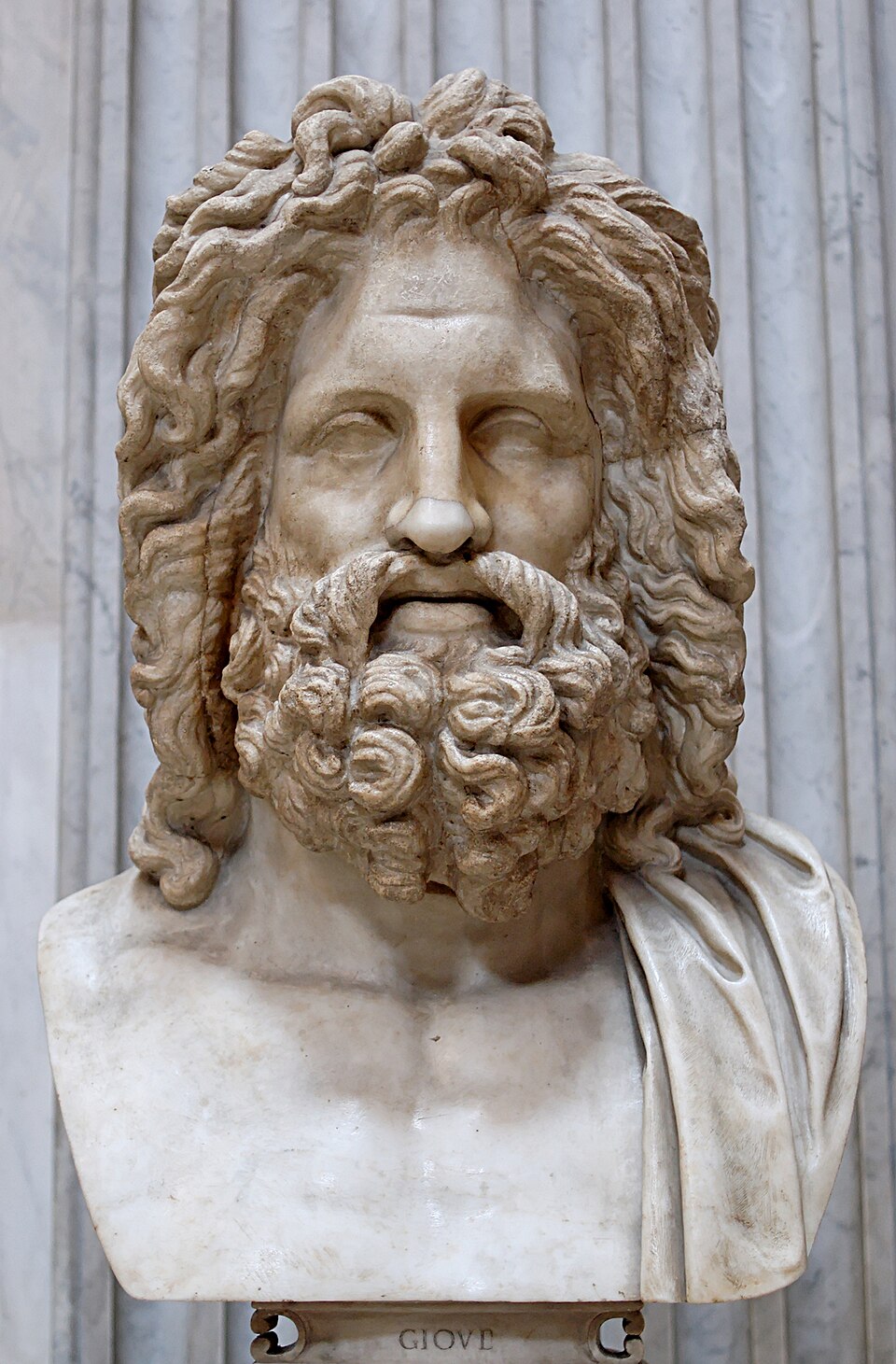
An epigram at the head of the Almagest, accepted by many scholars as his own, says that when his mind follows the stars he stands “by Zeus himself.”3 Zevism takes him at his word: his astronomy is a practice of likeness to the divine, carried out with numbers.
LIFE AND CONTEXT
Almost nothing is known of his life beyond his books, and his birth and death years aren't recorded. His name joins the Greek-Egyptian “Ptolemy” and the Roman “Claudius,” which suggests a Greek family settled in Egypt and Roman citizenship. Theodore Meliteniotes claimed around 1360 that he came from Hermiou in Upper Egypt, more than 1,200 years after his time, and no evidence shows he ever left Alexandria.3
He worked in Alexandria under Roman rule and observed the sky there from 127 to 141 CE. He used observations by “Theon the mathematician,” almost certainly Theon of Smyrna and almost certainly his teacher.3
His astronomy stood on older records. A 9th-century Greek manuscript of the Almagest in the Vatican Library contains Book IV, chapter 2, “on Hipparchus's examination of Babylonian cycles for the motion of the moon.” Ptolemy set those inherited cycles beside his own observations and rebuilt the theory.4
The work's name records its travels. Ptolemy called it The Mathematical Compilation; later Greek readers renamed it The Greatest Compilation; Arabic scholars rendered that as al-majisti; and Latin translators from the Arabic made it Almagest.3
The Almagest opens with an address to Syrus about why astronomy is worth a life. Ptolemy argues that mathematics gives sure demonstration, that the ordered motions of the heavens lead the mind toward the divine, and that contemplating their regularity helps bring a person's own conduct into order.5
ATTAINMENTS
- The Almagest, in 13 books, gave working models for the Sun, the Moon and each planet. His “really clever innovation” was the equant, a point set opposite the Earth across the circle's centre, around which the planet's motion is uniform.3
- Books 7 and 8 of the Almagest hold a star catalogue “containing over one thousand stars,” arranged in 48 constellations.6
- The Geography, in 8 books, gave the positions of the major places of the known world “in terms of latitude and longitude” and taught “three different methods of projection” for laying out maps.7
- He built a table of chords “at intervals of 1/2 a degree,” the trigonometry his models ran on, and from an inscribed 360-gon he took π as 3 17/120, about 3.14167.3
- The Handy Tables put his astronomy into a form for daily computation. Theon of Alexandria edited them in the 4th century, and they became “the basis of later astronomical tables in Greek, Arabic, and Latin.”8
- The Optics, in 5 books, studied “colour, reflection, refraction, and mirrors of various shapes,” and tested theory by experiment.3
- The Tetrabiblos, in 4 books, set out astrology as the 2nd branch of prediction from the heavens. It opens: “Of the means of prediction through astronomy, O Syrus, two are the most important and valid.”9
- The Planetary Hypotheses, in 2 books, replaced the abstract geometry with mechanical models for readers without advanced mathematics.3
KEY STORIES
Beside Zeus
Book 1 of the Almagest carries 4 lines of verse, placed after the list of contents. Many scholars accept them as Ptolemy's own.3
“Well do I know that I am mortal, a creature of one day. / But if my mind follows the winding paths of the stars / Then my feet no longer rest on earth, but standing by / Zeus himself I take my fill of ambrosia, the divine dish.”3
The poem sits at the door of 13 books of chord tables, eclipse calculations and planetary models. Its author knew exactly how much arithmetic lay ahead, and he still called the work a seat at the table of the Gods. The address to Syrus that follows makes the same claim in prose: the study of the heavens trains the soul as well as the mind.10
The Sky over Alexandria, 127–141
On 26 March 127, at Alexandria, Ptolemy made the first of his observations that can be dated exactly. The last came on 2 February 141. For 14 years he measured positions of the Sun, the Moon and the planets and set them against records that reached back through Hipparchus to Babylon.7
The planets needed a new device. A planet speeds up, slows down and sometimes appears to run backwards against the stars. Ptolemy kept the old rule of uniform circular motion but moved the point about which the motion is uniform. He placed it at the equant, on the far side of the centre from the Earth, and the predictions came into line with what he saw.3
His arrangement put the Earth at the centre, and in that it was wrong. The calculations still worked so well that the Almagest wasn't superseded until a century after Copernicus. He'd laid them out in full, so later readers could test every step and, in the end, replace the model.3
Gerard Goes to Toledo
In the 12th century Latin Europe didn't have the Almagest. Gerard, born at Cremona in 1114, went to Toledo in Spain because “his intention was to learn Arabic so he could read Ptolemy's Almagest,” since “no Latin translations existed at that time.”11
He learned the language and did the work himself. The Ptolemaeus Arabus et Latinus project records that Gerard translated the book “in Toledo between c. 1140 and 1175,” and that he worked from “the two main Arabic translations that were available at the time, namely al-Ḥajjāj's version and Isḥāq's version.” His Latin survives in an original and a revised version, in about 80 manuscripts.12
Over some 40 years Gerard translated about 80 works from Arabic, and he died in Toledo in 1187. His Almagest reached print at Venice in 1515, from the press of Petrus Liechtenstein.13
The Geography Returns in Latin
The Geography made a separate journey. Jacopo Angeli da Scarperia translated it into Latin by 1406–09 and dedicated it in turn to Popes Gregory XII and Alexander V.8
Western readers now had coordinates for about 8,000 places and Ptolemy's rules for drawing a round world on a flat sheet. A Latin copy of about 1470 in the Vatican Library preserves Jacopo's version. The maps in such later manuscripts were drawn by later hands from Ptolemy's numbers and instructions.8
The numbers themselves had limits. MacTutor judges that the maps “were quite inaccurate in many places for he could not be expected to do more than use the available data.” He couldn't do more than use the reports that reached Alexandria, and their errors went into his tables. What Ptolemy fixed was the method: every place given a latitude and a longitude, so that each new report could correct the old one.3
THE ZEVIST READING
Ptolemy's epigram states the aim of the Zevist path in his own words. Plato set that aim as ὁμοίωσις θεῷ κατὰ τὸ δυνατόν, becoming like the divine as far as possible.14 A mortal “creature of one day” follows the paths of the stars and stands beside Zeus: Zevism reads that as the literal elevation of human nature through knowledge, and Ptolemy wrote it at the head of his life's work.
The address to Syrus joins 2 dimensions of the path. Contemplation of ordered motion is meditation, the enlarging of capacity. The claim that it orders a person's conduct is ethics, the work of Φρόνησις. Ptolemy made astronomy the discipline that joins them. In Plato's myth the Egyptian God Theuth invented “numbers and arithmetic and geometry and astronomy,”15 and this Alexandrian of Egypt used all 4 of those gifts in a single book.
The star catalogue is the doctrine of Light and Darkness written out in columns. The night sky over Alexandria was dark in the plainest sense, and Ptolemy walked into it with instruments, fixing over 1,000 stars by position and brightness. Explored darkness becomes Light: a named, numbered star is knowledge that anyone after him can check.16
His planets also carry a lesson about truth. The geocentric arrangement was a mistake about the world, and the equant was a device to save the appearances. Zevism holds that knowledge evolves in transmission while the source keeps its priority. Ptolemy's source was the sky itself, measured and recorded, and his tables were exact enough for later astronomers to find where he'd gone wrong.
The chain behind and after him is the chain Zevism traces through every tradition. Babylonian cycles passed to Hipparchus and to Ptolemy, then to Theon, to al-Ḥajjāj and Isḥāq in Arabic, to Gerard in Toledo and to Jacopo Angeli. The Temple honours each of them as a keeper of the source. The Almagest's name, Greek become Arabic become Latin, records that transmission.
NOTES
1 O'Connor and Robertson, “Ptolemy”.
2 Library of Congress, “Mathematics”; O'Connor and Robertson.
4 Library of Congress, “Mathematics”.
5 Ptolemy, Almagest 1.1, tr. Toomer, pp. 35–37.
6 O'Connor and Robertson; Toomer, introduction.
7 O'Connor and Robertson; Library of Congress.
9 Ptolemy, Tetrabiblos 1.1, tr. Robbins.
10 Almagest 1.1, tr. Toomer, pp. 35–37.
11 O'Connor and Robertson, “Gherard of Cremona”.
12 Bavarian Academy, Ptolemaeus Arabus et Latinus A.1.2.
13 O'Connor and Robertson, “Gherard of Cremona”; Ptolemaeus Arabus et Latinus.
BIBLIOGRAPHY
J. J. O'Connor and E. F. Robertson, University of St Andrews, “Ptolemy”, MacTutor History of Mathematics; observations of 127–141, name, Theon, title, equant, star catalogue, Geography, Optics, Planetary Hypotheses, the epigram and the Almagest's long use.
Claudius Ptolemy, Ptolemy's Almagest, translated by G. J. Toomer, introduction and 1.1, pp. 35–37.
Ptolemy, Tetrabiblos, translated by F. E. Robbins, Loeb Classical Library, 1940, LacusCurtius; 1.1.
Library of Congress, “Mathematics,” Rome Reborn: The Vatican Library and Renaissance Culture, entries for the Almagest, Geography and Handy Tables.
Bavarian Academy of Sciences and Humanities, Ptolemaeus Arabus et Latinus, A.1.2, “Almagesti (tr. Gerard of Cremona)”, translation dates, Arabic sources, versions, manuscripts and 1515 printing.
J. J. O'Connor and E. F. Robertson, “Gherard of Cremona”, MacTutor History of Mathematics.
Plato, Phaedrus 274c–d, translated by H. N. Fowler, Perseus Digital Library.
Plato, Theaetetus 176a–b, Greek text, Perseus Digital Library.
CREDIT
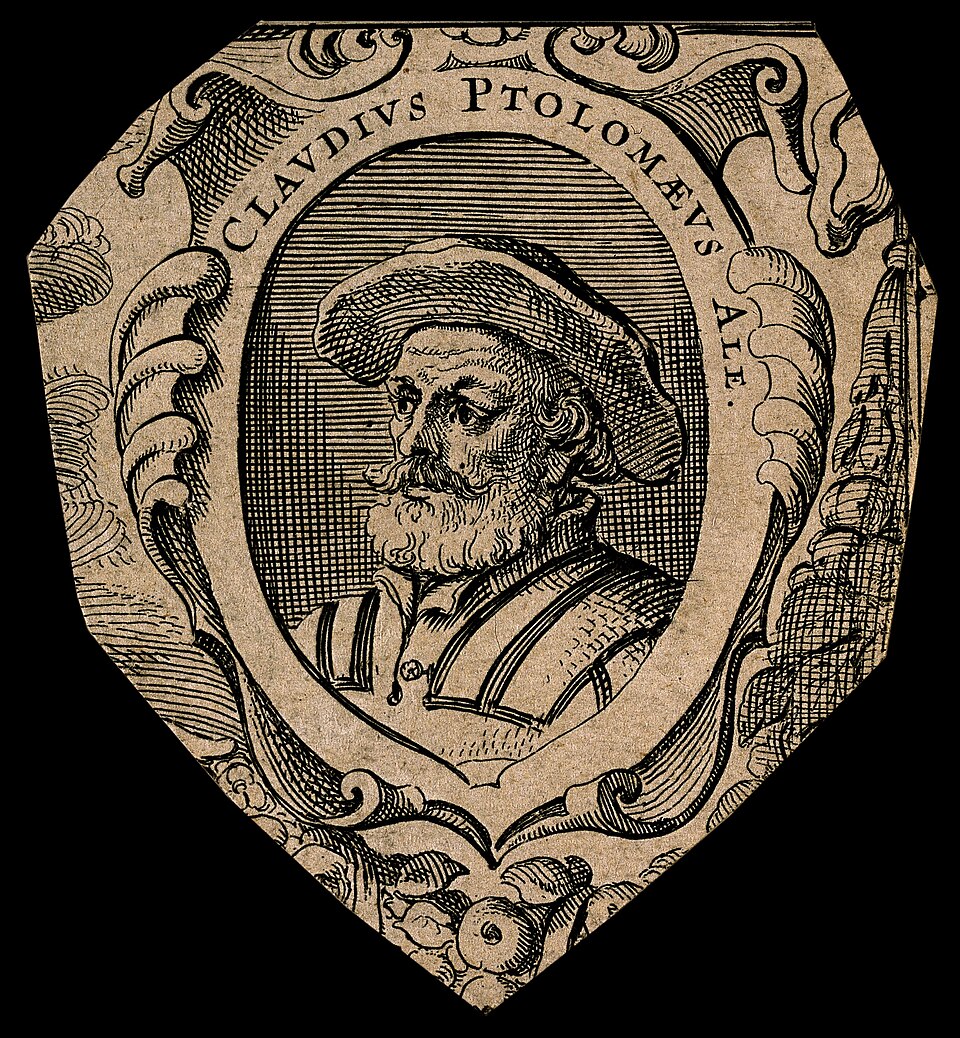
Picture: Later imagined portrait of Claudius Ptolemy; line engraving, Wellcome Collection V0004806.
Unidentified engraver; Wellcome Collection; Wikimedia Commons; Creative Commons Attribution4.0. Image record, Creative Commons Attribution4.0.
._Line_engraving._Wellcome_V0004806.jpg)
The round picture in the lists of the personalities is cropped from it.