




9 min read
Father of Bacteriology
Robert Koch
author: High Priest Zevios Metathronos
Making the Causes of Disease Knowable
Dates: 1843–1910
Period: Imperial period, with a legacy extending into the Modern period
Robert Koch was a German country doctor who found the living causes of 3 great killers. In 1876 he showed that anthrax comes from a single germ; on 24 March 1882 he announced the tubercle bacillus; in 1883 and 1884 he tracked the vibrio of cholera through Egypt and India. The Robert Koch Institute calls him a co-founder of microbiology, and the Nobel Prize of 1905 went to him “for his investigations and discoveries in relation to tuberculosis.”1
His paper on tuberculosis set out the stakes early: “Die Statistik lehrt, daß 1/7 aller Menschen an Tuberkulose stirbt,” statistics show that 1 person in 7 dies of tuberculosis. He isolated the bacillus, grew it in pure culture and passed the disease to animals, and he concluded that the bacilli were the cause of the tuberculous process and more than its companions.2
Zevism reads Koch's work as light carried into a darkness no eye had entered, and as service to Asclepius and Hygieia, the powers of healing and of health kept whole.
LIFE AND CONTEXT
Koch was born on 11 December 1843 at Clausthal in the Upper Harz, the son of a mining engineer. The Nobel biography records that he'd taught himself to read “with the aid of the newspapers.”3
At Göttingen the professor of anatomy was Jacob Henle, and Koch was, in the Nobel account, “no doubt, influenced by Henle's view, published in 1840, that infectious diseases were caused by living, parasitic organisms.” He took his M.D. in 1866, spent 6 months in Berlin studying chemistry under the influence of Virchow, and married Emmy in the same year.4
In 1870 he volunteered for the Franco-Prussian war. From 1872 to 1880 he was District Medical Officer at Wollstein, today Wolsztyn in Poland, and there he did the anthrax work that made his name.5
From Wollstein he moved with Emmy and their daughter Gertrud to Breslau, and in 1880 he was called to the Imperial Health Office in Berlin. In 1883 he led the German Cholera Commission to Egypt, and at the end of that year he took a research team to Calcutta. The sources place the find differently: the Nobel biography has him discover the vibrio in Egypt, the RKI dates the identification to early 1884 in Calcutta. Filippo Pacini had already seen and described the organism in 1854, in work that drew little notice in Germany and that Koch didn't know.6
In 1892 his knowledge of how cholera spread helped contain a severe epidemic in Hamburg. The Royal Prussian Institute for Infectious Diseases had opened on 1 July 1891 with Koch as director, a post he held until 1904, and his colleagues there included Ehrlich, von Behring and Kitasato. He married Hedwig Freiberg in 1893, received the Nobel Prize in 1905 and died at Baden-Baden on 27 May 1910.4
ATTAINMENTS
- He proved in 1876 that anthrax is caused by a single agent, and he found its resting form, the anthrax spore, which “can resist adverse conditions.”7
- He grew the anthrax bacillus in pure culture on “the aqueous humour of the ox's eye.”4
- He announced the tubercle bacillus in Berlin on 24 March 1882, having stained it with methylene blue and vesuvin and grown it in cultures that showed to the naked eye only in their 2nd week.8
- He set out the conditions, known as Koch's postulates, that must be met “before it can be accepted that particular bacteria cause particular diseases.”4
- He identified Vibrio cholerae on the expeditions of 1883 and 1884 and brought pure cultures of it back to Germany.6
- He won the 1905 Nobel Prize in Physiology or Medicine, alone, “for his investigations and discoveries in relation to tuberculosis.”9
- In his Nobel lecture he reported that, despite a growing population, “each year about 20,000 fewer people will die of consumption in Prussia now than 20 years ago.”10
KEY STORIES
The Laboratory in a 4-Roomed Flat
At Wollstein Koch had no institute. “His laboratory was the 4-roomed flat that was his home, and his equipment, apart from the microscope given to him by his wife, he provided for himself.” He was, the Nobel biography says, “cut off entirely from libraries and contact with other scientific workers.”4
Anthrax was killing people and animals in the district. Koch took the bacilli from the spleens of farm animals that had died of it and “inoculated mice, by means of home-made slivers of wood.” To free the germ from everything else he grew it on the aqueous humour of an ox's eye. He watched the rods form “rounded spores which can resist adverse conditions,” and that explained how the disease could lie in wait.6
He took the work to Ferdinand Cohn, editor of a botanical journal. “When Cohn, in 1876, published Koch's work in the botanical journal of which he was the editor, Koch immediately became famous.”4
The Evening of 24 March 1882
On 24 March 1882 Koch spoke in Berlin, at the Institute of Physiology, and announced the discovery of the tuberculosis germ. Early in the printed lecture stands its burden: 1 in 7 of all people died of the disease. It credits Jean-Antoine Villemin with the discovery “daß die Tuberkulose auf Tiere übertragbar ist,” that tuberculosis could be passed to animals.11
Then he showed his method. Cover-glasses and sections went into a staining solution with methylene blue and vesuvin, and the bacilli stood out. Finding them wasn't enough. The bacilli had to be isolated from the body and carried on in pure cultures until they were free of anything that clung to them, and the cultures had to produce the disease again in animals, with untreated animals kept for comparison.12
His conclusion was that the bacilli in tuberculous matter were “die Ursache desselben,” the cause of the tuberculous process itself. The lecture ends on public health and the sources of infection.13
The Lecture of 12 December 1905
Koch gave his Nobel lecture on “The Current State of the Struggle against Tuberculosis.” He began with the distance travelled: “Twenty years ago, tuberculosis, even in its most dangerous form, consumption, was still not considered infectious.” The discovery of the bacillus, he said, had put its aetiology “on a firm footing.”10
Then he explained how it spread. “Even the smallest drops of mucus expelled into the air by the patient when he coughs, clears his throat, and even speaks, contain bacilli.” The danger rose in crowded homes: “The risk of infection becomes particularly high if healthy people have to sleep with the sick in the same rooms, and especially in one bed.”14
The figures were already moving. In the decade 1876–1886, he said, deaths from consumption had stood “at a uniformly high level.” By one calculation, though Prussia's population had grown, some 20,000 fewer people now died of it each year than 20 years before. He closed on the campaign: “If the work goes on in this powerful way, then the victory must be won.”14
Tuberculin and Atoxyl
Koch's reputation drew him into cures he couldn't deliver. In 1890, at the 10th International Medical Congress in Berlin, he presented “Tuberkulin,” a preparation from killed tubercle bacilli, which later proved ineffective. The Nobel biography is blunt: “the healing power that Koch claimed for this preparation was greatly exaggerated.” The hopes it raised weren't fulfilled, and “opinion went against it.”7
In 1906 and 1907 he led a commission to East Africa to study sleeping sickness. Atoxyl, an arsenic drug, at first brought successes. Koch then doubled the dose, “obwohl er um die Risiken des Mittels wusste,” although he knew the risks of the drug. Many patients suffered pain and colic, and some went blind. The RKI records that Koch stayed convinced of Atoxyl's value in principle.15
THE ZEVIST READING
The Temple teaches that unexplored darkness isn't evil: it's what one walks into with a lamp, and explored darkness becomes Light. Germs were that darkness for every physician before Koch. His stains of methylene blue and vesuvin made invisible rods show under the lens, and his cultures made a hidden cause into a thing that could be grown and tested.
Disease is Izfet, dissolution working in bodies and in cities. Ma'at is “the personification of truth, justice, and the cosmic order,” and Zeus holds it as Sovereign of the Cosmos.16 A city that learns how cholera travels and stops it, as Hamburg did in 1892, restores Ma'at. So does the fall Koch reported in 1905: 20,000 fewer deaths a year from consumption in Prussia.
Koch's field belongs to Asclepius and above all to Hygieia, who keeps health whole before it breaks. The Hippocratic physician swore by “Apollo the physician, and Asclepius, and Hygieia and Panacea and all the gods.”17 His Nobel lecture reads like her rule: keep the sick from sharing rooms and beds with the healthy, and the disease falls back.14
The Good in Zevism is Ma'at joined to Right, a right act from a right will. Tuberculin was offered with a good aim and an exaggerated claim, and the doubled Atoxyl doses harmed the patients they were meant to save, so neither meets that measure. The discovery of causes does. Knowledge of that kind moves a human being toward ὁμοίωσις θεῷ κατὰ τὸ δυνατόν, likeness to the divine as far as possible.18
NOTES
1 Robert Koch Institute, “Robert Koch: Der Mitbegründer der Mikrobiologie”; NobelPrize.org, Robert Koch, facts.
2 Koch, “Die Ätiologie der Tuberkulose,” pp. 429, 433, 442.
3 NobelPrize.org, Robert Koch, biographical.
4 NobelPrize.org, biographical.
5 NobelPrize.org, biographical; RKI, “Robert Koch”.
6 NobelPrize.org, biographical; RKI.
7 RKI; NobelPrize.org, biographical.
8 Koch, “Die Ätiologie der Tuberkulose,” pp. 430, 434; RKI catalogue record.
9 NobelPrize.org, facts; NobelPrize.org, “The Nobel Prize in Physiology or Medicine, 1901–2000”.
10 Koch, Nobel lecture, 12 December 1905.
11 RKI; Koch, “Die Ätiologie der Tuberkulose,” p. 429.
15 RKI.
17 NLM, Hippocratic Oath, tr. Michael North.
BIBLIOGRAPHY
Robert Koch Institute, “Robert Koch: Der Mitbegründer der Mikrobiologie”, 19 April 2018; Wollstein, anthrax and spores, 24 March 1882, Calcutta, Pacini, Hamburg 1892, tuberculin, East Africa and Atoxyl.
Robert Koch, “Die Ätiologie der Tuberkulose”, lecture of 24 March 1882, Berliner klinische Wochenschrift, no. 15; reprinted in Gesammelte Werke, vol. 1, pp. 428–445; RKI catalogue record, DOI 10.25646/5088.
NobelPrize.org, “Robert Koch, Biographical”, from Nobel Lectures, Physiology or Medicine 1901–1921.
NobelPrize.org, “Robert Koch, Facts”; prize motivation and share.
Robert Koch, “The Current State of the Struggle against Tuberculosis”, Nobel lecture, 12 December 1905.
NobelPrize.org, “The Nobel Prize in Physiology or Medicine, 1901–2000”, table entry for Koch, 1905.
US National Library of Medicine, “Greek Medicine,” including “The Hippocratic Oath”, tr. Michael North, 2002.
Encyclopaedia Britannica, “Maat”.
Plato, Theaetetus 176a–b, Greek text, Perseus Digital Library.
CREDIT
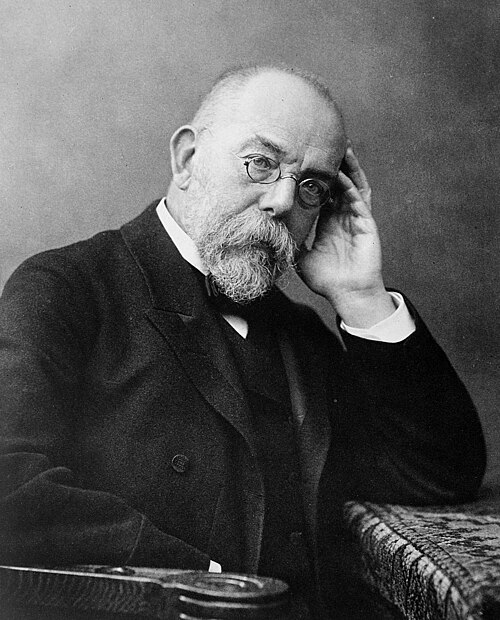
Picture: Robert Koch, photogravure after a photograph by Wilhelm Fechner, around 1900.
Wilhelm Fechner, via Wikimedia Commons; public domain. Image record, Public domain (PD-old-100 and pre-1931 publication).

The round picture in the lists of the personalities is cropped from it.