




9 min read
Master of X-Rays
Rosalind Franklin
author: High Priest Zevios Metathronos
The Discipline of Seeing Clearly
Dates: 1920–1958
Period: Modern period, 1900–present
Rosalind Franklin was an English physical chemist and X-ray crystallographer. She studied the properties of coal and graphite, showed that DNA takes 2 forms depending on how much water it holds, and made the X-ray photograph of the B form known as Photo 51. Her last 5 years went into the structure of viruses.1
Her greatest single result was the data on DNA. In May 1952, with her student Raymond Gosling, she photographed the B form, and in early 1953 that image and a report of her unpublished results gave Watson and Crick important evidence for their model. Matthew Cobb and Nathaniel Comfort call her “an equal member of a quartet who solved the double helix.”2
Zevism reads her work by its doctrine of Light and Darkness and by Ma'at, the order of truth and of true records. She carried light into structures no microscope could show, and she kept the record of what she found exact.
LIFE AND CONTEXT
She was born in London on 25 July 1920, the 2nd of 5 children in a prominent Anglo-Jewish family. St Paul's Girls' School prepared its pupils for careers, and in 1938 she went up to Newnham College, 1 of the 2 women's colleges at Cambridge, to read physical chemistry.3
During the war she joined the British Coal Utilisation Research Association and studied the properties of coal and graphite. That work became her Cambridge PhD in 1945 and her first publications.4
Adrienne Weill then helped her into Jacques Mering's laboratory at the Laboratoire Central des Services Chimiques de l'État in Paris. At the “labo” she learned to analyse carbons by X-ray crystallography and quickly became a respected authority in the field.4
In 1950 she won a 3-year Turner and Newall Fellowship to work in John Randall's Biophysics Unit at King's College London, and she arrived early in 1951. With her arrival, the Science History Institute writes, responsibility for subjects and techniques “became confused, creating intense rivalries within Randall's lab.” She and Maurice Wilkins drew apart, and within 6 months, the NLM notes, “they were having very little to do with each other.”4
In 1953 she moved her fellowship to J. D. Bernal's crystallography laboratory at Birkbeck College. She was diagnosed with ovarian cancer in the autumn of 1956 and died in London on 16 April 1958, aged 37. In 1962 Crick, Watson and Wilkins shared the Nobel Prize in Physiology or Medicine; she wasn't mentioned in the award.5
ATTAINMENTS
- Her research on coal and graphite at the British Coal Utilisation Research Association became her PhD dissertation of 1945 and the subject of her first papers.6
- By controlling the water content of DNA specimens she showed that the molecule exists in 2 forms, A and B.7
- In May 1952 she and Gosling took Photo 51, an X-ray image of the B form.7
- She determined that the bases on a strand have no effect on the structure, so that, as Cobb and Comfort quote her, “an infinite variety of nucleotide sequences would be possible to explain the biological specificity of DNA.”8
- With Gosling she published “Molecular Configuration in Sodium Thymonucleate,” Nature 171, 740–741, on 25 April 1953.9
- At Birkbeck she set up a group with Aaron Klug, John Finch and Ken Holmes to study the structure and assembly of tobacco mosaic virus, and she began work on poliovirus. Between 1953 and 1958 she published 17 papers on viruses.10
- The Royal Institution asked her to build large-scale models of rod-shaped and spherical viruses for the science exhibition of the 1958 Brussels World's Fair.11
KEY STORIES
Wet and Dry
At King's, Franklin controlled the water content of her DNA specimens and watched what it did to the X-ray pictures. She found that DNA came in 2 forms, “wet and dry,” and that they “produced very different pictures.” They became the A and B forms.12
In May 1952 she and her PhD student Ray Gosling captured an image of the B form. It became known as Photo 51.7
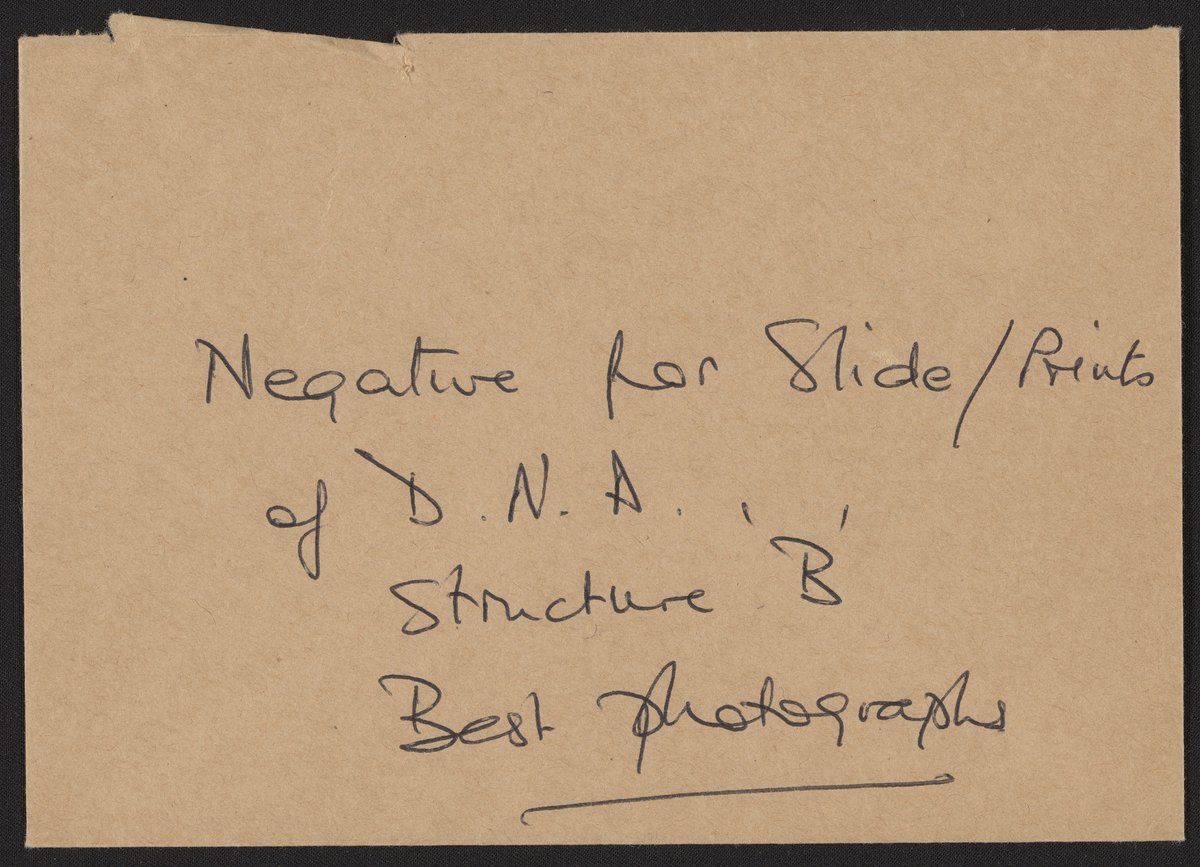
An envelope of 1952 from her papers survives in the History of Molecular Biology Collection of the Science History Institute, Box 10, Folder 17. Its label reads: “Negative for Slide. Prints of D.N.A. Structure ‘B’ Best Photographs.”13
The Photograph Wilkins Showed
Early in 1953 James Watson visited King's and got into a row with Franklin. By his own account Wilkins rescued him and then showed him Photograph 51, taken 8 months before by Franklin and Gosling. Soon after, Max Perutz, Crick's supervisor, handed Watson and Crick an informal report on the King's unit, which he'd received on an official visit in December 1952.8
The report held her numbers. Franklin had confirmed the 34 Å repeat of the B form and found that the unit cell of DNA held more atoms than that of any known molecular structure. For the A form she reported a “C2” symmetry, which implied an even number of sugar-phosphate strands “running in opposite directions.” Crick's notes for a lecture at Oxford in May 1961 show that this report, more than Photograph 51, confirmed the structure he and Watson reached.8
The NLM puts it plainly: they “gleaned crucial insights about DNA's structure” from her photograph and from the summary of her unpublished research. Cobb and Comfort judge that the 2 men should have asked permission to use the data.14
On 25 April 1953 Nature printed 3 papers back to back: Watson and Crick's model, a paper from Wilkins and his co-workers, and Franklin and Gosling's. A draft news story written for Time that year, in consultation with Franklin, described “two teams,” Wilkins and Franklin gathering the X-ray evidence and Watson and Crick working on theory. Cobb and Comfort also found a letter of January 1953 in which the King's researcher Pauline Cowan invited Crick to a talk by Franklin and Gosling. The speakers, she warned, said “that Perutz already knows more about it than they are likely to get across.”15
Faith, Defined
In the summer of 1940, with the war on and her Cambridge studies under way, Franklin argued religion with her father, Ellis Franklin, by letter. He'd defined faith as belief in life after death. She wouldn't accept it.11
“I agree that faith is essential to success in life,” she wrote, “but I do not accept your definition of faith, i.e., belief in life after death.” She gave him her own: “In my view, all that is necessary for faith is the belief that by doing our best we shall come nearer to success and that success in our aims (the improvement of the lot of mankind, present and future) is worth attaining.”11
The same letter set out what science meant to her. “Science and everyday life cannot and should not be separated. Science, for me, gives a partial explanation of life.”11
From a Palace to a Slum
Franklin called her move from King's to Birkbeck going “from a palace to a slum.” Clare Sansom writes that she thrived there all the same, “in the non-sectarian atmosphere,” and won recognition in her 5 years as a research fellow.16
Aaron Klug came to Birkbeck to join a project on the protein ribonuclease and soon met her. “Her beautiful X-ray photographs fascinated me,” he later wrote. He could explain some of them, pictures with curved layer lines that had looked anomalous, and he stayed on to work with her on the virus.17
She fell ill in the autumn of 1956 and died on 16 April 1958. Klug carried the work on: “Rosalind Franklin died in 1958 and, supported by an N.I.H. grant, Finch, Holmes and I continued the work on viruses, now extended to spherical viruses.” In 1982 he won the Nobel Prize in Chemistry.18
THE ZEVIST READING
Zevism teaches that unexplored darkness isn't evil; it's the ground one walks into with a light, and explored darkness becomes Light. The shape of a DNA molecule lay beyond any microscope. Franklin sent X-rays through a fibre whose water she'd fixed, read the pattern they left and turned it into measurements others could build on. That's discovery in the Temple's exact sense.
Ma'at is “the personification of truth, justice, and the cosmic order,” set against isfet, disorder.19 Her labelled envelope and her exact records are Ma'at at the laboratory bench. So is the slow correction of the record since her death: justice includes saying truly who found what, and Zevism counts a false credit as a small Izfet.
Zevism also holds that the source keeps priority over what's built on it. In the story of DNA the source was her data: the photograph of May 1952, the 34 Å repeat and the C2 symmetry in the report of December 1952. The model of 1953 stands on them, and the Temple honours the one who made the measurements alongside those who drew the conclusion.
Franklin was born into an Anglo-Jewish family, and her letter of 1940 defined faith in her own way, as the belief that doing one's best brings the improvement of humankind nearer and that the aim is worth the effort. The Temple doesn't claim her as a Zevist. It reads her words as the existential dimension of the path, a life spent in service of something higher than itself, and it sets them beside the aim Plato named, ὁμοίωσις θεῷ κατὰ τὸ δυνατόν, becoming like the divine “as far as possible.”20
NOTES
1 Science History Institute, “Francis Crick, Rosalind Franklin, James Watson, and Maurice Wilkins”; King's College London, “Photo 51”.
2 Cobb and Comfort, Nature, 25 April 2023.
3 NLM, “The Rosalind Franklin Papers: Biographical Overview”.
4 NLM; Science History Institute.
5 NLM; King's College London; Science History Institute.
9 PubMed, PMID 13054694; Nature.
10 Sansom, “A Life in Close-up”; King's College London; Science History Institute.
11 NLM.
12 NLM; King's College London.
13 Science History Institute, envelope, 1952.
14 NLM; Cobb and Comfort.
15 Cobb and Comfort; PubMed.
16 Sansom.
17 Klug, Nobel biographical, 1982.
18 Klug, Nobel biographical; NLM.
BIBLIOGRAPHY
National Library of Medicine, Profiles in Science, “The Rosalind Franklin Papers: Biographical Overview”; family, education, BCURA, Paris, King's, the letter to Ellis Franklin of about summer 1940, Birkbeck, Brussels and death.
Judith Kaplan, “Francis Crick, Rosalind Franklin, James Watson, and Maurice Wilkins”, Science History Institute, updated 8 September 2025; “Franklin Before DNA” and the 1962 award.
King's College London, “Photo 51 and the discovery of DNA's structure”, 25 April 2020.
Matthew Cobb and Nathaniel Comfort, “What Rosalind Franklin truly contributed to the discovery of DNA's structure”, Nature, 25 April 2023.
R. E. Franklin and R. G. Gosling, “Molecular Configuration in Sodium Thymonucleate”, Nature 171 (25 April 1953), 740–741; PubMed record, PMID 13054694.
Clare Sansom, “Rosalind Franklin: A Life in Close-up”, BBK, December 2002, pp. 26–27.
Aaron Klug, biographical statement, Nobel Prize in Chemistry 1982; and The Nobel Prize, “The Nobel Prize in Physiology or Medicine 1962”.
Science History Institute, DNA photograph envelope, 1952, History of Molecular Biology Collection, Box 10, Folder 17.
Encyclopaedia Britannica, “Maat”.
Plato, Theaetetus 176a–b, Greek text, Perseus Digital Library.
CREDIT
Illustration: Franklin's 1952 envelope for B-form DNA photograph negatives and prints, an authentic laboratory artifact rather than a portrait. Courtesy of Science History Institute, CC BY 4.0.
Courtesy of Science History Institute, History of Molecular Biology Collection, Box 10, Folder 17; CC BY 4.0. Image record, Creative Commons Attribution 4.0 International.
The round picture in the lists of the personalities is cropped from it.