



9 min read
Theologian of the Gods
Sallustius
author: High Priest Zevios Metathronos
Dates: Active 4th century CE; personal identity uncertain
Period: Roman period (30 BCE–800 CE)
Sallustius wrote On the Gods and the World, a treatise of 21 short chapters. It sets out the Gods, the cosmos, the soul, providence, virtue and worship as the Platonists of the emperor Julian's circle understood them. It closes on the promise that the good will be happy “both in this Life, and when they depart from it.”1
Dominic O'Meara reads the book as “a manual destined for teachers who intend to offer a basic course in Platonic philosophy.” Its author may be Saturninius Secundus Salutius, “a dignitary at Julian's court,” but the identification isn't certain.2
Zevism reads the book as a teacher's map of the divine order. Its 12 Gods, led by Zeus, make, animate, harmonize and guard the world, and that ordered cosmos is what Zevism names Ma'at.
LIFE AND CONTEXT
The book belongs to a movement. Julian studied philosophy at Pergamon around 350, and the philosophers Maximus and Priscus became his masters and counsellors. Lecerf writes that the teaching of Iamblichus “forms the philosophical background of Julian's project of restoration of Paganism, as shown by Julian's own writings” and by “the short treatise On the Gods and the Cosmos by one Salustius.”3
The vocabulary confirms the lineage. After Iamblichus the word noeron became a technical term for the order of Gods just below the Intelligible, and Lecerf finds it with that meaning in “fourth-century authors in the tradition of Iamblichus, such as the emperor Julian and Salustius.”4
Julian planned schools. O'Meara cites Gregory of Nazianzus and Sozomen for his aim “to establish schools (διδασκαλεῖα) in every city,” with “teachers and readers of Hellenic doctrines.” He suggests that if Julian meant to found schools of philosophy, “Sallustius' book could have been of use to the teachers in such schools.”5 Julian died in 363.6
Modern readers have given the book many labels. O'Meara lists “manifesto of paganism,” “official catechism of the pagan empire” and “a teaching manual for pagan priests.” He sets the author's identity aside on purpose and argues from the text itself: it names the qualities a student needs, lays out a syllabus in chapter V, and treats each topic briefly.7
That syllabus runs from “the First Cause and the orders of the gods” through the universe, intellect and soul, to “providence, fate and chance, virtue and vice and the political constitutions.” The author doesn't hide the compression: each topic “requires many long discussions, but there is perhaps no reason why we should not treat them in a summary way.”8
The book also screens its readers. “It is requisite that those who are willing to hear concerning the gods should have been well informed from their childhood,” the first chapter begins, and they “should be naturally prudent and good, that they may receive, and properly understand, the discourses.” Theology, for Sallustius, wasn't open to the careless.9
ATTAINMENTS
- He wrote a complete short course in Platonic theology: 21 chapters, from the qualities of the hearer to the happiness of good souls after death.10
- He grounded theology in shared first principles, “such things as all men, when interrogated, acknowledge to be indubitably certain; such as, that every god is good, without passivity, and free from all mutation.”11
- He sorted myths into 5 kinds: “theological, others physical, others animastic, (or belonging to soul,) others material, and lastly, others mixed.” His test case was Kronos devouring his children, which he read physically as Time devouring its own parts.12
- He explained why myths hide their meaning. The world itself “may very properly be called a fable,” since bodies appear and “souls and intellects are occult and invisible,” and hidden truth “compels the latter to philosophize.”13
- He ordered the 12 Gods into 4 working triads: “Jupiter, Neptune, and Vulcan, fabricate the world; Ceres, Juno, and Diana, animate it; Mercury, Venus, and Apollo, harmonize it; and, lastly, Vesta, Minerva, and Mars, preside over it with a guardian power.”14
- He defined the virtues as the order of the soul: “The virtue of reason is prudence; of anger, fortitude; of desire, temperance; and of the whole soul, justice.”15
- He stated the purpose of worship: the divine “is not indigent of any thing,” and “the honours which we pay to the gods, are performed for the sake of our advantage.”16
KEY STORIES
The Apple at the Banquet
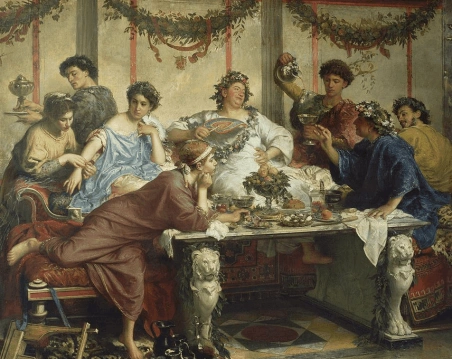
Sallustius chose a famous quarrel to show the “mixed kind of fables,” the kind he assigned to “initiatory rites,” while theological myths “belong to philosophers” and physical ones to poets. In the fable, “Discord at a banquet of the gods threw a golden apple,” the Goddesses disputed it, and Zeus sent them to Paris for judgement. Paris, “charmed with the beauty of Venus, gave her the apple in preference to the rest.”17
He read the scene from the top down. “The banquet denotes the supermundane powers of the gods.” The golden apple “denotes the world, which, on account of its composition from contrary natures, is not improperly said to be thrown by Discord.” Since “different gifts are imparted to the world by different gods, they appear to contest with each other for the apple.”
Paris is the reader's own soul. He's “a soul living according to sense,” one “not perceiving other powers in the universe,” so he decides that the world exists only through the beauty of Aphrodite. Read this way, the myth describes every soul that stops at the surface of things.12
The Spring Festival of Attis
The same chapter turns to a myth that was still being acted out in the 4th century. “The mother of the gods perceiving Attis by the river Gallus, became in love with him, and having placed on him a starry hat,” lived with him, until Attis left her for a nymph. The Goddess drove him mad, he mutilated himself, and then he returned to her.12
Sallustius gave the key in 1 sentence: “these things indeed never took place at any particular time, because they have a perpetuity of subsistence.” The Mother is “the vivific goddess”; Attis is the maker of all that's born and dies; the river Gallus “denotes the Galaxy, or milky circle.” The nymph is “the symbol of generation,” and the rite exists because “we ourselves falling from the celestial regions,” and joined to her, “live immersed in sorrow.”
Then he walked his readers through the rite, held “about spring and the equinoctial period.” The worshippers first abstain “from corn and other gross and sordid aliment.” Next come “the incisions of a tree and fasting.” Then “we employ the nutriment of milk, as if passing by this means into a state of regeneration: and lastly, festivity and crowns, and a re-ascent, as it were, to the gods.”12 In Zevist terms the festival is ὁμοίωσις θεῷ acted out in 4 steps.
The Prefect at Julian's Deathbed
If the author was Salutius, Ammianus Marcellinus shows him once in the full light of history. In 363 Julian was mortally wounded in battle against the Persians. In the same battle “Salutius, the prefect, was in extreme danger, but was saved by the help of his adjutant.”18
As Julian lay dying he refused to name a successor: “as to the choice of an emperor, I am prudently silent.” Then he asked for Anatolius, his court marshal. “And when the prefect Salutius replied ‘He has been happy,’ he understood that he had been slain.” The emperor grieved for his friend and then rebuked the weeping men around him: it was “unworthy to mourn for a prince who was called to union with heaven and the stars.” He spent his last hours with the philosophers Maximus and Priscus, discussing “the nobility of the soul.”19
At dawn on 27 June the generals assembled to choose an emperor. “All by general agreement united on Salutius,” Ammianus writes, “and when he pleaded illness and old age,” an officer pressed him to save the soldiers. Before the opinions had been weighed, “a few hot-headed soldiers” chose Jovian.20
THE ZEVIST READING
Sallustius built his theology on order. In chapter VI, 12 Gods stand in 4 triads, and Zeus heads the 1st: he, Poseidon and Hephaestus make the world, other Gods animate it, others harmonize it, and Hestia, Athena and Ares guard it.14 Egyptian religion named cosmic order Ma'at, “the personification of truth, justice, and the cosmic order.”21 Zevism holds that Zeus, Sovereign of the Cosmos, holds that order, and Sallustius drew its plan.
Hermes stands among the harmonizers, beside Aphrodite and Apollo. Sallustius adds that “Apollo harmonizes the lyre.” The Homeric Hymn tells where that lyre came from: Hermes built it from a mountain tortoise on the day he was born and later handed it to Apollo in exchange for the keeping of the herds.22 In Zevist terms the lyre that harmonizes the world came to Apollo by a fair exchange between Gods.
The Attis festival states the aim of the path. Its last step is “a re-ascent, as it were, to the gods,” and Plato named the same aim ὁμοίωσις θεῷ κατὰ τὸ δυνατόν, likeness to the divine “as far as possible.”23 Sallustius's rule that worship serves the worshipper fits it: the Gods don't lack anything, and the rite changes the one who performs it.
His sentence on myth is also a rule of return to the source. Stories that “never took place at any particular time” can't grow old. They stand at the source of the tradition, and each generation that reads them rightly goes back to it.
NOTES
1 Sallustius, On the Gods and the World, ch. XXI.
2 O'Meara, “A Manual for Teachers,” p. 294; Adrien Lecerf, “Iamblichus,” SEP, §2.4.
4 Lecerf, §3.2.
6 Christian Wildberg, “Neoplatonism,” SEP, §7.
9 On the Gods and the World, Chapter I.
10 On the Gods and the World, Chapters I and XXI; O'Meara, pp. 295–296.
11 Chapter I.
12 ch. IV.
13 ch. III.
14 ch. VI.
15 ch. X.
16 ch. XV.
17 On the Gods and the World, ch. IV.
18 Wildberg, §7; Ammianus Marcellinus 25.3.14.
22 ch. VI; Homeric Hymn to Hermes 39–51, 496–498.
BIBLIOGRAPHY
Sallustius, On the Gods and the World, tr. Thomas Taylor, 1793; Wikisource; chapters I, III–IV, VI, X, XV, XXI. The translator's older identification of the author isn't adopted here.
Dominic J. O'Meara, “Sallustius' On Gods and the Universe: A Manual for Teachers of Platonic Philosophy?”, Studia graeco-arabica 14 (2024), pp. 293–300.
Adrien Lecerf, “Iamblichus”, Stanford Encyclopedia of Philosophy, 2019, revised 2023; §§2.1, 2.4 and 3.2.
Christian Wildberg, “Neoplatonism”, Stanford Encyclopedia of Philosophy; §7.
Ammianus Marcellinus, History 25, tr. J. C. Rolfe, Loeb Classical Library, vol. 2, 1940; LacusCurtius; 25.3.14, 25.3.20–23, 25.5.1–4.
Homeric Hymn to Hermes 39–51 and 496–498, H. G. Evelyn-White translation, Theoi Classical Texts Library.
Encyclopaedia Britannica, “Maat”.
Plato, Theaetetus 176a–b, Greek text, Perseus Digital Library.
CREDIT
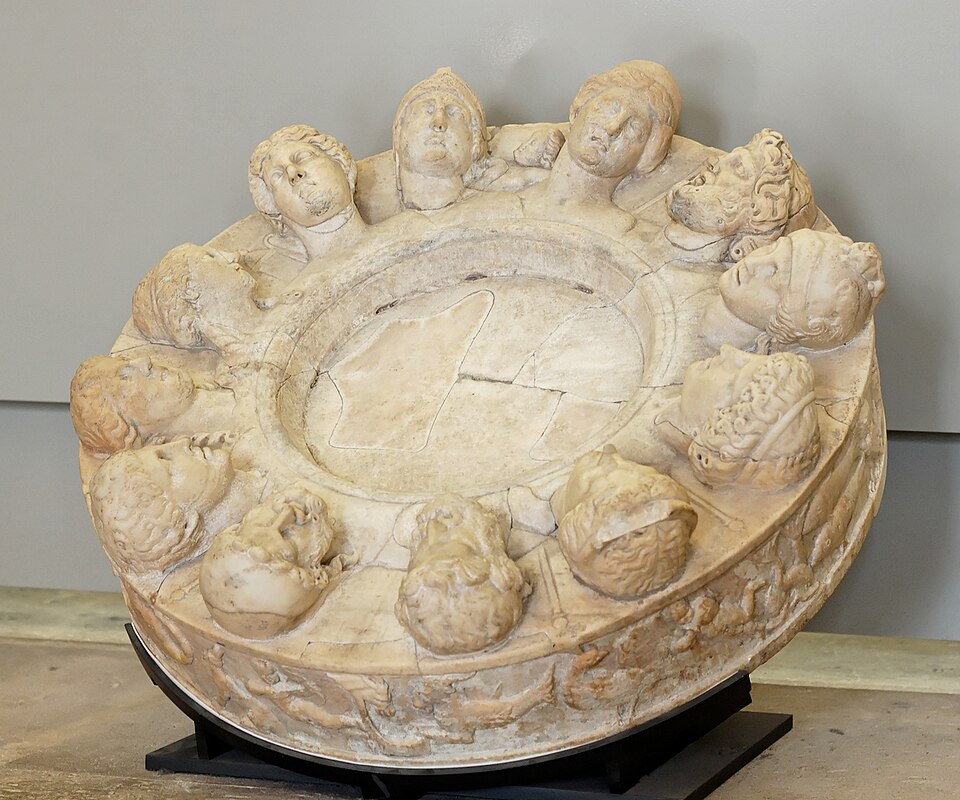
Picture: The twelve Gods on a first-century CE Roman marble object from Gabii, Louvre Ma 666. The object’s function is uncertain; it illustrates Sallustius’s subject and is not a portrait.
Jastrow, photograph 2006; Wikimedia Commons; Public domain, photographer’s explicit worldwide dedication. Image record, Public domain, photographer’s explicit worldwide dedication.

The round picture in the lists of the personalities is cropped from it.