





10 min read
Painter of Venus
Sandro Botticelli
author: High Priest Zevios Metathronos
Learning to Receive Divine Beauty
Dates: 1445–1510 CE
Period: Renaissance (1336–1650 CE)
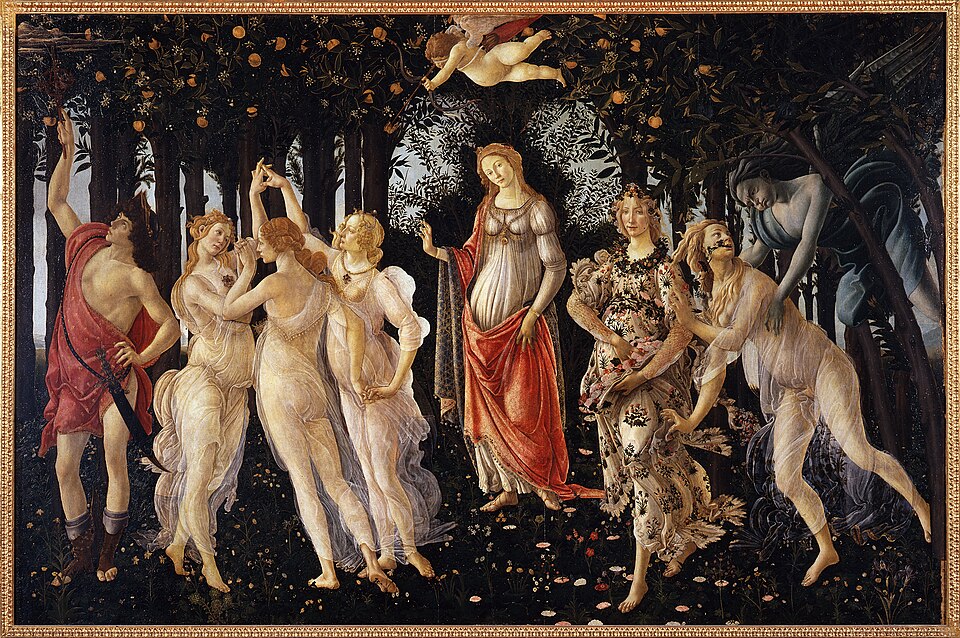
Sandro Botticelli painted the Gods of Greece back into Florence at full size. Around 1480 he set 9 figures of classical myth on a flowering lawn in the Primavera, a poplar panel 207 by 319 cm, and filled the grass with at least 42 identifiable plants. Around 1485 he brought Venus ashore on a scallop shell in the Birth of Venus.1
He also did something rarer. Apelles, the Greek painter of the 4th century BCE, had made an allegory of slander that was long lost. Botticelli rebuilt it from a written description by Lucian.2
Zevism receives this work under Aphrodite and the Graces, and under Athena, whom he painted dragging a centaur by the hair. Botticelli was a Christian and, in his last years, a follower of Savonarola. What the Temple claims is his brush: for some 15 years it gave the Gods bodies and real ground to stand on.
LIFE AND CONTEXT
He was born in Florence about 1445 as Alessandro di Mariano Filipepi, the son of a tanner. The National Gallery derives the name Botticelli from botticello, “small wine cask.” He left school early and trained with the goldsmith Maso Finiguerra, then entered the studio of the painter Fra Filippo Lippi. By 1470 he ran his own workshop, and Filippino Lippi was among his apprentices.3
Giorgio Vasari's Lives tells the school years differently. The boy learned easily but “was ever restless,” and his father, “weary of the vagaries of his son's brain,” apprenticed him to a goldsmith friend “called Botticello.” That's Vasari's explanation of the name.4
His patrons came from a single family and its friends. He “spent almost all his life working for the Medici family and their circle of friends,” in the National Gallery's words. The Primavera hung in the Via Larga house of the heirs of Lorenzo di Pierfrancesco de' Medici, cousin of Lorenzo the Magnificent. Pallas and the Centaur was commissioned for Lorenzo di Pierfrancesco's marriage to Semiramide Appiani in 1482.5
The 1490s broke the pattern. The National Gallery describes a “crisis of style” and a turn toward the Dominican preacher Girolamo Savonarola. Vasari says Sandro became “so ardent a partisan” of the friar's sect “that he was thereby induced to desert his painting, and, having no income to live on, fell into very great distress.”6
In 1500 he painted the Mystic Nativity on canvas, with 20 angels carrying olive branches and a Greek inscription across the top that speaks of “the troubles of Italy.” The National Gallery reads it as the French invasions and Florentine strife seen through the Book of Revelation.7
He died in Florence on 17 May 1510. Vasari remembers him old and “forced to walk with crutches,” and buried in Ognissanti, though he puts the death 5 years too late, in 1515. Afterwards, the National Gallery notes, “his name all but disappeared until the late 19th century.”8
ATTAINMENTS
- The Primavera, about 1480, placed 9 figures of classical mythology, among them Venus, Cupid, the 3 Graces and Mercury, on a poplar panel 207 by 319 cm. The Uffizi counts at least 42 identifiable species in its lawn, 14 green plants and 28 flowering ones.9
- The Birth of Venus, about 1485, measures 172.5 by 278.5 cm in tempera on canvas. He took the Goddess's modest pose from classical statues and the embracing pair of Winds from a Hellenistic gem owned by Lorenzo the Magnificent.10
- In 1481 and 1482 he frescoed the walls of the chapel of Sixtus IV in the Vatican beside Perugino, Ghirlandaio and Cosimo Rosselli, painting scenes from the life of Moses and the Temptations of Christ.11
- Pallas and the Centaur, about 1480 to 1485, is a canvas 207 by 148 cm showing an armed woman, Pallas Athena or Camilla in the Uffizi's reading, gripping a centaur by the hair; her dress repeats the 3-ring device of the Medici.12
- Venus and Mars, about 1485, a panel 69.2 by 173.4 cm of the kind made for a newly married couple's chamber, shows Venus awake while satyrs make off with the sleeping war God's lance and helmet and blow a conch in his ear.13
- He drew a cycle of 100 illustrations to Dante's Divine Comedy on parchment. The Kupferstichkabinett in Berlin bought 85 of them from the Duke of Hamilton's collection in 1882, and 7 are in the Vatican Library.14
- The Calumny of Apelles, about 1495, a panel 62 by 91 cm, reconstructs a lost allegory by Apelles from Lucian's description of it.15
KEY STORIES
The Weaver's Looms and the Heresy Jest
Vasari tells how a cloth-weaver moved in next door to Sandro and “erected no less than eight looms.” When they ran, they deafened the painter and shook his house until he couldn't work. Sandro asked him to stop. The weaver answered “that he both would and could do what he pleased in his own house.”6
Sandro's own wall stood higher than the weaver's. On top of it he balanced “an enormous stone, more than enough to fill a wagon,” where the slightest shaking of the wall threatened to bring it down on the weaver's roof and looms. The frightened weaver came round to protest, and “he was answered in his very own words.” He came to terms, and the looms stopped troubling Sandro.
The same chapter has a jest with a sharper edge. Sandro, “for a jest, accused a friend of his own of heresy before his vicar,” charging him with “believing that the soul dies with the body.” The friend admitted it: “It is true that I hold this opinion with regard to this man's soul, for he is an animal.” Then he turned the charge round. Wasn't Sandro the real heretic, a man who “plays the commentator to Dante and takes his name in vain?”
Rome, 1481: A Chapel for Sixtus IV
Pope Sixtus IV had restored the old Cappella Magna in the Vatican between 1477 and 1480. In 1481 he brought in Perugino, Botticelli, Ghirlandaio and Cosimo Rosselli, each with his workshop, to paint its walls with the Stories of Moses on 1 side, the Stories of Christ on the other, and a gallery of popes. The work began in 1481 and ended in 1482.16
Vasari says the pope “ordained that he should be made head of that work.” Sandro's hand gave the chapel “the Temptation of Christ by the Devil, Moses slaying the Egyptian,” Moses at the well with the daughters of Jethro, and fire falling from heaven on the sacrifice of the sons of Aaron, with popes in the niches above.6
The fee didn't survive the city. He “received from the Pope a good sum of money, the whole of which he consumed and squandered in a moment during his residence in Rome,” Vasari writes, and he went home to Florence. On 15 August 1483 Sixtus consecrated the finished chapel, “dedicating it to Our Lady of the Assumption.”16
Repainting Apelles from Lucian's Words
Lucian's essay on slander tells a story about the painter Apelles. A rival named Antiphilus went to King Ptolemy and claimed that Apelles had joined the rebel Theodotas: “he had seen him at Theodotas's table in Phoenicia, whispering in his ear all through dinner,” and in the end he made Apelles out “prime instigator of the Tyrian revolt.” A prisoner who knew the truth spoke up. Ptolemy paid Apelles and handed Antiphilus over to him as a slave.17
“The painter was impressed by his experience, and took his revenge upon Slander in a picture.” Lucian described it: “a man with long ears almost of the Midas pattern,” Slander herself with “a lighted torch” in 1 hand while “with her right she is haling a youth by the hair,” pale Envy leading the way, and Repentance, who “looks tearfully behind her, awaiting shame-faced the approach of Truth.”
Around 1495 Botticelli turned those sentences back into paint. The Uffizi reads his figures as a king with donkey's ears, Ignorance and Suspicion at his side, Calumny with her torch dragging the victim by the hair, Rancour, Fraud and Deceit, and Penitence turning toward a naked Truth “ignored by the other characters.” Vasari called it “as beautiful as any picture could be” and records that Sandro gave it to his friend Antonio Segni.18 Apelles's panel had perished long before. Its description hadn't, and a Florentine painter went back to it.
THE ZEVIST READING
Aphrodite comes first. The 6th Homeric Hymn sings how “the moist breath of the western wind wafted her over the waves of the loud-moaning sea in soft foam” to Cyprus, where “the gold-filleted Hours welcomed her joyously. They clothed her with heavenly garments.”19 The Birth of Venus paints the same arrival in the same order: Zephyr blowing, the shell at the shore, and a woman the Uffizi calls a Grace or the Hora of spring holding out a cloak.20 Zevism reads the canvas as a hymn made visible.
Athena gives the 2nd measure. In Pallas and the Centaur the Goddess holds the beast by the hair, and the Uffizi reads it as virtues that “act as a brake on a bad-tempered, passionate temperament.”12 Zevism names the 2 powers in that grip. Egyptian religion called Maat “the personification of truth, justice, and the cosmic order” and set her against isfet, disorder.21 Athena's hand on the centaur is Ma'at holding Izfet inside the human soul.
The Calumny moves the same contest into a court. Slander there is Izfet with a torch: a false report dragging an innocent man before a king who listens with the ears of Midas to Ignorance and Suspicion. Truth stands apart, naked and unheard. Zevism reads the panel as a lesson for every ruler and every judge, since a throne that hears false witness undoes the order it exists to keep.
The Calumny also carries the doctrine of the source. Zevism holds that one must return to the source, and that knowledge evolves as it passes from hand to hand while the source keeps its priority. Botticelli had no Greek panel to copy, so he went back to Lucian's words and built the image again from them. The Temple doesn't claim Botticelli as a worshipper of the Gods. It claims the work: from about 1480 to about 1495 a Florentine workshop kept Aphrodite, Hermes, Athena and the Graces alive in paint, and gave the viewer a place to stand before them.
NOTES
1 Uffizi, Spring; Uffizi, Birth of Venus.
3 National Gallery, “Sandro Botticelli”; Britannica, “Sandro Botticelli”.
4 Vasari, Lives, tr. de Vere, “Sandro Botticelli”.
5 Uffizi, Spring; Uffizi, Pallas and the Centaur.
6 Vasari, Lives, “Sandro Botticelli”.
7 National Gallery, Mystic Nativity, NG1034.
8 Britannica, “Sandro Botticelli”; National Gallery, “Sandro Botticelli”.
9 Uffizi, Spring, inv. 1890 n. 8360.
10 Uffizi, Birth of Venus, inv. 1890 n. 878.
11 Vatican Museums, “Sistine Chapel”; National Gallery, “Sandro Botticelli”.
12 Uffizi, Pallas and the Centaur.
13 National Gallery, Venus and Mars, NG915.
14 Staatliche Museen zu Berlin, “The Botticelli Coup”; Kupferstichkabinett, “Botticelli Featuring Dante”.
15 Uffizi, Calumny, inv. 1890 n. 1496.
16 Vatican Museums, “Sistine Chapel”.
17 Lucian, Slander, tr. Fowler.
18 Uffizi, Calumny; Vasari, Lives.
19 Homeric Hymn to Aphrodite (6), tr. Evelyn-White.
BIBLIOGRAPHY
Daniela Parenti, Uffizi Galleries, Spring, c.1480, inventory 1890 n. 8360; description and technical record: 9 figures, 42 identifiable species, Via Larga provenance, poplar support, 207 × 319 cm.
Daniela Parenti, Uffizi Galleries, Birth of Venus, c.1485, inventory 1890 n. 878; description, qualified identifications (Aura; Grace or Hora), classical models, Hellenistic gem, canvas support.
Uffizi Galleries, Pallas and the Centaur, c.1480–1485, Pitti Objects of Art 1911 n. 752; 1482 marriage commission and allegorical reading.
Uffizi Galleries, Calumny, c.1495, inventory 1890 n. 1496; figures, Lucianic source and Segni provenance.
National Gallery, London, “Sandro Botticelli (about 1445–1510)”, artist biography; Venus and Mars, NG915, overview and in-depth account (proposed sources and commission remain hypotheses); The Mystic Nativity, NG1034.
Encyclopaedia Britannica, “Sandro Botticelli”, birth in Florence and death on 17 May 1510.
Vatican Museums, “Sistine Chapel: History”, 15th-century wall decoration, 1481–1482, and consecration of 15 August 1483.
Giorgio Vasari, Lives of the Most Eminent Painters, Sculptors and Architects, vol. 3, translated by Gaston du C. de Vere, Project Gutenberg; “Life of Sandro Botticelli.”
Lucian of Samosata, “Slander, a Warning”, in The Works of Lucian of Samosata, vol. 4, translated by H. W. and F. G. Fowler, Oxford, 1905; Project Gutenberg.
Staatliche Museen zu Berlin, “The Botticelli Coup”, on the 1882 Hamilton purchase; Kupferstichkabinett, “Botticelli Featuring Dante”, on the 100-drawing cycle, 85 sheets in Berlin and 7 in the Vatican.
Homeric Hymn to Aphrodite (Hymn 6), H. G. Evelyn-White translation, Theoi Classical Texts Library.
Encyclopaedia Britannica, “Maat”.
CREDIT
Picture: Botticelli's Primavera, Uffizi, Florence; Google Art Project reproduction of the public-domain painting. Work dated c.1480 in the Uffizi's current record.

Sandro Botticelli / Wikimedia Commons; Public domain. Image record, Public domain.
The round picture in the lists of the personalities is cropped from it.