




9 min read
Creator of Bitcoin
Satoshi Nakamoto
author: High Priest Zevios Metathronos
Invention Open to Examination
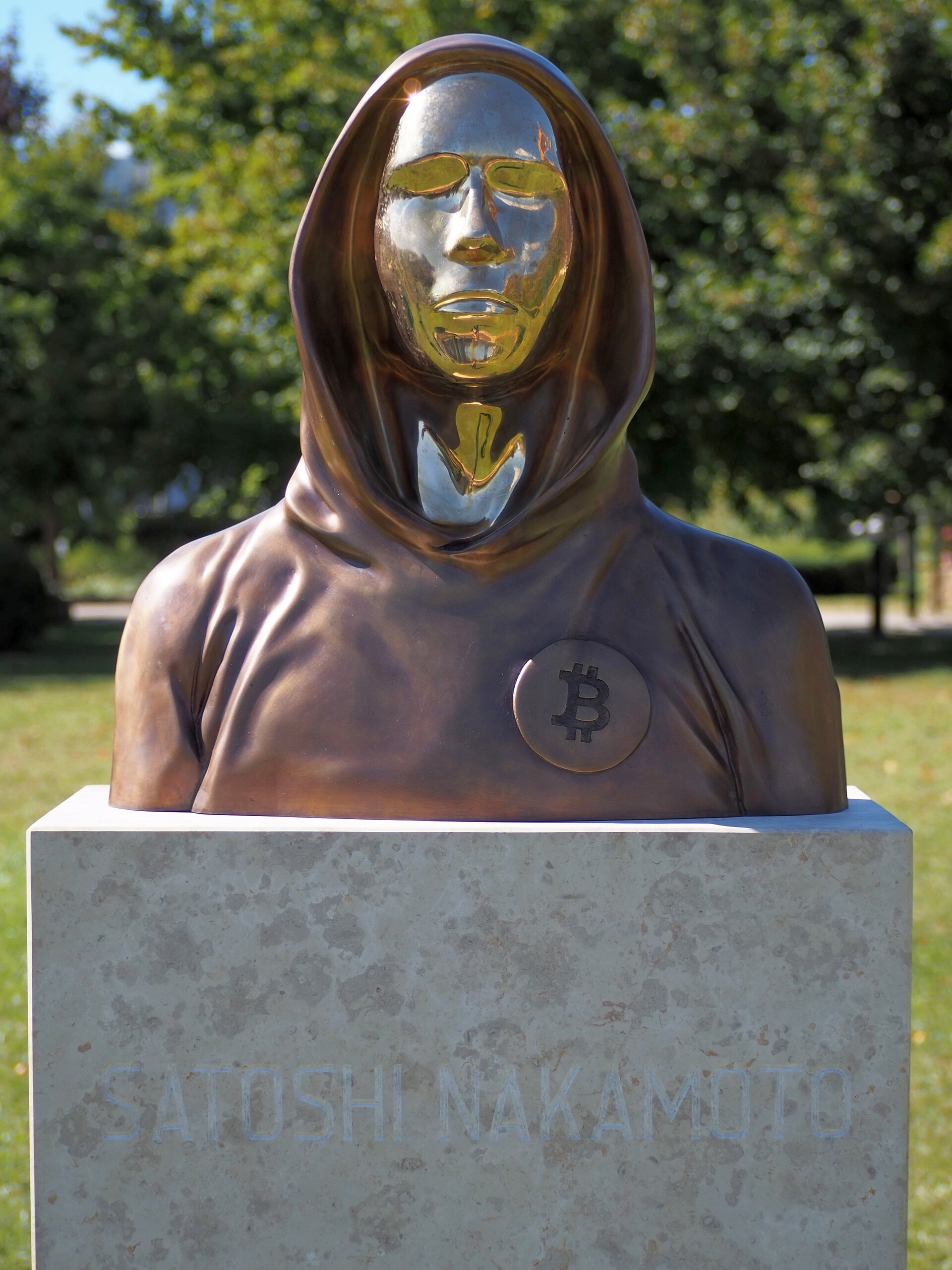
Dates: Identity and life dates unknown; Bitcoin paper announced in 2008 and software released in 2009
Period: Modern, 1900–present
Satoshi Nakamoto is the name on the Bitcoin white paper, on the first Bitcoin software and on 2 years of emails and forum posts. Nobody has shown who used the name, and it may have covered more than 1 person. The work itself is public down to the last line of code.1
The paper opens with its aim: “A purely peer-to-peer version of electronic cash would allow online payments to be sent directly from one party to another without going through a financial institution.” Nakamoto then built the system that sentence describes and kept it running until others could carry it.2
Zevism receives this work under 2 powers. Hermes is the God of exchange, messengers and the roads between cities. Ma'at is the order that keeps a record true. Nakamoto gave the world a ledger that no single hand can rewrite, then stepped away and let it stand on its own.
LIFE AND CONTEXT
The name first appeared on 31 October 2008, in a message to the Cryptography Mailing List. “I've been working on a new electronic cash system that's fully peer-to-peer, with no trusted third party,” it began, and it linked a paper of 9 pages.3
The paper took on an old difficulty of digital money. A file can be copied, so a digital coin can be spent twice unless someone keeps the books. Until then that someone had been a bank or a central server. Nakamoto's design handed the bookkeeping to an open network and made cheating more expensive than honesty.4
The reception was cool. Hal Finney, who took part in the first discussion, later recalled that when Satoshi announced Bitcoin on the list, “he got a skeptical reception at best.”5
For the next 2 years Nakamoto released new versions, answered critics and ran discussion on the project's forum. The Satoshi Nakamoto Institute keeps the archive of those emails and posts. Then the messages stopped. Bitcoin.org records that Nakamoto left the project in late 2010, and the last release announcement in the archive is dated 12 December 2010.6
Control passed to the users. Bitcoin.org puts it plainly: “Nobody owns the Bitcoin network much like no one owns the technology behind email.” A change takes effect only when users choose to run it, and that's why the network outlived its author's silence.7
The originality lay in the combination. The paper's references include Wei Dai's b-money, Adam Back's Hashcash, Haber and Stornetta on timestamping and Ralph Merkle on public-key protocols. Nakamoto joined these parts into a working whole and shipped it.8

ATTAINMENTS
- The paper solved double spending without a trusted third party. Transactions are timestamped into blocks, each block carries the hash of the one before it, and proof of work makes rewriting history cost more computing power than an honest majority controls.9
- It tied security to self-interest. A miner with more power than everyone else, the paper argues, “ought to find it more profitable to play by the rules, such rules that favour him with more new coins than everyone else combined, than to undermine the system and the validity of his own wealth.”10
- Nakamoto fixed the money supply in advance. The release notes of January 2009 set the limit: “Total circulation will be 21,000,000 coins,” with the issue “cut in half every 4 years.”11
- The code shipped and worked. Version 0.1 went out on 8 January 2009 as open-source C++ for Windows, so anyone could run the network and read exactly how it worked.11
- The design planned for ordinary users. Section 8 of the paper shows that “it is possible to verify payments without running a full network node,” keeping only the chain of block headers.12
- The ledger kept names out of the record. Keys stay anonymous, so “the public can see that someone is sending an amount to someone else, but without information linking the transaction to anyone.”13
- A crisis was repaired in hours. When a flaw let a single transaction create over 184 billion coins in August 2010, a corrected client was out within 5 hours of the discovery.14
KEY STORIES
The Critic and the Calculation
James A. Donald posted the first serious objection 2 days after the announcement. To catch a double spend, he wrote, each peer would need most past transactions, and “if hundreds of millions of people are doing transactions, that is a lot of bandwidth.”15
Nakamoto answered on 3 November with numbers. Ordinary users wouldn't need the full ledger. Simplified Payment Verification would let them check payments with block headers, “about 12KB per day.” Handling Visa's 100 million daily transactions would take about 100GB, which Nakamoto put at “the size of 12 DVD or 2 HD quality movies.”16
Another list member warned 3 days later: “You will not find a solution to political problems in cryptography.” The reply came back the same day. “Yes, but we can win a major battle in the arms race and gain a new territory of freedom for several years.”17
The thread ran to 27 messages in just over 2 weeks. Nakamoto took each objection on its terms and answered it with a mechanism or a figure.
The Headline in the First Block
On 3 January 2009, at 18:15:05 UTC, the first block of the chain was created. Inside its coinbase field sits a line of text: “The Times 03/Jan/2009 Chancellor on brink of second bailout for banks.”18
The line did 2 jobs. It proved the block couldn't have been made before that day's front page of The Times. It also tied the network's first day to a report that Britain's Chancellor was about to rescue the banks a 2nd time.
The block paid a reward of 50 coins that can't be spent, “due to a quirk in the way that the genesis block is expressed in the code.” Nobody knows whether the quirk was deliberate.18
10 Coins to Hal Finney
Hal Finney had started in cryptography on an early version of PGP, working with Phil Zimmermann. He downloaded Bitcoin as soon as it appeared and became, in his words, “the first person besides Satoshi to run bitcoin.” He “mined block 70-something” and “was the recipient of the first bitcoin transaction, when Satoshi sent ten coins to me as a test.”5
The story has a hard 2nd half. In August 2009 Finney was diagnosed with ALS. As the coins gained value, he moved them “into an offline wallet, where hopefully they'll be worth something to my heirs.” By 2013 he was “essentially paralyzed” and ran his computer with an eyetracker. He was still writing code for Bitcoin wallet security, “probably 50 times slower than I was before.”19
The Night of 184 Billion Coins
On 15 August 2010 someone found that block 74638 held a transaction creating 184,467,440,737.09551616 bitcoins, split across 2 addresses. The code that checked transactions hadn't allowed for outputs so large that their sum overflowed.14
A new client appeared within 5 hours with a rule that rejected such transactions. That night Nakamoto told users not to take a copied chain “right up to the end,” so their own nodes would download and check the newest blocks.20
The corrected chain grew past the bad one at block 74691. From that point every node accepted it, and the phantom coins were gone from the record.14
THE ZEVIST READING
Hermes presides over this work. The Homeric Hymn has him born at dawn and playing a lyre by midday, one he'd built from a mountain tortoise. It ends his quarrel with Apollo by an exchange: Hermes holds out the lyre, and Apollo puts the shining whip in his hand and makes him keeper of herds.21 Invention, trade and a settlement both parties accept belong to the same God. They're also the substance of Nakamoto's paper.
Ma'at gives the 2nd measure. Egyptian religion named her “the personification of truth, justice, and the cosmic order” and set her against isfet, disorder.22 A ledger that anyone can check and no one can quietly alter is Ma'at in technical form. A double spend is a small act of Izfet, a claim that 1 coin belongs to 2 owners at once. Proof of work makes that lie too expensive to tell.
The genesis headline carries a 3rd lesson. Zevism names the andrapod: the person who lives among ruins and answers them with complaint and nostalgia. Nakamoto read about a bank rescue and answered with a working system, published for anyone to test, attack and improve. That's the Creator's answer to a broken order.
The disappearance completes the picture. Nakamoto never claimed the credit, and the ledger doesn't need its maker's authority to keep running. A creation that holds its order after its creator has gone moves toward the pattern Plato set for human life, likeness to the divine “as far as possible,” ὁμοίωσις θεῷ κατὰ τὸ δυνατόν.23
NOTES
1 Bitcoin.org, “Who created Bitcoin?”.
2 Nakamoto, Bitcoin, abstract.
3 Nakamoto, “Bitcoin P2P e-cash paper,” 31 October 2008.
5 Finney, “Bitcoin and me,” 19 March 2013.
6 Nakamoto, “Added some DoS limits, removed safe mode,” 12 December 2010.
7 Bitcoin.org, “Who controls the Bitcoin network?”.
8 Nakamoto, Bitcoin, references, p. 9.
10 Bitcoin, §6.
11 Nakamoto, “Bitcoin v0.1 released”.
12 Bitcoin, §8.
13 Bitcoin, §10.
14 Bitcoin Wiki, “Value overflow incident”.
15 Satoshi Nakamoto Institute, thread of 31 October to 16 November 2008.
16 Nakamoto, reply of 3 November 2008.
17 Nakamoto, reply of 6 November 2008.
18 Bitcoin Wiki, “Genesis block”.
20 Nakamoto, “Re: overflow bug SERIOUS,” 15 August 2010.
21 Homeric Hymn to Hermes 17–19, 39–51, 496–498.
BIBLIOGRAPHY
Satoshi Nakamoto, Bitcoin: A Peer-to-Peer Electronic Cash System, 2008; abstract, §§1–8, 10 and 11, references on p. 9.
Nakamoto, “Bitcoin P2P e-cash paper”, Cryptography Mailing List, 31 October 2008.
Satoshi Nakamoto Institute, “Bitcoin P2P e-cash paper” thread, 31 October to 16 November 2008, with Nakamoto's replies of 3 November and 6 November 2008.
Nakamoto, “Bitcoin v0.1 released”, Cryptography Mailing List, 8 January 2009.
Bitcoin Wiki, “Genesis block”: timestamp, coinbase text and unspendable reward.
Hal Finney, “Bitcoin and me (Hal Finney)”, BitcoinTalk, 19 March 2013.
Bitcoin Wiki, “Value overflow incident”, CVE-2010-5139; Nakamoto, “Re: overflow bug SERIOUS”, 15 August 2010.
Nakamoto, “Added some DoS limits, removed safe mode”, BitcoinTalk, 12 December 2010.
Bitcoin.org, Frequently Asked Questions, “Who created Bitcoin?” and “Who controls the Bitcoin network?”
Homeric Hymn to Hermes 17–19, 39–51 and 496–498, H. G. Evelyn-White translation, Theoi Classical Texts Library.
Encyclopaedia Britannica, “Maat”.
Plato, Theaetetus 176a–b, Greek text, Perseus Digital Library.
CREDIT
Portrait: Bust of Satoshi Nakamoto by Tamás Gilly and Réka Gergely, bronze and aluminium alloy, inaugurated 16 September 2021 in Graphisoft Park, Budapest; its mirror face lets the viewer see themselves in it. Photograph by Fekist, 19 September 2021. Image record, CC BY-SA 4.0; the 1920-pixel copy, unaltered; the round picture is cropped from it.

Image: Bitcoin symbol, an illustration of the project rather than a portrait of Nakamoto. Public-domain text logo; Commons file credits Grayliptrot. Verified file and rights statement.

Grayliptrot (file-page credit) / Wikimedia Commons; Public domain (PD-textlogo). Image record, Public domain (PD-textlogo).
The round picture in the lists of the personalities is cropped from the portrait.