





3 min read
Chola Queen of Temples
Sembiyan Mahadevi
author: High Priest Zevios Metathronos
The queen who preserved worship and its records
Dates: patronage documented from 941 CE
Period: Darkness (800–1000 CE)
Region: Tamil country, South India
Tradition: Śaiva temple patronage
Religion or tradition: Hinduism, especially Śaivism; patronage of Śiva temples and sacred images.
Heresy status: No designation documented.
Sembiyan Mahadevi’s religious achievement can be read in temples, bronzes and inscriptions. Her recorded patronage extended from 941 to 1001, placing nearly all of that documented activity within this collection’s tenth-century period. She supported sacred buildings and images over decades, giving her influence a continuity that outlasted a single reign.1
PRESERVING THE WORK OF DONORS WHO CAME BEFORE HER
Sembiyan Mahadevi’s instruction to copy older inscriptions onto rebuilt temples protected the record of earlier gifts. It allowed a more durable building to retain the history of the community that had supported its predecessor. The act preserved names and obligations as well as stonework, giving later generations evidence they could still consult.2
Her temple and image patronage also supported the material forms through which Śiva’s worship continued. Humanity received works of exceptional artistry and a richer surviving historical record; worshippers received renewed settings for religious observance. Her achievement joins beauty with administrative care. She exemplifies a patron who could improve what she inherited while preserving the contributions that had made it possible.
REBUILDING WITHOUT ERASING
One especially revealing act concerns the replacement of earlier temple structures with stone. Sembiyan Mahadevi arranged for the old records of grants and donations to be copied onto the new buildings. At Aduturai, an inscription describes the preservation and re-engraving of these records. Her new work thus retained evidence of the service of earlier donors.3
This is a substantial form of religious care. A donor who preserves earlier records acknowledges that the sanctuary has a history beyond the present benefactor. Gifts, obligations and the identities of predecessors remain visible. The act joins material restoration to the continuity of institutional memory.
IMAGES MADE FOR A LIVING TEMPLE
The queen is also associated with the flourishing of Chola bronze sculpture. The Norton Simon Museum discusses her patronage in connection with the artistic tradition represented by its Somaskanda, the image of Śiva with Umā and Skanda. These are divine images belonging to a religious world of worship, procession and recurring observance.4
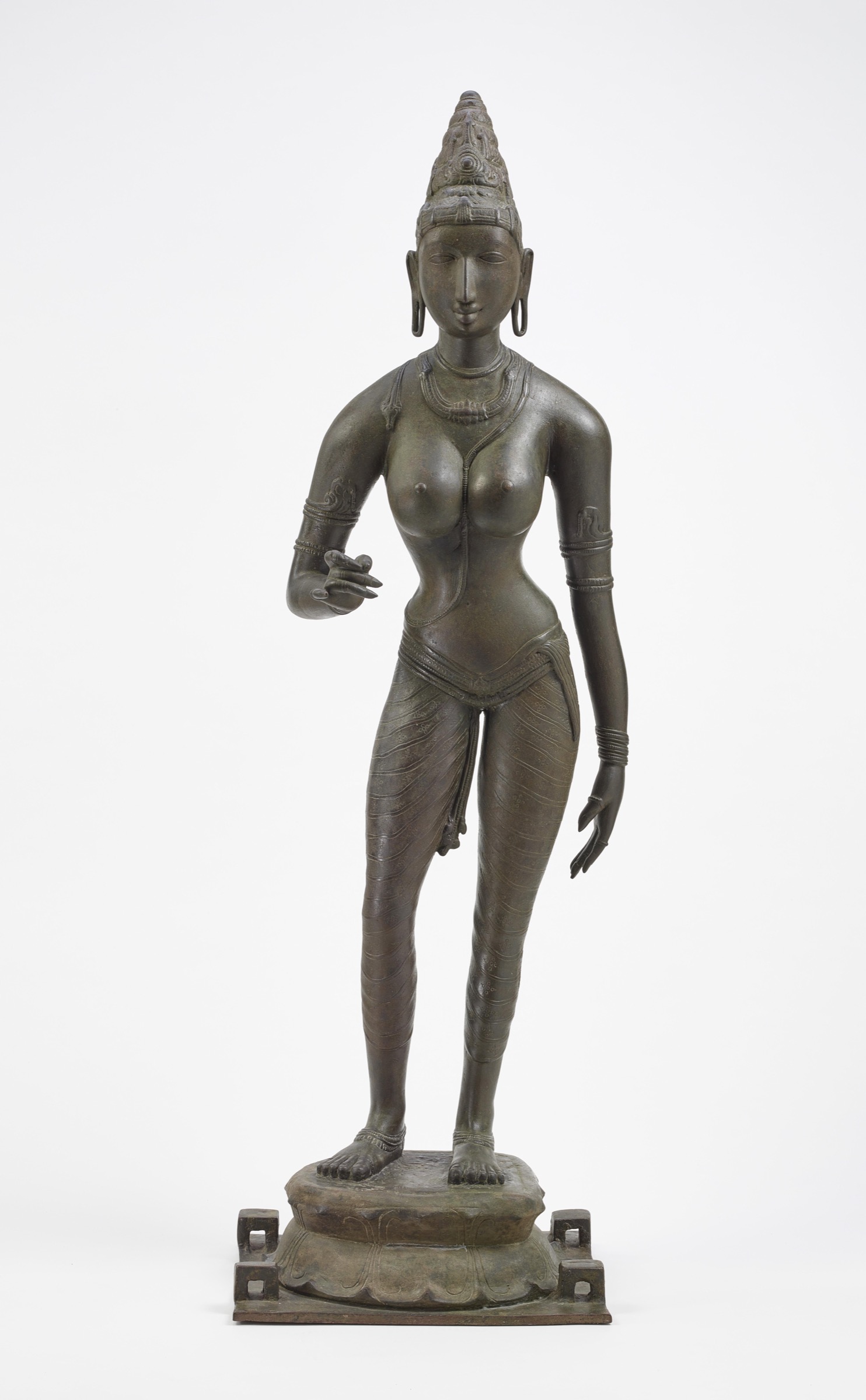
The Smithsonian’s celebrated female bronze has been interpreted as an idealized image of the queen in the form of Pārvatī. The identification is a scholarly proposal, not a securely inscribed personal likeness. It is best presented with that distinction intact.5
A ZEVIST EXAMPLE OF LASTING SERVICE
Sembiyan Mahadevi offers an unusually practical model of spiritual responsibility. She used resources to maintain places where the Gods could be honoured and knowledge could continue. Her preservation of earlier inscriptions is particularly instructive for anyone entrusted with sacred archives: renewal should retain the record of what made renewal possible.
Her example also broadens the meaning of personal power. Power can be measured by the ability to create conditions that endure: a sanctuary maintained, an image commissioned, a grant recorded, a history protected. Here devotion acquires a public and lasting form through sustained work.
NOTES
1 Vidya Dehejia, “The Very Idea of a Portrait”.
2 Dehejia, discussion of Aduturai.
5 Smithsonian collection record.
BIBLIOGRAPHY
Vidya Dehejia, “The Very Idea of a Portrait,” Ars Orientalis 28 (1998), especially pp. 42–43, author-hosted PDF.
Norton Simon Museum, Shiva with Uma and Skanda (Somaskanda), F.1972.23.1.S, collection record.
Smithsonian National Museum of Asian Art, Queen Sembiyan Mahadevi as the Goddess Parvati, F1929.84, collection record. The portrait identification remains interpretive.
CREDIT
Picture: Museum identification. Tenth-century Chola bronze identified by the Smithsonian as Queen Sembiyan Mahadevi in the form of the Goddess Uma (Parvati), Freer Gallery F1929.84. The personal identification is interpretive; the figure is idealized.
Credit: Unknown Chola sculptor; Smithsonian National Museum of Asian Art. Source record, CC0.

The round picture in the lists of the personalities is cropped from it.