




9 min read
King of the Four Quarters
Shulgi of Ur
author: High Priest Zevios Metathronos
The Long Life of Sacred Learning
Dates: Reigned c. 2094–2047 BCE.
Period: Ancient.
Shulgi was the son of Ur-Nammu and the 2nd king of the 3rd dynasty of Ur. He took the throne about 2094 BCE, when his father died in battle, and ruled until 2047 BCE, 48 years by the conventional count. Steve Tinney of the Penn Museum describes the dynasty as one “which reached its pinnacle under King Shulgi.”1
His praise poems present him as a scholar-king. They make him a scribe, a reckoner, a diviner, a musician and a speaker of 5 languages, and the Oxford corpus of Sumerian literature catalogues 26 compositions about him. Students copied his hymns “for centuries after his death.”2
Zevism reads Shulgi as a Sumerian link in the chain of spirituality. His patron in learning was Nisaba, Goddess of the scribe's art, whose office the Temple reads beside Thoth and the Theuth of Plato's Phaedrus, inventor of number and letters.
LIFE AND CONTEXT
Shulgi inherited a new kingdom from a father who hadn't finished it. Jeanny Vorys Canby writes that “when Ur-Nammu died in battle ca. 2094 B.C., he was succeeded on the throne by his well-educated son Shulgi.” The temple of Nannar and Ningal at Ur, with “its great brick tower,” had been begun by Ur-Nammu, and Shulgi completed it.3
The hymns give him a divine pedigree. “I am a child born of Ninsun. I am the choice of holy An's heart,” he says in Shulgi A. Gilgameš swears in his own poem “by the life of my own mother Ninsun,” so the hymn gives the king and the hero the same mother. Tinney notes that “Shulgi was considered the brother of Gilgamesh in ancient Ur and Nippur.”4
They also claim he was trained from childhood. “When I was small, I was at the academy, where I learned the scribal art from the tablets of Sumer and Akkad,” the king says in Shulgi B. “None of the nobles could write on clay as I could.”5
The kingdom ran on writing. Tinney points to the “accounts and contracts large and small from the great dynasty of Ur,” and Shulgi A makes the king an organiser of space as well as records: “I marked out the double-hour distances, built there lodging houses.”6
He was also a warrior king. Shulgi A has him say, “I consolidated my kingship, subdued the foreign lands, fortified the Land.” Shulgi B adds the hunt: “The number of lions that I have dispatched with my weapons is limitless; their total is unknown.”7
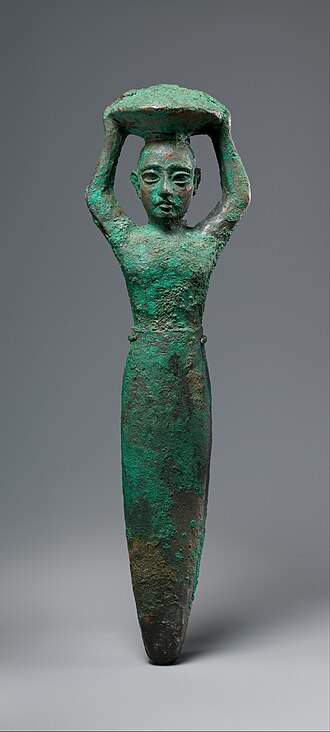
His image survives in metal and stone. A copper foundation figure of the king carrying a basket, 31.1 cm tall, was excavated at Nippur in 1955–56 by the Joint Expedition to Nippur and is now in New York. A fragmentary statue in basic hornfels, 25.4 cm high, bears his identification.8 His memory outlived the dynasty in the schools.9
ATTAINMENTS
- He ruled Ur from about 2094 to 2047 BCE, and under him the 3rd dynasty of Ur reached what Tinney calls its “pinnacle.”10
- He completed the temple of Nannar and Ningal at Ur with its great brick tower, the work his father had begun.11
- He built up the kingdom's roads. Shulgi A credits him with strengthening the roads, marking out the double-hour distances, building lodging houses and planting gardens along them.12
- He placed copper foundation figures in his temples, such as the 31.1 cm basket-carrier excavated at Nippur in 1955–56.13
- Songs about him survive in number: the Oxford corpus lists 26 compositions, among them praise poems, adab songs, a lullaby for a son of Shulgi and a love song. Shulgi B alone runs to 385 lines.14
- He claimed to judge in 5 languages: “When I provide justice in the legal cases of Sumer, I give answers in all five languages.”15
- His hymns entered the school curriculum, and students copied them and his inscriptions for centuries after his death.10
KEY STORIES
From Nibru to Urim in a Day
Shulgi A tells the king's most famous feat in his own voice, and it opens with the man who'd perform it: “I, the king, was a hero already in the womb.”16
He was at Nibru, Enlil's city, when “to prove my speed, my heart prompted me to make a return journey from Nibru to brick-built Urim as if it were only the distance of a double-hour.”17
He tied the small nijlam garment firmly to his hips and set off. The poet reaches for birds to show the speed: “Like a pigeon anxiously fleeing from a ...... snake, I spread my wings.” “The inhabitants of the cities which I had founded in the land, lined up for me” as he passed.18
At Urim he went straight to the moon God's house. “I filled with abundance the temple of Suen, a cow-pen which yields plenty of fat,” he says. “I had oxen slaughtered there; I had sheep offered there lavishly.” The offering made, he turned back north toward Nibru the same day.19
Hail on the Road Home
On the way back the weather turned. “But a storm shrieked, and the west wind whirled around.” Lightning “together with the seven winds vied with each other in the heavens,” and the hail came down: “Small and large hailstones drummed on my back.” The king kept going. “I, the king, however, did not fear, nor was I terrified.”20
“I rushed forth like a fierce lion. I galloped like an ass in the desert.” The poem gives the distance: “I traversed a distance of fifteen double-hours by the time Utu was to set his face toward his house,” that is, by sunset. He'd kept the festival “in both Nibru and Urim on the same day!”21
Then he feasted with the Gods. “I drank beer in the palace founded by An with my brother and companion, the hero Utu.” The Goddess herself joined him: “My spouse, the maiden Inana, the lady, the joy of heaven and earth, sat with me at the banquet.”22
The King Who Went to School
Shulgi B turns from the runner to the scholar. At the academy, the king says, “I qualified fully in subtraction, addition, reckoning and accounting.” He learned to read omens: “After I have determined a sound omen through extispicy from a white lamb and a sheep, water and flour are libated at the place of invocation.”23
He claimed the foreigners' languages as well. “Fourthly, I can do service as a translator with an Amorite, a man of the mountains.” Of the man from Subir he claims, “I can even distinguish the words in his language.”24
He also went looking for old songs. “I have discovered tigi and zamzam hymns from past days, old ones from ancient times,” he says, and “I have never declared them to be false.” Near the end he gives an order for the future: “The academies are never to be altered; the places of learning shall never cease to exist.”25
The order held longer than his dynasty. Scribes in training copied his hymns and inscriptions for centuries, and the Temple counts those students among the keepers of the source.10
THE ZEVIST READING
Zevism holds that spirituality forms one chain from its inception to the present, and Shulgi's Gods keep their own names in it. Nisaba owns the scribe's art he claims, Suen receives his oxen at Urim, Utu drinks with him in An's palace. The Temple reads Nisaba's office through the Hellenic lens, and it doesn't need to change her name to do so. In the Phaedrus the Egyptian God Theuth invents number, calculation, geometry, astronomy and letters.26 A king who prides himself on subtraction, reckoning and writing on clay is claiming Theuth's gifts.
Zevism also holds that one must return to the source. Knowledge changes as it's handed on, and the source keeps priority. Shulgi's claim to have found hymns “from past days, old ones from ancient times” and never declared them false is that doctrine in Sumerian form. The scribes who copied him for centuries did the same service for his own words, and Zevism honours them as transmitters.
His roads and courts give the doctrine of Ma'at a Sumerian shape. Egyptian religion named Maat “the personification of truth, justice, and the cosmic order” and set her against isfet.27 A highway marked out in double-hours, with lodging houses and gardens for the traveller, keeps order on the ground. A judge who can answer in 5 languages keeps it in the court. A lawless road and a plea no judge can understand belong to Izfet.
The hymns set their king an extreme ideal. “I am a knowledgeable scribe of Nisaba; I have perfected my wisdom just as my heroism and my strength,” says Shulgi A, and it adds: “I cherish righteousness but do not tolerate wickedness.”28 Tinney writes that he shared Gilgamesh's “aspirations to immortality through writing.”10
The run through the hail belongs to the same portrait. It's a human life stretched toward the divine, and Plato named that aim likeness to God “as far as possible,” ὁμοίωσις θεῷ κατὰ τὸ δυνατόν.29 The Temple reads Shulgi's hymns as that ascent put into praise: wisdom joined to strength, the body tested on the road and the mind trained at the tablet.
NOTES
1 Canby, “A Monumental Puzzle,” 1987; Tinney, “The Uses of Writing,” 2018.
2 ETCSL catalogue, section 2.4.2; Tinney, 2018.
4 ETCSL 2.4.2.01, lines 7–15; ETCSL 1.8.1.5, lines 90–91; Tinney, 2018.
5 ETCSL 2.4.2.02, lines 11–20.
6 Tinney, 2018; ETCSL 2.4.2.01, lines 26–35.
7 ETCSL 2.4.2.01, lines 88–94; ETCSL 2.4.2.02, lines 56–76.
8 Metropolitan Museum, 59.41.1; Metropolitan Museum, L.1983.95a–b.
9 Metropolitan Museum, 59.41.1; Tinney, 2018.
10 Tinney, 2018.
11 Legrain, 1944.
12 ETCSL 2.4.2.01, lines 26–35.
13 Metropolitan Museum, 59.41.1.
14 ETCSL catalogue, section 2.4.2; ETCSL 2.4.2.02.
15 ETCSL 2.4.2.02, lines 206–220.
17 ETCSL 2.4.2.01, lines 36–41.
18 Lines 42–47.
19 Lines 48–59.
20 ETCSL 2.4.2.01, lines 60–69.
21 Lines 70–78.
22 Lines 79–83.
23 ETCSL 2.4.2.02, lines 11–20, 131–149.
24 Lines 206–220.
28 ETCSL 2.4.2.01, lines 19–25.
BIBLIOGRAPHY
Electronic Text Corpus of Sumerian Literature, University of Oxford, A Praise Poem of Shulgi (Shulgi A), composition 2.4.2.01; lines 1–15, 19–35 and 36–94.
ETCSL, A Praise Poem of Shulgi (Shulgi B), composition 2.4.2.02; lines 11–20, 56–76, 131–149, 206–220, 270–280 and 308–319.
ETCSL, Catalogue of Sumerian literature, section 2; compositions 2.4.2.01 to 2.4.2.b on Shulgi.
Steve Tinney, The Uses of Writing, Penn Museum, Expedition 60, no. 1, May 2018, especially “Writing and Administration” and “Writing, Religion, and Power.”
Jeanny Vorys Canby, “A Monumental Puzzle: Reconstructing the Ur-Nammu Stela”, Expedition 29, no. 1, Penn Museum, March 1987.
Leon Legrain, The Third Dynasty of Ur. The Stela of Ur–Nammu, Museum Bulletin X, nos. 3–4, June 1944, pp. 56–57.
Metropolitan Museum of Art, Fragmentary Statue of King Shulgi of Ur, L.1983.95a–b, object record.
Metropolitan Museum of Art, Foundation figure of king Shulgi of Ur, carrying a basket, 59.41.1; date, medium, dimensions and excavation at Nippur.
ETCSL, Gilgamesh and Huwawa, version A, composition 1.8.1.5; lines 90–91.
Plato, Phaedrus 274c–275b, English translation, Perseus Digital Library.
Encyclopaedia Britannica, “Maat”.
Plato, Theaetetus 176a–b, Greek text, Perseus Digital Library.
CREDIT
Picture: Foundation figure of King Shulgi carrying a basket, Metropolitan Museum of Art, 59.41.1. An ancient royal foundation figure; museum open-access image.

The Metropolitan Museum of Art, via Wikimedia Commons; CC0 1.0. Image record, CC0 1.0.
The round picture in the lists of the personalities is cropped from it.