






4 min read
Founder of the Tondrakians
Smbat of Zarehawan
author: High Priest Zevios Metathronos
The disputed founder of a durable Armenian dissent
Dates: ninth or early tenth century CE
Period: Darkness (800–1000 CE)
Region: Armenia
Tradition: Tondrakian religious dissent
Religion or tradition: Armenian Christian dissent: founder traditionally associated with the Tondrakian movement.
Heresy status: Christian Heretic: founder associated with a condemned Armenian Christian movement.
Smbat, associated with Zarehawan and Tondrak, is remembered as a founder of the Tondrakian movement. His chronology is disputed. Later Armenian writers supply references that do not align neatly, so an exact lifespan would give a false impression of certainty. The movement is securely situated within the religious conflicts of medieval Armenia; the founder’s individual life is much less fully documented.1
WHY HE IS IDENTIFIED AS A CHRISTIAN HERETIC
Smbat receives this designation as the founder traditionally associated with the Tondrakians, an Armenian Christian movement condemned by ecclesiastical opponents. Their accounts connect the movement with rejection of accepted rites and Church authority. The details of its doctrine and the founder’s chronology remain disputed, so the label records the Church’s treatment of the movement rather than an independently documented personal trial.2
Knowledge of the Gods: a Zevist interpretation. Smbat’s relevance is the effort, remembered through the movement associated with him, to sustain religious life outside the accepted hierarchy. For Zevist study, this makes the case an example of the struggle over access to divine understanding: who may teach, practise and seek sacred truth? The connection to the Gods is this defence of independent spiritual inquiry. The sources establish Christian dissent; they leave his supposed personal worship of ancient Armenian Gods unproven.
KEEPING A SUPPRESSED RELIGIOUS COMMUNITY IN HISTORY
The persistence of the Tondrakian tradition associated with Smbat shows that ecclesiastical condemnation did not immediately erase alternative forms of religious life. The surviving testimonies record a conflict over rites, authority and belonging, preserving evidence of people who maintained an identity outside the accepted Church order. Smbat’s role is remembered within that tradition of foundation and resistance.3
The positive legacy is the presence of this otherwise vulnerable religious history within humanity’s record. Its study helps restore the distinction between the people themselves and the hostile names applied to them. For a Zevist reader, that recovery serves the defence of religious independence and fair remembrance. The remembered persistence of the movement gives that appreciation its historical centre.
A FOUNDER DESCRIBED BY OPPONENTS
The letters and notices collected by F. C. Conybeare preserve hostile descriptions of Smbat and his followers. Gregory Magistros’s account is particularly important, but its abuse and retrospective chronology require scrutiny. Terms such as “wolf” are the opponent’s rhetoric, not a neutral description of the man.4
The documents associate the movement with rejection of established ecclesiastical rites and claims to authority. Its opponents treated this challenge as an assault upon the Church’s religious order. A careful reading can recover the existence and persistence of that challenge without accepting every accusation made against it. The sources are strongest as evidence for a conflict and for how the ecclesiastical side represented its adversaries.
WHAT CAN BE RECOVERED
The name of a founder can become the organizing point for a movement’s later history. In Smbat’s case, the evidence does not justify attributing every subsequent Tondrakian belief or act directly to him. Nor does it establish that he worshipped the ancient Armenian Gods under a Christian disguise. His inclusion rests on the documented tradition of resistance associated with his name.
Conybeare’s nineteenth-century interpretations also require separation from the older documents he translated. His edition remains useful as access to those witnesses, while later scholarship revises the relationships he proposed among Armenian and Byzantine dissenting groups.
A ZEVIST READING OF RELIGIOUS INDEPENDENCE
Smbat’s profile asks the reader to look beneath the label “Christian Heretic” and identify the contest it conceals. Who claimed the right to determine legitimate worship? What forms of obedience were demanded? How did a dissenting community retain its identity when its opponents controlled much of the surviving written record?
These questions make him relevant to the Era of Darkness section. The value of the account lies in recovering a suppressed side of religious history with care. Precision itself becomes an act of respect: it allows a dissenter to remain a historical person rather than a figure invented to serve a later argument.
NOTES
2 Armenian testimonies collected by Conybeare; Hamilton and Hamilton, Armenian-source appendix, pp. 293–295.
3 Armenian-source discussion in Hamilton and Hamilton.
4 Conybeare’s source collection.
BIBLIOGRAPHY
F. C. Conybeare, The Key of Truth: A Manual of the Paulician Church of Armenia (Oxford: Clarendon Press, 1898), introduction and appended Armenian testimonies, especially those of Gregory Magistros, National Library of Armenia digitization. The translated documents and Conybeare’s reconstruction are distinct evidence layers.
Janet Hamilton and Bernard Hamilton, with Yuri Stoyanov, Christian Dualist Heresies in the Byzantine World, c. 650–c. 1450 (1998), appendix on Armenian sources, especially pp. 293–294, text.
CREDIT
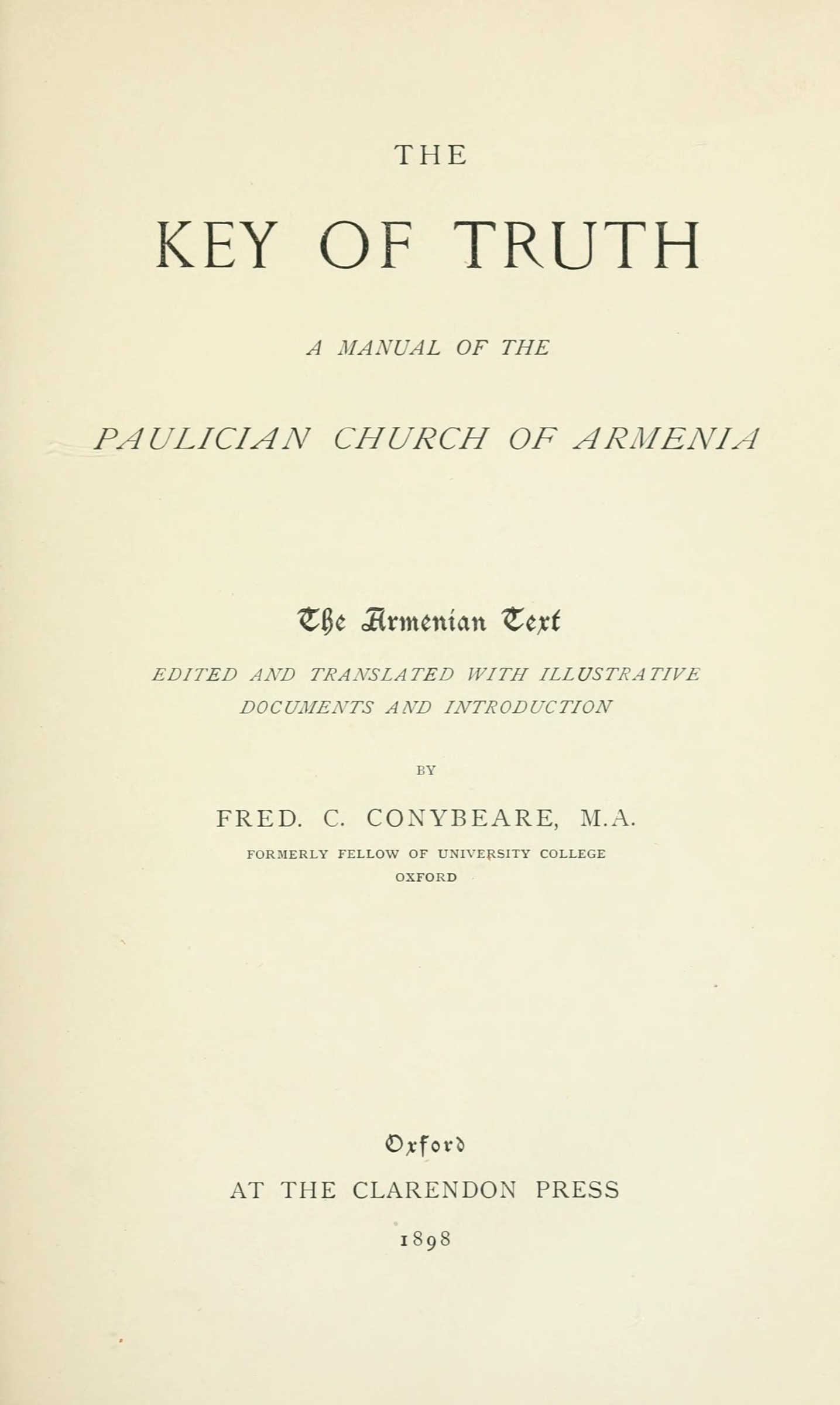
Picture: Historical source collection. Title page of F. C. Conybeare’s The Key of Truth, Oxford, 1898. Its introduction and appended testimonies are sources for the history of Smbat and the Tondrakians; this book is not presented as Smbat’s own work.
Credit: F. C. Conybeare; Clarendon Press. Source record, Public domain.
The round picture in the lists of the personalities is cropped from it.