




9 min read
Keeper of the Edda
Snorri Sturluson
author: High Priest Zevios Metathronos
Keeping the Language of the Gods Intelligible
Dates: 1179–1241 CE
Period: Ignorance (1000–1336 CE)
Snorri Sturluson was an Icelandic chieftain, lawspeaker and poet, and the author of the Prose Edda and the Heimskringla. The Edda is a handbook for poets. It retells the myths of the Norse Gods, then explains the ornate diction and the metres of the old skalds, so that a reader who'd lost the stories could still read the poems.1
His greatest attainment is concrete. He wrote down, in connected prose, the stories that the old poems only glanced at: the ash Yggdrasill and the Norns who water it, the theft of the mead of poetry, the questions of King Gylfi. A kenning such as Kvasir's Blood for poetry stays a riddle until his book supplies the story behind it.
Snorri was a Christian and wrote as one. Zevism reads his book as Odin's mead passed down a further link of the chain: the Gods of the North kept intelligible under their own names, by a man who didn't worship them.
LIFE AND CONTEXT
He was born in 1179 at Hvammur in the Dales, on the farm once held by the settler Auður the Deepminded. From the age of 3 he was raised at Oddi in the household of Jón Loftsson, who was for years the leading chieftain of Iceland. In the 12th century Sæmundur and his descendants had kept a school at Oddi.2
In 1199 his brother Þórður and Sæmundur Jónsson of Oddi arranged his marriage to an heiress, Herdís Bessadóttir, and he began to gather lands and power. By 1206 the marriage had broken up, and he settled at Reykholt, a farm on a main crossroads. Britannica places most of his writing there, between 1223 and 1235.3
He was lawspeaker, the president of the Icelandic high court, in 1215–18 and again in 1222–32. In 1218 King Haakon IV invited him to Norway, and he stayed with the king and with Earl Skúli at Túnsberg. Snorrastofa credits him with heading off a planned Norwegian war against the Icelanders. He became the king's man and returned home in 1220.4
The price of that favour was politics. Britannica says he “convinced Haakon that he could become king of Iceland” and became the king's vassal. At home he was soon caught in fierce political conflict, and in 1237 he sailed for Norway again.4
This time he took the side of Earl Skúli, and it cost him his life. In the autumn of 1241, on Haakon's order, Snorri was killed at Reykholt. The date isn't settled: Snorrastofa has the night of 23 September, Britannica 22 September.3
ATTAINMENTS
- He wrote the Prose Edda in 3 parts: Gylfaginning, the myths told as a dialogue; Skáldskaparmál, the language of poetry; and Háttatal, a poem that works through the metres.3
- He wrote the Heimskringla, a history of the kings of Norway from their legendary descent from Odin down to the reign of Magnus Erlingsson, who died in 1184.5
- He divided the northern past by its burial customs: an Age of Burning, when the dead were burned and standing stones raised over their ashes, and then an age of cairns, after Frey was buried under one at Uppsala.6
- He served 2 terms as lawspeaker of the Althing, 1215–18 and 1222–32.5
- In Norway in 1218–20 he helped stop a planned war on Iceland and was honoured at court, where the king made him his man.7
- Snorrastofa lists Egils saga among the works attributed to him; the attribution is traditional and unproven.7
KEY STORIES
Gylfi in the Hall of the High One
Gylfaginning opens with a king in disguise. Gylfi, who ruled the land now called Sweden, “clad himself in the likeness of an old man” and went to Asgard to learn the source of the Æsir's power. He called himself Gangleri. The hall he reached had “thatching laid with golden shields after the fashion of a shingled roof.” On 3 high seats sat Hárr, Jafnhárr and Thridi, and they told him plainly that “he should not escape whole from thence unless he were wiser.”8
So he asked, and they answered, and Snorri's mythology unfolds as a contest of questions. They told him of the ash: “The Ash is greatest of all trees and best: its limbs spread out over all the world and stand above heaven.” The Norns take water from the well every day, with the clay that lies about it, and sprinkle the tree “to the end that its limbs shall not wither nor rot.”9
When the questions ran out, Gangleri heard a great noise and found that he “stood on a level plain.” The hall was gone. He went home to his kingdom and told what he'd heard, and that telling is the book.10
How Odin Won the Mead of Poetry
In Skáldskaparmál a man named Ægir, or Hlér, comes to Asgard and sits beside Bragi, who tells him how poetry began. The Æsir and the Vanir spat into a vat and shaped a man from it, Kvasir, “so wise that none could question him concerning anything but that he knew the solution.” The dwarves Fjalar and Galarr killed him. “The kettle is named Ódrerir, and the vats Són and Bodn; they blended honey with the blood.” The mead passed to the giant Suttungr, who hid it at Hnitbjörg with his daughter Gunnlöd on guard.11
Odin came as Bölverkr. He drilled into the mountain with the auger Rati, “turned himself into a serpent and crawled into the auger-hole,” and won Gunnlöd over; she “gave him leave to drink three draughts of the mead.” He took everything: “In the first draught he drank every drop out of Ódrerir; and in the second, he emptied Bodn; and in the third, Són.” Then he flew off as an eagle, with Suttungr after him in the same shape.12
“When the Æsir saw Odin flying, straightway they set out their vats in the court.” Some mead he let fall behind him, and Snorri adds, “we call that the poetaster's part.” The rest “Odin gave the mead of Suttungr to the Æsir and to those men who possess the ability to compose.” That's why a skald could call a poem Kvasir's Blood, or “Odin's Booty and Find, and his Drink and Gift.”13
The Chain of Witnesses
Snorri opens the Heimskringla by telling his readers where it came from. “In this book I have had old stories written down, as I have heard them told by intelligent people.” Then he names the chain. The priest Ari the Learned “was the first man in this country who wrote down in the Norse language narratives of events both old and new.” Ari came to Haukadal at 7 years old, to Hal Thorarinson, and stayed 14 years.6
Hal had lived at Haukadal for 64 years and reached nearly 94. He could remember being baptised at 3 by the missionary priest Thangbrand, the year before Christianity became law in Iceland. Teit, son of Bishop Isleif, grew up in Hal's house and taught Ari. Through 3 lives Snorri could reach back to the conversion itself.14
For older times he turned to the poems. Thjodolf of Hvin, skald of Harald Fairhair, composed the Ynglingatal for King Rognvald, and in it “thirty of his forefathers are reckoned up, and the death and burial-place of each are given.” Snorri trusted such verse for a stated reason. Skalds praised the man before them, yet none would recite to a chief “a false and imaginary, not a true account of his deeds; because that would be mockery, not praise.”14
The Last Voyage from Norway
In 1237 Snorri sailed to Norway for the 2nd time and threw in his lot with Earl Skúli. Snorrastofa reports that Skúli “secretly ordained him as earl,” presumably meaning to make himself king of Norway and his friend earl of Iceland. King Haakon wouldn't let Snorri and his companions sail home. Snorri is supposed to have answered: “I want out!” He sailed.7
The gamble failed. Skúli was killed on 24 May 1240, and Haakon's order against Snorri followed. Gissur and his companions came to Reykholt by night in September 1241 and killed the poet in his own home.3
Tradition keeps his last words as a plea drawn from the commandment against killing: “Thou shalt not strike!” The man who'd written down how Odin brought poetry to the Gods died with a sentence of his own faith in his mouth.7
THE ZEVIST READING
Snorri's myth makes poetry a divine gift. Odin carried the mead to the Æsir and to the men “who possess the ability to compose,” so every skald who composes drinks from the vessels Odin filled. Zevism reads the art of the skalds under Odin. Zevism is the chain of all spirituality from its inception to today, and Scandinavia's Gods served the divine order under their own names. Snorri kept those names readable.
He also stated the rule of the source outright. Young skalds, he wrote, weren't to forget these traditions or “remove from poesy those ancient metaphors with which it has pleased Chief Skalds to be content.”12 Zevism holds the same rule: knowledge changes in transmission, and the source keeps priority. Snorri told Christian readers not to believe in the heathen Gods, and his Prologue gave them a Trojan ancestry.15 Neither frame altered the stories inside it: Gylfi still questions the High One, and Odin still carries the mead.
The Heimskringla preface adds Ma'at. Egyptian religion named her “the personification of truth, justice, and the cosmic order.”16 Snorri's test for a court poem, that a false account recited before its witnesses would be mockery, is a test of Ma'at. A record checked by the people who saw the deeds keeps truth and order together in words.
The Norns who water the ash every day, “to the end that its limbs shall not wither nor rot,” give the Temple its picture of that labour. Zevism holds that the order of the cosmos, held by Zeus as its sovereign, needs daily tending, and a tradition needs the same. Snorri gave it that tending with a pen at Reykholt, where Britannica places most of his writing between 1223 and 1235.
NOTES
1 UC Press, The Prose Edda; Britannica, “Snorri Sturluson”.
2 Snorrastofa, “Snorri Sturluson”; Britannica.
5 Britannica.
6 Snorri, Heimskringla, preface.
7 Snorrastofa.
8 Snorri, Gylfaginning, Brodeur tr..
9 Gylfaginning XV–XVI; sacred-texts edition.
10 Gylfaginning, closing chapter.
11 Snorri, Skáldskaparmál, Brodeur tr..
12 Skáldskaparmál.
13 Skáldskaparmál; Skáldskaparmál 1–2.
15 Skáldskaparmál 1; Prologue 3.
BIBLIOGRAPHY
Snorri Sturluson, Gylfaginning and Skáldskaparmál, in The Prose Edda, translated by Arthur Gilchrist Brodeur, American-Scandinavian Foundation, 1916; Internet Sacred Text Archive.
Snorri Sturluson, Gylfaginning XV–XVI, Skáldskaparmál I–II and Prologue III, same translation, Wikisource; the ash and the Norns, the mead narrative, the address to young skalds, the Trojan genealogy.
Snorri Sturluson, Heimskringla, preface, English translation, Project Gutenberg eBook 598.
University of California Press, The Prose Edda: Tales from Norse Mythology, Jean I. Young translation, 2012 edition description and author note. ISBN 9780520273054.
Encyclopaedia Britannica, “Snorri Sturluson”.
Snorrastofa, Reykholt, “Snorri Sturluson”.
Encyclopaedia Britannica, “Maat”.
CREDIT
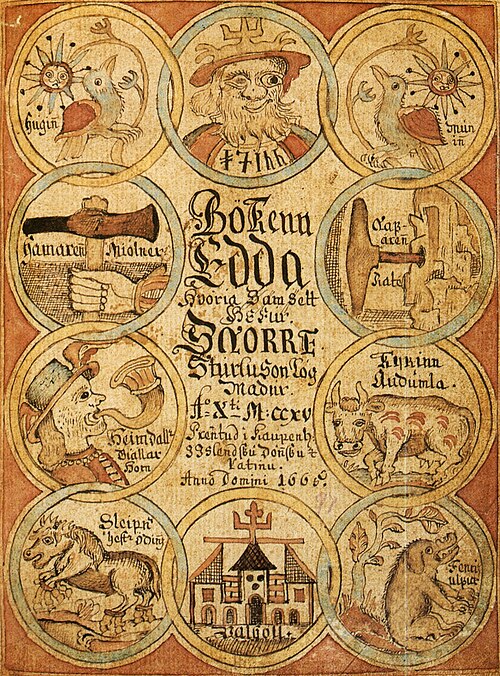
Picture: Title page of an eighteenth-century Prose Edda manuscript, ÍB 299 4to, fol. 58r, Icelandic National Library. Anonymous; public domain. This later illustration represents the work's transmission, not Snorri's appearance.

Anonymous / Wikimedia Commons; Public domain. Image record, Public domain.
The round picture in the lists of the personalities is cropped from it.