




9 min read
Pioneer of Elasticity
Sophie Germain
author: High Priest Zevios Metathronos
The Courage to Enter the Problem
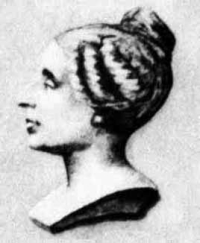
Dates: 1776–1831
Period: Imperial.
Sophie Germain was a Parisian mathematician who taught herself from books and borrowed lecture notes, because the schools that trained mathematicians in her time didn't admit women. In 1816, on her 3rd attempt, she won the prize of the Paris Academy of Sciences for a mathematical theory of vibrating elastic surfaces, a medal of 1 kilogram of gold.1
In number theory she proved the result now called Sophie Germain's theorem, and her manuscripts hold a plan of attack on Fermat's Last Theorem that reaches well beyond it.2
She chose mathematics after reading how Archimedes died over a diagram, and she studied through winter nights after her parents took away her fire and her light. Zevism reads her work under Prometheus, giver of fire and of number, and as light carried into the dark in the plainest sense.
LIFE AND CONTEXT
Germain was born in Paris on 1 April 1776. Her father, Ambroise-François Germain, was “a prosperous merchant, goldsmith and jeweller who later became a silk-merchant.” She was 13 when the Revolution broke out in 1789.3
Lazare Carnot and Gaspard Monge founded a school of public works in Paris in 1794, renamed the École Polytechnique the following year, and there was no way a girl could enrol. Germain got its mathematics courses by post and sent her own work to Joseph-Louis Lagrange under the name of a former student, Antoine Auguste Le Blanc. Lagrange, struck by the student's intelligence, sent for him and found the deception. He became her mentor.4
From 1804 to 1808 she wrote to Carl Friedrich Gauss about number theory, again as Le Blanc.5 She never married and never held a post, and her father supported her financially throughout her life.3 She became the first woman allowed to attend the sessions of the Institut de France.6
Breast cancer struck her in 1829. She kept working through the illness and the fighting of the 1830 revolution, and she finished papers on number theory and on the curvature of surfaces in 1831.3
She died on 27 June 1831 at 13 rue de Savoie in Paris, where a plaque now marks the house. Her death certificate didn't call her a mathematician or a scientist. It listed her as a “rentier,” a property holder.3
ATTAINMENTS
- She won the Academy's prize on elastic surfaces with her 3rd entry, judged worthy of a gold medal of 1 kilogram, and the award was made in 1816.7
- She was the only entrant in the same contest in 1811 and again in 1813, when she received an honourable mention.3
- Her theorem states that for an odd prime p, if there is an auxiliary prime θ modulo which no 2 nonzero p-th powers are consecutive and p itself is not a p-th power, then in any solution of Fermat's equation 1 of x, y, z is divisible by p².8
- She applied it to every odd prime below 100, and Legendre credited her with both the theorem and that application in his memoir of 1823.9
- Her surviving papers show, in the words of their modern editors, “a fully-fledged, highly developed, sophisticated plan of attack” on the whole of Fermat's Last Theorem.10
- She completed papers on number theory and on the curvature of surfaces in 1831, while ill with cancer.3
- She was the first woman authorised to attend the sessions of the Institut de France.6
KEY STORIES
The Death of Archimedes
“With Paris in chaos and normal life suspended, she decided that she would go to her father's library, which was extensive, and pass the time reading books.”3 Her biographer Hippolyte Stupuy tells how she opened Montucla's Histoire des mathématiques there and found the account of the death of Archimedes.11 The book described a man who “would forget to eat and drink,” whose servant “would almost have to force him to satisfy these human needs.”3
The ending is Plutarch's. Archimedes was “working out some problem with the aid of a diagram,” and “he was not aware of the incursion of the Romans or of the capture of the city.” A soldier ordered him to come to Marcellus. He refused “until he had worked out his problem and established his demonstration,” and the soldier killed him.12 “She was moved by this story and decided that she too must become a mathematician.”3
Her parents tried to stop her. They “took away her fire, her light and her clothes in an attempt to force her away from her books.” One morning her bed was empty, and they found her “asleep in the library which was so cold that the ink had frozen solid in the ink well.” After that they eased their opposition.13
The General Before Breslau
In 1806, during the Jena campaign, French troops occupied Brunswick, where Gauss lived. Stupuy writes that Germain remembered Archimedes and took alarm. She wrote to a friend of her family, General Pernety, chief of staff of the artillery of the French army in Germany.14
Her letter found Pernety directing the siege of Breslau. He sent an officer to Brunswick to ask after Gauss on behalf of the general and of Mademoiselle Germain. Gauss told the officer he knew neither the general nor any Sophie Germain. Explanations followed, and Gauss learned who his correspondent had been.15
In his next letter he wrote: “But how to describe to you my admiration and astonishment at seeing my esteemed correspondent M LeBlanc metamorphose himself into this illustrious personage.” The charms of number, he wrote, “reveal themselves only to those who have the courage to go deeply into it.”16
Three Entries for One Prize
In 1808 the German physicist Ernst Chladni came to Paris and demonstrated his vibrating plates and the figures they formed, now called Chladni figures. The Institut then set a prize: “formulate a mathematical theory of elastic surfaces and indicate just how it agrees with empirical evidence.”3
In 1811 “Germain was the only entrant in the contest,” and she didn't win. Lagrange, a judge, corrected her calculations and found an equation he believed described Chladni's patterns. The deadline was extended by 2 years, and again hers was the only entry. She showed that Lagrange's equation did yield Chladni's patterns “in several cases,” but she couldn't derive it from physical principles, and she got an honourable mention.3
Her 3rd attempt, in the reopened contest of 1815, “was deemed worthy of the prize of a medal of one kilogram of gold, although deficiencies in its mathematical rigour remained.” When the prize was given, “she did not appear as anticipated at the award ceremony.” She thought the judges hadn't fully appreciated her work. Poisson, her chief rival on elasticity and also a judge, “sent a laconic and formal acknowledgement of her work, avoided any serious discussion with her and ignored her in public.”3
Here Is What I Have Found
On 12 May 1819 she wrote to Gauss again. “Although I have worked for some time on the theory of vibrating surfaces,” she began, “I have never ceased thinking about the theory of numbers.” She confessed that “even without any hope of success, I still prefer it to other work which might interest me while I think about it, and which is sure to yield results.”17
Fermat's equation, she wrote, had “tormented me often,” and she'd glimpsed “a connection between the theory of residues and the famous equation.” Then: “Here is what I have found.” She set out a plan to find infinitely many auxiliary primes of the kind her theorem needed, and she admitted that she hadn't proved the supply was infinite.18
The full plan couldn't be completed, but pieces of it held. Legendre printed her theorem, with credit to her, in his memoir of 1823, and it carries her name today.9
THE ZEVIST READING
Aeschylus gives Prometheus 2 gifts that meet in this life. He hid in a fennel stalk “the stolen source of fire that has proved a teacher to mortals in every art and a means to mighty ends.”19 He also says: “Yes, and numbers, too, chiefest of sciences, I invented for them.” He ends the list with “every art possessed by man comes from Prometheus.”20 Germain's parents took away her fire to keep her from numbers, and she went on working beside an inkwell frozen solid.
Zevism teaches that unexplored darkness isn't evil; one enters it carrying a light, and darkness explored becomes Light. Germain worked in a literal dark, a room without candle or fire. She walked into harder darkness too: Chladni's patterns had no theory and Fermat's equation no proof. What she lit there, a prize memoir and a theorem that Legendre put into print, stayed lit for those who came after.
The chain of transmission runs straight through her story. Archimedes died over a diagram at Syracuse, Plutarch wrote the scene down, Montucla retold it, and a girl in revolutionary Paris read it and became a mathematician. Years later she remembered the same story when Gauss's city fell, and a Greek death of antiquity sent a French officer to a German scholar's door. Zevism holds that one must return to the source; here the source reached forward and changed a life.
The aim of the path is ὁμοίωσις θεῷ κατὰ τὸ δυνατόν, likeness to the divine “as far as possible.”21 Τὸ δυνατόν is capacity. Germain found hers with no school and no post, and she spent it to the last year of her life.
NOTES
1 MacTutor, “Sophie Germain”; École Polytechnique.
2 Laubenbacher and Pengelley, pp. 1, 9.
3 MacTutor.
4 École Polytechnique; MacTutor.
5 Laubenbacher and Pengelley, p. 18.
7 MacTutor; École Polytechnique.
8 Laubenbacher and Pengelley, p. 9.
9 Laubenbacher and Pengelley, pp. 9–12.
10 Laubenbacher and Pengelley, p. 1.
11 Stupuy, Œuvres philosophiques de Sophie Germain, p. 6.
12 Plutarch, Marcellus 19.4–6, tr. Perrin.
13 MacTutor; Stupuy, p. 7.
15 Stupuy, pp. 15–16; Laubenbacher and Pengelley, p. 7.
17 Laubenbacher and Pengelley, p. 20.
18 Laubenbacher and Pengelley, pp. 20–24.
20 Prometheus Bound 459–460, 507, tr. Smyth.
BIBLIOGRAPHY
École Polytechnique, “Sophie Germain, première femme à l'X (1776–1831)”, L'X en 225 histoires, 2019; the courses obtained by post, the borrowed name, Lagrange, the 1816 prize and her admission to the sessions of the Institut. She is not described here as an enrolled student.
J. J. O'Connor and E. F. Robertson, “Sophie Germain”, MacTutor History of Mathematics, University of St Andrews, November 2020; family, Montucla and Archimedes, her parents' opposition, Gauss's letter, the 3 elasticity entries, her illness, death and death certificate.
Reinhard Laubenbacher and David Pengelley, “‘Voici ce que j'ai trouvé’: Sophie Germain's grand plan to prove Fermat's Last Theorem”, 2010 author manuscript, published in Historia Mathematica 37 (2010), 641–692; pp. 1, 7, 9–12, 18 and 20–24 of the linked manuscript, including the translation of her letter of 12 May 1819.
Hippolyte Stupuy, study of her life and works in Œuvres philosophiques de Sophie Germain (Paris: Firmin-Didot, 1896), pp. 6–7 and 15–16; Internet Archive.
Plutarch, Life of Marcellus 19.4–6, translated by Bernadotte Perrin, Loeb Classical Library, 1917; LacusCurtius.
Aeschylus, Prometheus Bound 107–111, 459–460 and 507, translated by Herbert Weir Smyth, Theoi Classical Texts Library.
Plato, Theaetetus 176a–b, Greek text, Perseus Digital Library.
CREDIT
Picture: Sophie Germain, an early nineteenth-century portrait by an unidentified artist.
Unknown artist / Wikimedia Commons. Image record, Public domain, faithful reproduction of public-domain artwork.

The round picture in the lists of the personalities is cropped from it.