





9 min read
Great Tragedian
Sophocles
author: High Priest Zevios Metathronos
Reverence and the Courage to Learn
Dates: Approximately 496–406 BCE.
Period: Classical (500–334 BCE).
Sophocles of Colonus wrote tragedy at Athens for more than 60 years and never finished last in a contest. His ancient biography credits him with 130 plays and 20 victories; 7 tragedies survive whole, among them Antigone, Oedipus Tyrannus and Oedipus at Colonus.1
He was also a treasurer and a general of Athens, and a priest. Tradition held that he received the healer God Asclepius, and after his death the Athenians honoured him as a hero under the name Dexion, a name drawn from that “reception.”2
Zevism reads him as the poet of the unwritten law. His Antigone defies a king's decree in the name of “the unwritten and unfailing statutes of heaven,” the order that Zeus holds and that no human edict can overturn.
LIFE AND CONTEXT
Sophocles was born in 497/6 BCE in the deme of Colonus, just outside Athens, the son of Sophillus.3 He studied music under Lamprus. After the sea battle at Salamis, when the Athenians gathered at the victory monument, the boy “led the chorus with his lyre in the victory songs, naked and anointed with oil.”4
He first competed in 468 BCE and won at once, over Aeschylus.5 Over the next 6 decades he reshaped the stage. Aristotle records that “Sophocles raised the number of actors to three, and added scene-painting,” and the Life says he enlarged the chorus from 12 to 15.6
Athens gave him office as well as prizes. He was treasurer in 443/2 BCE and general with Pericles during the revolt of Samos in 441/0.7 The Life says the city elected him general at 65, and that he wouldn't leave it: “although many kings sent for him, he did not want to leave his fatherland.”8
His religious life was public. The Life makes him priest of Halon, a healer-hero “educated” with Asclepius by Cheiron, and says his “piety exceeded that of anyone else.”9 Plutarch calls it “a story, still well attested, that Sophocles, during his life, was blessed with the friendship of Aesculapius.”10 A paean he wrote for Asclepius was still performed in Athens in the time of Philostratus.7
He didn't stop working in old age. Plutarch quotes a poem he wrote for Herodotus at 55 and tells how, much older, he read to a court from Oedipus at Colonus, the play set in his own deme.11 He died in 406 BCE, and the city's enemies let him be buried.12
Plato preserved his own verdict on age. In the Republic old Cephalus recalls someone asking the aged poet how love suited his years, and Sophocles answering: “most gladly have I escaped the thing of which you speak; I feel as if I had escaped from a mad and furious master.” Cephalus says the words still seemed as good to him as the day they were spoken.13
ATTAINMENTS
- He wrote 130 plays by the count of the Life, which rejects 17 as spurious; 7 tragedies survive complete.14
- He won 20 victories, according to Carystius, “and also often took the second prize, but never the third.”15
- He won with his first production in 468 BCE, defeating Aeschylus before a panel of the 10 generals.16
- He added the 3rd actor and painted scenery, and he raised the chorus from 12 to 15 members.17
- He held high office in the Athenian state: treasurer in 443/2 BCE and general with Pericles in the Samian war of 441/0.7
- He was priest of the healer-hero Halon, and his paean to Asclepius was still being performed in Athens in the time of Philostratus, centuries after his death.18
- After his death Athens gave him hero cult as Dexion, a name tied to his “reception” of Asclepius.7
KEY STORIES
The Generals Sworn as Judges
Sophocles was still a young man when he entered his first plays at the Dionysia. Plutarch says the crowd was so divided that the archon Apsephion “did not appoint the judges of the contest as usual by lot.”19
Then Cimon and his fellow generals walked into the theatre to pour the customary libation to the God. The archon wouldn't let them leave. He “forced them to take the oath and sit as judges, being ten in all, one from each tribe.”
The contest, Plutarch writes, “was more animated than ever before.” The newcomer beat the master of the Athenian stage. “Sophocles came off victorious, and it is said that Aeschylus, in great distress and indignation thereat, lingered only a little while at Athens, and then went off in anger to Sicily.”20
Heracles Names the Thief
Cicero calls Sophocles “a most learned man and truly divine poet,” and tells this story of him. “A heavy gold dish having been stolen from the temple of Hercules, the god himself appeared to Sophocles in a dream and told who had committed the theft.”21
Sophocles didn't act on it. He “ignored the dream a first and second time.” The God kept coming back, and at last Sophocles “went up to the Areopagus” and laid the matter before the judges. They ordered the arrest of the man he'd named. “The defendant after examination confessed his crime and brought back the dish.”
The shrine took a new name from the episode. “This is the reason why that temple is called ‘the temple of Hercules the Informer.’”22 In Zevist terms the God chose the poet as his witness, and the court of the Areopagus gave back what had been taken from him.
Oedipus at Colonus in the Courtroom
In old age Sophocles doted on a grandson, also named Sophocles, the child of his son Ariston. His son Iophon grew jealous and brought a charge before the phratry that his father “was suffering from dementia.”23
The old man answered with a sentence and a song. “If I am Sophocles I am not mad. But if I am mad, I am not Sophocles,” he said, and “then he read from the Oedipus.” Plutarch names the passage: “the entrance song of the chorus in the Oedipus at Colonus,” his praise of his own birthplace, which begins “Of this region famed for horses / Thou hast, stranger, reached the fairest / Dwellings in the land.”24
The verdict went against the son: “they penalized Iophon.” Plutarch adds that “the song aroused such admiration that he was escorted from the court as if from the theatre, with the applause and shouts of those present.”25
Dionysus and the New Siren
The Life collects several deaths for him. In one, the actor Callipides, back from work in Opous around the festival of the Choes, sent him a bunch of grapes, and Sophocles, “putting a grape in his mouth that was still unripe, choked as a result of his extreme old age and then died.” Satyrus said instead that he ran out of breath reading a long, unpunctuated sentence of his own Antigone.26
His family's tomb lay “beside the road to Deceleia, eleven stades in front of the wall,” and the Spartans were fortifying that very ground. Dionysus came to their commander Lysander in a dream “and ordered him to allow the man to be placed in the tomb.” Lysander shrugged it off, and the God came “a second time, with the same instruction.” Lysander asked some Athenian exiles who the dead man was. When he heard it was Sophocles, he “sent a herald granting the man burial.”27
Pausanias heard the God's words. Dionysus bade the commander honour, “with all the customary honors of the dead, the new Siren,” and he “interpreted the dream as referring to Sophocles and his poetry.” Some said a statue of a Siren stood on his grave.28
THE ZEVIST READING
Antigone's answer to Creon is the centre of the Temple's reading. Asked whether she dared to break his law, she replies: “Yes; for it was not Zeus that had published me that edict.” No mortal, she says, can “override the unwritten and unfailing statutes of heaven. For their life is not of to-day or yesterday, but from all time.”29 Zevism names that everlasting order Ma'at, held by Zeus as Sovereign of the Cosmos. A decree that sets itself against it is Izfet written into law.
Creon had authority and a rule on the books, and the play destroys him anyway. The doctrine of the Good explains why: right order must meet right action from a right will, and Creon's act came from pride. The closing chorus states the measure: “Wisdom is the supreme part of happiness; and reverence towards the gods must be inviolate.”30 That wisdom is Φρόνησις, the ethical dimension of the Zevist path.
Asclepius completes the picture. Sophocles was priest to a healer-hero, welcomed the God of medicine and wrote the paean that Athenians sang to him for centuries. Healing restores Ma'at in the body, as law restores it in the city. It's fitting, in the Temple's reading, that the poet who received the healer was himself received among the heroes as Dexion.
The Gods kept faith with him to the grave. Heracles chose him as a witness, and Dionysus, the God of his theatre, came twice to an enemy commander until he let the poet be buried. Zevism reads a life so honoured as one carried as far toward the divine as a mortal can go, ὁμοίωσις θεῷ κατὰ τὸ δυνατόν.
NOTES
1 Life of Sophocles 8, 18, Living Poets; Harvard University Press, Sophocles I, ed. and tr. H. Lloyd-Jones.
2 Burges Watson, Sophocles: A Guide to Selected Sources.
4 Life 3.
5 Cambridge, “Sophocles,” Early Greek Political Thought; Plutarch, Cimon 8.7–9.
6 Aristotle, Poetics 4, tr. Butcher; Life 4.
8 Life 9–10.
9 Life 11–12.
10 Plutarch, Numa 4.6, tr. Perrin.
12 HUP, Sophocles I.
13 Plato, Republic 1, 329b–c, tr. Jowett.
14 Life 18; HUP, Sophocles I.
15 Life 8.
17 Aristotle, Poetics 4; Life 4.
18 Life 11; Burges Watson, Guide.
21 Cicero, De Divinatione 1.54, tr. Falconer.
22 Cicero, De Divinatione 1.54.
23 Life 13.
24 Plutarch, An seni 785a–b, tr. Fowler.
25 Life 13; Plutarch, An seni 785b.
26 Life 14.
27 Life 15.
28 Pausanias 1.21.1, tr. Jones; Life 15.
BIBLIOGRAPHY
Anonymous, Life of Sophocles 1, 3–4, 8–15, 18, translated on Living Poets, Durham University.
Sarah Burges Watson, Sophocles: A Guide to Selected Sources, Living Poets, Durham University; offices of 443/2 and 441/0, Dexion, paean to Asclepius.
Harvard University Press, Sophocles I: Ajax. Electra. Oedipus Tyrannus, ed. and tr. Hugh Lloyd-Jones, Loeb Classical Library; publisher's description.
Cambridge University Press, “Sophocles,” Early Greek Political Thought from Homer to the Sophists, public summary; first production in 468 BCE.
Plutarch, Cimon 8.7–9 and Numa 4.6, tr. B. Perrin; An seni respublica gerenda sit 3, 785a–b, tr. H. N. Fowler; Loeb Classical Library, LacusCurtius.
Cicero, De Divinatione 1.54, tr. W. A. Falconer, Loeb Classical Library; LacusCurtius.
Pausanias, Description of Greece 1.21.1, tr. W. H. S. Jones, Theoi Classical Texts Library.
Aristotle, Poetics 4, tr. S. H. Butcher, Project Gutenberg.
Sophocles, Antigone, tr. R. C. Jebb, Internet Classics Archive, MIT; Antigone's answer to Creon and the final chorus.
Plato, Republic 1, 329b–c, tr. Benjamin Jowett, Internet Classics Archive, MIT.
CREDIT
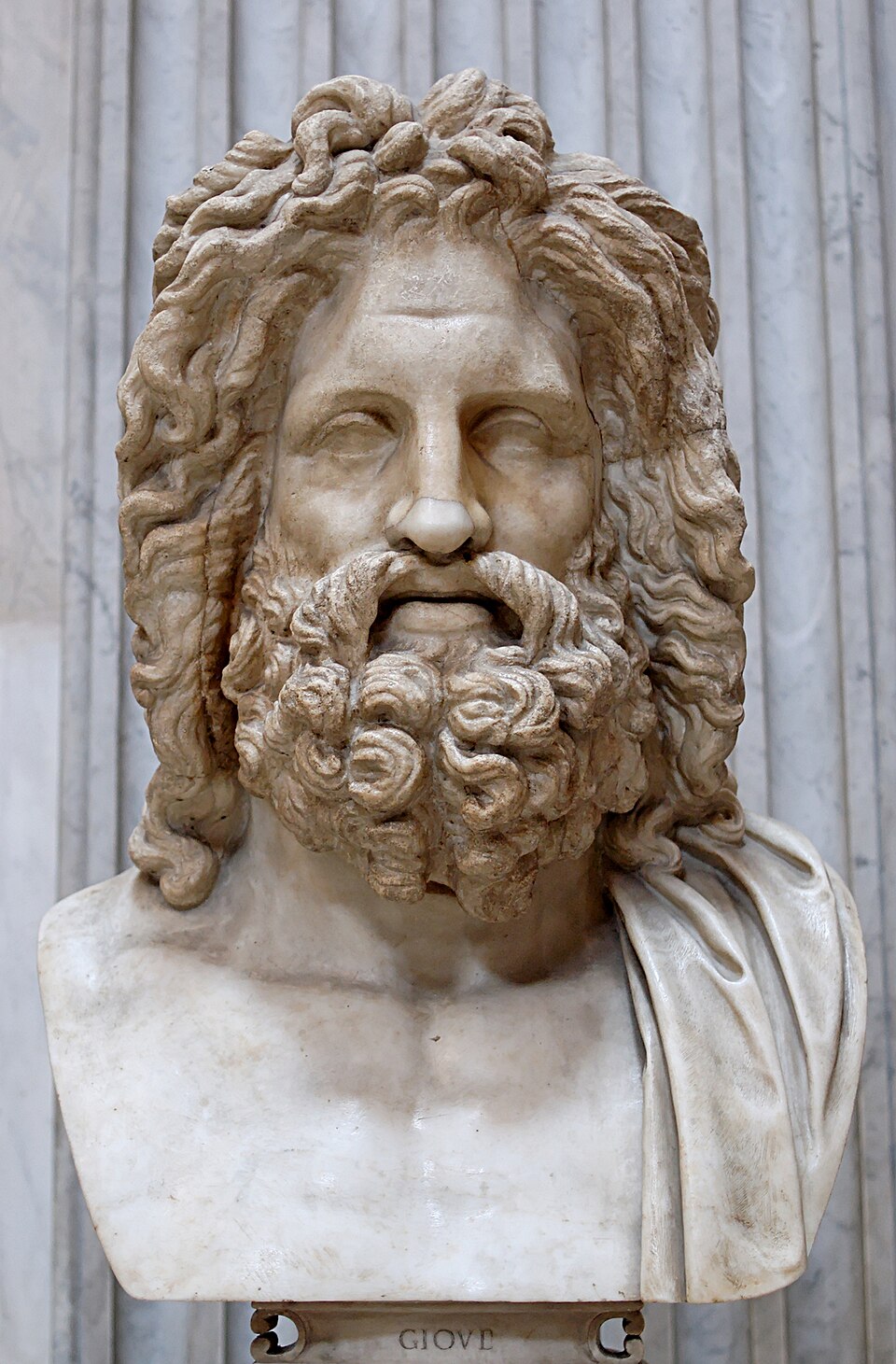
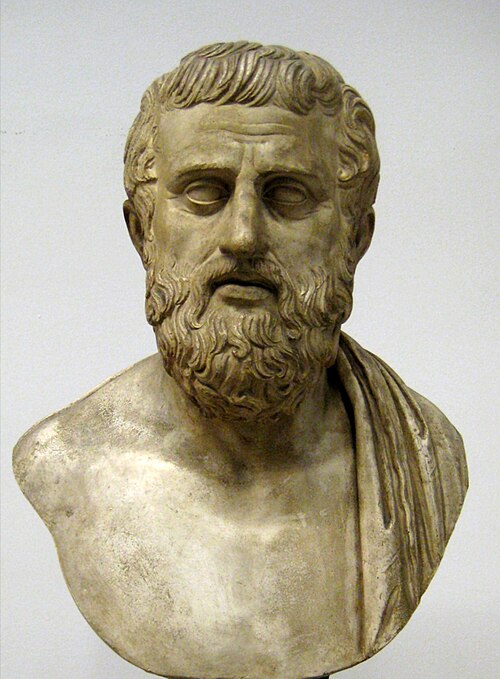
Picture: Cast of a bust representing Sophocles, photographed by Shakko in 2008.
Shakko; CC BY-SA 3.0; Wikimedia Commons. Image record, CC BY-SA 3.0.

The round picture in the lists of the personalities is cropped from it.