





9 min read
Father of Surgery
Sushruta
author: High Priest Zevios Metathronos
The Trained Hand and the Sacred Task of Healing
Dates: Personal dates uncertain
Period: Roman period in this collection, assigned to the compendium’s development across the late centuries BCE and early centuries CE
Sushruta is the teacher whose name heads the Suśrutasaṃhitā, the great Sanskrit compendium of surgery and medicine. The book grew in layers. Its composition may have begun in the last centuries BCE, later editors finished it, and Chinese Buddhist translators were already drawing on 1 of its chapters in the mid- to late 2nd century CE.1
Its greatest attainment is the surgeon it sets out to train. Pupils cut gourds, stitched cloth and bandaged a full-sized doll before they touched a patient. The text describes 101 blunt appliances and 20 sharp instruments, and it rebuilds a severed nose with a flap of living flesh cut from the cheek.2
The compendium traces its art to Dhanvantari, the healing God. Zevism reads its surgeons as a link in the chain of all spirituality, serving under their own Gods' names the same order of healing that Asclepius and Apollo keep among the Greeks.3
LIFE AND CONTEXT
No record of Sushruta's life survives outside the tradition that carries his name, and the popular date of 600 BCE doesn't hold. Dominik Wujastyk puts it plainly: “The date of the Suśrutasaṃhitā is not 600 BCE.” The figure is still repeated, he adds, “very often, even today, by scholars who are not familiar with the progress of scholarship.”4
The evidence he reports points to a work begun in the last centuries BCE and completed by another author “who redacted its first five chapters,” and perhaps by another again who added the Uttaratantra, the “Later Treatise,” which is “more than a third of the work.”4
Outside witnesses fix the range. Material from Sūtrasthāna 29 turns up in the Chinese translations of Saṅgharakṣa's Yogācārabhūmi made by An Shigao (ca. 148–180 CE) and Dharmarakṣa (fl. 284). The earliest sure mention of the name comes in the Bower Manuscript of the 6th century CE, where Suśruta is listed among 10 sages living in the Himalayas.4
The book sets its teaching at Kashi, modern Varanasi. Early Buddhist Jatakas, Wujastyk notes, “mention a Divodāsa as a physician who lived and taught in ancient Kashi.” The compendium's own teacher at Kashi bears the same name.4
The oldest copy is a palm-leaf manuscript from the Kathmandu library of Kesar Shamsher Jang Bahadur Rana, catalogued as KL 699 and “reliably datable to 878 CE.” It's on UNESCO's Memory of the World register, and its study “reveals a much earlier stage of the work's textual development.”5
English readers met the text through Kaviraj Kunja Lal Bhishagratna, whose translation of the Sūtrasthāna appeared in 1907. The Suśruta Project's draft translation follows the older Nepalese version, and it's still being revised.6
ATTAINMENTS
- The compendium made practice on models a condition of practice on people. “A pupil, otherwise well read, but uninitiated into the practice (of medicine or surgery) is not competent to take in hand the medical or Surgical treatment of a disease.”7
- It counted the surgeon's blunt appliances: “Surgical instruments number one hundred and one,” in 6 groups, with mouths shaped to resemble “those of birds and beasts.” Of them all, “the hand is the most important.”8
- It set the sharp instruments at 20, from the Mandalagram and the Karapatram to the Nakhashastram and the Mudrika.9
- It described the rebuilding of a severed nose with a patch of living flesh sliced from the cheek, and 2 small pipes set in the nostrils to keep the breath passing.10
- It repaired torn ear lobes the same way. The operation called Ganda-Karna “consists in slicing off a patch of healthy flesh from one of the regions of the cheeks and in adhering it to one of the severed lobes.”11
- It divided the whole science into 8 branches, with the Salya-Tantram, surgery, named first.3
- In its older Nepalese form it taught diagnosis by looking, by touch and by questioning the patient.12
KEY STORIES
The Sages at the Hermitage of Kashi
The compendium opens with a scene. “Once upon a time, when the holy Dhanvantari, the greatest of the mighty celestials, incarnated in the form of Divodasa, the king of Kasi, was blissfully seated, in his hermitage, surrounded by a concourse of holy Rishis,” several of them addressed him. They're named: “Aupadhenava, Vaitarana, Aurabhra, Paush-kalavata, Karavirya, Gopura-rakshita, Sushruta and others.” They asked the king to teach them the science of healing.13
The chapter then reaches back to creation. The self-begotten Brahma, it says, “strung it together into a hundred thousand couplets (Shlokas), divided into a thousand chapters.” Then it sets out 8 branches, beginning with surgery.3
The manuscripts show how the scene grew. In the oldest Nepalese witnesses Sushruta's teacher is Divodasa, the king. His identification with the God Dhanvantari belongs to the later transmitted framing of the work.14
The Oath Before the Fire
Sūtrasthāna 2 describes how a teacher took a pupil. The young man had to show “a desire to learn, strength, energy of action, contentment, character, self-control, a good retentive memory,” and even “a straight nose, large, honest, intelligent eyes.” On sacred, level ground the teacher built “a square sand cushion or platform, measuring a cubit in length and breadth,” kindled the fire beside his seat and cast clarified butter into it with the Maha Vyahriti mantras. The fire was circled 3 times, and the fire-god, the Brahmanas and the physicians stood witness.15
Then came the charge. “Thou shalt renounce lust, anger, greed, ignorance, vanity, egotistic feelings, envy, harshness, niggardliness, falsehood, idleness.” The new physician would treat Brahmanas, elders, friends, “the indigent, the honest, the anchorites, the helpless” and “give them medicine without charging for it any remuneration whatever.”15
The oath bound the teacher too. If he treated an obedient pupil unjustly, he said, “may I incur equal sin with thee, and may all my knowledge prove futile.” Greek physicians swore by Apollo and Asclepius; these swore before the fire-god, and in Zevist terms both oaths bound skill to the Gods' order.16
Gourds, Water-Bags and a Doll
Sūtrasthāna 9 turns the pupil's hands into a surgeon's. “The art of making specific forms of incision should be taught by making cuts in the body of a Pushpaphala,” a gourd, or a watermelon or cucumber. Excision was practised by “making openings in the body of a full water-bag, or in the bladder of a dead animal.”7
Every skill had its object. The pupil learned scraping on “a piece of skin on which the hair has been allowed to remain,” venesection “on the vein of a dead animal, or with the help of a lotus stem,” and probing on worm-eaten wood or a bamboo reed. He pulled seeds from a Vimbi, Vilva or jack fruit to learn extraction.7
Stitching was learned “on pieces of cloth, skin or hide,” and bandaging on the limbs “of a full-sized doll.” The chapter ties the whole drill to steadiness in real operations, so the hand's first mistakes fell on fruit, leather and cloth.7
A Nose From the Cheek
Sūtrasthāna 16 moves from ears to noses, with an operation for a patient whose nose had been cut off. “First the leaf of a creeper, long and broad enough to fully cover the whole of the severed or clipped off part, should be gathered.” The leaf gave the pattern. Then “a patch of living flesh, equal in dimension to the preceding leaf, should be sliced off (from down upward) from the region of the cheek and, after scarifying it with a knife, swiftly adhered to the severed nose.”17
The surgeon checked the join and inserted “two small pipes into the nostrils to facilitate respiration, and to prevent the adhesioned flesh from hanging down.” He dusted the new tissue with powders of Pattanga, Yashti-madhukam and Rasanjana, wrapped the nose in Karpasa cotton and sprinkled it several times with refined oil. The text says when the work was done: “Adhesion should be deemed complete after the incidental ulcer had been perfectly healed up.”17
THE ZEVIST READING
Zevism holds that spirituality forms 1 chain from its inception to today, and that India's healers stand in it under the names of their own Gods. The compendium calls Dhanvantari “the greatest of the mighty celestials” and gives him the origin of the art. Greek medicine gave the same office to Apollo and Asclepius, whom the Hippocratic physician named first in his oath.18
A severed nose is Izfet written on a face: the body's form broken by violence or disease. Ma'at is “the personification of truth, justice, and the cosmic order,” and Zeus holds it as Sovereign of the Cosmos.19 The flap of cheek flesh, cut to a leaf's pattern and held open by 2 pipes, puts that order back.
The Temple teaches that knowledge evolves in transmission and that the source holds priority. The Suśruta Project's return to a palm leaf copied in 878 is that rule at work. Its scholars recovered a stage of the text older than the printed editions, and that's the stage they translate. Zevism honours the hands that kept the text alive: the redactors, the Nepalese scribes, and the translator who carried it into English.
The Good, in Zevist doctrine, joins Ma'at to Right, a right act done from a right will. The initiation demanded both. Its charge stripped the will of greed and falsehood, and the gourds and water-bags trained the hand. A surgeon formed that way moves toward ὁμοίωσις θεῷ κατὰ τὸ δυνατόν, likeness to the divine as far as possible.20
NOTES
1 Wujastyk, “On the Date of the Suśrutasaṃhitā”.
2 Suśrutasaṃhitā, Sūtrasthāna 7–9 and 16, tr. Bhishagratna.
5 The Suśruta Project, overview.
6 Bhishagratna, The Sushruta Samhita, vol. 1, contents; Wujastyk and others, Draft Translation of the Nepalese Suśrutasaṃhitā.
10 Sūtrasthāna 16.
11 Sūtrasthāna 16.
12 Draft Translation, pp. 14–15, on Sūtrasthāna 10.
13 Sūtrasthāna 1, tr. Bhishagratna.
14 Draft Translation, pp. 13–15.
15 Sūtrasthāna 2.
16 Sūtrasthāna 2; NLM, Hippocratic Oath.
18 Sūtrasthāna 1; NLM, Hippocratic Oath, tr. Michael North.
BIBLIOGRAPHY
Dominik Wujastyk, “On the Date of the Suśrutasaṃhitā”, The Suśruta Project blog, 17 July 2026; chronology, redaction, Uttaratantra, Chinese reception, Bower Manuscript, Divodāsa in the Jatakas.
The Suśruta Project 1.0, overview; manuscript Kathmandu KL 699, dated 878 CE, and its place in the textual history.
Dominik Wujastyk, Jason Birch, Lisa A. Brooks and collaborators, Draft Translation of the Nepalese Suśrutasaṃhitā, draft dated 25 September 2026, introduction pp. 13–15; Divodasa, the later Dhanvantari framing and the diagnostic passage of Sūtrasthāna 10. An evolving research draft.
Kaviraj Kunja Lal Bhishagratna, tr., The Sushruta Samhita, vol. 1, Sutrasthanam, Calcutta, 1907, reproduced by Chest of Books; contents page.
Suśrutasaṃhitā, Sūtrasthāna 1, “The Origin of the Science of Medicine”, tr. Bhishagratna; opening scene, Brahma's couplets and the 8 branches.
Suśrutasaṃhitā, Sūtrasthāna 2, “Rites of Formal Initiation of a Pupil”, tr. Bhishagratna.
Suśrutasaṃhitā, Sūtrasthāna 7, “Surgical Appliances” and Sūtrasthāna 8, “Instruments Used in Connection with a Surgical Operation”, tr. Bhishagratna.
Suśrutasaṃhitā, Sūtrasthāna 9, “Practical Instructions in Surgical Operations”, tr. Bhishagratna.
Suśrutasaṃhitā, Sūtrasthāna 16, “Piercing and Bandaging of the Lobules of Ears”, with part 3, the restoration of the nose, tr. Bhishagratna.
US National Library of Medicine, “Greek Medicine,” including “The Hippocratic Oath”, tr. Michael North, 2002.
Encyclopaedia Britannica, “Maat”.
Plato, Theaetetus 176a–b, Greek text, Perseus Digital Library.
CREDIT
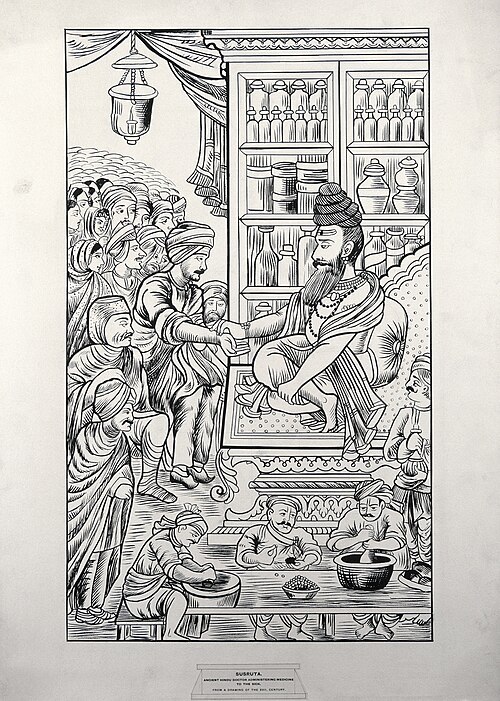
Picture: A later pen drawing imagining Sushruta; an undated representation, not a contemporary likeness.
Wellcome Collection, V0006619, ICV6834; via Wikimedia Commons. Image record, CC BY 4.0.

The round picture in the lists of the personalities is cropped from it.