




3 min read
Prince of the Old Gods
Sviatoslav of Kyiv
author: High Priest Zevios Metathronos
A prince who retained the Gods of his people
Dates: died 972 CE
Period: Darkness (800–1000 CE)
Region: Rusʹ
Tradition: worship of Perun and Volos
Religion or tradition: Pre-Christian religion of Rusʹ; Perun and Volos are named in his treaty oath.
Heresy status: No designation documented.
Sviatoslav, son of Igor and Olga, remained attached to the traditional religion of Rusʹ despite his mother’s conversion to Christianity. The Primary Chronicle connects his refusal of baptism with the loyalty and expectations of his warrior companions.1 More tangible than a reconstructed private theology is the religious language of the peace agreement of 971: its oath invokes Perun and Volos as guarantors.2
KEEPING ANCESTRAL WORSHIP PRESENT IN PUBLIC OBLIGATIONS
Sviatoslav’s retained allegiance gave the Gods of Rusʹ a place in the surviving record of royal diplomacy. The treaty of 971 names Perun and Volos within its oath, making a promise of peace intelligible through the religious language of those undertaking it. This is a documented expression of ancestral worship in a consequential public act.3
His positive significance here concerns the preservation of that religious identity and the principle expressed by the oath. Agreements intended to end hostilities require obligations that the participants take seriously. For a Zevist reader, the text offers a valuable example of invoking the Gods in connection with pledged conduct. The constructive significance lies in the obligation attached to the pledged word and the continued public acknowledgement of the Gods.
DIVINE OBLIGATION IN PUBLIC LIFE
An oath places conduct under a religious obligation. In this case, the Gods appear within the language of diplomacy, linking a ruler’s promise to consequences beyond immediate political convenience. Sviatoslav’s religious affiliation therefore has documentary expression within the transmitted treaty tradition; it need not be inferred solely from a later image of him as a warrior.
His campaigns extended through the Khazar and Danubian regions. Conflict with Byzantium ended in the settlement of 971, and he was killed by Pechenegs on his return towards Kyiv in 972. The history includes defeat as well as conquest. Imperial ambition, strategy and control of territory shaped these campaigns alongside the religious differences between the opposing courts.4
A REPUTATION SHAPED BY COMPETING NARRATORS
The Christian chronicle and Byzantine accounts judge Sviatoslav from different political and religious positions. Their disagreements require attention, especially in the chronology and presentation of his Balkan wars. A scholarly reassessment by Walter K. Hanak examines how the image of an unreliable or reckless enemy emerged from these sources.5
THE ZEVIST SIGNIFICANCE OF AN OATH
The most useful religious lesson in this profile is the seriousness of a pledged word. Sviatoslav’s place in the collection rests on documented adherence to the old Gods and the public expression of that allegiance.
For a Zevist reader, the treaty provides a precise point of reflection: religious commitment should govern decisions when honouring an obligation becomes difficult. An oath is meaningful when it binds the powerful as well as the weak. That principle can be studied here without inventing a lost initiatory teaching or attributing modern doctrines to a tenth-century prince.
NOTES
1 Primary Chronicle, account of Olga’s conversion.
BIBLIOGRAPHY
Russian Primary Chronicle, account of Olga’s conversion and Sviatoslav’s response, University of North Carolina at Greensboro teaching excerpts. This is a later Christian narrative of tenth-century events.
Mikhail Raev, “The Russian-Byzantine Treaty of 971: Texts and Contexts,” Yearbook of Sofia University, Centre for Slavo-Byzantine Studies 99 (18), 2017, pp. 113–128, author’s research record.
Mykhailo Zhdan and Arkadii Zhukovsky, “Sviatoslav I Ihorovych,” Encyclopedia of Ukraine, vol. 5 (1993), online entry.
Walter K. Hanak, “The Infamous Svjatoslav: Master of Duplicity in War and Peace?”, scholarly article reproduced by De Re Militari.
CREDIT
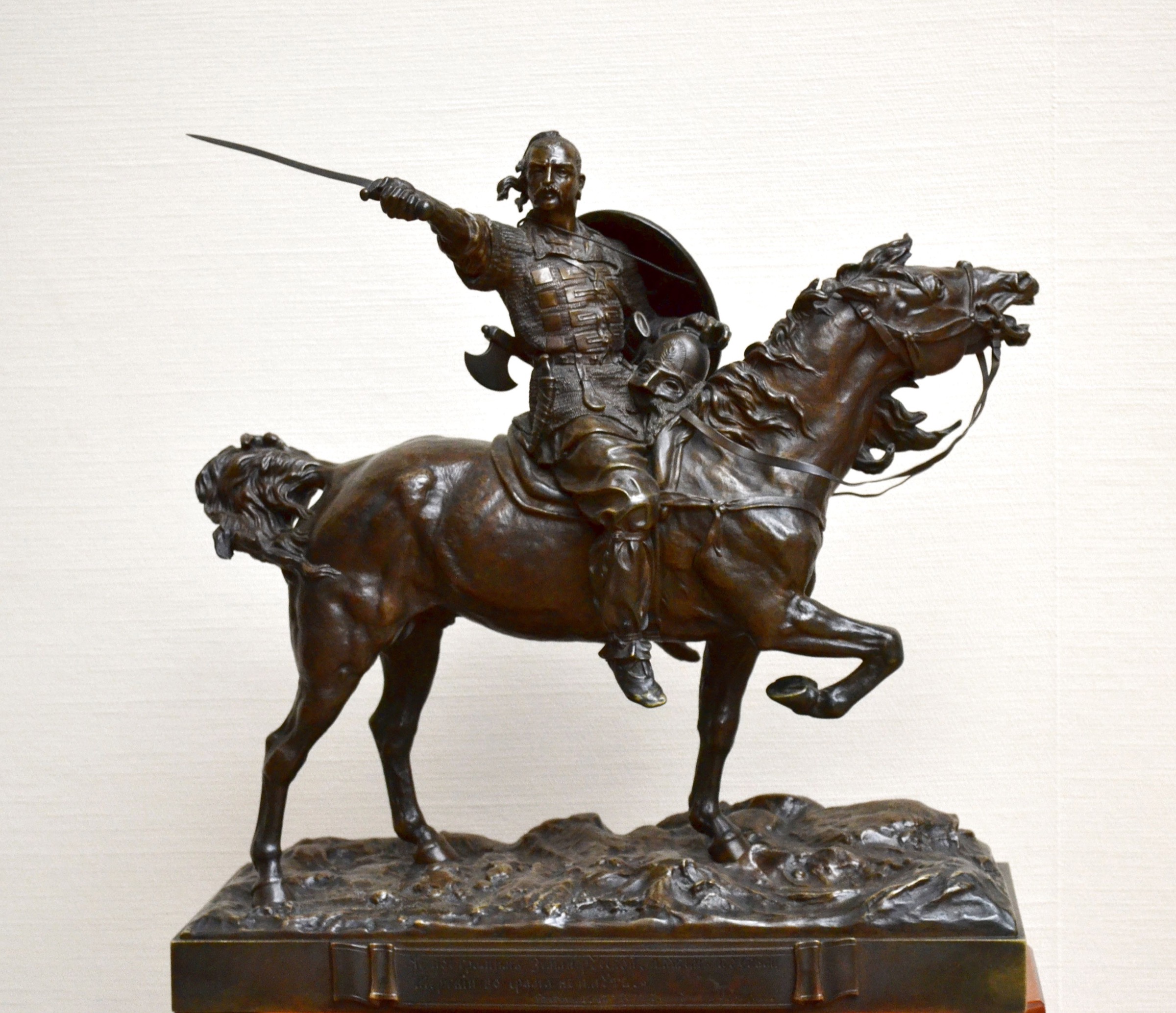
Picture: Later commemorative sculpture. Sviatoslav by Yevgeny Lanceray, 1886; photograph by Dmitry Ivanov. The sculpture is a later artistic representation of the prince.
Credit: Yevgeny Lanceray (sculpture); Dmitry Ivanov (photograph). Source record, Public domain.

The round picture in the lists of the personalities is cropped from it.