




9 min read
Sage of Harran
Thabit ibn Qurra
author: High Priest Zevios Metathronos
Dates: 9th century–901 CE
Period: Darkness (800–1000 CE)
Thabit ibn Qurra was a mathematician, astronomer and translator from Harran who worked in Baghdad in the 9th century. He carried Greek mathematics into Arabic, including 3 books of Apollonius's Conics that no longer survive in Greek, and he proved new results of his own, among them a rule that generates amicable numbers.1
He belonged to the Sabians of Harran, whom Britannica describes as “a Hellenized Semitic astronomical cult.”2 Zevism reads his work under Thoth, the God of number, geometry and astronomy, and counts him among the keepers of the source: a transmitter who saved Greek texts and then built on them.
LIFE AND CONTEXT
Thabit was born near Harran in upper Mesopotamia. The year is disputed: JoAnn Palmeri gives about 830, while MacTutor and Britannica give 836. He died in Baghdad on 18 February 901.3
Harran kept its old religion under Muslim rule. The Sabians of Harran worshipped the stars, and by calling themselves Sabians, after a group named in the Qur'an, they won standing as a “People of the Book.”2 MacTutor notes that “being worshipers of the stars meant that there was strong motivation for the study of astronomy.”4
He grew up with 3 languages. Syriac was his native tongue, and he also knew Greek and Arabic; some of his works he wrote in Syriac, though most are in Arabic. That combination made him useful to the translation circle of the Banu Musa in Baghdad. MacTutor adds that he wrote on the grammar of the Syriac language.5
Britannica describes the patrons as “three wealthy brothers, known as the Banū Mūsā,” who employed him in “translating Greek mathematical texts.” In Baghdad he worked on Euclid, Archimedes, Apollonius and Ptolemy, and he wrote original works “on geometry, statics, magic squares, the theory of numbers, music, astronomy, medicine, and philosophy.” Late in life he became court astronomer to the caliph al-Mu'tadid.6
Learning stayed in the family. His son Sinan ibn Thabit and his grandson Ibrahim ibn Sinan both worked in medicine and the exact sciences.7
ATTAINMENTS
- He translated Books 5 to 7 of Apollonius's Conics. Only Books 1 to 4 survive in Greek, so these 3 books are known through the Arabic tradition.8
- He revised Ishaq ibn Hunayn's Arabic translation of Euclid's Elements; his redaction “is extant in at least 19 manuscripts,” and Gerard of Cremona's Latin version “basically follows the Ishaq-Thabit version.”9
- He revised Hunayn ibn Ishaq's translation of Ptolemy's Almagest and translated Archimedes' Lemmata and On Triangles.10
- He proved a rule for constructing amicable numbers in a treatise of 10 propositions, preserved in manuscripts at Istanbul and Paris.11
- He gave proofs of the Pythagorean theorem and of Menelaus's theorem and wrote treatises that set out to prove Euclid's 5th postulate; he also extended Pythagoras's theorem to any triangle.12
- Fewer than 12 of his astronomical treatises survive, “about a fourth of the number he is credited with composing,” on the uneven motion of the Sun, the Moon, crescent visibility and sundials.7
- His works were translated into Latin and Hebrew and, in Britannica's words, “proved to be influential in the Latin West.”6
- His Kitab fi'l-qarastun, on the beam balance, was translated into Latin by Gerard of Cremona and “became a popular work on mechanics.”4
KEY STORIES
From Harran to Baghdad and Back
Muhammad ibn Musa ibn Shakir, one of the Banu Musa brothers, came to Harran and met the young Thabit. MacTutor reports that he “was impressed at Thabit's knowledge of languages” and “persuaded him to go to Baghdad and take lessons in mathematics from him and his brothers.” Some accounts make Thabit a money changer at the time. Palmeri puts it more cautiously: Thabit “seems to have been asked to join this circle” by Muhammad ibn Musa. Either way, Thabit went to Baghdad and joined the brothers' work.13
He learned mathematics in Baghdad and then went home. MacTutor tells what followed: “He returned to Harran but his liberal philosophies led to a religious court appearance when he had to recant his ‘heresies’.”4
Thabit didn't stay to be tried again. “To escape further persecution he left Harran and was appointed court astronomer in Baghdad,” where his patron was the caliph al-Mu'tadid.4 Al-Mu'tadid reigned from 892 to 902, so the post came late in Thabit's life.6 His name kept both his city and his faith: al-Harrani al-Sabi', the Harranian, the Sabian. It's under that name that the manuscript catalogues still list him.14
The Lost Books of the Conics
Apollonius of Perga, “The Great Geometer,” worked in the 3rd and early 2nd centuries BCE and died at Alexandria. His Conics, the work that “introduced the terms parabola, ellipse and hyperbola,” ran to 8 books. Only the first 4 survived in Greek. In Arabic, “the first seven of the eight books of Conics survive.” The 8th is lost in both languages.15
The Arabic Books 5, 6 and 7 are Thabit's work: Palmeri lists among his translations “Books V–VII of Apollonius's On Conics.”10 Whoever reads those books today, in any language, reads them through the Arabic tradition in which his translation stands.
Euclid's Elements also reached later readers through him. According to the Fihrist of Ibn al-Nadim, al-Hajjaj had already translated the Elements twice. Another version was ascribed to Ishaq ibn Hunayn. No manuscript of Ishaq's version is known, “but Thabit's redaction of this text is extant in at least 19 manuscripts.” The oldest, Tehran, Malik 3586, was copied in A.H. 343, that is 954 or 955 CE. Later, Gerard of Cremona put the Elements into Latin, and Menso Folkerts found that he “basically follows the Ishaq-Thabit version.”9
The Rule for Amicable Numbers
A pair of numbers is amicable when each equals the sum of the other's proper divisors. The divisors of 220 below itself are 1, 2, 4, 5, 10, 11, 20, 22, 44, 55 and 110, which add to 284. Those of 284 are 1, 2, 4, 71 and 142, which add to 220. Thabit wrote that Pythagoras had begun the study of such numbers, a claim MacTutor calls “almost certainly false.”4
Euclid and Nicomachus had worked on perfect numbers, and Thabit went further. In a treatise of 10 propositions, catalogued as Thābit ibn Qurrah fī al-aʿdād al-mutaḥābbah, he proved a rule. Its 2 known copies are in the Süleymaniye Library at Istanbul and the Bibliothèque nationale in Paris. Take a number n. If 3·2ⁿ⁻¹ − 1, 3·2ⁿ − 1 and 9·2²ⁿ⁻¹ − 1 are all prime, then 2ⁿ times the product of the first 2, and 2ⁿ times the third, form an amicable pair.16
With n = 2 the rule gives the primes 5, 11 and 71, and the pair 220 and 284. With n = 4 the same rule yields 23, 47 and 1,151, and the pair 17,296 and 18,416. It doesn't work for every n: with n = 3 the 3rd number is 287, which isn't prime, since it's 7 × 41. A check of the divisor sums confirms both pairs.
The Beam Balance
Palmeri notes that Thabit “wrote important treatises related to Archimedean problems in statics and mechanics.” The best known is the Kitab fi'l-qarastun, the book on the beam balance. He proved the principle of equilibrium of levers and showed “that two equal loads, balancing a third, can be replaced by their sum placed at a point halfway between the two without destroying the equilibrium.”13
Then he went from separate weights to a load spread evenly along a heavy beam, and found the conditions under which such a beam stays in equilibrium. Gerard of Cremona translated the book into Latin, and it “became a popular work on mechanics.”4 Egypt pictured Ma'at herself as the counterweight in a scale, and Thabit proved how a scale holds true.17
THE ZEVIST READING
Plato tells how Theuth, the Egyptian God Thoth, invented number and calculation, geometry and astronomy, and letters.18 Thabit's work covered that list almost item for item: numbers in the amicable pairs, geometry in Euclid and Apollonius, astronomy in his treatises on the Sun and Moon, and letters in 3 languages. Zevism places him under Thoth. It holds that Egypt kept early forms of the Logos in the powers of Thoth, and that Zevism is the Logos restored; a mathematician who proves what he claims serves that Logos directly.
Zevism holds that one must return to the source, and it honours those who keep the source alive. Thabit's hands passed on Euclid's Elements in a text extant in at least 19 manuscripts, and Books 5 to 7 of the Conics, which survive only in Arabic. Knowledge evolves in transmission, and he didn't stop at transmitting: he added the amicable rule and the heavy beam.
The balance carries the doctrine of Ma'at. The judgement of the dead, as Britannica describes it, turned on “the weighing of the heart of the deceased in a scale balanced by Maat (or her hieroglyph, the ostrich feather).”17 A proof about equilibrium is Ma'at in its mathematical form: it states exactly when things hold in right order. The heavy beam of the qarastun comes to rest only when its loads and distances answer each other, and Thabit wrote down the conditions.
Harran itself is a link in the chain. MacTutor observes that the Sabian sect “produced many quality astronomers and mathematicians.”4 Zevism is the chain of all spirituality from its inception, and it reads the star worshippers of Harran, Hellenized and still holding their rites under Islam, as one of its late links. Thabit answered to a religious court at home and kept his Sabian name at the caliph's court. The Temple counts that fidelity, and the work built on it, as service to the divine order.
NOTES
1 Palmeri, “Thabit ibn Qurra,” pp. 1129–1130; MacTutor, “Apollonius”.
2 Britannica, “Thabit ibn Qurrah”.
3 Palmeri, p. 1129; MacTutor, “Thabit ibn Qurra”.
4 MacTutor.
6 Britannica.
8 Palmeri; MacTutor, “Apollonius”.
9 Folkerts, “Euclid in Medieval Europe”.
10 Palmeri, p. 1129.
11 ISMI, Fi al-aʿdad al-mutahabba; MacTutor.
14 ISMI.
BIBLIOGRAPHY
JoAnn Palmeri, “Thabit ibn Qurra”, in Thomas Hockey et al. (eds.), The Biographical Encyclopedia of Astronomers, Springer, 2007, pp. 1129–1130.
J. J. O'Connor and E. F. Robertson, “Thabit ibn Qurra”, MacTutor History of Mathematics, University of St Andrews.
J. J. O'Connor and E. F. Robertson, “Apollonius of Perga”, MacTutor History of Mathematics, University of St Andrews.
Menso Folkerts, “Euclid in Medieval Europe”, University of British Columbia hosted text; Arabic versions and Gerard of Cremona.
Islamic Scientific Manuscripts Initiative, Fi al-aʿdad al-mutahabba, Max Planck Institute for the History of Science; 10 propositions, manuscripts Istanbul, Ayasofya 4830, and Paris, BnF Arabe 2457.
Encyclopaedia Britannica, “Thabit ibn Qurrah”.
Plato, Phaedrus 274c–275b, English translation, Perseus Digital Library.
Encyclopaedia Britannica, “Maat”.
CREDIT
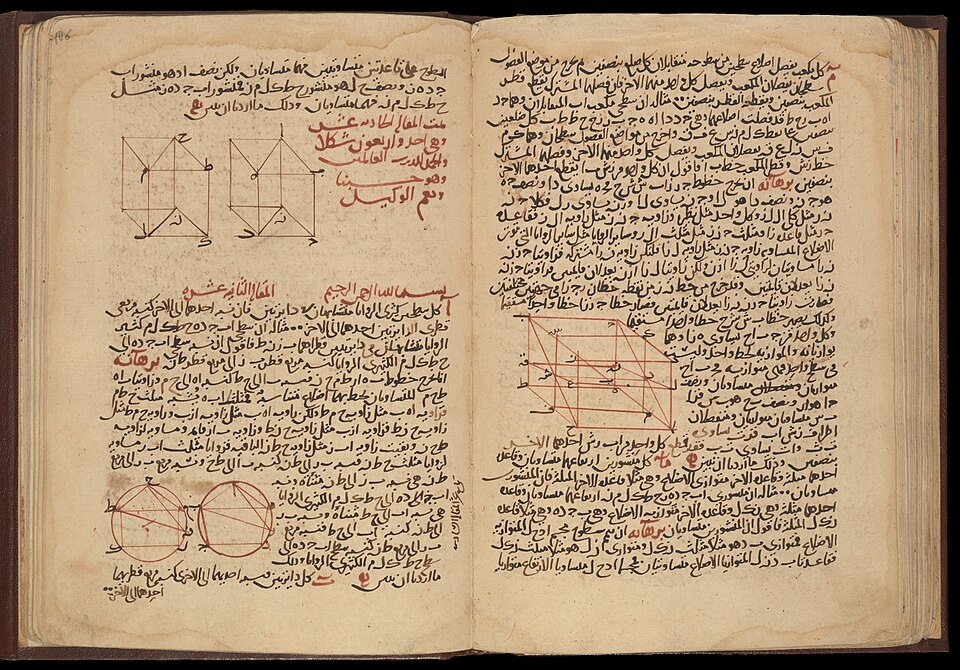
Picture: Opening from a medieval Arabic manuscript of Euclid’s Elements, Chester Beatty Library Ar 3035, fols. 105b–106a. Illustration of the Arabic Euclidean tradition, not Thabit’s autograph or portrait.
Unknown manuscript artist/scribe; Chester Beatty Library reproduction; Wikimedia Commons; Public domain; faithful reproduction of a public-domain artwork. Image record, Public domain; faithful reproduction of a public-domain artwork.
.jpg)
The round picture in the lists of the personalities is cropped from it.