




10 min read
Skald of Hvinir
Þjóðólfr of Hvinir
author: High Priest Zevios Metathronos
Giving the Sacred Image a Voice
Dates: Flourished around 900 CE; details of his life remain uncertain.
Period: Darkness (800–1000 CE).
Þjóðólfr of Hvinir was a Norwegian court poet of the years around 900, named in Skáldatal, the medieval list of skalds, as a poet of King Harald Fairhair. His name is attached to 2 long poems. Haustlǫng describes the pictures painted on a shield and retells 2 myths of the Gods. Ynglingatal follows a Norwegian king's ancestors back through 27 generations and tells how each of them died.1
His greatest attainment can be measured in a later book. Snorri Sturluson built the opening saga of his Heimskringla on the stanzas of Ynglingatal, quoting them king after king, and he kept Haustlǫng alive by quoting it in his handbook for poets. The abduction of Iðunn and Thor's duel with the stone giant Hrungnir came down to Snorri in Þjóðólfr's words.2
Zevism reads his work under Odin, who won the mead of poetry and gave it “to the Æsir and to those men who possess the ability to compose.”3 Þjóðólfr took a painted shield and a royal family tree and made both into memory that could be recited. That's the task Zevism assigns to the keepers of the source.
LIFE AND CONTEXT
Hvinir is the old name of Fedafjorden in Agder, where the river Kvina runs out through Kvinesdal, and the byname says the poet came from there. Nearly everything else known about his life comes from Snorri's Heimskringla.4
Snorri states the essentials in his preface: “Thjodolf of Hvin was the skald of Harald Harfager, and he composed a poem for King Rognvald the Mountain-high, which is called 'Ynglingatal.'” Rognvald was a son of Olaf Geirstadalf, “the brother of King Halfdan the Black,” and Harald had succeeded that same Halfdan as a boy of 10. The poem's patron was the king's first cousin.5
The sagas also give the poet a place in the royal household. He brought up Gudrod Ljome, one of Harald's sons by Snaefrid, daughter of Svase, and he was “a great friend of the king.” One winter Gudrod stayed with him at Hvin and wanted to sail north to Rogaland in a heavy storm. Þjóðólfr warned him in verse, “Wait, Gudrod, till the storm is past,” and “Deep runs the sea off the Jadar's shore.” Gudrod sailed anyway, and off Jadar the vessel sank with them.6
Richard North dates Haustlǫng to around 900. Ynglingatal is harder to place: the historian Claus Krag, among others, has questioned the poem's age and with it the attribution to Þjóðólfr. In Finnur Jónsson's edition 37 or 38 stanzas survive, covering 27 generations, while Snorri counted 30 forefathers, so some scholars think the poem is incomplete.7
Haustlǫng is a shield poem. It describes images painted on a shield that Þorleifr the Wise, son of Hǫrða-Kári, had given the poet, and it's dedicated to him. It's composed in dróttkvætt, and Jørgensen calls it full of lively kennings. It survives only because Snorri quoted it in his Edda.8
ATTAINMENTS
- He composed Haustlǫng, a shield poem in dróttkvætt that survives in 20 stanzas in Richard North's edition. Stanzas 1–13 frame the gift and tell the abduction and recovery of Iðunn; stanzas 14–20 tell Thor's duel with Hrungnir and return to the giver.9
- By the tradition Snorri followed, he composed Ynglingatal for King Rognvald, a poem in which “thirty of his forefathers are reckoned up, and the death and burial-place of each are given.”10
- The surviving Ynglingatal runs to 37 or 38 stanzas and follows the Yngling kings through 27 generations, from Fjölnir, who drowned in a vat of mead, to Rognvald Heidumhære.11
- He gave Snorri the frame of the Ynglinga Saga. Snorri quotes him for the deaths of the kings from Fjölnir in chapter 14 to Rognvald in chapter 55, where he writes that “Thjodolf of Hvina composed for him the 'Ynglinga-tal.'”12
- His diction entered the poets' textbook. In Skáldskaparmál Snorri quotes his lines as models for the names of heaven and earth, among them the sky as “the Moon-Way” quivering under the driving God.3
- He served Harald Fairhair as a skald, raised the king's son Gudrod Ljome, and with a single verse won back the king's favour for the exiled sons of Snaefrid.13
KEY STORIES
The Skald at the King's Door
When Snaefrid died, her body “never changed, but was as fresh and red as when she lived,” and Harald mourned over it for 3 years. Once he learned what the saga calls “the cunning of the Fin woman,” he was so angry that he drove away the 4 sons she'd borne him. Gudrod Ljome went “to his foster-father Thjodolf of Hvin” and asked him to go to the king, who was then in the Uplands.14
They reached the king's house late in the evening and sat down unnoticed near the door. The mead had just been mixed. Harald walked up and down the floor “casting his eye along the benches” and spoke a verse to the “aged gray-haired heroes,” asking why he had to feed so many men who loved to steep their souls in the mead-bowl.13
Þjóðólfr answered from the door: “A certain wealthy chief, I think, / Would gladly have had more to drink / With him, upon one bloody day, / When crowns were cracked in our sword-play.” Then he took off his hat, and the king knew him and welcomed him. The skald begged Harald not to cast off his sons, “for they would with great pleasure have taken a better family descent.” The king agreed, told him to take Gudrod home as before, and sent Halfdan and Sigurd to Ringerike.13
The Giant Eagle and the Apples of Iðunn
Haustlǫng opens with a debt of honour: “How shall I make voice-payment / Meetly for the shield-bridge,” the poet asks, for the “war-wall Thórleifr gave me?” The first picture on the shield told a story that Snorri later wrote out in prose.15
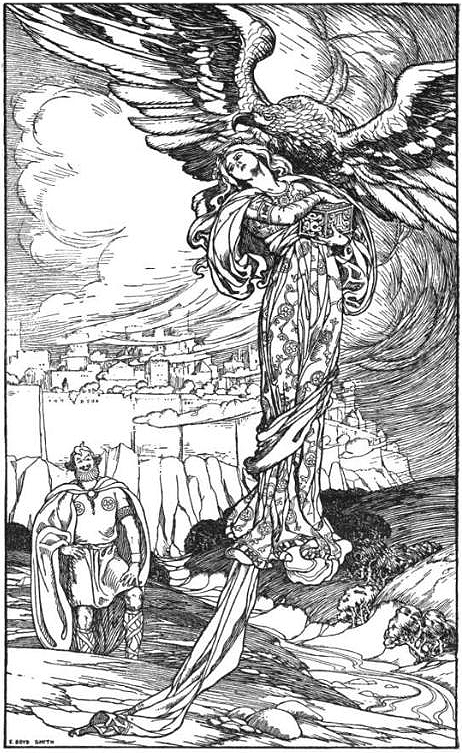
Odin, Loki and Hœnir were travelling, and their ox wouldn't cook. An eagle said, “If ye are willing to give me my fill of the ox, then it will cook in the fire.” The eagle was the giant Þjazi. Loki, angered, drove a great pole at him; “the pole was fast to the eagle's back, and Loki's hands to the other end of the pole.” The eagle flew off with him and let him go only on an oath “to induce Idunn to come out of Ásgard with her apples.”3
Iðunn vanished, and the Gods paid for it: “speedily they became hoary and old.” They forced Loki to put things right. He borrowed Freyja's hawk plumage, flew to Þjazi's home, “turned her into the shape of a nut and grasped her in his claws and flew his utmost.” Þjazi followed in eagle shape. As he came on, the Æsir “struck fire to the plane-shavings”; the eagle “could not stop himself,” his feathers caught fire, and “the Æsir slew Thjazi the giant within the Gate of the Æsir.” Snorri adds that Þjóðólfr of Hvin “composed verses after that tale in the Haustlöng.”3
Thor Drives to Hrungnir
The shield's 2nd picture showed a duel. Snorri describes the giant: Hrungnir had a heart “of hard stone and spiked with three corners,” his head was of stone, and “his shield too was stone, wide and thick.” For a weapon he carried a whetstone.3
Þjóðólfr's lines put Thor on the road: “Jörd's Son drove to the steel-play / (High swelled the godlike anger / In the mind of Meili's Brother), / And the Moon-Way 'neath him quivered.” Hrungnir threw the whetstone with both hands. It met the hammer in flight and burst apart, and a piece of it “burst on Thor's head, so that he fell forward to the earth.” The hammer flew on: “Mjöllnir struck Hrungnir in the middle of the head, and smashed his skull.”3
The giant fell across the God with his foot over Thor's neck. Thjálfi couldn't move it. Then “Magni came up, son of Thor and Járnsaxa: he was then three nights old.” Afterwards the wise woman Gróa “sang her spells over Thor until the hone was loosened.” Snorri closes with his source: “Thjódólfr of Hvin has made a song after this tale in the Haustlöng.”3
The King in the Mead Vat
Ynglingatal begins with a strange death. Fjölnir, “Yngve Frey's son,” ruled the Swedes at Uppsala and went to a feast with King Frode in Sealand. Frode's house held “a great vessel many ells high,” full of mead “which was excessively strong,” with a loft above it. In the night Fjölnir went out to the gallery, very sleepy; “his foot slipping, he fell into the vessel of mead and was drowned.”16
Þjóðólfr's stanza, as Laing renders it, ends: “In Frode's mansion drowned was he, / Drowned in a waveless, windless sea.” Later in the line, the saga says, famine struck the Swedes under King Dómaldi. “The first autumn they sacrificed oxen, but the succeeding season was not improved thereby.” In the 3rd autumn the chiefs met at Uppsala and decided the scarcity was the king's doing, so they “resolved to offer him for good seasons.” The poem records it: “But Domald dies by bloody arms, / Raised not by foes in war's alarms.”17
THE ZEVIST READING
In Snorri's telling, poetry came down from the Gods: Odin carried the mead to the Æsir and to the men who can compose, and a poem may be called “Kvasir's Blood or Dwarves' Drink.”3 Zevism reads the skald's art under Odin. It holds that spirituality forms a single chain from its inception to today, and that the Gods of the North served the divine order under their own names. Þjóðólfr's stanzas are an early link in that chain, older than any manuscript that carries them.
The 2 myths on the shield describe the same danger from 2 sides. Without Iðunn the Gods grew “hoary and old”; with the stone giant loose, the world's defender lay pinned under a dead weight. Egyptian religion named Ma'at “the personification of truth, justice, and the cosmic order” and set her against isfet.18 Age without renewal and brute stone without mind are forms of Izfet. The Gods win back Iðunn by cunning and break the giant with the thunderer's hammer, and in Zevist terms both victories restore the order that Zeus holds as sovereign of the cosmos.
Ynglingatal serves Ma'at in a plainer way. It records how each king died and where he lay, including deaths that did the royal line no credit. Snorri trusted such poems because no skald would recite to a chief “a false and imaginary, not a true account of his deeds; because that would be mockery, not praise.”10 A true record of the dead is one of the works by which Ma'at is kept.
Zevism holds that the source has priority and honours those who carry it forward. The shield Þorleifr gave is long gone. Þjóðólfr turned the pictures into verse, Snorri copied the verse into his book, and the Gods on the shield outlived the wood and paint they were first given.
NOTES
1 Jon Gunnar Jørgensen, “Tjodolv fra Kvine,” Store norske leksikon.
2 Snorri, Heimskringla, preface; Snorri, Skáldskaparmál, Brodeur tr..
5 Heimskringla, preface and Harald Harfager's Saga 1.
6 Snorri, Harald Harfager's Saga 25–26, 37, Laing tr..
7 North, Haustlǫng, introduction; Jørgensen, “Ynglingatal”.
8 Jørgensen, “Haustlong”; North, introduction.
9 North, Haustlǫng, introduction and text.
12 Snorri, Ynglinga Saga 14, 18, 55, Laing tr..
14 Harald Harfager's Saga 25–26.
15 Skáldskaparmál, Brodeur tr..
16 Ynglinga Saga 14.
BIBLIOGRAPHY
Jon Gunnar Jørgensen, University of Oslo, “Tjodolv fra Kvine,” Store norske leksikon, updated 6 June 2026; “Bakgrunn,” “Ynglingatal” and “Haustlong.”
Richard North, edition and translation of Haustlǫng, introduction and stanzas 1–20; World-Tree Project record, identifying the source anthology edited by Richard North, Joe Allard and Patricia Gillies (2010).
Snorri Sturluson, Heimskringla, preface and Harald Harfager's Saga 1, English translation, Project Gutenberg eBook 598.
Snorri Sturluson, The Ynglinga Saga, in Heimskringla, translated by Samuel Laing, Internet Sacred Text Archive; chapters 12, 14, 18 and 55.
Snorri Sturluson, Harald Harfager's Saga, in Heimskringla, translated by Samuel Laing, Internet Sacred Text Archive; chapters 25, 26 and 37.
Snorri Sturluson, Skáldskaparmál, in The Prose Edda, translated by Arthur Gilchrist Brodeur, American-Scandinavian Foundation, 1916; Internet Sacred Text Archive; the mead of poetry, Þjazi and Iðunn, Thor and Hrungnir, and the Haustlǫng stanzas quoted there.
Encyclopaedia Britannica, “Maat”.
CREDIT
Picture: Þjazi carrying away Iðunn: Elmer Boyd Smith’s 1902 illustration of a narrative treated in Haustlǫng. A later illustration, not a portrait of the poet or a reconstruction of his shield.
Elmer Boyd Smith; Public domain in the United States (1902 publication); Wikimedia Commons. Image record, Public domain in the United States (1902 publication).

The round picture in the lists of the personalities is cropped from it.