




9 min read
The Platonist
Thomas Taylor
author: High Priest Zevios Metathronos
Giving Ancient Theology an English Voice
Dates: 1758–1835 CE
Period: Imperial Era, 1804–1900
Principal editions discussed: 1816 and 1821
Thomas Taylor was a London bank clerk who learned his Greek through Greek philosophy and spent the rest of his life carrying the Platonic tradition into English. His Plato of 1804 gave English readers 55 dialogues and 12 epistles in 5 quarto volumes, and his Aristotle followed in 9 more. The Princeton edition of his selected writings calls this “the first full translation into English of Plato and Aristotle.”1
Plotinus, Proclus, Iamblichus, Porphyry, Pausanias and the Orphic Hymns came out under his name as well. He never hid what he believed. Britannica judges that he “was as militant in his pagan Platonism as was Gemistus Plethon.”2
Zevism counts Taylor among the keepers of the source. He saw the theology he translated as a single line running from Orpheus through Pythagoras to Plato, and he gave his life to moving that line into a new language. That's the office of Hermes, the interpreter and messenger.
LIFE AND CONTEXT
Taylor was born in London on 15 May 1758, the son of Joseph Taylor, a staymaker of Round Court, St Martin's-le-Grand. Signs of consumption sent the boy to Staffordshire. He came back in his 9th year and entered St Paul's School in April 1767.3
A copy of Ward's Young Mathematician's Guide turned him to mathematics, and a passage in Sir Kenelm Digby sent him to Aristotle. At 15 he was put to work under an uncle at the Sheerness Dockyard. He got out of it by becoming the pupil of Mr Worthington, the dissenting minister of Salters' Hall. He liked to say that he'd “learned Greek rather through the Greek philosophy than the Greek philosophy through Greek.”3
The early years of his marriage were poor ones, spent at a school desk and then a bank counter. After about 6 years at Lubbock's Bank, George Cumberland and other friends made it possible for him to leave, and their influence later made him assistant secretary of the Society of Arts.3
Patrons paid for the printing. William Meredith “enabled him to print his translations of the Hymns of Orpheus, the Commentaries of Proclus on Euclid, and the Fable of Cupid and Psyche,” and Thomas Love Peacock stated that the Aristotle came out at the expense of the Duke of Norfolk.3 Taylor dedicated his Proclus of 1816 to Meredith, who “has patronized the philosophy of Plato and Aristotle, and its English promulgator.”4
The large books came out in a steady run: Pausanias in 1794, Plato in 1804, Aristotle by 1812, Proclus on the Theology of Plato in 1816, Proclus on the Timaeus in 2 quarto volumes in 1820 and Iamblichus in 1821. The Plato, the Proclus and the Iamblichus were all printed for the translator himself.5
The critics weren't kind. Isaac Disraeli sneered in Curiosities of Literature that “a modern Plato has arisen in Mr. Thomas Taylor, who consonant to the Platonic Philosophy, religiously professes polytheism!”3 Across the Atlantic, Emerson judged him “a better feeder to a poet, than any man between Milton and Wordsworth.”6
Taylor died at his house in Walworth on 1 November 1835. He was buried in Walworth churchyard, “but no stone marks the spot.”3
ATTAINMENTS
- In 1804 he published The Works of Plato, 55 dialogues and 12 epistles in 5 quarto volumes. The notes give “the substance of nearly all the existing Greek ms. commentaries on the philosophy of Plato.”7
- He translated Aristotle in 9 quarto volumes between 1806 and 1812, and with the Plato this completed the first full English version of both philosophers.8
- He put the Orphic hymns into English in 1787 as The Mystical Initiations; or, Hymns of Orpheus, with a preliminary dissertation, printed in London for the author.9
- He brought Plotinus to English readers with Concerning the Beautiful in 1787 and Select Works in 1817, and he translated Pausanias' Description of Greece in 3 volumes in 1794.5
- His 2-volume Six Books of Proclus on the Theology of Plato (1816) added a 7th book, compiled by Taylor “in order to supply the deficiency of another book.”10
- His Iamblichus on the Mysteries (1821) printed Porphyry's letter to Anebo ahead of Iamblichus' reply. C. Whittingham printed it at Chiswick, and Sir John Soane bought his copy from Taylor in December 1821.11
- He wrote 12 lectures on the Platonic philosophy for reading at the sculptor John Flaxman's house, and Flaxman's circle brought him to the notice of Bennet Langton and, through Langton, of the king.3
KEY STORIES
The Tinder-Box Under the Pillow
Joseph Taylor wanted his son in the pulpit. When the boy found Ward's Young Mathematician's Guide at home, his father set himself against it. Axon's sketch tells how the son kept going in secret, “in hours stolen from rest,” and slept “with a tinder-box under his pillow” so he could strike a light and get back to his figures.3
At Salters' Hall the days filled up. Taylor “studied Greek and Latin in the day, courted Miss Morton in the evening, and at night read Simson's Conic Sections.” Mary Morton's father “intended his daughter for a richer man,” so the couple married in secret.
The money stopped when the marriage came out. “For about a year the philosopher and his wife had only about seven shillings a week on which to live.” Taylor took a post as an usher, then a clerkship at Lubbock's Bank at 50 pounds a year, paid quarterly. He was kept at the bank “until seven and often until ten,” and “frequently from want of food he would be in a fainting condition on reaching home.”3
The Lamp at the Freemasons' Tavern
During his bank years Taylor tried his hand at chemistry. He'd come to believe a perpetual lamp could be made. His recipe boiled oil and salt into what Axon calls “a fluid vehicle” for phosphorus, and he gave a public exhibition of the invention at the Freemasons' Tavern. In front of the audience the phosphorus took fire. The accident “raised a prejudice against the invention which could never afterwards be removed.”3
The failure opened a door anyway. The exhibition “attracted the attention of Mr. George Cumberland, who, with other friends, enabled Taylor to leave the bank.” The sculptor John Flaxman persuaded him to write 12 lectures on the Platonic philosophy, which were read at Flaxman's house, with Sir William Fordyce, Mrs Cosway and Mr Romney among the listeners. Flaxman also introduced him to Bennet Langton, “who thrice mentioned him to the king.”
While Taylor worked on Proclus, Mary Wollstonecraft and her friend Miss Blood lodged in his house for 3 months. Wollstonecraft called his study the “Abode of Peace.”3
Sydenham's 9 Dialogues
Taylor wasn't the first Englishman to translate Plato. Floyer Sydenham, “an elderly translator of Plato,” had put several dialogues into English and then “died penniless in a debtors' prison.” His death moved the Reverend David Williams to found a fund for authors in distress. Its first committee met on 18 May 1790, and it's now the Royal Literary Fund.12
Taylor's Plato brought the dead man back into print. The title page of 1804 names “nine of the dialogues by the late Floyer Sydenham, and the remainder by Thomas Taylor,” with Taylor's annotations on Sydenham's 9 and his own “copious notes” on the rest. The book was printed for Taylor himself.7 He kept Sydenham's name on Sydenham's work and translated the other 46 dialogues around it.
The set crossed the ocean. Emerson, as Axon quotes him, complained that “no one in all the country knew anything of Thomas Taylor, the Platonist, whilst in every American library his translations were found.”3
THE ZEVIST READING
Taylor named the chain himself. In 1816 he offered his reader “a treasure of Grecian theology; of a theology, which was first mystically and symbolically promulgated by Orpheus, afterwards disseminated enigmatically through images by Pythagoras, and in the last place scientifically unfolded by Plato and his genuine disciples.” Its reasoning, he wrote, shows “all the links of that golden chain of which deity is the one extreme, and body the other.”13 Zevism reads all spirituality as 1 chain from its inception to today. Taylor's Orphic and Platonic line is its Hellenic strand, the one Zevism takes as its primary lens.
The Temple honours transmitters as keepers of the source, and Hermes is their God. In Plato's Cratylus, Socrates says the name Hermes “seems to be concerned with speech” and calls him “an interpreter (hermēnea), a messenger.”14 Taylor did that work in book after book, from the Orphic hymns of 1787 to the Iamblichus of 1821. He went back to the Greek commentators and to Proclus and Iamblichus themselves, because Zevism holds that the source keeps priority over everything said about it later.
The Iamblichus of 1821 carries the 4th dimension of the path, Theurgy. In Taylor's English, invocation raises the worshipper and fits the human will for participation in the divine, and the Gods don't hear through bodily ears.15 Prayer so understood joins human intelligence to the intelligence of the Gods, which is what Zevism means by Σοφία. Disraeli meant “religiously professes polytheism” as an insult. The Temple takes it as an accurate description of a man who translated the old theology and professed it in print.
His Plato also carried the aim of the whole path into English: becoming like the divine “as far as possible,” ὁμοίωσις θεῷ κατὰ τὸ δυνατόν.16 Taylor lived toward that aim on 7 shillings a week and a clerk's wage, and he left the texts open for everyone who came after.
NOTES
1 Raine and Harper, Thomas Taylor, the Platonist.
2 Encyclopaedia Britannica, “Thomas Taylor”.
3 Axon, Thomas Taylor, the Platonist.
4 Taylor, The Six Books of Proclus, dedication.
6 Emerson, “Poetry and Imagination”, p. 50.
7 The Works of Plato, vol. 1, title page.
8 Axon, bibliography; Raine and Harper.
9 Wellcome Collection, ESTC T148287.
10 Taylor, The Six Books of Proclus, title page.
11 Sir John Soane's Museum, ref. 895.
12 Royal Literary Fund, “Our History”.
13 Taylor, The Six Books of Proclus, introduction, p. ix.
14 Plato, Cratylus 407e–408a, tr. Horan.
15 Iamblichus, On the Mysteries, Section I, chapters 12 and 15, tr. Taylor.
BIBLIOGRAPHY
William E. A. Axon, Thomas Taylor, the Platonist: A Biographical and Bibliographical Sketch, reprinted from The Library, July and August 1890, London, 1890; biographical sketch and bibliography.
Kathleen Raine and George Mills Harper, eds., Thomas Taylor, the Platonist: Selected Writings, Bollingen Series LXXXVIII, Princeton University Press, 1969; publisher's description.
Encyclopaedia Britannica, “Thomas Taylor”.
Plato, The Works of Plato, vol. 1, translated by Floyer Sydenham and Thomas Taylor, London: printed for Thomas Taylor, 1804; title page.
Thomas Taylor, translator, The Mystical Initiations; or, Hymns of Orpheus, London, printed for the author, 1787; Wellcome catalogue, ESTC T148287.
Proclus, The Six Books … on the Theology of Plato, translated with additions by Thomas Taylor, London: A. J. Valpy for the author, 1816, vol. I; title page, dedication and introduction, p. ix.
Iamblichus on the Mysteries, translated by Thomas Taylor, Chiswick: C. Whittingham for the translator, 1821; Sir John Soane's Museum, book reference 895.
Iamblichus, On the Mysteries, Taylor's 1821 translation, translator's introduction and Section I, chapters XII and XV; digital transcription with scan link.
Royal Literary Fund, “Our History”: Floyer Sydenham, David Williams and the first committee of 18 May 1790.
Ralph Waldo Emerson, “Poetry and Imagination”, Letters and Social Aims, Complete Works, vol. 8, Boston: Houghton Mifflin; p. 50.
Plato, Cratylus 407e–408a, translated by David Horan, Platonic Foundation.
Plato, Theaetetus 176a–b, Greek text, Perseus Digital Library.
CREDIT
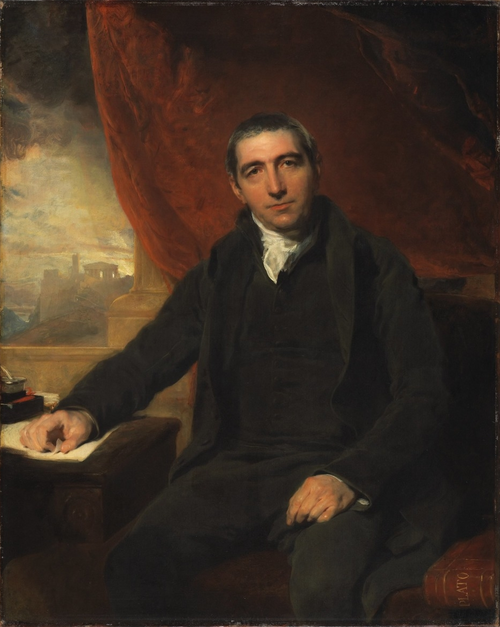
Image: Thomas Lawrence, portrait of Thomas Taylor, c.1812, National Gallery of Canada, accession 354. Public-domain painting and reproduction.
.png)
Thomas Lawrence / Wikimedia Commons; Public domain. Image record, Public domain.
The round picture in the lists of the personalities is cropped from it.