



10 min read
Inventor of the Web
Tim Berners-Lee
author: High Priest Zevios Metathronos
Making Knowledge Reachable
Dates: Born 1955
Period: Modern period, 1900–present
Tim Berners-Lee wrote the proposal for the World Wide Web at CERN, the particle physics laboratory at Geneva, in March 1989. Between October and December 1990 he wrote the first Web server and the first browser and ran them on a NeXT computer that he kept in his own office.1
His great attainment was a set of rules simple enough for any computer to follow: an address for every document, a protocol to fetch it and a markup language to display it with links to anything else. The Association for Computing Machinery gave him the Turing Award “for inventing the World Wide Web, the first web browser, and the fundamental protocols and algorithms allowing the Web to scale.”2
Zevism reads the Web under Theuth, who offered writing to an Egyptian king as “an elixir of memory and wisdom,” and under Hermes, the God of invention and exchange.3 Berners-Lee built a road back to any source from any page, and the Temple counts that as service to the source.
LIFE AND CONTEXT
Berners-Lee was born in London on 8 June 1955. His parents, Mary Lee Woods and Conway Berners-Lee, were mathematicians who had worked on the Ferranti Mark 1. In his own words, they “actually met while working on the Ferranti Mark I, the first computer sold commercially.”4
He read physics at the Queen's College, Oxford, from 1973 to 1976 and took a 1st-class degree. He didn't stay on for a doctorate. Asked why, he recalled that he'd already “slowly put together a display unit out of an old TV, bits of TTL logic and junk from the Tottenham Court Road.”5
Industry came next. He spent 2 years at Plessey Telecommunications in Poole, Dorset, working on distributed transaction systems, message relays and bar codes. In 1978 he moved to D.G. Nash at Ferndown, where he wrote typesetting software for intelligent printers and a multitasking operating system. From 1981 to 1984 he held technical design responsibility at John Poole's Image Computer Systems.6
CERN shaped the rest. He first went there for 6 months in 1980 as a consultant software engineer, and in 1984 he came back on a fellowship to work on distributed real-time systems for scientific data acquisition and control. The proposal grew out of that 2nd stay. In November 1990 the Belgian systems engineer Robert Cailliau helped him turn it into a formal management proposal, and by the end of that year the first server and browser were running.1
The Web soon outgrew its birthplace. Mosaic, a browser released in 1993 at the University of Illinois, “brought the Web to millions of users.” CERN counted over 500 known Web servers by late 1993 and 10,000 by the end of 1994. That year Berners-Lee left Geneva for the Massachusetts Institute of Technology, where he founded the World Wide Web Consortium.7
He kept building. In 2009 he founded the World Wide Web Foundation, and in 2012 he and Sir Nigel Shadbolt founded the Open Data Institute in London. In 2016 he joined the Computer Science Department at Oxford as a professor. His later work centres on Solid, a project “to give people control of their own data and to re-decentralize the Web.”6
ATTAINMENTS
- In 1980 he wrote Enquire, a private program for tracking the software of CERN's PS control system. It “allowed one to store snippets of information, and to link related pieces together in any way,” and the W3C biography calls it the conceptual basis of the Web.8
- Information Management: A Proposal, dated March 1989 and recirculated in May 1990, argued that “a ‘web’ of notes with links (like references) between them is far more useful than a fixed hierarchical system.”9
- By October 1990 he'd written the 3 technologies the Web still runs on: HTML to mark up pages, the URI (commonly called the URL) to give every resource an address, and HTTP to transfer it.10
- He wrote the first server, “httpd,” and the first client, “WorldWideWeb,” starting in October 1990. The client was an editor as well as a browser: it “allowed users to edit pages, and save the changes back on the server.”11
- He put up the world's first website at info.cern.ch. It ran on his NeXT computer and described the Web project itself.12
- In 1994 he founded the World Wide Web Consortium at MIT's Laboratory for Computer Science, to develop the Web's common standards.6
- The Queen knighted him in 2004 “for services to the global development of the Internet” and gave him the Order of Merit in 2007. On 4 April 2017 he was awarded the ACM A.M. Turing Award.6
KEY STORIES
Enquire Within Upon Everything
In June 1980 Berners-Lee arrived at CERN as a consultant for a stint of 6 months. He worked on software for the control system of the PS, the Proton Synchrotron, and he wrote a program of his own to keep track of it.13
He named it Enquire, “short for Enquire Within Upon Everything, named after a Victorian book of that name full of all sorts of useful advice about anything.” He found it “really useful for keeping track of all the random associations one comes across in Real Life.”14
Enquire was never published. In 1984 he came back on a fellowship and met the same tangle again, as he wrote in 1989: “Soon after my re-arrival at CERN in the DD division, I found that the environment was similar to that in PS, and I missed Enquire.”15
Vague but Exciting
In March 1989 Berners-Lee put the problem on paper for his managers. The proposal's first line was plain: “This proposal concerns the management of general information about accelerators and experiments at CERN.” He praised the place, “a wonderful organisation,” and then named the flaw: “When two years is a typical length of stay, information is constantly being lost.”16
He gave examples. “The technical details of past projects are sometimes lost forever, or only recovered after a detective investigation in an emergency.” And he looked past Geneva: “CERN is a model in miniature of the rest of world in a few years time.”17
The document went to Mike Sendall, his manager. Thomas Haigh records that Sendall “wrote ‘vague but exciting’ on his copy of the proposal.” The machine for the work was a NeXT, “a high-end personal computer with a novel Unix-based operating system that optimized the rapid implementation of graphical applications.” By October 1990 Berners-Lee “had begun to code prototype Web browser and server software, finishing in December.”18
Collaborators Welcome
By the end of 1990 the NeXT in Berners-Lee's office was serving the first Web page. Its address, he later wrote, “was basically http://nxoc01.cern.ch/hypertext/WWW/TheProject.html”. CERN keeps a restored copy of that page at info.cern.ch, and its first sentence reads: “The WorldWideWeb (W3) is a wide-area hypermedia information retrieval initiative aiming to give universal access to a large universe of documents.”19
Few people had a NeXT to run the browser on. Nicola Pellow, a student on a work placement at CERN, wrote a simpler line-mode browser “which could run on any system.”20
On 6 August 1991 Berners-Lee answered a thread on the newsgroup alt.hypertext. “The WorldWideWeb (WWW) project aims to allow links to be made to any information anywhere,” he wrote, and he said where to get it: “It's very prototype, but available by anonymous FTP from info.cern.ch.” He ended with an invitation. “We are very interested in spreading the web to other areas, and having gateway servers for other data. Collaborators welcome!” In December the Stanford Linear Accelerator Center in California put up the first Web server in the United States.21
To Whom It May Concern
The code still belonged to CERN. The Web Foundation records that Berners-Lee “and others advocated to ensure that CERN would agree to make the underlying code available on a royalty-free basis, forever.” His reason was practical: “had the technology been proprietary, and in my total control, it would probably not have taken off.”22
On 30 April 1993 CERN issued an internal document addressed “to whom it may concern.” Walter Hoogland, Director of Research, and Helmut Weber, Director of Administration, signed it. It stated: “CERN relinquishes all intellectual property rights to this code, both source and binary form, and permission is granted for anyone to use, duplicate, modify and redistribute it.”23
In 2012, during the opening ceremony of the London Olympics, Berners-Lee tweeted a line that the Web Foundation still quotes: “This is for Everyone.”24
THE ZEVIST READING
In the Phaedrus Theuth brings letters to King Thamus of Egypt and promises: “This invention, O king, will make the Egyptians wiser and will improve their memories; for it is an elixir of memory and wisdom that I have discovered.”25 Zevism holds that Egypt kept earlier forms of the Logos in the powers of Thoth. The proposal of 1989 starts from Theuth's problem, a community whose memory walks out of the door every 2 years, and answers it with a new kind of writing.
Ma'at gives the 2nd measure. Egyptian religion named her “the personification of truth, justice, and the cosmic order” and set her against isfet.26 A record that can't be found is a small collapse of order, and a detail “lost forever” is Izfet in an archive. A link that leads a reader back to the page where a claim began restores the record. Zevism teaches that knowledge changes in transmission and that the source keeps priority; the hyperlink is that return to the source made mechanical, and the Temple counts its builders among the keepers of the source.
Hermes governs the gift. The Homeric Hymn has him born at dawn and playing, by midday, a lyre he'd made from a mountain tortoise, and it settles his quarrel with Apollo by exchange: the lyre for the shining whip and the herds.27 The release of 1993, which Berners-Lee had pressed CERN to make, put the invention on the common road, where anyone could “use, duplicate, modify and redistribute it.”
Thamus answered Theuth that “one man has the ability to beget arts, but the ability to judge of their usefulness or harmfulness to their users belongs to another.”28 Berners-Lee took on both offices. He begot the art in 1990 and has spent the decades since at the Consortium and on Solid, judging what the art does to its users and building repairs. In Zevist terms that's Φρόνησις joined to craft.
NOTES
1 W3C, “Longer Bio”; CERN, “A short history of the Web”.
2 Haigh, “Sir Tim Berners-Lee,” ACM.
4 Haigh, ACM; Berners-Lee, “Frequently asked questions”.
5 W3C, “Longer Bio”; Berners-Lee, “Frequently asked questions”.
7 Haigh, ACM; CERN, “A short history of the Web”.
8 Berners-Lee, Information Management: A Proposal; W3C, “Longer Bio”.
9 Berners-Lee, Proposal, “Linked information systems”.
10 World Wide Web Foundation, “History of the Web”; Haigh, ACM.
11 W3C, “Longer Bio”; Haigh, ACM.
12 CERN, “The birth of the Web”.
13 W3C, “Longer Bio”; Proposal.
14 Berners-Lee, “Frequently asked questions”.
15 Proposal, “Linked information systems”.
16 Proposal, “Losing Information at CERN”.
17 Proposal.
18 Haigh, ACM.
19 Berners-Lee, “The World Wide Web project”; CERN, “A short history of the Web”.
20 CERN, “A short history of the Web”.
21 Berners-Lee, post to alt.hypertext, 6 August 1991; CERN, “A short history of the Web”.
22 World Wide Web Foundation, “History of the Web”; Berners-Lee, “Frequently asked questions”.
23 Dinmore, “30 years of a free and open Web,” CERN.
24 World Wide Web Foundation, “History of the Web”.
25 Plato, Phaedrus 274e, tr. Fowler.
27 Homeric Hymn to Hermes 17–19, 39–51, 496–498.
28 Phaedrus 274e.
BIBLIOGRAPHY
Tim Berners-Lee, “Longer Bio”, W3C; birth, education, early employment, Enquire, CERN fellowship, first server and client, Consortium, honours, Web Foundation, Open Data Institute and Solid.
Tim Berners-Lee, Information Management: A Proposal, CERN, March 1989, recirculated May 1990, W3C HTML transcription; opening, “Losing Information at CERN” and “Linked information systems.”
Tim Berners-Lee, “Frequently asked questions”, W3C; answers on his parents, his Oxford years, Enquire and the open design of the Web.
Tim Berners-Lee, “The World Wide Web project”, the first website, as restored by CERN at info.cern.ch.
Tim Berners-Lee, reply in “Qualifiers on Hypertext links”, newsgroup alt.hypertext, 6 August 1991, W3C archive.
Thomas Haigh, “Sir Tim Berners-Lee”, A.M. Turing Award laureate profile, Association for Computing Machinery; citation, parents, Sendall's note, NeXT, the editing browser and Mosaic.
CERN, “A short history of the Web”; Cailliau's proposal of November 1990, the NeXT server, Pellow's line-mode browser, SLAC and server counts for 1993 and 1994.
CERN, “The birth of the Web”; the first website and the release of 30 April 1993.
Naomi Dinmore, “30 years of a free and open Web”, CERN, 30 April 2023; signatories and wording of the release document.
World Wide Web Foundation, “History of the Web”; the 3 technologies, the royalty-free campaign and the Olympic message of 2012.
Plato, Phaedrus 274c–e, translated by H. N. Fowler, Perseus Digital Library.
Homeric Hymn to Hermes 17–19, 39–51 and 496–498, H. G. Evelyn-White translation, Theoi Classical Texts Library; Encyclopaedia Britannica, “Maat”.
CREDIT
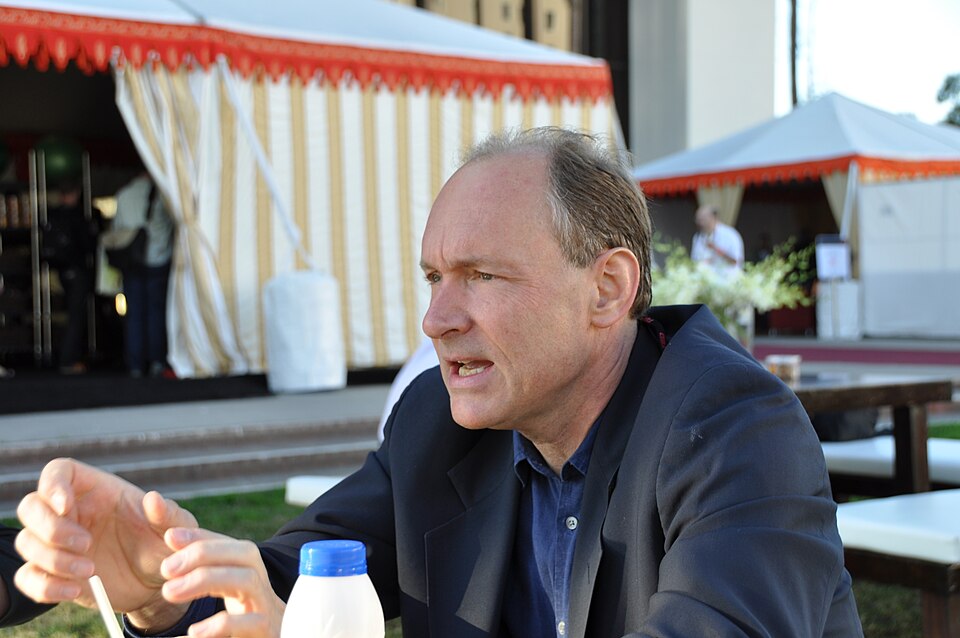
Portrait: Tim Berners-Lee at TED in 2009, photograph by Veni Markovski, Wikimedia Commons, CC BY 3.0.

Veni Markovski, via Wikimedia Commons, CC BY 3.0. Image record, Creative Commons Attribution 3.0 Unported.
The round picture in the lists of the personalities is cropped from it.