




9 min read
Skald of the Hall
Úlfr Uggason
author: High Priest Zevios Metathronos
A Hall Made Lasting Through Song
Dates: Flourished around 990–1000 CE; the poem is dated to the early 990s in the edition used here; other datings differ.
Period: Darkness (800–1000 CE).
Úlfr Uggason was an Icelandic skald of the late 10th century, remembered for a single poem. Laxdæla saga says that Óláfr Hǫskuldsson built a great hall at Hjarðarholt, with “noble legends” painted on its walls and roof, and that Úlfr made a poem about Óláfr and those pictures and recited it at a wedding feast there. The saga calls it the “House Song”: Húsdrápa.1
His greatest attainment survives in Snorri Sturluson's Edda. Snorri drew on Húsdrápa for 3 of the myths he retold: Thor's fishing for the World Serpent, the funeral of Baldr, and Heimdallr's fight with Loki in the shape of seals. The painted hall is long gone; Úlfr's description of it isn't.2
Zevism reads Úlfr as a keeper of the source. He took images of the Gods off a wall and set them in verse, calling his poem “the Gift of Grímnir,” one of Odin's names, and the words carried the images long after the hall was gone.3
LIFE AND CONTEXT
Little is known of Úlfr's life. Edith Marold's biography for the Skaldic Project places him in western Iceland around the end of the 10th century, and the evidence for more than that is thin.4
His patron is better documented. Óláfr Hǫskuldsson set up his household at Hjarðarholt, “and a stately one it soon became,” the saga says. “That summer Olaf had a fire-hall built at Herdholt, a greater and better than had ever been seen before.” It wasn't only large. “Noble legends were painted on its wainscoting and in the roof, and this was so well done that the hall was thought even more beautiful when the hangings were not up.”5
Richard North's edition places the wedding feast, and so the poem, in the early 990s; Marold's dating differs. The verses survive only as quotations in Snorri's Skáldskaparmál, and their arrangement into a continuous poem is an editor's work. They can't be read as a plan of the hall.6
Snorri drew on the poem for more than one myth. On Baldr he wrote that “Úlfr Uggason, following the story of Baldr, has composed a long passage in the Húsdrápa.” He didn't have to work from the pictures themselves; for several of his scenes a poet had already put them into words.7
North's text gathers the surviving pieces into 12 numbered sections. The opening addresses Óláfr and offers the poem as Odin's gift, and a closing fragment brings the account to an end.8
ATTAINMENTS
- He composed Húsdrápa for Óláfr Hǫskuldsson and recited it at the wedding feast in the new hall at Hjarðarholt. The saga judged that it “is well made,” and “Olaf rewarded him well for the poem.”9
- He turned a painted room into a sequence of myths. In the Baldr section he says it outright: “With old tales the hall was painted.”10
- Snorri names Húsdrápa as his authority for Heimdallr's fight with Loki over the Brísinga-men, in which “they were in the form of seals.”7
- He gave Snorri a verse witness to Baldr's funeral: Odin riding to his son's pyre with Valkyries and ravens, and Heimdallr spurring his horse to it.7
- He described Thor's fishing for the World Serpent in lines that Snorri used as models for the names of Thor.7
- His surviving verses fill 12 numbered sections in Richard North's edition, which dates the poem to the early 990s.11
KEY STORIES
The House Song at Hjarðarholt
The wedding was set for the end of winter, and the hall was ready. “The wedding feast was a very crowded one,” the saga says. Among the guests was the poet: “Ulf Uggason was of the bidden guests, and he had made a poem on Olaf Hoskuldson and of the legends that were painted round the hall.” He recited it at the feast.12
Snorri kept the opening lines. Úlfr turned to his host and named his gift: “I show to host-glad Áleifr / The Heart-Fjord's Shoal of Odin,” and then, “him do I summon / To hear the Gift of Grímnir.” Grímnir is Odin, so both phrases name the poem as Odin's. Úlfr offered Óláfr the God's mead as a return for his hospitality.10
The saga records the result. “This poem is called the 'House Song,' and is well made. Olaf rewarded him well for the poem.” The feast raised Óláfr's standing too: “Olaf was considered to have gained in renown by this feast.”9
Thor Fishes for the World Serpent
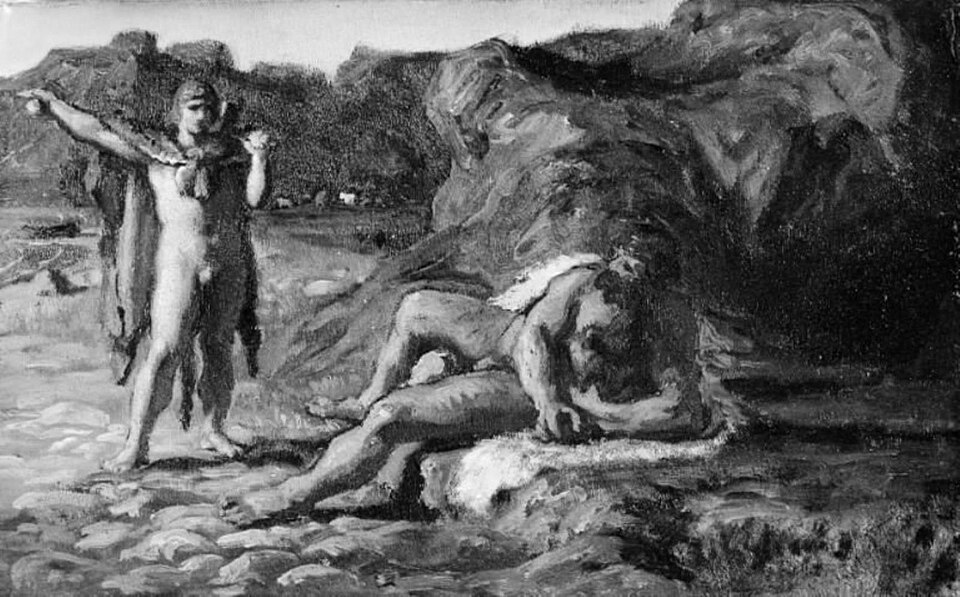
One of the painted scenes showed Thor at sea. In Snorri's Gylfaginning, Thor came to the giant Hymir “in the guise of a young lad” and rowed out with him to fish. “Then Thor put the ox-head on the hook and cast it overboard, and the hook went to the bottom.” The Midgard Serpent “snapped at the ox-head, and the hook caught in its jaw; but when the Serpent was aware of this, it dashed away.”13
Thor hauled it up. Hymir saw “the Serpent, and how the sea rushed out and in through the boat,” and “the giant grew pale, became yellow, and was sore afraid.” Then “the giant fumbled for his fish-knife and hacked off” the line, and the Serpent sank back into the sea. “Thor swung his fist and brought it against Hymir's ear, so that he plunged overboard, and Thor saw the soles of his feet.”14
Úlfr's version keeps the giant's terror: “Faintly the stout-framed thickling / A fearful peril called it, / At the great draught wondrous heavy / Drawn up by the Lord of he-goats.” Then the blow: “The very mighty Slayer / Of the Mountain-Man brought crashing / His fist on Hymir's temple.”7
The Gods Ride to Baldr's Pyre
Another wall showed a funeral. Snorri tells how the Gods tried to launch Baldr's ship to build his pyre on it, “but the ship stirred not forward.” A giantess “called Hyrrokkin” came, “riding a wolf and having a viper for bridle,” and set it moving. “Then was the body of Baldr borne out on shipboard,” and when his wife Nanna saw it, “straightway her heart burst with grief.” She too “was borne to the pyre, and fire was kindled.”
“Then Thor stood by and hallowed the pyre with Mjolnir.” A dwarf named Litr ran before his feet, and “Thor kicked at him with his foot and thrust him into the fire.”15
Then came the mourners. “First is to be told of Odin, how Frigg and the Valkyrs went with him, and his ravens; but Freyr drove in his chariot with the boar called Gold-Mane, or Fearful-Tusk, and Heimdallr rode the horse called Gold-Top, and Freyja drove her cats.” Odin laid the gold ring Draupnir on the pyre.16
Úlfr's stanzas follow the same procession. “Swiftly the Far-Famed rideth, / The Foretelling God, to the fire speeds, / To the wide pyre of his offspring.” He saw the Valkyries and “ravens, Victorious Odin / To the blood of holy Baldr,” and “His steed the lordly Heimdallr / Spurs to the pyre gods builded / For the fallen son of Odin.” Between those lines he named his source: “With old tales the hall was painted.”7
The Seal Fight at Singasteinn
Heimdallr rode in that procession on his horse Gold-Top, and he had a story of his own on the walls. Snorri lists his names: “Son of Nine Mothers, or Watchman of the Gods,” “White God, Foe of Loki, Seeker of Freyja's Necklace.” He's also the “Frequenter of Vágasker and Singasteinn, where he contended with Loki for the Necklace Brísinga-men.”7
Heimdallr sought Freyja's necklace, and Loki fought him for it. For the shape of the fight Snorri sends his reader to the poem: “Úlfr Uggason composed a long passage in the Húsdrápa on that legend, and there it is written that they were in the form of seals.” So the watchman of the Gods and the trickster fought at Vágasker and Singasteinn as seals, and it's Úlfr's poem that kept the picture.17
THE ZEVIST READING
Úlfr called his poem “the Gift of Grímnir,” and in his own lines the praise-songs pour through his cheeks. Snorri's myth explains the claim: Odin gave the mead “to the Æsir and to those men who possess the ability to compose.”7 Zevism reads the skalds under Odin and holds that the Gods of the North served the divine order under their own names, as links in the single chain of spirituality from its inception to today.
The fishing scene is a picture of Ma'at and Izfet. Egyptian religion named Ma'at “the personification of truth, justice, and the cosmic order” and set her against isfet.18 The Serpent in the deep is dissolution held at bay. Encyclopaedia Britannica calls Thor “an implacable foe to the harmful race of giants but benevolent toward humankind,” and notes that he was sometimes equated with Jupiter.19 Thor draws the Serpent up, and a frightened giant cuts the line. In Zevist terms the order of the cosmos, held by Zeus as its sovereign, is never won once for all; it has to be defended again and again.
Baldr's funeral shows the other side of order. The Gods gather in rank, each with a named mount or companion, and they give the dead his due; Thor hallows the fire, and Odin lays his ring on the pyre. Ritual done rightly is a form of Ma'at, even in grief, and the hall that held a wedding feast carried a funeral on its walls.
Zevism holds that the source keeps its priority and honours those who carry it forward. Óláfr's hall, its wainscoting and its roof have disappeared. Úlfr turned the painted legends into verse, Snorri copied the verse into his handbook, and the Gods of Hjarðarholt reached readers who never saw the hall.
NOTES
1 Laxdæla Saga, Press tr., pp. 89–90.
2 Snorri, Skáldskaparmál, Brodeur tr..
3 Brodeur tr., index, “Grimnir”.
4 Marold, “Úlfr Uggason,” Skaldic Poetry of the Scandinavian Middle Ages.
6 North, Húsdrápa, introduction.
10 Skáldskaparmál, Brodeur tr..
11 North, introduction and stanzas 1–12.
12 Laxdæla Saga, Press tr., p. 90.
13 Snorri, Gylfaginning, Brodeur tr., pp. 68–70.
17 Skáldskaparmál; North, Húsdrápa, stanzas 2–11.
BIBLIOGRAPHY
Edith Marold, “Úlfr Uggason,” Skaldic Poetry of the Scandinavian Middle Ages, specialist biography; biographical evidence is sparse.
Richard North, edition and translation of Húsdrápa, introduction and stanzas 1–12. World-Tree Project record identifies the 2010 anthology source; the posted PDF carries the revision date 25 September 2016.
Laxdaela Saga, translated by Muriel A. C. Press, London: Dent, 1899; Internet Archive; pp. 76, 89–90, the household and hall at Herdholt and the “House Song.”
Snorri Sturluson, Skáldskaparmál, in The Prose Edda, translated by Arthur Gilchrist Brodeur, American-Scandinavian Foundation, 1916; Internet Sacred Text Archive; the Húsdrápa stanzas, the names of Heimdallr and Baldr, and the mead of poetry.
Snorri Sturluson, Gylfaginning, in The Prose Edda, translated by Arthur Gilchrist Brodeur, New York: American-Scandinavian Foundation, 1916; Internet Archive scan; pp. 68–73, Thor and Hymir and the funeral of Baldr; index entry “Grimnir, a name of Odin.”
Encyclopaedia Britannica, “Thor”.
Encyclopaedia Britannica, “Maat”.
CREDIT
Picture: Thor and Hymir, painted by Lorenz Frølich around 1870–1875; Statens Museum for Kunst, KMS7046. A later illustration of a narrative also treated in Húsdrápa, not a surviving image from Úlfr’s hall.
Lorenz Frølich; digital reproduction Statens Museum for Kunst; CC0 1.0; underlying painting public domain; Wikimedia Commons. Image record, CC0 1.0; underlying painting public domain.

The round picture in the lists of the personalities is cropped from it.