




9 min read
King of Ur
Ur-Nammu of Ur
author: High Priest Zevios Metathronos
Building for Those Who Come After
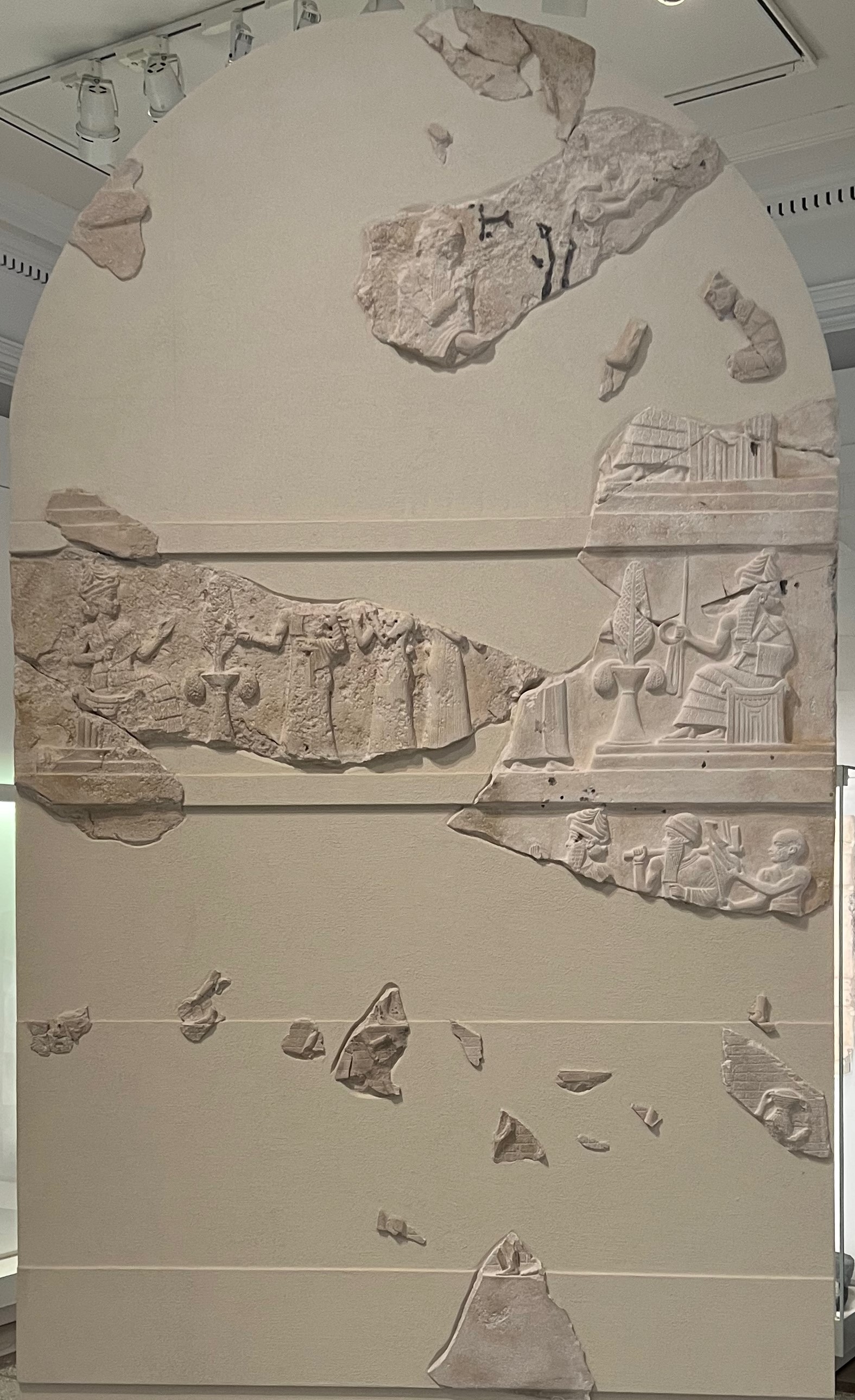
Dates: Reigned around 2100 BCE.
Period: Ancient.
Ur-Nammu, whom Sumerologists now spell Ur-Namma, founded the 3rd dynasty of Ur. He began as governor of the city, became king and took the title “king of Sumer and Akkad.” He ruled for 18 years and died in battle about 2094 BCE.1
He left 3 kinds of work behind him: the brick tower of the moon God at Ur, canals for the fields, and the law collection that carries his name, which Britannica calls “the oldest known legal code.” His praise poem gives the programme in 1 line: “I make justice apparent; I defeat wickedness.”2
Zevism reads Ur-Nammu as a Sumerian link in the chain of spirituality, a builder and judge who served Nanna and Enlil under their own names. His verdicts, his opened roads and his canals belong to Ma'at, the right order that Zeus holds as Sovereign of the Cosmos.
LIFE AND CONTEXT
Britannica credits Ur-Nammu with a state that took in “at least the southern part of Mesopotamia” and says he directed overseas trade through Ur. His praise poem remembers the enemy of that age: “I …… the savage hands of the Gutians.”3
His own hymns place his kingship in Enlil's hands. “He decreed my fate in Nibru, in the mountain of life,” the king says in one of them. “He beamed at me approvingly and bestowed the kingship on me.”4
He built across Sumer. Britannica names “the impressive ziggurats at Ur and Uruk.” At Ur he began the temple of Nannar and Ningal, “the moon-god and his wife, with its great brick tower,” and his son Shulgi finished it. A copper foundation figure in New York, 27.3 cm tall, carries a basket of earth on its head, and its inscription says it was buried in the foundation of a temple of Inanna that Ur-Nammu restored or built.5
The law collection dealt “with issues such as bodily injury, witchcraft, and the flight of slaves.” Its authorship is disputed: Britannica dates it to Ur-Nammu's reign and notes that “some scholars have attributed it to Ur-Nammu's son Shulgi.” The praise poem, at least, is sure of its king: “My judgments make Sumer and Akkad follow a single path.”2
He didn't live to see the tower done. Jeanny Vorys Canby, writing on his stela for the Penn Museum, reports that “when Ur-Nammu died in battle ca. 2094 B.C., he was succeeded on the throne by his well-educated son Shulgi.” The dynasty held until the Elamites of southwestern Iran attacked in 2004 BCE.6
ATTAINMENTS
- He founded the 3rd dynasty of Ur, rose from governor of Ur to king, and took the title “king of Sumer and Akkad.”7
- He raised ziggurats at Ur and Uruk, and at Ur he began the temple of Nannar and Ningal with its brick tower, which Shulgi completed.8
- The law collection under his name is the oldest known, with rulings on bodily injury, witchcraft and runaway slaves, though some scholars give it to Shulgi.9
- He dug canals, among them the Keshe-kug canal at Ur, and his stela lists canals he opened.10
- He set up the E-kiš-nu-ĝal for Nanna, and he had foundation figures cast in copper for his temples, such as the 27.3 cm basket-carrier from a temple of Inanna.11
- He opened the roads. “In the desert, the roads are made up as for a festival, and are passable because of me,” his praise poem says.12
- He set up a carved stela at Ur showing him pouring libations and carrying the builder's tools, now restored at the Penn Museum as a monument 3 m high.13
KEY STORIES
The King Shoulders the Tools
The stela told its story in registers of carved stone. In the 2nd register the king poured a libation “to a god on the right and to a goddess on the left.” Legrain saw him pour it “over green palms and bunches of dates in a tall vase shaped like an hour-glass.”14
Then the king went to work. Canby listed what he carried over his shoulder: “pick, compass, adze, and spreading tool, as well as a basket.” In Legrain's words, “Preceded by his patron god and shouldering the mason's tools he goes to lay the foundation brick.” Workers “carry baskets of mud and climb ladders to the top of the wall,” and “youthful aerial figures pour from heaven the fertilizing rain, a reward for the pious work.”15
The stone itself came back in pieces. Leonard Woolley's joint expedition of the University Museum and the British Museum turned up the first pieces in 1923, bits showing “a ladder and figures against a brick background.” “Most of the fragments were recovered in March 1925,” lying above a brick pavement near the E-dublal-mah shrine beside the ziggurat. By 1932 the larger fragments stood in “a 3-meter-high restored monument” in Philadelphia.6
The Canal of Abundance
On the stela's back the inscription doesn't name the king, but Canby notes that “canals known to have been dug by Ur-Nammu are listed.” Legrain read it as “a list of the canals opened by royal command to insure the fertility of the land and its connection with the sea.”14
A hymn lets the king tell it himself. “In Urim, I dug a canal of abundance and named it the Keše-kug canal.” He gave a 2nd canal a name meant to last: “I named it the Pabi-luḫ canal, a lasting name worthy to be praised.”16
Then he described what the water did. “The watercourse of Urim is full of fish, and the air above it is full of birds.” Honey-plants were planted in Urim, “and the carp grow fat.” The gizi reeds were so sweet “that the cows eat them,” and the king asked that the fish be “carried in baskets to him.” The Urim version of the song adds the fields: “Its arable tracts grow fine grain sprouting abundantly like a forest.”17
The Urim version closes on its refrain: “Ur-Namma, king of eternal fame, sweet is your praise!” In Zevist terms the canal is Ma'at dug into the ground, water brought in measure to fields that wouldn't otherwise bear.18
Abandoned Like a Broken Jar
A long Sumerian poem tells how the founder died. “Evil came upon Urim and made the trustworthy shepherd pass away.” An “had altered his holy words completely,” and Enlil “had completely changed the fate he decreed.” The poet doesn't soften it: “How iniquitously Ur-Namma was abandoned, like a broken jar!” His soldiers wept, for “their boat (i.e. Ur-Namma) was sunk in a land as foreign to them as Dilmun.”19
He went down with gifts. He gave presents to “the seven chief porters of the nether world.” To Nergal he offered a mace, a large bow with quiver and arrows and a barbed dagger. To Gilgameš, “the king of the nether world,” he gave a spear, a lion-headed mace, a shield and a battle-axe. The poem says plainly what waited for him: “The food of the nether world is bitter, the water of the nether world is brackish.”20
The underworld gave him an office: “with Gilgameš, his beloved brother, he will issue the judgments of the nether world.” Yet he grieved “that he could not complete the wall of Urim” and “that he could not bring up his sons on his knees.” Then he spoke the poem's hardest lines: “I, who have been treated like this, served the gods well, set up chapels for them.” And: “Yet no god stood by me and soothed my heart.”21
The poem ends with a promise that his “august name will be called upon” and that people will admire “the canals which you have dug.”22
THE ZEVIST READING
Zevism holds that spirituality forms one chain from its inception to the present, and Ur-Nammu's Gods keep their own names in it. Enlil decrees his fate at Nibru, Nanna is “my master,” and the dead king sits in judgment beside Gilgameš. The Temple reads the same order in the Hellenic lens, where Hesiod seats Dike, the daughter of Zeus, beside her father.23 A king who claims to “make justice apparent” is claiming to serve her.
Egyptian religion called the right order Maat, “the personification of truth, justice, and the cosmic order,” and set it against isfet.24 Ur-Nammu's works fit that pair closely. A king who sets his foot “on the necks of thieves and criminals,” a desert road made “passable,” a canal full of fish and a tower of measured brick all restore Ma'at. The Gutians of his poem belong to Izfet.25
He's also a clear case of the Creator. Zevism names the andrapod as the one who lives among ruins and answers them with complaint and nostalgia. Ur-Nammu faced the “savage hands of the Gutians” and answered with pick, compass and basket, the tools his own stela puts on his shoulder.
The death poem gives the doctrine its hardest test, and the Temple doesn't look away from it. The king served the Gods and still went down to Arali “in his prime,” with his wall unfinished. Zevism reads his complaint as honest speech before the Gods and reads the answer in the work itself. Shulgi completed the tower, the poem promises that the canals will be admired, and Creation stays open forward to whoever takes up the tools.26
NOTES
1 Britannica, “Ur-Nammu”; Canby, “A Monumental Puzzle,” 1987.
2 Britannica, “Code of Ur-Nammu”; ETCSL 2.4.1.3, lines 31–42.
3 Britannica, “Ur-Nammu”; ETCSL 2.4.1.3, lines 86–100.
4 ETCSL 2.4.1.4, version of unknown provenance, lines 6–20.
5 Britannica, “Ur-Nammu”; Legrain, 1944, pp. 56–57; Metropolitan Museum, 47.49.
6 Canby, 1987.
8 Britannica, “Ur-Nammu”; Legrain, 1944.
9 Britannica, “Code of Ur-Nammu”.
10 ETCSL 2.4.1.4, version of unknown provenance, lines 21–33; Canby, 1987.
11 ETCSL 2.4.1.3, lines 101–110; Metropolitan Museum, 47.49.
12 ETCSL 2.4.1.3, lines 50–56.
13 Canby, 1987; Penn Museum, B16676.14.
14 Canby, 1987; Legrain, 1944.
16 ETCSL 2.4.1.4, version of unknown provenance, lines 21–33.
17 Lines 21–33; Urim version, lines 29–36.
18 ETCSL 2.4.1.4, Urim version, line 40.
19 ETCSL 2.4.1.1, lines 1–14, 52–75.
20 Lines 76–96.
21 Lines 145–186.
22 Lines 234–242.
23 Hesiod, Works and Days 256–262.
25 ETCSL 2.4.1.3, lines 31–100.
26 Legrain, 1944.
BIBLIOGRAPHY
University of Oxford, Electronic Text Corpus of Sumerian Literature, “The death of Ur-Namma (Ur-Namma A),” translation 2.4.1.1, ETCSL project, Faculty of Oriental Studies; lines 1–14, 52–96, 145–186 and 234–242.
ETCSL, “A praise poem of Ur-Namma (Ur-Namma C),” translation 2.4.1.3; lines 31–42, 50–56, 86–100 and 101–110.
ETCSL, “Ur-Namma the canal-digger (Ur-Namma D),” translation 2.4.1.4; version of unknown provenance, lines 6–33; Urim version, lines 29–36 and line 40.
Leon Legrain, The Third Dynasty of Ur. The Stela of Ur–Nammu, Museum Bulletin X, nos. 3–4, June 1944, pp. 56–57. Used for the monument's published description, with its older chronology set aside.
Jeanny Vorys Canby, “A Monumental Puzzle: Reconstructing the Ur-Nammu Stela”, Expedition 29, no. 1, Penn Museum, March 1987.
Penn Museum, Ur-Namu Stele, B16676.14, current object record, especially Date Made and Description.
Metropolitan Museum of Art, Foundation figure of Ur-Namma holding a basket, 47.49; date, medium, dimensions and description.
Encyclopaedia Britannica, “Ur-Nammu” and “Code of Ur-Nammu”.
Hesiod, Works and Days 256–262, tr. H. G. Evelyn-White, Theoi Classical Texts Library.
Encyclopaedia Britannica, “Maat”.
CREDIT
Picture: Stele of Ur-Namma, obverse, Penn Museum. Surviving fragments displayed with a copy of registers at the far right. Photograph by Onceinawhile, 2022, cropped version uploaded by Zunkir; CC BY-SA 4.0.

Onceinawhile; cropped version uploaded by Zunkir, via Wikimedia Commons; CC BY-SA 4.0. Image record, CC BY-SA4.0.
The round picture in the lists of the personalities is cropped from it.