




9 min read
King of Lagash
Ur-Nanshe of Lagash
author: High Priest Zevios Metathronos
The Sacred Burden of Building
Dates: Flourished c. 2500 BCE; exact regnal chronology varies.
Period: Ancient.
Ur-Nanshe was king of Lagash, a city-state of the Sumerian south, around 2550 to 2500 BCE. He founded the dynasty that ruled the city for the next generations, and his inscriptions record temples, a storehouse, a canal and the city wall, with no conquest among them.1
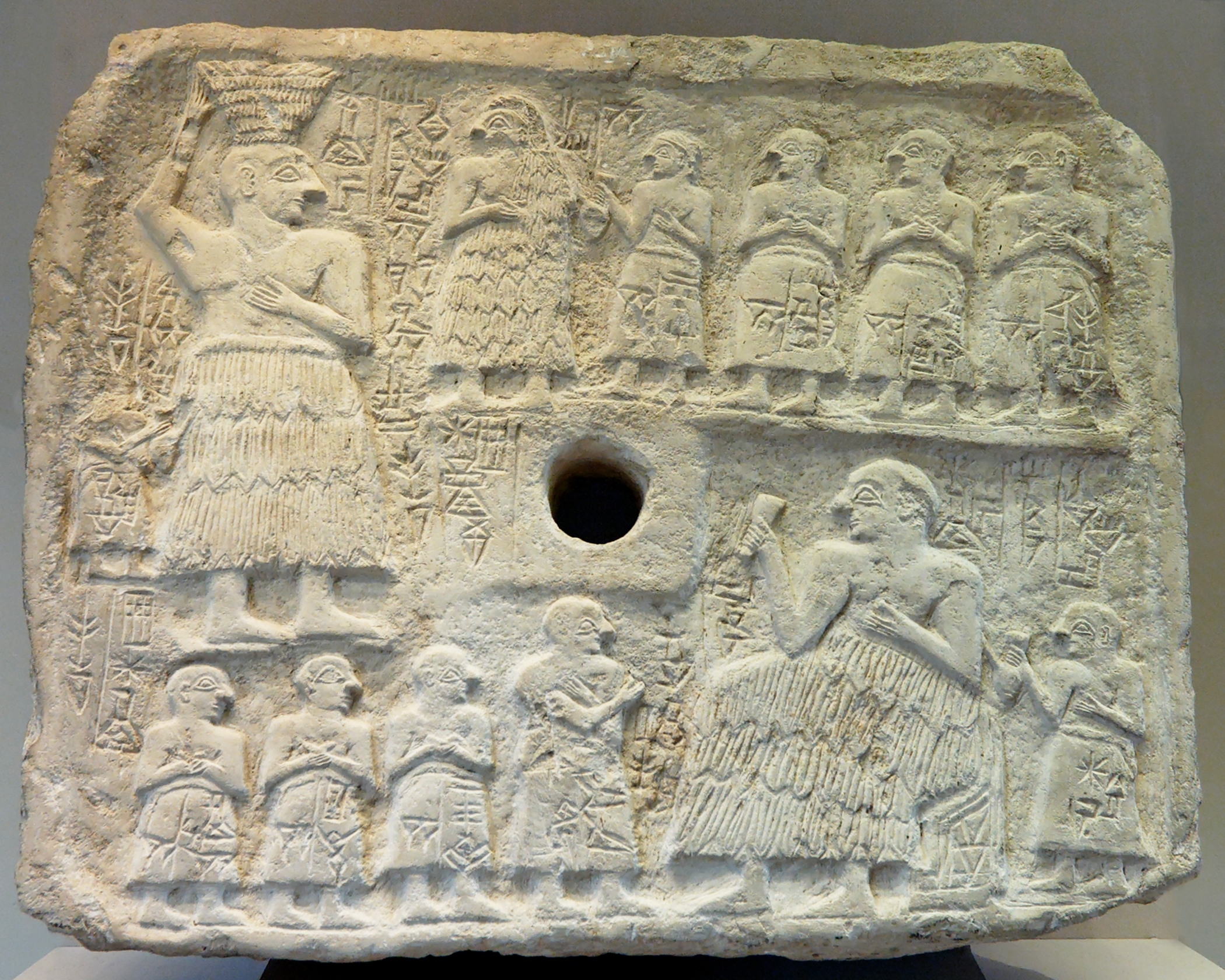
His best-known monument shows him at work. On a limestone plaque from Girsu, modern Tello, the king stands with a basket of bricks on his head for the building of a temple, and below he sits at a feast of worship.2
Zevism reads Ur-Nanshe as an early link in the chain of spirituality, serving the divine order under the names of the Gods of Lagash, Ningirsu and Nanshe. A king who carries the clay for a God's house is the Creator in his plainest form.
LIFE AND CONTEXT
Lagash lay in the south of Sumer, and its monuments come from Girsu, modern Tello. The Louvre dates Ur-Nanshe to the Early Dynastic IIIB period, “Vers 2550-2500 av. J.-C.” Older books read his name as Ur-Nina, the form George Barton and Leonard King used.3
His inscriptions open with his lineage, “Ur-Nina, king of Lagash, son of Gunidu, son of Gurshar.” King drew the conclusion in 1910: “we know that he was the founder of his dynasty, for to neither his father Gunidu, nor to his grandfather Gursar, does he ascribe any titular rank.” How he came to the throne “is not recorded.”4
He wasn't a conqueror. King noted that “in none of his numerous inscriptions does he lay claim to any conquest or achievement in the field,” and that “the nearest approach to a record of a military nature is that he rebuilt the wall of Lagash.” His texts are dedications: houses for Gods, a reservoir, a canal.5
His line held Lagash after him. His son Akurgal, shown on the family plaque, “succeeded Ur-Nina upon the throne,” and the rule then “passed from Akurgal to his son Eannatum.” Britannica describes Eannatum's Stele of the Vultures as “erected to celebrate the victory of King Eannatum over the neighbouring state of Umma.”6
King knew 3 plaques of the royal family. On a smaller one the king carries “no basket, but is represented as standing with hands clasped upon the breast, an attitude of humility and submission in the presence of his god.” King observed that “the texts upon all three plaques record the building of Ningirsu's temple,” so they seem to have been made for a single occasion.7
The king came back to light in the French excavations at Tello. Ernest de Sarzec found the great plaque in 1888 in Tell K, “Près de la construction d'Ur-Nanshe,” near the king's own building. An inscribed door socket of his had come out of the ground at Girsu in the campaigns of 1877 to 1881. Both are in the Louvre.8
ATTAINMENTS
- He founded the 1st dynasty of Lagash; his son Akurgal and his grandson Eannatum reigned after him.9
- He built the temple of Ningirsu and the temple of the Goddess Nanshe, whose name the old translators read as Nina. The family plaque records both, with “the abzu-banda,” which King took for a great basin for the temple service.10
- He had a statue of Nanshe carved and set in her new house. In Barton's translation, “Nina he carved, as a statue he cut,” and the statue “at the beginning of the year into the house entered.”11
- He built a storehouse at Girsu of kiln-baked bricks. A few carry his name and record his building of the “House of Girsu,” and 1 names the temple of Ningirsu.12
- He rebuilt the wall of Lagash and dug a canal.13
- He brought timber down to Lagash for his temples. Barton renders the phrase “from the mountain as tribute he brought down,” and King reads the family plaque as recording “that he had brought wood from the mountains.”14
- He had his building list cut on a limestone door socket 27 cm across, the stone in which a door's pivot turned. Its inscription lists his principal constructions, the temple of Ningirsu among them.15
KEY STORIES
The King with the Basket
The plaque is a pierced slab of limestone 39 cm high and 46.5 cm long. In the upper scene Ur-Nanshe stands in the skirt the Louvre calls a kaunakès, with a basket on his head, and the museum's record says it's a basket of bricks for the building of a temple.2
King looked closely. The king “is nude down to the waist and his feet are bare,” he wrote, “and upon his shaven head he supports a basket which he steadies with his right hand.” He matched it with the baskets that labourers carry to heap earth over the dead on the Stele of the Vultures, and concluded that “the king is here revealed in the character of a labourer.”16
His family faces him. The carved labels name Lidda first, then 4 sons: Akurgal, Lugal-ezen, Anikurra and Muninnikurta. Lidda wears long hair and a richer dress, and King thought it “not unlikely” that she was the king's daughter. Behind the king stands his cupbearer Anita.17
In the lower scene the work is done. The king sits on a throne “raising in his right hand a cup from which he appears to be pouring a libation,” and King saw in it “the king dedicating the temple after the task of building was finished.” The Louvre calls the scene a “banquet cultuel,” a feast of worship.18
The Goddess Enters Her House
One of Ur-Nanshe's tablets tells what he did for Nanshe. He built her house. Then, in Barton's translation, “Nina he carved, as a statue he cut,” and “at the beginning of the year” the image “into the house entered.” The same text says he dug a canal and built the wall of Lagash.19
A Sumerian hymn to Nanshe, kept in the Oxford corpus, describes the Goddess who moved into that house. It opens on her own city: “Niĝin is the city whose powers are apparent.” Then it turns to her character. “She is concerned for the orphan and concerned for the widow,” it says. She is “a mother for the orphan,” and “Nanše sees into the heart of the Land as if it were a split reed.” Among the wrongdoers she turns away is the one who deals in “a small weight in place (?) of a large weight.”20
A king who bore her name gave her a house, a statue and an entry at the New Year. The hymn says what the city looked for from her in return: fair weights, and a place for the weak.
Thumbprints in the Bricks
At Tello the excavators deepened their trenches under a building of Gudea's. “At no great depth beneath Gudea's building,” King reported, “were unearthed the remains of Ur-Nina's storehouse.” It was small and set by its corners to the compass, “in accordance with the normal Sumerian system.”12
The bricks were kiln-baked, “oblong and plano-convex,” and “each bore the mark of a right thumb imprinted in the middle of its convex side.” A few carried Ur-Nanshe's name and recorded his building of the “House of Girsu,” and 1 of them named the temple of Ningirsu.12
Every brick of that storehouse passed through a worker's hand, and the hand left its mark. The later kings of Lagash kept the old foundations inside their new platforms, so Gudea's builders raised their own work on top of Ur-Nanshe's and didn't clear it away.12
THE ZEVIST READING
Zevism is the chain of all spirituality, and Ur-Nanshe stands near its visible beginning. He didn't know the name of Zeus. He served the divine order under the names his city gave it, Ningirsu and Nanshe, and Zevism receives that service as a link in the same chain.
Nanshe's hymn describes Ma'at in Sumerian words. Egyptian religion named Ma'at “the personification of truth, justice, and the cosmic order.”21 A Goddess who cares for the orphan, sees into the heart of the land and punishes the false weight is the keeper of that order at Lagash. Housing her, and setting her image in its place, was an act of Ma'at.
The basket carries the doctrine of the Creator. The andrapod lives among ruins and answers them with complaint and nostalgia; the Creator builds, and creation asks for work. Ur-Nanshe had himself carved with the labourer's basket on his head, and the only claim his inscriptions make is a list of buildings. That's the Creator's record, and it's why the Temple keeps his image.
Good building restores order, and bad building lets it fall. The storehouse bricks, each pressed by a thumb, and the door socket with its list of buildings belong to the same work as the temple. In Zevist terms a sound wall and a true brick are Ma'at in clay, and the king who ordered them stood on the side of order.
The record survived because others kept it. Scribes cut the king's words into stone and clay, the diggers at Tello lifted them out, and Barton and King turned them into English. Zevism honours such transmitters as keepers of the source, since the source holds priority and every later reading depends on it.
NOTES
1 Musée du Louvre, Relief d'Ur-Nanshe, AO 2344; L. W. King, A History of Sumer and Akkad, p. 166.
3 Louvre, AO 2344; George A. Barton, The Royal Inscriptions of Sumer and Akkad, pp. 15–19.
4 Barton, p. 15; King, p. 166.
5 King, p. 166; Barton, pp. 15–16.
6 King, pp. 174, 182; Britannica, “Lagash”.
8 Louvre, AO 2344; Louvre, AO 252.
10 King, p. 173; Barton, p. 19.
11 Barton, p. 15.
12 King, p. 149.
13 King, p. 166; Barton, p. 15.
14 Barton, p. 15; King, p. 174.
15 Louvre, AO 252.
16 King, p. 173.
17 Barton, p. 19; King, p. 174.
18 King, p. 174; Louvre, AO 2344.
19 Barton, Royal Inscriptions, Ur-Nina Tablet A, p. 15.
20 ETCSL, “A hymn to Nanše,” lines 1–9, 20–31, 137–153, 163–174.
BIBLIOGRAPHY
Musée du Louvre, Relief d'Ur-Nanshe, AO 2344; description, registers, material, dimensions, excavation of 1888 at Tello and dating.
Musée du Louvre, inscribed door socket (crapaudine) of Ur-Nanshe, AO 252; description, inscription, material, dimensions and find-place.
George A. Barton, The Royal Inscriptions of Sumer and Akkad, Yale University Press for the American Oriental Society, 1929, Internet Archive; Ur-Nina, Tablet A (p. 15) and Family group I (p. 19).
L. W. King, A History of Sumer and Akkad, London, Chatto and Windus, 1910, Internet Archive; pp. 149, 166, 173–174 and 182.
University of Oxford, Electronic Text Corpus of Sumerian Literature, “A hymn to Nanše (Nanše A),” translation 4.14.1; lines 1–9, 20–31, 137–153 and 163–174.
Encyclopaedia Britannica, “Lagash”; the Stele of the Vultures.
Encyclopaedia Britannica, “Maat”.
CREDIT
Picture: Votive relief of Ur-Nanshe, Louvre AO 2344. Ancient representation of temple building and a cultic banquet. Photograph by Marie-Lan Nguyen, 2006; CC BY 2.5. This is an ancient representation, not a modern reconstruction of his appearance.

Photograph: Marie-Lan Nguyen, 2006, CC BY 2.5, via Wikimedia Commons. Image record, CC BY 2.5.
The round picture in the lists of the personalities is cropped from it.