






3 min read
Philosopher of Recognition
Utpaladeva
author: High Priest Zevios Metathronos
Recognition joined to devotion
Dates: tenth century CE
Period: Darkness (800–1000 CE)
Region: Kashmir
Tradition: Śaiva philosophy and hymnody
Religion or tradition: Hinduism: nondual Kashmir Śaivism, Pratyabhijñā philosophy and devotion to Śiva.
Heresy status: No designation documented.
Utpaladeva united exact philosophical argument with direct devotional address to Śiva. A student of Somānanda, he became a foundational author of Pratyabhijñā, the philosophy of recognition. His Īśvarapratyabhijñākārikā and accompanying explanations examine the knowing subject and its relation to divine agency.1
GIVING DEVOTION BOTH ARGUMENTS AND A VOICE
Utpaladeva left two complementary resources for religious life. His philosophical works supplied a sustained investigation of recognition and the knowing subject; his hymns supplied language through which a worshipper could address Śiva with longing, praise and devotion. The survival of both allows later readers to encounter the reasoning and the prayer of the same religious author.2
This is a substantial gift to human culture: a precise intellectual inheritance joined to an expressive devotional one. Within the Temple’s reading, his service to the Divine lies in helping people make their approach more conscious. The hymns direct attention towards the God, while the arguments give the student demanding questions through which to deepen understanding. Each work offers something a later practitioner can actively use.
THE KNOWER WITHIN EXPERIENCE
Recognition is central to his philosophical project. Remembering and identifying something across time raise questions about the subject that connects experiences. In the Śaiva account, the investigation of knowing leads towards a fuller understanding of Śiva’s consciousness and power. Philosophical inquiry is consequently connected with a religious aim, rather than treated as an isolated intellectual exercise.3
THE PHILOSOPHER WHO PRAYS
Utpaladeva’s Śivastotrāvalī gives this religious orientation a different literary form. Its hymns speak to Śiva in the language of devotion, longing and praise. The opening verses juxtapose the renewal received through devotion with the weariness of ordinary worldly involvement. A person capable of complex argument also appears as one seeking a living relationship with the God.4
The conjunction matters. Philosophical precision need not extinguish prayer; devotion need not exclude reflection. In reading the two kinds of work together, the student encounters different activities directed towards the same religious centre. The argument asks what the self and its experience are. The hymn expresses the orientation of that self towards Śiva.
A ZEVIST READING OF DISCIPLINED DEVOTION
Utpaladeva is particularly valuable for a community that places study, practice and renewed study in a continuing cycle. His surviving works invite the reader to develop both understanding and religious attention. A hymn can direct the mind towards the God, while philosophical reflection helps the reader examine what that direction means.
This is not an instruction to claim an attainment simply because one has learned its terminology. The practical lesson is patient integration: read carefully, pray attentively and return to the text with sharper questions. The capacity to understand can deepen through practice, while understanding can make practice more deliberate.
His place in the collection rests on a clearly identifiable Śaiva body of work. Its historical and doctrinal specificity gives the comparison substance; the reader can encounter an actual tradition of divine recognition rather than a generalized image of “Eastern wisdom.”
NOTES
1 David Peter Lawrence’s scholarly overview.
2 Philosophical overview; Śivastotrāvalī, Sanskrit text.
4 Sanskrit text and translation, hymn 1.
BIBLIOGRAPHY
David Peter Lawrence, “Kashmiri Shaiva Philosophy,” Internet Encyclopedia of Philosophy, especially sections 1 and 3–5, scholarly entry.
Utpaladeva, Śivastotrāvalī, hymn 1, Sanskrit and translated reading text. This is a modern devotional presentation of the primary text, distinguished from a critical edition.
Utpaladeva, Śivastotrāvalī, Sanskrit transcription, for comparison of the primary text.
CREDIT
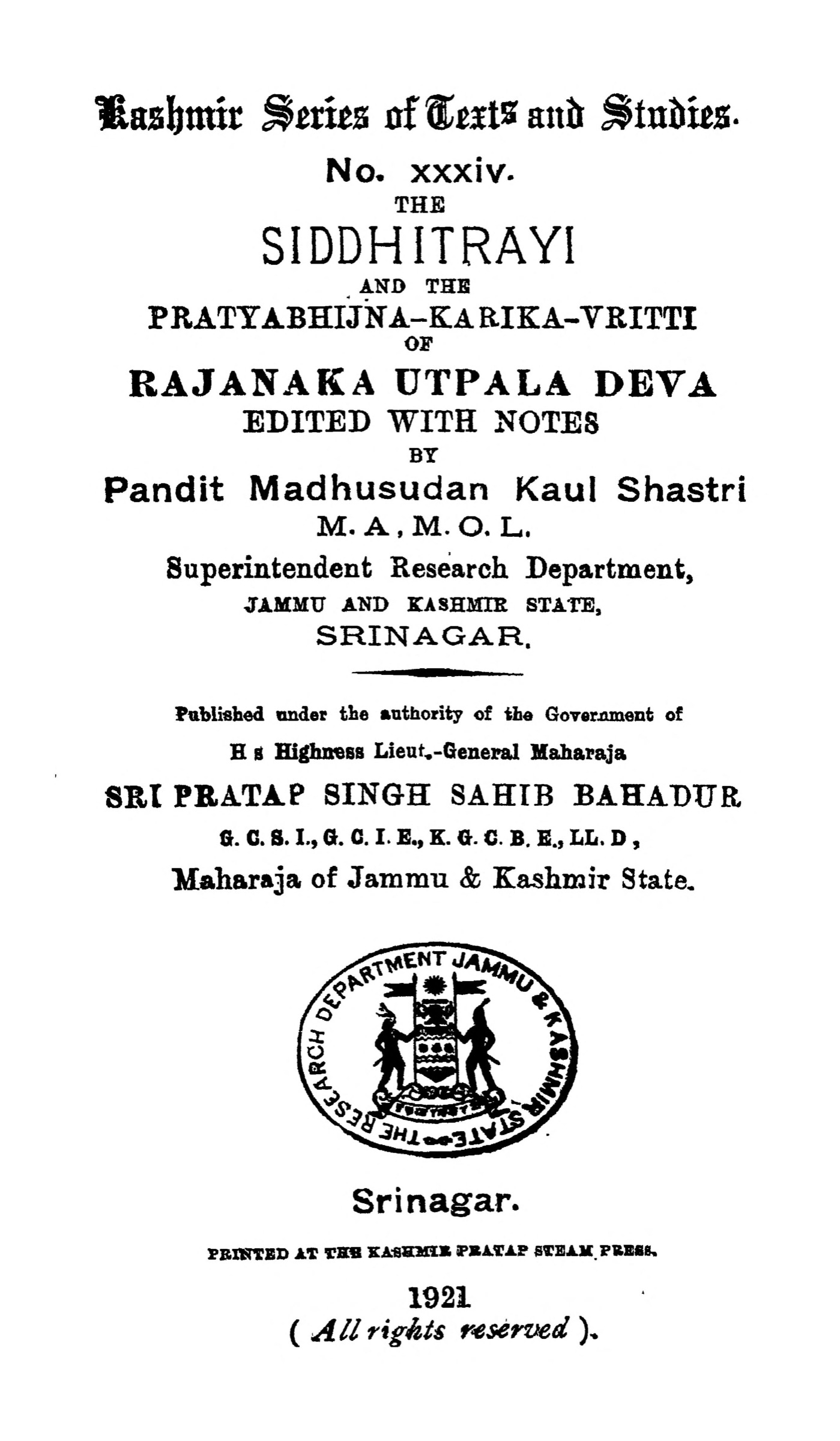
Picture: Historical edition of his work. Title page of The Siddhitrayi and the Pratyabhijna-Karika-Vritti of Rajanaka Utpala Deva, edited by Madhusudan Kaul Shastri, Srinagar, 1921. A facsimile of his works’ printed transmission.
Credit: Madhusudan Kaul Shastri, editor; Kashmir Pratap Steam Press. Source record, Public domain.
The round picture in the lists of the personalities is cropped from it.