




9 min read
Philosopher of Liberty
Voltaire
author: High Priest Zevios Metathronos
Conscience Answerable to Humanity
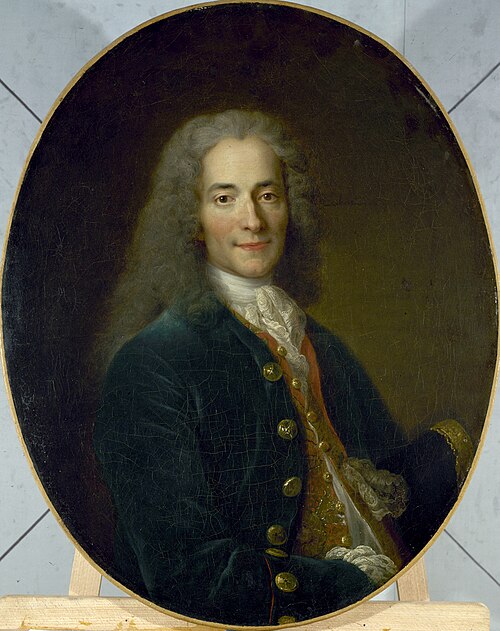
Dates: 1694–1778 CE
Period: Enlightenment (1650–1804 CE)
Voltaire, born François-Marie Arouet, wrote tragedies, epic verse, history, philosophy, a famous short novel and a vast correspondence. His best-known act of justice began in 1762. That year a Protestant merchant of Toulouse, Jean Calas, was broken on the wheel for a murder he hadn't committed, and Voltaire spent 3 years forcing France to admit it.1
Zevism reads that campaign under Zeus and his daughter Dike, Justice, who carries every crooked sentence to her father's throne, and under Ma'at, the order that a false verdict breaks. Voltaire was a deist, and he built a church to the God he believed in. What the Temple claims is his work for justice.
LIFE AND CONTEXT
He was born in Paris on 21 November 1694 into a wealthy bourgeois family and was “a brilliant pupil of the Jesuits.” His father wanted him in the law. In 1718 he refused that future by inventing a name, “de Voltaire,” an anagram of “Arouet l(e) j(eune).” The same year the Comédie-Française staged his tragedy Œdipe, his first major success.2
A quarrel with the Duc de Rohan drove him to England in 1726. Back in France, he lived from 1734 to 1749 at Cirey-en-Champagne, the château of Émilie du Châtelet. There he wrote the Éléments de la philosophie de Newton of 1738, and she reviewed it in the Journal des savants.3
After Du Châtelet's death he went to the court of Frederick II at Potsdam, from 1750 to 1753. In January 1755 he bought a house near Geneva, Les Délices, and in 1759 the seigneurie of Ferney, just inside France.4
Ferney was his base for the last 20 years of his life. He found “un hameau misérable” of barely 200 people and gave it drains, paved streets, a fountain, a school and houses for artisans, with watchmaking, a faience works and a tannery. He also built a church for the villagers inscribed Deo erexit Voltaire, “Voltaire erected [this] to God.”5
From 1760 he signed many letters with the cry Écrasons l'Infâme. J. B. Shank reads the campaign as war on “the twin hydras of fanaticism and superstition,” and adds that “it would be wrong to call Voltaire an atheist.”6
He died in Paris on 30 May 1778, 2 months after a triumphant return to the capital.7
ATTAINMENTS
- He put English religion, politics and science before French readers in a book of letters first printed in English in London in 1733. The French Lettres philosophiques followed and were “publicly burned by the royal hangman several months after” they appeared.8
- His Éléments de la philosophie de Newton of 1738 made him, in Shank's words, “the leading philosophical advocate” of the new science Newton had begun.9
- He published Candide in 1759. Its 5th and 6th chapters set the Lisbon earthquake beside an auto-da-fé staged to stop the ground from shaking.10
- He brought out the Dictionnaire philosophique between 1764 and 1770, the one explicitly philosophical book of his campaign against fanaticism.9
- He ran the campaign that cleared Jean Calas. His Traité sur la tolérance came out in 1763, and in 1765 the King's council declared Calas innocent.11
- He rebuilt Ferney. The château was finished in 1762 and took its final shape in 1766, and the hamlet around it grew into a working town with its own trades.12
- His writings fill the Oxford critical edition of the Voltaire Foundation, which will run to over 200 volumes.13
KEY STORIES
An Exile Learns English
In 1726 Voltaire was an established poet and dramatist, planning a trip to England to oversee the definitive edition of his epic, La Henriade. Then he got into what the Voltaire Foundation calls “a humiliating argument with an aristocrat, who had him briefly interned in the Bastille.” Shank names the man as the Duc de Rohan, who accused the writer of defamation. The untitled poet chose to leave the country. He reached London in the autumn of 1726.8
He set about the language at once. He read Swift's Gulliver's Travels when it first came out and learned to read English from Addison's Spectator. Before he went home in 1728 he'd begun a history of Charles XII and a book about the English.13
That book's 6th letter took the reader into the Royal Exchange in London. “There the Jew, the Mahometan, and the Christian transact together, as though they all professed the same religion, and give the name of infidel to none but bankrupts.” England had many sects, Voltaire concluded, and so “they all live happy and in peace.”14
France answered the French edition with fire. The royal hangman burned it in public, and Shank observes that the burning “turned Voltaire into a widely known intellectual outlaw.”9
Candide in the Ruins of Lisbon
In the 5th chapter of Candide the hero and his tutor Pangloss reach Lisbon by sea. “Scarcely had they reached the city, lamenting the death of their benefactor, when they felt the earth tremble under their feet. The sea swelled and foamed in the harbour.” Then the count: “Thirty thousand inhabitants of all ages and sexes were crushed under the ruins.”15
The next chapter turns from the earth to its survivors. “After the earthquake had destroyed three-fourths of Lisbon, the sages of that country could think of no means more effectual to prevent utter ruin than to give the people a beautiful auto-da-fé; for it had been decided by the University of Coimbra, that the burning of a few people alive by a slow fire, and with great ceremony, is an infallible secret to hinder the earth from quaking.”16
The satire set 2 disasters side by side, the one nobody could stop and the one that men decided on. Voltaire published it in 1759. Within 3 years the 2nd kind of disaster had a name and an address in Toulouse.
The Wheel at Toulouse
Voltaire told the story himself in the opening chapter of the Traité. On an October night in 1761 the Calas household found the son Marc-Antoine, “en chemise, pendu à une porte” near the shop. A voice in the crowd said that “Jean Calas avait pendu son propre fils,” and the rumour added that the son had meant to renounce Protestantism the next day. The White Penitents gave Marc-Antoine a solemn service “comme à un Martyr,” with a skeleton that moved and held a palm.17
“Treize Juges s'assemblèrent,” and they condemned the father by “huit voix contre cinq.” It seemed impossible, Voltaire wrote, that an old man of 68 had strangled and hanged a son of 28 on his own. Calas died on the wheel on 10 March 1762. Voltaire records that he “prit Dieu à témoin de son innocence, & le conjura de pardonner à ses Juges.”18
Voltaire heard of the case that same March and began to ask questions. He wrote letter after letter, published pamphlets and then the Traité, and kept at it until 1765, when the King's council declared Calas innocent and restored his name.19 A court's lie was taken back out of the record, which in Zevist terms is Ma'at restored.
A Laurel Wreath at the Comédie-Française
In February 1778 friends persuaded the old man to leave Ferney for Paris, ostensibly to oversee preparations for staging his new tragedy, Irène. He hadn't set foot in the capital since 1750. He “was received in triumph,” and friends called on him in a steady stream.13
His health was failing, but he went to a performance of Irène at the Comédie-Française, the house that had staged his Œdipe 60 years before. During the evening his bust was “crowned on stage with a laurel wreath” in front of him. He was too weak to travel home to Ferney and died in Paris 2 months later, on 30 May 1778.20 His niece, Madame Denis, sold the château of Ferney and part of its furniture soon afterwards.12
THE ZEVIST READING
Hesiod gives the Calas affair its oldest frame. “And there is virgin Justice, the daughter of Zeus,” he sang, “and whenever anyone hurts her with lying slander, she sits beside her father, Zeus the son of Cronos, and tells him of men's wicked heart, until the people pay for the mad folly of their princes who, evilly minded, pervert judgement and give sentence crookedly.”21 A verdict of 8 votes to 5 against an innocent father is such a sentence. Zevism reads Voltaire's 3 years of letters as Dike's complaint carried up to the throne.
Egypt names the same stakes. Maat was “the personification of truth, justice, and the cosmic order,” set against isfet, disorder.22 A false judgment is Izfet written into the law's own record, and it spreads: an exiled son, a family scattered, a city certain of a crime that never happened.
The Temple's doctrine of the Good adds a finer point. The Good is Ma'at joined to Right, the right act from a right will, and a good intention doesn't redeem a wrong act. The judges of Toulouse believed they were punishing a murderer. In chapter 6 of the Traité Voltaire tested their certainty with the rule that one shouldn't do to others what one wouldn't accept for oneself.23 That's a test Zevism accepts.
Voltaire's own faith was deism. His prayer in chapter 23 of the Traité addresses the God of all beings, all worlds and all times, and asks that small differences of dress, language and custom stop serving as signals for hatred.24 Zevism reads that prayer as a link in the long chain, a man of the Enlightenment reaching past the quarrels of sects toward 1 divine order.
NOTES
1 Voltaire Foundation, “About Voltaire”; Musée protestant, “The Calas affair”.
2 Voltaire Foundation, “About Voltaire”; Britannica, “Voltaire”.
3 Voltaire Foundation; Shank, “Voltaire,” SEP.
4 Voltaire Foundation; Château de Ferney-Voltaire, “Histoire du château”.
5 Château de Ferney-Voltaire; Voltaire Foundation.
6 Shank, SEP; Voltaire Foundation.
8 Voltaire Foundation; Shank, SEP.
9 Shank, SEP.
10 Voltaire Foundation; Candide, chs. 5–6.
11 Voltaire Foundation, Traité sur la tolérance; Musée protestant.
12 Château de Ferney-Voltaire.
14 Voltaire, Letters on England, Letter VI.
16 Candide, ch. 6.
17 Voltaire, Traité sur la tolérance, ch. 1.
18 Traité, ch. 1; Musée protestant.
19 Musée protestant; Voltaire Foundation.
20 Voltaire Foundation; Britannica, “Voltaire”.
21 Hesiod, Works and Days 256–262.
23 Traité, ch. 6.
24 Traité, ch. 23.
BIBLIOGRAPHY
Voltaire Foundation, University of Oxford, “About Voltaire”, biography: youth and name, England, Cirey, Potsdam, Ferney, the Calas campaign, the return to Paris and the complete works.
Voltaire Foundation, Traité sur la tolérance, critical edition by John Renwick, Œuvres complètes de Voltaire 56C, 2000; publication description, not a claim to have inspected the full critical apparatus.
Voltaire, Traité sur la tolérance, 1763 edition: chapter I, pp. 1–16, “Histoire abrégée de la mort de Jean Calas”; chapter VI, pp. 41–42; chapter XXIII, pp. 166–168, “Prière à Dieu.” Long s modernised in quotations.
J. B. Shank, “Voltaire”, Stanford Encyclopedia of Philosophy, first published 2009, revised 2024.
Voltaire, Letters on England, edited by Henry Morley, Cassell, 1894; Project Gutenberg; Letter VI.
Voltaire, Candide, Boni and Liveright, 1918; Project Gutenberg; chapters 5 and 6.
Musée protestant, “The Calas affair”; execution date, Voltaire's inquiries and the 1765 declaration of innocence.
Centre des monuments nationaux, Château de Ferney-Voltaire, “Histoire du château de Voltaire”.
Encyclopaedia Britannica, “Voltaire”, birth and death dates.
Hesiod, Works and Days 256–262, translated by H. G. Evelyn-White, Theoi Classical Texts Library.
Encyclopaedia Britannica, “Maat”.
CREDIT
Picture: Portrait of Voltaire traditionally identified with his age of twenty-four, Nicolas de Largillière, Musée Carnavalet, P208. Photograph by Wikimedia contributor Pyb, released under CC0.
_en_1718_-_P208_-_mus%C3%A9e_Carnavalet_-_5.jpg)
Nicolas de Largillière;photograph byPyb / Wikimedia Commons; CC0 1.0. Image record, CC0 1.0.
The round picture in the lists of the personalities is cropped from it.