





9 min read
Rocket Pioneer
Wernher von Braun
author: High Priest Zevios Metathronos
The Reach of Engineering and Its Responsibility
Dates: 1912–1977 CE
Period: Modern period (1900–present)
Wernher von Braun built rockets for 2 governments. In Germany he led the engineers who made the V-2 missile. In the United States he ran NASA's Marshall Space Flight Center and was chief architect of the Saturn V, the rocket that sent Americans to the Moon.1
The Saturn V stood 363 feet tall. When the first one lifted off on 9 November 1967, its 5 F-1 engines put out 7.5 million pounds of thrust, and on 20 July 1969 the Apollo 11 crew it had launched landed on the Moon.2
Zevism reads that machine under Prometheus, the giver of fire and of every craft. It reads the life behind the machine by the doctrine of the Good, which asks for right order and a right act together.
LIFE AND CONTEXT
He was born on 23 March 1912 at Wirsitz in Germany, now Wyrzysk in Poland. As a youth he read Hermann Oberth's 1923 book The Rocket into Interplanetary Space, and it drove him to master calculus and trigonometry so he could follow the physics. In 1928 he joined the German Society for Space Travel, the VfR.3
The field was older than he was. Robert Goddard flew the first liquid-fuel rocket at Auburn, Massachusetts, on 16 March 1926, and NASA counts him among the fathers of rocketry with Konstantin Tsiolkovsky and Oberth.4 Von Braun went to work on liquid-fuel missiles for the German army in late 1932 and took a doctorate in physics in Berlin on 27 July 1934. After 1937 the army team worked at a secret laboratory at Peenemünde on the Baltic.5
NASA's biography sets out his political record plainly: “Von Braun was a member of an SS equestrian unit in 1933–34, joined the Nazi Party in 1937 and became a junior SS officer in 1940.”5 The V-2 first flew successfully on 3 October 1942. Shortly after 11 a.m. on 8 September 1944 one struck the outskirts of newly liberated Paris, and that evening another killed 3 people in Chiswick, in west London. Over 3,000 were fired, mostly at London and Antwerp.6
In 1945 he surrendered to the Americans in the Austrian Alps with other leaders of the team. Under Project Paperclip he and about 125 colleagues were sent to Fort Bliss, outside El Paso, Texas, and helped launch V-2s at White Sands Proving Ground. In 1950 the group moved to Redstone Arsenal near Huntsville, Alabama.7
President Eisenhower transferred the Huntsville group from the Army to NASA in 1960, and von Braun became director of Marshall. In 1970 NASA called him to Washington to lead its strategic planning. He retired in 1972 to work for Fairchild Industries and died at Alexandria, Virginia, on 16 June 1977, aged 65.8
ATTAINMENTS
- The V-2 was a liquid-propellant missile 46 feet long and weighing 29,000 pounds. It flew at over 3,500 miles per hour and carried a 2,200-pound warhead to a target 200 miles away.5
- At Huntsville his team designed the Army's Redstone and Jupiter ballistic missiles and the Jupiter-C, Juno II and Saturn I launch vehicles.5
- A Jupiter-C, a modified Redstone topped by 3 solid-propellant upper stages, put Explorer 1, the first American satellite, into orbit on 31 January 1958.9
- His Marshall group worked on the Mercury-Redstone, which carried Alan Shepard, the first American astronaut, on a suborbital flight on 5 May 1961.5
- The first Saturn V flew on 9 November 1967 from Pad 39A as Apollo 4, the first all-up test of all 3 stages, and the uncrewed mission lasted 8 hours, 27 minutes and 9 seconds.10
- He made spaceflight a public cause. Collier's built a series of spaceflight issues around his ideas from March 1952, and he was spokesman for 3 Walt Disney television programmes on space travel, Man in Space.11
KEY STORIES
The Tunnels at Nordhausen
In August 1943 the Royal Air Force bombed Peenemünde, and Hitler ordered V-2 production moved underground. Within days the planners chose old mining tunnels outside Nordhausen, in central Germany, then a dump for oil products and chemical weapons. By the end of August a work commando of prisoners from Buchenwald had been sent into the tunnels.12
That autumn and winter, Michael Neufeld writes, the place “quickly became a hell on Earth.” Prisoners slept on rows of bunks in “sleeping tunnels.” Barrels cut in half with a board across them were the toilets, and blasting went on day and night and filled the living space with dust. By the end of the winter 3,000 prisoners had died, and 3,000 more, sick or dying, had been shipped off to die in other camps.12
NASA's biography states von Braun's part: “Von Braun was well aware of the terrible conditions and was involved in decision-making about the use of slave labor.” In 1969 he testified that he'd gone to the Nordhausen area around 15 times between late 1943 and February 1945.5
Of 60,000 people sent into the Mittelbau camp system, an estimated 20,000 to 25,000 died, and Neufeld attributes at least 10,000 of those deaths to the V-2 programme. The rocket itself killed a little over 5,000 Allied people, so “twice as many died producing it (or building the factory to produce it) than being hit by it.” The U.S. Army reached Nordhausen on 11 April 1945.12
The Novel 18 Publishers Refused
Once his work and home life at Fort Bliss had settled in 1947, von Braun began a novel about the first human expedition to Mars. He built it on worked-out calculations and ship designs, and he finished Mars Project in German in mid-1949.13
The story opens in 1980. A fleet of 10 ships is assembled in orbit through 950 launches of a 3-stage reusable booster. Of the 10 ships, 3 are “landing boats,” and the landing parties find “an underground technological utopia inhabited by Martians very like us.”13
It wasn't the book publishers wanted, and about 18 of them turned it down. One editor wrote back: “Somewhere in this pulpy mass are the seeds of a good piece of science fiction, but I'm darned if I can get at them.”13
The numbers outlived the plot. After Collier's made him famous in 1952, a German publisher printed the technical appendix as Das Marsprojekt late that year, and the University of Illinois Press issued a revised English version, The Mars Project, in 1953. The novel itself came out in 2006, 29 years after his death, from a small Canadian publisher.13
84 Days to Orbit
On 4 October 1957 the Soviet Union put Sputnik, the world's first artificial satellite, into orbit. The American reply, a Vanguard rocket, exploded a few seconds after liftoff on 6 December.14
Washington turned to the Army. Von Braun's team at the Army Ballistic Missile Agency and the Jet Propulsion Laboratory turned the Jupiter-C into the Juno rocket and built Explorer 1 in 84 days. The University of Iowa physicist James Van Allen designed its instruments, chief among them a cosmic ray detector.15
The rocket left Pad 26 at Cape Canaveral at 10:48 p.m. Eastern time on 31 January 1958. A team of women mathematicians at JPL computed the trajectory and confirmed that the satellite was in orbit. At 1 a.m. on 1 February, JPL's director William Pickering, Van Allen and von Braun gave the news to the press at the National Academy of Sciences building in Washington and posed holding a model of Explorer 1.16
The detector counted far fewer cosmic rays than expected. The gap led to the discovery of belts of trapped radiation around the Earth, which were named after Van Allen. Explorer 1 sent its last signal on 23 May 1958 and burned up on 31 March 1970, after more than 58,000 orbits.17
THE ZEVIST READING
Aeschylus gives Prometheus a single line for all his gifts: “every art possessed by man comes from Prometheus.”18 A rocket engine is the Titan's fire held in a chamber and aimed at the sky. Zevism reads the Saturn V as Promethean craft at the scale of a nation, the work of many trained hands joined to 1 design.
Zevism also holds that the source keeps its priority as knowledge passes from hand to hand. Von Braun learned the physics of rocketry from Oberth's book, and NASA sets Goddard, Tsiolkovsky and Oberth together as the fathers of the field. The Huntsville engineers carried an inheritance they hadn't founded.
Explorer 1 shows the doctrine of Light and Darkness at work. Unexplored darkness isn't evil; it's the ground one walks into carrying a light. The satellite took a cosmic ray detector into the dark above the atmosphere and brought back a fact nobody had held before, the belts of trapped radiation. That's discovery in the Temple's exact sense: explored darkness became knowledge.
Ma'at, “the personification of truth, justice, and the cosmic order,” stands against isfet, disorder.19 The Good in Zevism joins Ma'at to Right, the right act from a right will. The V-2 fails on both counts, a weapon aimed at cities and built in tunnels where prisoners were worked to death, and no later success changes that account.
The same doctrine lets the Temple honour what passes the test. Explorer 1 and the Saturn V were built to explore. Zevism honours that work and keeps the dead of Nordhausen in the same record.
NOTES
1 Britannica, “V-2 rocket”; NASA, “Wernher von Braun”.
2 NASA, “55 Years Ago: Apollo 4”; NASA, “Wernher von Braun”.
3 Britannica, “Wernher von Braun,” Quick Facts; NASA, “Wernher von Braun”.
4 NASA, “Dr. Robert H. Goddard”.
6 Britannica, “V-2 rocket”; Neufeld, “Vengeance Weapon 2”.
7 NASA, “Wernher von Braun”; Neufeld, “Project Paperclip”.
8 NASA, “Wernher von Braun”; Britannica, Quick Facts.
10 NASA, “55 Years Ago: Apollo 4”; NASA, “Apollo 4”.
11 Neufeld, “Mars Project”; NASA, “Wernher von Braun”.
12 Neufeld, “Wonder Weapons” and Slave Labor.
14 NASA, “60 Years Ago: Explorer 1”; NASA Science, “Explorer 1”.
15 NASA, “60 Years Ago: Explorer 1”; NASA Science, “Explorer 1”; JPL, “Explorer 1”.
16 NASA Science, “Explorer 1”; NASA, “60 Years Ago: Explorer 1”.
18 Aeschylus, Prometheus Bound 507.
BIBLIOGRAPHY
NASA, “Wernher von Braun”, biography; Oberth and the VfR, doctorate, Peenemünde, SS and Nazi Party membership, V-2 specifications, Mittelwerk and the 1969 testimony, surrender, Paperclip, Huntsville, Marshall, Mercury-Redstone, retirement and death.
Encyclopaedia Britannica, “Wernher von Braun”, Quick Facts (birth and death), and “V-2 rocket” (first successful launch, 3 October 1942).
NASA, “Dr. Robert H. Goddard, American Rocketry Pioneer”; the flight of 16 March 1926 and the shared priority of Tsiolkovsky and Oberth.
Michael Neufeld, “Wonder Weapons” and Slave Labor, National Air and Space Museum, 23 June 2020; the Nordhausen tunnels, conditions and death figures.
Michael Neufeld, “Vengeance Weapon 2”: 70th Anniversary of the V-2 Campaign, National Air and Space Museum, 8 September 2014.
Michael Neufeld, “Project Paperclip and American Rocketry after World War II”, National Air and Space Museum, 31 March 2023.
Michael Neufeld, “Mars Project: Wernher von Braun as a Science-Fiction Writer”, National Air and Space Museum, 22 January 2021.
NASA Science, “Explorer 1”; NASA History, “60 Years Ago: Explorer 1 Becomes America's First Satellite”; JPL, “Explorer 1”, mission timeline.
NASA History, “55 Years Ago: Apollo 4, the First Flight of the Saturn V”, and NASA, “Apollo 4”, mission page.
Aeschylus, Prometheus Bound 507, translated by Herbert Weir Smyth, Theoi Classical Texts Library.
Encyclopaedia Britannica, “Maat”.
CREDIT
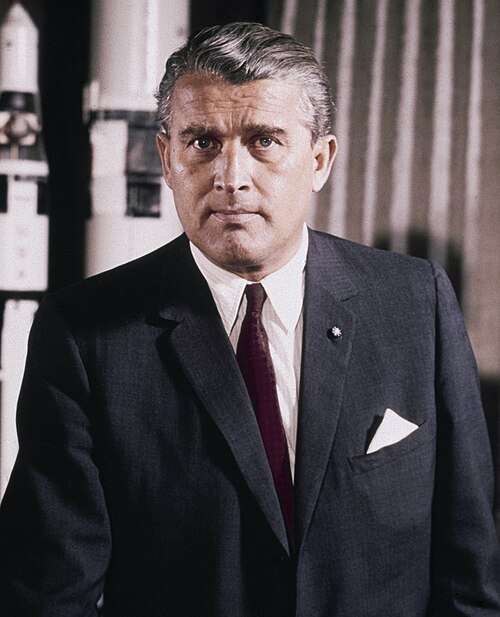
Image: Wernher von Braun in his office, 1964, NASA/MSFC photograph 6407244, cropped. Public domain; verified Commons file record.
.jpg)
NASA/MSFC, photo 6407244 (1964), cropped by Wcamp9, via Wikimedia Commons; public domain. Image record, Public domain: NASA federal work.
The round picture in the lists of the personalities is cropped from it.