




9 min read
Soldier and Historian
Xenophon
author: High Priest Zevios Metathronos
Devotion Made Durable Through Care
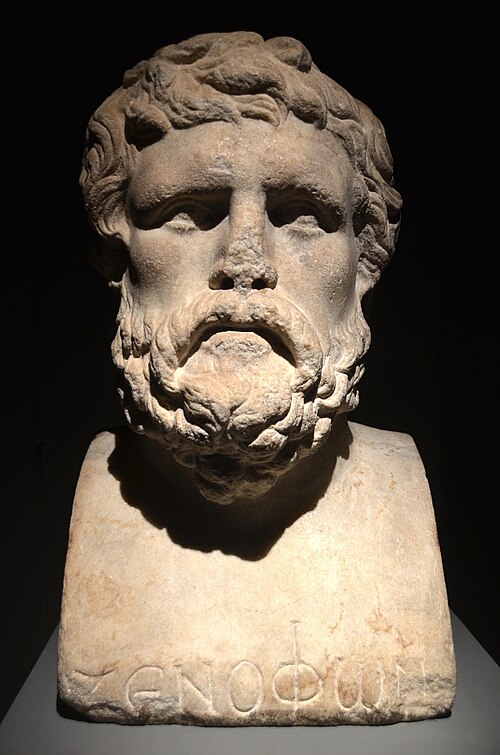
Dates: Approximately 430–354 BCE.
Period: Classical (500–334 BCE).
Xenophon of Athens was a pupil of Socrates, a mercenary officer, a historian and, by the count of Diogenes Laertius, the author of about 40 books. His prose won him the name “the Attic Muse.”1
His greatest feat came in 401 BCE. He had marched into the Persian Empire with the Greek mercenaries of the prince Cyrus. Cyrus died in the first battle, the Greek generals were then killed by treachery, and Xenophon took command of the stranded army and led the survivors to safety. He wrote the march down as the Anabasis.2
Xenophon worshipped the Gods of the Greeks and left a record of it: he consulted Apollo at Delphi, read his dreams as signs from Zeus the King, and built a shrine to Artemis. Zevism reads his march as light carried into darkness, and his shrine as the Creator's kind of offering, built to outlast its builder.
LIFE AND CONTEXT
Diogenes Laertius describes Xenophon as “a man of rare modesty and extremely handsome,” and tells how Socrates met him as a young man in a narrow passage and “stretched out his stick to bar the way.” Socrates asked where every kind of food was sold, then where men become good and honourable. Xenophon was “fairly puzzled.” “Then follow me,” said Socrates, “and learn.” Xenophon later became the first to take notes of Socrates' conversations and publish them, as the Memorabilia.3
In 401 BCE, at 29, he accepted an invitation from his friend Proxenus to join a mercenary venture into Persia. The IEP calls it “a game of thrones,” an attempt by Cyrus the Younger on the claim of his brother, King Artaxerxes II. After Cyrus fell, the treacherous execution of the Greek generals left the army “stranded, leaderless and surrounded by hostile peoples.”4
Athens banished him, Diogenes says, “for siding with Sparta.” The Spartans gave him an estate at Scillus in Elis, about 2 miles from Olympia, and he lived there in semi-retirement for about 23 years.5
After Sparta's defeat at Leuctra in 371 BCE, the Eleans drove him out of Scillus, and he moved to Corinth. He had 2 sons, Gryllus and Diodorus. Gryllus fell at Mantinea in 362 BCE, posted with the cavalry, and fought “stoutly” before he died, as Ephorus recorded.6
The news, Diogenes says, reached Xenophon while he was sacrificing “with a chaplet on his head.” He took the garland off; when he learned that his son “had fallen gloriously,” he put it back on. Some said he didn't weep at all and only said, “I knew my son was mortal.” Aristotle noted that countless writers composed eulogies of Gryllus, partly to please his father.7
The date of his death is disputed. Diogenes puts it at Corinth in the archonship of Callidemides, “obviously at an advanced age”; the IEP gives 354 BCE, and Christopher Tuplin places it shortly before 350.8
ATTAINMENTS
- He wrote about 40 books by Diogenes' count. The IEP's list of his works runs to 14 titles, from the Hellenica and the Education of Cyrus to On Horsemanship, The Cavalry Commander, On Hunting and Ways and Means.9
- He was the first to publish notes of Socrates' conversations. His Memorabilia opens by answering the charge that Socrates refused “to recognise the gods acknowledged by the state” and corrupted the young; an Apology and a Symposium add 2 more portraits of his teacher.10
- After the murder of the generals in 401 BCE he took command of Cyrus' stranded Greek army and brought the survivors out of the Persian interior to the sea.11
- His Hellenica carries Greek history from 411 to 362 BCE, starting where Thucydides stops.12
- He founded a sanctuary of Artemis at Scillus: land bought for the Goddess, a temple modelled on the one at Ephesus, a cypress-wood image, and a yearly festival for his neighbours, women and men.13
- In the Oeconomicus he made the running of a household a subject for philosophy. His speaker Ischomachus praises the gear of a Phoenician merchant ship, stowed so each item could be reached at once and checked at leisure before it was needed.14
KEY STORIES
The Thunderbolt on His Father's House
The invitation came from Proxenus, an old guest-friend, who promised to make Xenophon a friend of Cyrus. Socrates worried the city would hold it against him, since Cyrus had helped Sparta in its war on Athens, and told him to put the question to the God at Delphi.15
Xenophon went, but he asked Apollo something else: τίνι ἂν θεῶν θύων καὶ εὐχόμενος κάλλιστα καὶ ἄριστα ἔλθοι, to which of the Gods he should sacrifice and pray so as to make the journey well. Apollo named them. Socrates scolded him for not first asking whether it was better to go or to stay.16
Later, with Cyrus dead and the generals seized, Xenophon fell asleep in the camp and dreamed. There was thunder, and a bolt fell on his father's house, καὶ ἐκ τούτου λάμπεσθαι πᾶσα, and the whole house blazed. He read it 2 ways. In the midst of toil and danger he'd seen φῶς μέγα ἐκ Διὸς, a great light from Zeus. Yet the dream came from Zeus the King, Διὸς βασιλέως, and the fire burned all round him; he might never get out of the country.17 He woke, thought it through, then got up and called together Proxenus' captains first.18
The Sea! The Sea!
Late in the retreat, after the army had crossed the Harpasus river, a local guide promised to bring them within 5 days to a place from which they could see the sea. If he failed, he said, he was ready to die. “On the fifth day they did in fact reach the mountain; its name was Theches.”19
The vanguard reached the top and began to shout. In the rear Xenophon and his men “imagined that other enemies were attacking in front,” since enemies were already following behind. He mounted a horse, took Lycius and the cavalry, and pushed ahead. As he rode, the words came clear: “The Sea! The Sea!”20
On the summit the soldiers “fell to embracing one another, and generals and captains as well, with tears in their eyes.” Then they carried stones and built “a great cairn,” and heaped on it raw ox-hides, walking-sticks and the wicker shields they'd captured. The guide received a horse, a silver cup, a Persian dress and 10 darics.21
The Shrine at Scillus
After the army reached the coast, part of the expedition's proceeds was set aside for Apollo and for Artemis of Ephesus. Xenophon left the Goddess's share with Megabyzus, her temple warden at Ephesus, with orders for its use if he didn't come back alive.22
He came back. Years later, settled at Scillus near Olympia, he got the deposit back and bought land for Artemis. He built a temple and an altar there, a small copy of the great temple at Ephesus, with a cypress-wood image shaped like the golden one. A yearly tithe paid for the Goddess's festival, and the neighbours came to it, women and men.23
An inscription on the site bound whoever held the land to make the yearly offering and keep the shrine in repair.24 In Zevist terms the inscription is the finest line in the story: a dedication that names its own future keepers.
THE ZEVIST READING
Xenophon's piety is on the record, and Zevism takes it at his word. His handbook on hunting opens with the Gods: “Game and hounds are the invention of gods, of Apollo and Artemis. They bestowed it on Cheiron and honoured him therewith for his righteousness.”25 He asked Apollo which Gods to address before he marched, and he built for Artemis when he came home.
The Delphi episode adds a lesson in Φρόνησις. Socrates' complaint was exact: Xenophon asked the God how to make a journey he'd already chosen and never asked whether to make it. Zevism holds that order of questions binding on anyone who consults the Gods: first whether, then how. The ethics of the path begin with the right question.
The garland at Gryllus' death belongs to the same piety. Xenophon was at worship when the news came; he took the chaplet off in grief and put it back on when he heard how his son had fought. The Temple reads that as the existential dimension of the path: a life is judged by the way it was lived, the last day included.
The dream gives the central image. A man sleeps in a camp without leaders, deep in a country none of them knew, and sees in a dream φῶς μέγα ἐκ Διὸς, a great light from Zeus. Zevism teaches that unexplored darkness isn't evil; it's what one walks into carrying light, and darkness explored becomes knowledge. The retreat did exactly that. An army that didn't know the road walked north through unknown mountains until the vanguard saw the sea.
The Temple's doctrine of the Creator and the andrapod fits the morning after the dream. The andrapod lives among ruins and answers them with complaint. The murdered generals left Xenophon's army among ruins, and he answered by calling the captains together and making a plan. Creation is open forward and asks for work. Scillus shows the same instinct at peace. Xenophon gave Artemis land that pays its own tithe, a festival open to the neighbours and an inscription that binds every later owner to repair. Zevism reads that as Ma'at in the form of upkeep: order built so it can be carried on by other hands.
NOTES
2 Internet Encyclopedia of Philosophy, “Xenophon”.
5 Diogenes Laertius 2.51–52; IEP.
6 IEP; Diogenes Laertius 2.54.
8 Diogenes Laertius 2.56; Tuplin, “Xenophon,” Britannica.
9 Diogenes Laertius 2.57; IEP.
10 Diogenes Laertius 2.48; Memorabilia 1.1.1.
11 IEP; Anabasis 4.7.24.
12 IEP.
14 Oeconomicus 8.
15 Anabasis 3.1.4–5, Greek text ed. Steadman.
16 Anabasis 3.1.6–8.
19 Anabasis 4.7.19–21, tr. Brownson.
22 Anabasis 5.3.4–6.
24 Anabasis 5.3.13.
25 Xenophon, On Hunting 1.1, tr. Marchant.
BIBLIOGRAPHY
Diogenes Laertius, Lives of Eminent Philosophers 2.48–57, “Xenophon”, R. D. Hicks translation, Loeb Classical Library, 1925; LacusCurtius transcription.
Eve A. Browning, “Xenophon,” Internet Encyclopedia of Philosophy, introduction and §§1, 4–5; chronology, expedition, Scillus, Corinth, sons and works.
Christopher J. Tuplin, “Xenophon,” Encyclopaedia Britannica, summary dates.
Xenophon, Anabasis III, Greek text with facing vocabulary and commentary, ed. Geoffrey Steadman, 2020; 3.1.4–15. English renderings in the text are the Temple's own.
Xenophon, Anabasis 4.7.19–27, Carleton L. Brownson translation, Perseus Digital Library; passage also transcribed by the University of Pennsylvania.
Xenophon, Anabasis 5.3, especially 5.3.4–13; H. G. Dakyns translation, Project Gutenberg.
Xenophon, Memorabilia 1.1.1, H. G. Dakyns translation, Macmillan, 1897; Project Gutenberg.
Xenophon, Oeconomicus 8, published as The Economist in H. G. Dakyns's translation; the Phoenician merchant ship.
Xenophon, On Hunting 1.1, E. C. Marchant translation, Loeb Classical Library, 1925; ToposText.
CREDIT
Picture: Roman marble portrait identified as Xenophon, dated about 120 CE, Bibliotheca Alexandrina. Photograph by Carole Raddato.
Carole Raddato; CC BY-SA 2.0; Wikimedia Commons. Image record, CC BY-SA 2.0.

The round picture in the lists of the personalities is cropped from it.