





3 min read
Teacher of the Self
Yājñavalkya
author: High Priest Zevios Metathronos
The teacher of sustained inquiry into the Self
Dates: early Upanishadic tradition, first millennium BCE
Period: Ancient (6000–500 BCE)
Region: Vedic India
Tradition: sage and philosophical teacher
Religion or tradition: Vedic / early Upanishadic Brahmanical tradition; teaching concerning the Self and Brahman.
Heresy status: No designation documented.
Yājñavalkya is a central teacher in the Bṛhadāraṇyaka Upaniṣad. His instruction unfolds through exchanges with people who bring substantial questions of their own. Two of the strongest examples are his dialogue with Maitreyī about immortality and the Self, and his answers to Gārgī concerning the imperishable foundation of existence.1
GIVING STUDENTS A METHOD OF SUSTAINED INQUIRY
Yājñavalkya’s instruction joins hearing with reflection and close examination. In the Maitreyī dialogue, comparisons with sound and its instruments help the listener consider an abstract teaching through familiar experience. In the exchange with Gārgī, successive questions lead towards an account of the imperishable and cosmic order. The transmitted dialogues preserve both the conclusions and the work of reaching them.2
His positive contribution is a substantial inheritance of spiritual teaching that expects intellectual participation. Humanity received arguments, comparisons and questions through which to study the Self; inquiry into divine reality received an exacting method. For Zevist readers, the lasting service is the example of a teacher who makes understanding central and provides material to which a practitioner can return with increasing depth.
HEARING, REFLECTION AND UNDERSTANDING
In the Maitreyī dialogue, Yājñavalkya directs attention toward the Self as something to be known through hearing and sustained consideration. He develops the teaching with comparisons, including the relation of particular sounds to the instrument from which they arise. The form of the instruction matters: an abstract claim is followed by images through which the listener can examine it.3
The exchange with Gārgī gives a complementary account of the imperishable and its relationship to cosmic order. Yājñavalkya distinguishes knowledge of that reality from the accumulation of finite ritual results. The passage places a demand for understanding within the religious life itself.4
The teacher’s historical profile is inseparable from these transmitted dialogues. They establish his importance without requiring the many later works bearing his name to be treated as products of one author.
A ZEVIST INTERPRETATION
Yājñavalkya represents spiritual education that expects the student to understand. Instruction is followed by reflection, and reflection must become sufficiently clear to change how the student approaches the subject.
His example is particularly relevant to the repeated cycle of learning, application and deeper learning. An initial explanation opens a question; sustained attention exposes what remains unclear; a further exchange carries the inquiry onward. Religious growth acquires continuity through that process.
The Zevist reading here concerns the discipline of knowing and the seriousness of its aim. Yājñavalkya’s own Upanishadic teaching retains its distinctive account of the Self and ultimate reality, providing a substantial ancient source for comparative spiritual study.
NOTES
2 Bṛhadāraṇyaka 2.4; 3.8.
3 2.4.5–10.
4 3.8.8–11.
PRIMARY SOURCES
Bṛhadāraṇyaka Upaniṣad 2.4 and 3.8, trans. F. Max Müller, Sacred Books of the East 15 (1884).
CREDIT
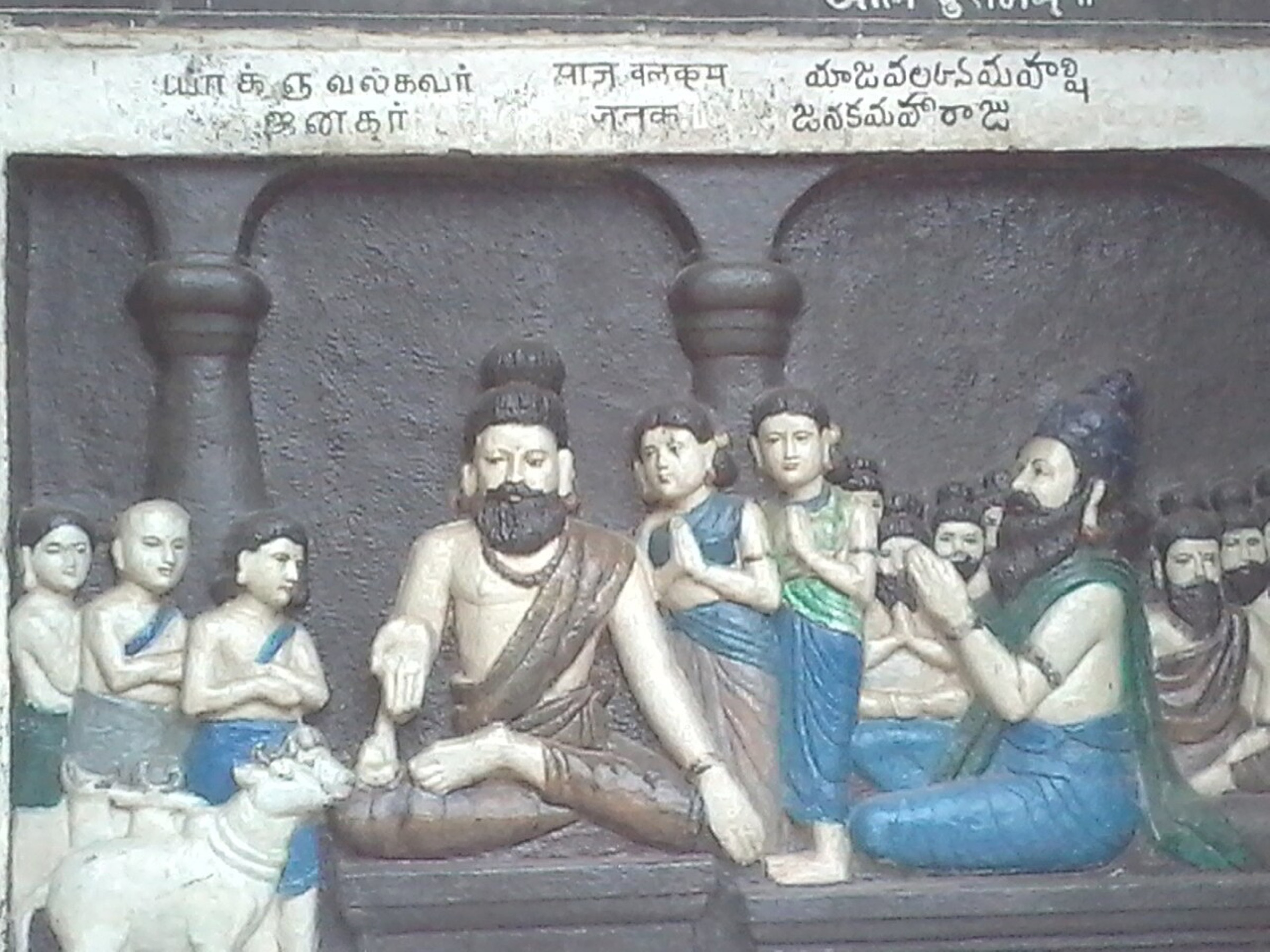
Picture: Traditional narrative image. Yājñavalkya and King Janaka, religious artwork photographed at the Sankara Mutt, Rameshwaram, by S. P. Krishnamoorthy in 2015. A traditional representation of their encounter, not an ancient portrait.
Credit: S. P. Krishnamoorthy (photograph); unidentified artist. Source record, CC BY-SA 3.0.

The round picture in the lists of the personalities is cropped from it.