





9 min read
Founder of Stoicism
Zeno of Citium
author: High Priest Zevios Metathronos
A Life Brought into Agreement
Dates: Approximately 335–263 BCE; ancient and modern chronologies vary.
Period: Hellenistic (334–30 BCE).
Zeno came from Citium on Cyprus, reached Athens after a shipwreck and founded the Stoic school there about 300 BCE. The school took its name from the Stoa Poikile, the Painted Porch on the Athenian agora, where he taught.1
His greatest attainment was a single formula for the goal of life. Diogenes Laertius says Zeno “was the first (in his treatise On the Nature of Man) to designate as the end ‘life in agreement with nature.’” He also split philosophy into physics, ethics and logic, and Athens voted him a golden crown because his conduct matched his teaching.2
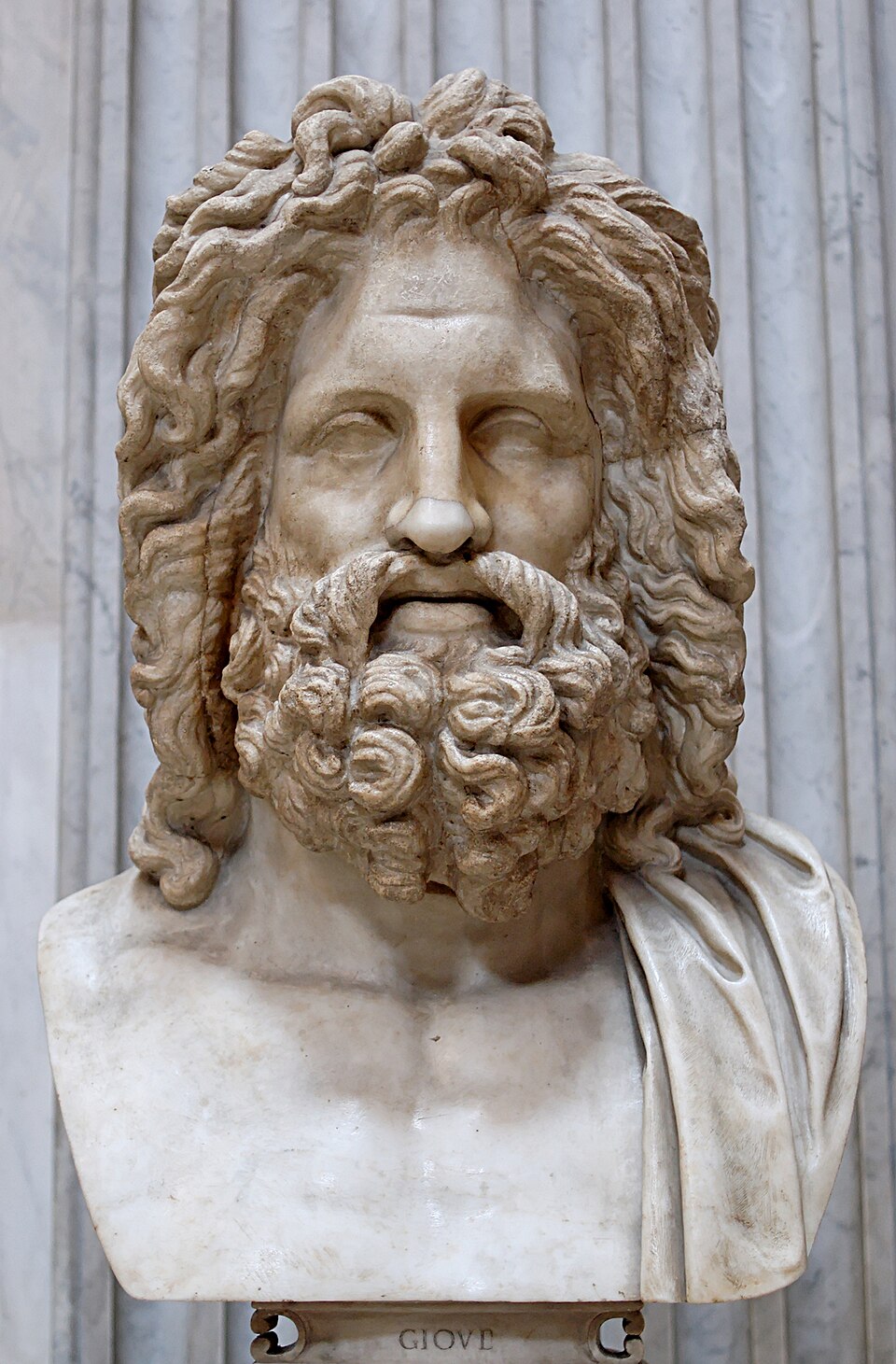
Zeno's school named the reason in all things Zeus. Zevism reads him as a link in the chain of the Logos that runs from Heraclitus, and reads his “life in agreement” as a Hellenistic name for ὁμοίωσις θεῷ, likeness to the divine.
LIFE AND CONTEXT
Diogenes gives a sharp portrait. Zeno “had a wry neck,” was lean, fairly tall and swarthy, “hence some one called him an Egyptian vine-branch.” His teacher Crates would later call him “my little Phoenician.”3 The ancient figures for his life don't agree. Diogenes has him shipwrecked at 30 and dying at 98; Persaeus “makes him die at the age of seventy‑two, having come to Athens at the age of twenty‑two.” The Oxford Classical Dictionary gives about 335–263 BCE.4
In Athens he studied with the Cynic Crates and came to know other Socratic traditions.5 While still Crates' pupil he wrote the Republic, and some said in jest that he'd written it “on the dog's tail.” Diogenes catalogues about 20 of his titles, from Of Life according to Nature and Of Duty to Homeric Problems in 5 books.6
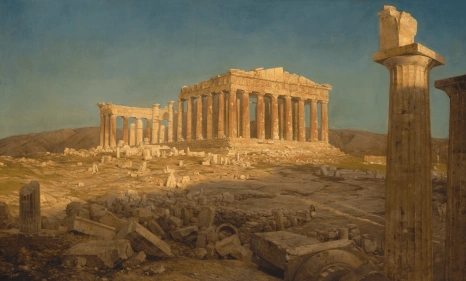
He taught in the Painted Stoa, named for the painting of Polygnotus. It was, Diogenes adds, the place where “in the time of the Thirty 1400 Athenian citizens had been put to death.”7 Pausanias saw its paintings: Athenians against Spartans at Oenoe, Theseus fighting the Amazons, the Greeks after the fall of Troy, and those who fought at Marathon. Bronze shields taken from the Spartans on Sphacteria hung there too.8
He lived plainly. “The food he used required no fire to dress, and the cloak he wore was thin”; he ate “little loaves and honey” with “a little wine of good bouquet.” His sayings were short. People have 2 ears and 1 mouth, he said, “that we may listen the more and talk the less,” and a friend is “a second self.”9
Diogenes tells of his death. Leaving the school, he tripped and broke a toe. He struck the ground and quoted the Niobe, “I come, I come, why dost thou call for me?” and “died on the spot through holding his breath.”10
No complete work of his survives. What's known comes through later writers such as Diogenes. Cleanthes of Assos succeeded him as head of the Stoa, and then Chrysippus of Soli, who ran the school from about 230 to 206 BCE and built the system out far beyond its founder. In the Roman period Stoicism reached Seneca, Epictetus and the emperor Marcus Aurelius.11
ATTAINMENTS
- He founded the Stoic school at Athens about 300 BCE, and the school took its name from the portico where it met.12
- He was the first to name the end of life as “life in agreement with nature.” Stobaeus credits him with the shorter “living in agreement” and gives “with nature” to Cleanthes.13
- He divided philosophical discourse into 3 parts, physics, ethics and logic, the frame the school kept.14
- His Republic asked that “we should consider all men to be of one community and one polity,” living “as a herd that feeds together and shares the pasturage of a common field.”15
- He taught that divine reason is active throughout matter, and his school's ethics named “the right reason which pervades all things” as “identical with this Zeus, lord and ruler of all that is.”16
- Athens trusted him with the keys of the city walls and honoured him with a golden crown and a bronze statue in his lifetime.17
KEY STORIES
The Purple Cargo and the Bookseller
Zeno was sailing from Phoenicia to the Piraeus with a cargo of purple dye when the ship went down. He was 30. He made his way up to Athens and sat down in a bookseller's shop.18
The book in his hands was the 2nd book of Xenophon's Memorabilia. He read on and was so pleased that he asked where men like Socrates were to be found. At that moment Crates the Cynic walked past. The bookseller pointed and said, “Follow yonder man.”19
Crates found his new pupil too modest for a Cynic and set out to cure him. He gave Zeno a pot of lentil soup to carry through the Ceramicus. When he saw the young man was ashamed, he smashed the pot with his staff. Zeno ran, the soup streaming down his legs, and Crates called after him: “Why run away, my little Phoenician? nothing terrible has befallen you.”20 Diogenes preserves Zeno's own summary of the whole episode: “I made a prosperous voyage when I suffered shipwreck.”6
The King's Letter
Antigonus Gonatas, king of Macedon, came to Zeno's lectures whenever he was in Athens, and at last he wrote asking Zeno to come to his court. Teaching the king, the letter said, would make Zeno “not the instructor of myself alone but of all the Macedonians taken together.”21
Zeno wrote back and declined. “I am constrained by bodily weakness, due to old age, for I am eighty years old,” he answered. He didn't leave the king without a teacher. He sent 2 of his circle, Persaeus and Philonides the Theban, to the Macedonian court in his place.22
At home the Athenians had already left the keys of their walls in his keeping, and they'd set up his bronze statue.17 The king kept his regard to the end. When the news of Zeno's death reached him, Antigonus said, “What an audience I have lost.”23
The Decree of Thraso
After his death the assembly passed a decree on the motion of Thraso, son of Thraso, of the deme Anacaea, in the archonship of Arrhenides. Diogenes copied its text.24
The decree praised Zeno for turning the young who came to him toward virtue and temperance, and above all for “affording to all in his own conduct a pattern for imitation in perfect consistency with his teaching.” It resolved to “crown him with a golden crown” and to “build him a tomb in the Ceramicus at the public cost.” The people were to elect 5 commissioners to see it done, and the secretary was to carve the decree “on two stone pillars,” 1 for the Academy and 1 for the Lyceum.25
Zeno had never hidden where he came from. When he helped pay for the restoration of the baths and the pillar listed him as “Zeno the philosopher,” he asked that the words “of Citium” be added.26 Zevism reads the pillar at the baths and the 2 pillars of the decree as 1 record: a man whose teaching and life said the same thing.
THE ZEVIST READING
The Logos begins with Heraclitus. In Daniel Graham's rendering of fragment B1, “Of this Word's being forever do men prove to be uncomprehending, both before they hear and once they have heard it.” Graham adds that “the Stoics used Heraclitus' physics as the inspiration for their own.”27 Zevism holds that the Logos originates with Heraclitus, that Egypt keeps earlier forms of it in the powers of Thoth, and that Zevism is the Logos restored. Zeno's school stands in that chain: it found reason in all things and identified that reason with Zeus.
That naming decides the reading. If “right reason” is “identical with this Zeus, lord and ruler of all that is,” then a life in agreement with nature is a life brought into line with the mind of Zeus.28 Plato called the goal ὁμοίωσις θεῷ κατὰ τὸ δυνατόν, likeness to the divine as far as possible.29 Zevism reads the Stoic end as the same ascent under a new name.
The decree of Thraso gives the Temple's measure of the Good. It praised a teacher whose conduct matched his teaching. Zevism defines the Good as Ma'at and Right together, right order joined to right act from a right will; Athens honoured Zeno for exactly that conjunction. He held his household to the same rule. A slave caught stealing pleaded that “it was his fate to steal,” and Zeno answered, “Yes, and to be beaten too.”30 An order that governs all things doesn't excuse a wrong act inside it.
Zevism also holds that one must return to the source. Zeno's own books are lost, and his words reach the present through Diogenes, Stobaeus and Plutarch. The Temple honours those transmitters as keepers of the source, and it reads the later Stoa as knowledge that evolved in transmission. The founder's formula still holds priority. Zeno kept the same rule himself: among his titles Diogenes lists Homeric Problems, in 5 books, and Of the Reading of Poetry, the work of a man who went back to Homer before he built.
NOTES
1 Stanford Encyclopedia of Philosophy, “Stoicism,” §1.1.
2 Diogenes Laertius 7.10–11, 7.39, 7.87.
4 Diogenes Laertius 7.2, 7.28; OCD, “Zeno (2), of Citium”.
9 Diogenes Laertius 7.13, 7.23, 7.26.
11 SEP, “Stoicism,” §§1.1–1.3.
12 SEP, “Stoicism,” introduction and §1.1.
13 Diogenes Laertius 7.87; SEP, §4.1.
15 Plutarch, On the Fortune of Alexander 329B.
16 Diogenes Laertius 7.88, 7.134.
BIBLIOGRAPHY
Diogenes Laertius, Lives of Eminent Philosophers, Book 7, Zeno, R. D. Hicks translation, Loeb Classical Library, 1925; LacusCurtius transcription; 7.1–15, 7.23, 7.26, 7.28, 7.39, 7.87–88, 7.134.
Dirk Baltzly, “Stoicism,” Stanford Encyclopedia of Philosophy, introduction, §§1.1–1.3 and 4.1; school history, surviving evidence and the formulations of the ethical goal.
Oxford Classical Dictionary, “Zeno (2), of Citium, founder of Stoicism”, date heading; approximate 335–263 BCE chronology.
Plutarch, On the Fortune or the Virtue of Alexander 1.6, 329B, Frank Cole Babbitt translation, Moralia vol. IV, Loeb Classical Library, 1936; LacusCurtius transcription.
Pausanias, Description of Greece 1.15.1–4, W. H. S. Jones translation, Theoi Classical Texts Library.
Daniel W. Graham, “Heraclitus,” Stanford Encyclopedia of Philosophy, fragment B1 and the Stoic reception.
Plato, Theaetetus 176a–b, Greek text, Perseus Digital Library.
CREDIT
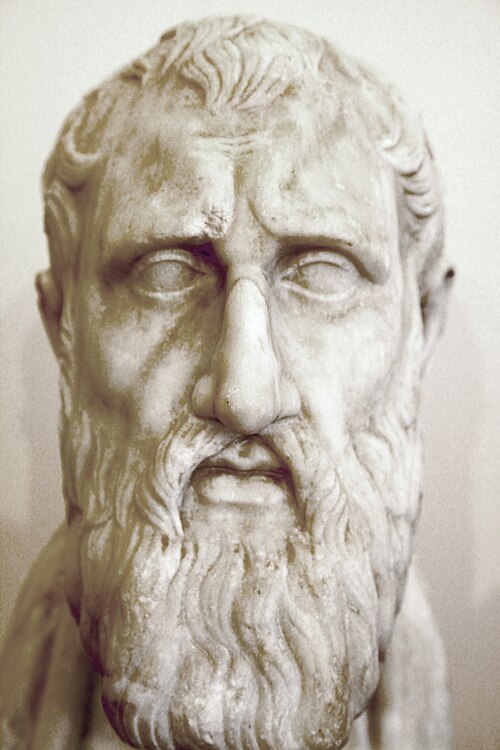
Picture: Marble portrait identified as Zeno of Citium, Farnese Collection, National Archaeological Museum of Naples, inventory 6128. Photograph by Jeremy Weate.
Jeremy Weate; CC BY 2.0; Wikimedia Commons. Image record, CC BY 2.0.

The round picture in the lists of the personalities is cropped from it.