




9 min read
Sage of Medicine
Zhang Zhongjing
author: High Priest Zevios Metathronos
Dates: Late Eastern Han period; traditionally c. 150–c. 219 CE
Period: Roman period in this collection’s timeline
Zhang Zhongjing was a physician of the last decades of the Han dynasty. He wrote the Shanghan zabing lun, the Treatise on Cold Damage and Miscellaneous Diseases, in 16 scrolls, and the 2 books later carved out of it, the Shanghan lun and the Jingui yaolüe, are still read and used in Chinese medicine.1
Britannica notes that he's “often referred to as the Chinese Hippocrates” and that his work “remains highly regarded and important in the practice of Chinese medicine.”2 His Song editors judged that his words were “refined and deep” and his methods “simple and detailed,” beyond the reach of anyone who'd heard and seen little.3
Zevism reads him as a Chinese link in the chain of healing that runs, under Greek names, through Apollo and Asclepius. His own preface gives the principle that Zevism holds first: return to the source. He wrote that his book couldn't cure every illness but might let a physician “see the illness and know its source,” 見病知源.4
LIFE AND CONTEXT
The Han histories give Zhang no biography, as the Song editors of his book observed in the 11th century. They quoted instead a lost Record of Famous Physicians: his name was Ji, Zhongjing was his courtesy name, he came from Nanyang, was recommended as “filial and incorrupt,” and rose to be governor of Changsha. He learned medicine from Zhang Bozu of the same commandery, and people of his day said his skill surpassed his teacher's.5
Modern scholarship gives his dates as about 150 to 219, so his life ended just as the Han gave way to the upheavals of the Three Kingdoms (220–265).6 The preface that carries his name dates its grief to the Jian'an period and counts the dead in his own clan.7 Its authorship is disputed: Volker Scheid notes that the foreword is “commonly perceived” to be a later addition, though the Qing imperial compendium Yizong jinjian printed it as the original preface.8
The illness that killed them was shanghan, cold damage. Cold was long held to be the most dangerous evil that enters from outside, so the term covered “feverish and epidemic disorders” in general as well as fevers caused by cold.9
The book didn't survive intact. It was lost in the wars of the Three Kingdoms, and Wang Shuhe (201–280) rebuilt it from fragments under the Western Jin and split it into 2 books.10 The Song editors call Wang the Grand Physician and write that in the more than 800 years since Zhang, “only Wang Shuhe” had been able to learn from him.3
Under the Sui and Tang the treatise circulated among physicians, but it wasn't a dominant text.10 In the Kaibao era of the early Song the military governor Gao Jichong compiled a copy and presented it to the throne, but its text was garbled and no one had ever corrected it.3 That changed after 1065, when the Song Imperial Bureau for Revising Medical Texts printed and distributed an official edition.10 Britannica records a strong revival of his teaching and practice in the 16th and 17th centuries.2
ATTAINMENTS
- He compiled the Shanghan zabing lun in 16 scrolls, drawing on the Suwen, the Nine Scrolls, the 81 Difficulties, the Great Treatise on Yin and Yang and the Tailu Drug Record, and joining them to pulse assessment and the discrimination of patterns.7
- The Shanghan lun as fixed by the Song editors runs to 10 scrolls in 22 chapters, with 397 methods and 112 formulas once duplicates were removed.3
- The Jingui yaolüe, the part on miscellaneous diseases, was edited into 25 chapters and 262 formulas in 3 scrolls.11
- He set a standard of examination. His preface condemns doctors who look at a patient for a moment, take the pulse at the hand but not at the foot and count fewer than 50 beats before they prescribe.7
- He “paid close attention to the physical signs, symptoms, kind, and course of a disease,” and “carefully recorded the results obtained from any drugs that he prescribed.”2
- Huangfu Mi, writing under the Jin, credited him with expanding the ancient decoctions of Yi Yin into dozens of scrolls, “much verified in use.”12
- His formulas kept being reworked. In 1171 the Southern Song physician Li Cheng selected more than 100 prescriptions and 172 entries from the official edition; that copy survives in the National Library of China.13
KEY STORIES
The Preface of Grief
Every time the author of the preface read of Bian Que's diagnosis in the state of Guo and his reading of the Marquis of Qi's complexion, he “sighed at the brilliance of his talent.” He marvelled at the gentlemen of his own day, who never gave their minds to medicine “to treat the illnesses of lord and parents above, to rescue the poor and lowly below,” but “raced after glory and power.” When sickness struck them, they trembled, bowed to shamans and, at the end, “gave themselves up to Heaven.”7
Then the author gave his own reason. “My clan was large, once more than 200 people. Since the Jian'an era began, not yet 10 years have passed, and 2 in 3 have died, 7 in 10 of them from cold damage.” Grieving “that the untimely dead could not be saved,” he “diligently sought the ancient teachings and gathered formulas widely.”7
The physicians fared no better. They “each carry on the family craft” without seeking the meaning of the classics, and “they face the patient for a moment and then prescribe a decoction.” That, the author wrote, “is what is called peering through a tube,” and by it “to tell death from life is hard indeed.”7
He didn't claim too much for his own result. “Though it can't cure every illness, it may let one see the illness and know its source.” He closed with Confucius: those born knowing come first, “those who learn come next.”7
The Eyebrows of Wang Zhongxuan
Huangfu Mi, writing under the Jin dynasty, tells this story in the preface to his Classic of Acupuncture and Moxibustion. Zhang met Wang Zhongxuan, whom Huangfu calls a palace attendant, when Wang was a little over 20. “You have an illness,” Zhang told him. “At 40 your eyebrows will fall out, and half a year after they fall you'll die. Take the Five Minerals Decoction and you can escape it.”14
Wang took offence at the words. He accepted the medicine and didn't drink it. After 3 days Zhang saw him again and asked whether he'd taken it. Wang said he had. Zhang answered: “Your complexion is not that of a man who has taken the decoction. Why do you hold your life so cheap?” Wang still didn't believe him.14
After 20 years his eyebrows fell out. After 187 days more, just over the half year Zhang had named, he died, “exactly as he'd said.” Huangfu paired it with another fulfilled forecast and judged that “even Bian Que and Canggong could have added nothing” to them.14
The Worm-Eaten Slips
More than 800 years after Zhang, the Hanlin academician Wang Zhu was working in the imperial library when he found, among worm-eaten bamboo slips, a text in 3 scrolls: Zhongjing's Essential Formulas of the Golden Cabinet and Jade Casket. The first scroll discussed cold damage, the 2nd miscellaneous illnesses, and the 3rd recorded the formulas and the treatment of women.15
He copied it and passed it to scholars, though only a few families held it. Physicians who used it where formula and pattern matched found that “the effect was like a god's.” Yet sometimes a pattern had no formula, sometimes a formula no pattern.16
The throne then ordered scholar officials to correct the medical books. Sun Qi, with Gao Baoheng and Lin Yi, first fixed the Shanghan lun, then the Jingui yuhan jing, and at last this text. They cut the abridged section on cold damage, kept everything from the miscellaneous diseases down to the rules on food and drink, and set 25 chapters and 262 formulas in 3 scrolls. They kept the old name.16 Zevism counts that act of rescue as part of Zhang's own work, because a source that no one copies is a source lost.
THE ZEVIST READING
Zevism holds that spirituality is one chain from its beginning to today, running through many peoples under the names of their own Gods. Zhang's preface names his part of it: the healers of high antiquity, Shennong, Huangdi and Qibo, then Bian Que and Canggong.7 In Greece the same office belongs to Apollo the physician, Asclepius and Hygieia, the powers the Hippocratic physician swore by.17 The Temple reads them as one service under different names.
His method is the Zevist return to the source. He “diligently sought the ancient teachings,” and he measured his own book by a single test: whether it let a physician see an illness and know where it came from. Zevism holds that knowledge grows as it's handed on, and that the source keeps priority over every later layer.
The chain around Zhang shows the 2nd half of that doctrine. Wang Shuhe rebuilt his text from fragments, Wang Zhu lifted it out of worm-eaten slips, Lin Yi and his colleagues corrected it, and Li Cheng rearranged it for use. Zevism honours such transmitters as keepers of the source. Without them the 16 scrolls would be a name in a preface.
The epidemic that took 2 in 3 of his clan was Izfet, the dissolution of a living order. Ma'at is “the personification of truth, justice, and the cosmic order.”18 Zhang's standard of examination is Ma'at in practice: the pulse taken at every site, the beats counted in full, the formula fitted to the pattern. A glance and a quick prescription, what the preface calls “peering through a tube,” is disorder dressed as medicine.
NOTES
1 Volker Scheid, “Transmitting Chinese Medicine,” pp. 311–313; Britannica, “Zhang Zhongjing”.
2 Britannica.
4 Preface, Zhujie Shanghan lun.
5 Song editors' preface, Zhujie Shanghan lun.
7 Preface.
8 Scheid, note 27; Yizong jinjian, juan 1.
10 Scheid, p. 313.
11 Song preface, Xinbian Jingui yaolüe fanglun.
12 Huangfu Mi, preface to Zhenjiu jiayi jing.
13 Library of Congress, Shang han yao zhi.
15 Song preface, Jingui yaolüe.
16 Song preface.
17 NLM, “Greek Medicine,” Oath tr. Michael North.
BIBLIOGRAPHY
Zhang Zhongjing (attributed), preface to the Shanghan zabing lun, titled “Shanghan zubing lun ji,” in Cheng Wuji, Zhujie Shanghan lun, Sibu congkan edition, Kanseki Repository KR3e0008, front matter; with the Song editors' preface by Gao Baoheng, Sun Qi and Lin Yi. English renderings in this article are its own.
Gao Baoheng, Sun Qi and Lin Yi, preface to Xinbian Jingui yaolüe fanglun, Sibu congkan edition, Kanseki Repository KR3e0007, front matter.
Huangfu Mi, preface to the Zhenjiu jiayi jing, Siku quanshu (Wenyuange) edition, Kanseki Repository KR3e0005, front matter; the prediction for Wang Zhongxuan.
Volker Scheid, “Transmitting Chinese Medicine: Changing Perceptions of Body, Pathology, and Treatment in Late Imperial China”, Asian Medicine 8 (2013), 299–360; pp. 311–313 and note 27.
Yizong jinjian (醫宗金鑑), juan 1, “傷寒雜病論 原序”, the received preface in the Qing imperial compendium.
Encyclopaedia Britannica, “Zhang Zhongjing”; dates, works, clinical method and later revival.
Library of Congress, World Digital Library, Shang han yao zhi yi juan: Yao fang yi juan, Li Cheng, 1171, National Library of China.
US National Library of Medicine, “Greek Medicine”, Hippocratic Oath tr. Michael North, 2002.
Encyclopaedia Britannica, “Maat”.
CREDIT
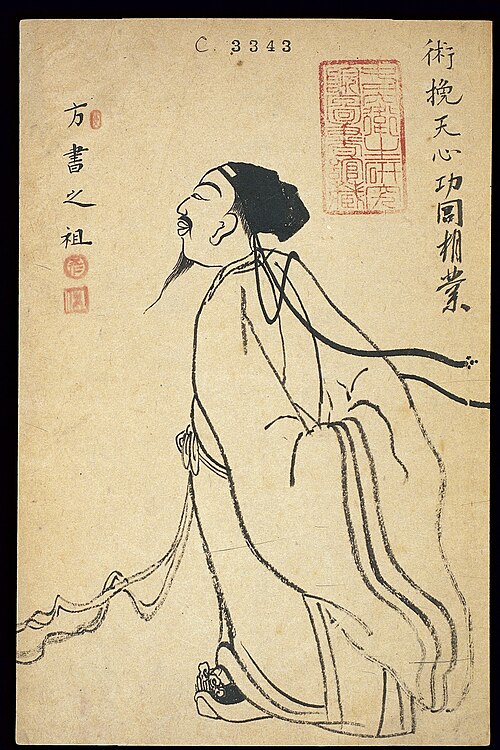
Picture: Zhang Zhongjing as represented in Lin Zhong’s Portraits of Ancient Physicians, published in 1816. A later imagined likeness.
Wellcome Collection, L0039825, via Wikimedia Commons. Image record, CC BY 4.0.

The round picture in the lists of the personalities is cropped from it.