





9 min read
Master Zhuang
Zhuangzi
author: High Priest Zevios Metathronos
Attention, Freedom, and the Art of Living
Dates: Flourished approximately 350–300 BCE; precise life dates uncertain.
Period: Hellenistic, a chronological placement covering the later part of his reported activity and the text's development.
Zhuang Zhou, Master Zhuang, was a Chinese thinker of the later 4th century BCE. Sima Qian's biography makes him a native of Meng who held an office at Qiyuan and turned down the chief ministry of Chu.1
His attainment is a book of stories. Sima Qian counted “more than ten myriads of characters” in it, over 100,000, and its 33 surviving chapters hold a cook who hadn't changed his knife in 19 years, a dream of being a butterfly and a debate about the happiness of fish.2
Zhuangzi's world was Daoist and Chinese. Zevism reads him as a link in the chain of spirituality: his cook finds the Logos in the joints of an ox, and his account of death sets the end of a life inside the order of the seasons, which is Ma'at.
LIFE AND CONTEXT
Legge's rendering of Sima Qian gives the frame. Zhuangzi “was a native, he tells us, of the territory of Mäng,” and “held an office, he does not say what, in the city of Khî-yüan.” He lived under King Hui of Liang, King Xuan of Qi and King Wei of Chu. Steve Coutinho places Meng in the state of Song.3
Chad Hansen writes that Zhuangzi “flourished through the latter half of the fourth century BC, roughly contemporary with Mencius.” His companion in argument was Hui Shi, “Zhuangzi's close friend, perhaps mentor, his interlocutor, and occasionally his foil.”4
Sima Qian admired the writing. “Kwang was an admirable writer and skilful composer,” he says in Legge's version, and most of the work is “occupied with metaphorical illustrations of Lâo's doctrines.” He names 3 chapters, “The Old Fisherman,” “The Robber Kih” and “The Cutting open Satchels,” that satirized the followers of Confucius.5
The book reached its present shape about 600 years later. Guo Xiang, who died in 312 CE, judged that many chapters had been added after Zhuangzi's time. He “reports compressing that prior collection of writings from fifty-two chapters to thirty-three” and divided them into the Inner Chapters (1–7), the Outer Chapters (8–22) and the Miscellaneous Chapters (23–33).4
That history leaves authorship open. The received text holds the work of several hands, and even Zhuangzi's authorship of all 7 Inner Chapters is a scholarly hypothesis. The stories are told here as the Zhuangzi tells them.6
ATTAINMENTS
- He left, by Sima Qian's count, more than 100,000 characters of writing, of which Guo Xiang kept 33 chapters in 3 sections.7
- Chapter 3 turned butchery into a lesson on skill. Cook Ding tells his lord, “What I care about is the Way, which goes beyond skill,” and the lord answers that he has learned “how to care for life.”8
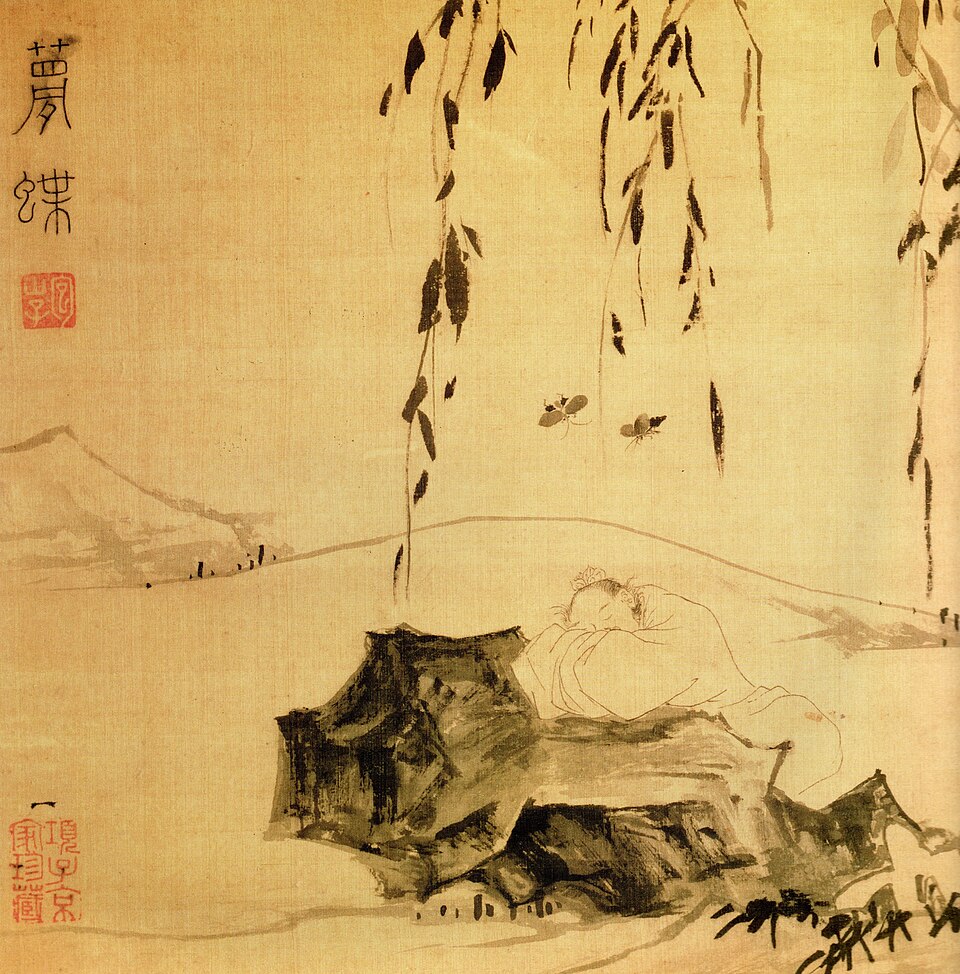
- Chapter 2 closes with Zhuangzi's dream of being a butterfly, after which he can't tell whether he dreamed the butterfly or the butterfly dreams him. The text uses it to reflect on transformation.9
- Chapter 17 records his debate with Hui Shi on the bridge over the Hao, which ends on the words “I knew it here above the Hao.” A.C. Graham drew attention to the role of perspective in it.10
- Chapter 18 gives an account of death as a single change in a series, from formless chaos to breath, bodily form, life and death, “like the procession of the four seasons.”11
- His satire of the Confucians and Mohists won the historian's praise: “by his instances and truthful descriptions” he “hit and exposed the Mohists and Literati.”5
KEY STORIES
The Cook and the Ox
Cook Ding was cutting up an ox for Lord Wenhui. The chapter gives the sound of it. With every touch of his hand, heave of his shoulder, move of his feet and thrust of his knee came a “zip, zoop!” The knife moved “in perfect rhythm, as though he were performing the dance of the Mulberry Grove.”8
“Ah, this is marvelous!” said the lord. Ding laid down his knife and explained. At first he saw only the whole ox. After 3 years he no longer did. Now, he said, “I go at it by spirit and don't look with my eyes.” He followed the natural makeup, struck in the big hollows and guided the blade through the openings.12
A good cook changes his knife once a year, because he cuts; a mediocre one changes it monthly, because he hacks. “I've had this knife of mine for nineteen years and have cut up thousands of oxen with it,” Ding said, and the edge was still as if fresh from the grindstone.12
At a hard place he slowed down, watched closely and moved the knife with the greatest care “until flop! The whole thing comes apart like a clod of earth crumbling to the ground.” Then he wiped the knife and put it away. “Excellent!” said Lord Wenhui. “I have heard the words of Cook Ding and learned how to care for life!”12
The Ox for the Border Sacrifice
King Wei of Chu heard of Zhuangzi's ability, Sima Qian writes, and “sent messengers with large gifts to bring him to his court,” with the promise that he'd make him chief minister.13
Zhuangzi answered the envoys plainly. “A thousand ounces of silver are a great gain to me,” he said, and a minister's post “a most honourable position.” Then he asked them about the ox kept for the border sacrifice. “It is carefully fed for several years, and robed with rich embroidery that it may be fit to enter the Grand Temple.” On the day it's led in, it would gladly be a little pig, “but it cannot get to be so.”5
He sent them off: “Go away quickly, and do not soil me with your presence. I had rather amuse and enjoy myself in the midst of a filthy ditch than be subject to the rules and restrictions in the court of a sovereign.” He'd decided, he told them, “never to take office.”5
The Fish Under the Hao Bridge
Zhuangzi and Hui Shi were strolling over the bridge on the Hao River. Zhuangzi looked down and said, in Hansen's translation, that the little fish “cruising around, relaxed and unhurried, are fish at leisure.”10
Hui Shi pounced. “You are not a fish; from whence do you know the leisure of fish?” Zhuangzi turned it back on him: “You are not me, from whence do you know my not knowing fish at leisure?” Hui Shi pressed on. He wasn't Zhuangzi, so he couldn't know about Zhuangzi, and Zhuangzi wasn't a fish, “and that's enough to count as you're not knowing fish's leisure.”10
Zhuangzi asked to go back to the start. Hui Shi's own question, “from what perspective do you know,” had already granted that he knew. Then he gave his answer: “I knew it here above the Hao.” Hansen notes that A.C. Graham drew attention to the role of perspective in the exchange.10
The Drum at His Wife's Death
When Zhuangzi's wife died, Hui Shi came to offer condolence. Legge's translation of chapter 18 says he found Zhuangzi “squatted on the ground, drumming on the basin, and singing.”11
Hui Shi was shocked. She'd lived with him, raised his children and grown old, he said; “not to wail for her is enough. When you go on to drum on this basin and sing, is it not an excessive (and strange) demonstration?”14
Zhuangzi didn't deny his grief. “When she first died, was it possible for me to be singular and not affected by the event?” Then he'd thought back to before her birth, when she had no life, no form and no breath. Out of the chaos came a change and there was breath, another and there was form, another and there was life. “There is now a change again, and she is dead.”14
The whole sequence, he said, was “like the procession of the four seasons from spring to autumn, from winter to summer.” She lay now “sleeping in the Great Chamber,” and to sob and wail would show he “did not understand what was appointed (for all).” So he stopped.14
THE ZEVIST READING
Cook Ding's method is to follow “the natural makeup” of the ox and “follow things as they are.”12 Heraclitus said that “all things happen according to this Word,” the Logos, though most people never grasp it.15 Zevism reads the spaces between the joints as the Logos written in flesh. The knife that lasts 19 years is intelligence joined to the structure of things, and the Temple holds that Zevism is that Logos restored.
The cook's words also describe the dimension of Meditation, the capacity of power, τὸ δυνατόν. “Perception and understanding have come to a stop and spirit moves where it wants.” That's power trained until it wastes nothing: no hacking, no broken blade, and care at the hard place. The Temple's practice aims at the same capacity.
The death of Zhuangzi's wife is a lesson in Ma'at, which Egyptian religion named “the personification of truth, justice, and the cosmic order.”16 Chaos becomes breath, breath becomes form, form becomes life, and life returns, in the order of the seasons. Zevism reads that order as the structured cosmos that Zeus holds as Sovereign. Zhuangzi's grief was real, and his understanding set it inside that order.
The refusal of King Wei completes the portrait. The embroidered ox is fed for years so it can die in a temple ceremony. Zhuangzi saw the price of the honour and kept his freedom for his work. In Zevist terms a life lived in service of the path needs that freedom, since a mind owned by a court can't follow the Logos where it leads.
NOTES
1 Sima Qian, in Legge, Texts of Taoism, introduction, chapter 4; Hansen, “Zhuangzi,” §1.
2 Legge, chapter 4; Zhuangzi 3, in Sources of Chinese Tradition.
3 Legge, chapter 4; Coutinho, “Zhuangzi,” IEP.
4 Hansen, §1.
7 Legge, chapter 4; Hansen, §1.
8 Zhuangzi 3, Sources of Chinese Tradition.
9 Hansen, discussion of Zhuangzi 2:14.
11 Legge, Texts of Taoism, part 2, book 18.
12 Zhuangzi 3.
13 Sima Qian, in Legge, chapter 4.
14 Legge, book 18.
15 Graham, “Heraclitus,” fragment B1.
BIBLIOGRAPHY
Chad Hansen, “Zhuangzi”, Stanford Encyclopedia of Philosophy, substantive revision 24 March 2024; §§1–2, Guo Xiang's edition, Hui Shi, the butterfly dream (2:14) and the Hao River dialogue (17:13), in Hansen's translation.
Steve Coutinho, “Zhuangzi (Chuang-Tzu, 369–298 B.C.E.)”, Internet Encyclopedia of Philosophy; Meng in the state of Song.
Sima Qian, Shiji 63, “Accounts of Lâo-dze and Kwang-dze given by Sze-mâ Khien”, translated by James Legge, The Texts of Taoism, part 1, Sacred Books of the East 39 (Oxford, 1891), introduction, chapter 4; Internet Sacred Text Archive.
Columbia University, Asia for Educators, Selection from the Zhuangzi: Chapter 3, “The Secret of Caring for Life”, from Wm. Theodore de Bary and Irene Bloom, compilers, Sources of Chinese Tradition, 2nd edition, volume 1, Columbia University Press, 1999, pp. 103–104.
James Legge, translator, The Texts of Taoism, part 2, Sacred Books of the East 40, Oxford, Clarendon Press, 1891; book 18, “Kih Lo, or Perfect Enjoyment,” paragraph 2; Internet Archive text.
Daniel W. Graham, “Heraclitus”, Stanford Encyclopedia of Philosophy; fragment B1.
Encyclopaedia Britannica, “Maat”.
CREDIT
Picture: Lu Zhi, Zhuangzi Dreaming of a Butterfly, mid-sixteenth century, detail. A later artistic interpretation of the chapter 2 story, not a contemporary portrait. Public-domain artwork and reproduction as documented by Commons.

Lu Zhi, Zhuangzi Dreaming of a Butterfly, detail; Wikimedia Commons; public domain. Image record, Public domain artwork and reproduction.
The round picture in the lists of the personalities is cropped from it.