




| Language / Culture | Name of Ra | Attestation |
|---|---|---|
| Old Egyptian | Rꜥ (𓂋𓂝𓇳) | Name of Hesy-Ra (27th century BCE) |
| Old Coptic Egyptian | ⲣⲏ (Re) | Crum 287 (3rd–4th century CE) |
| Akkadian | 𒊑𒀀 (Ria) | Treaty of Ramesses II and Hattusili III (circa 1259 BCE) |
| Phoenician | 𐤓𐤏 (Ra) | Iron Age II Levantine-Phoenician scarabs |
| Greek | Φρῆ (Phre) | PGM V.24–30 (fourth century CE) |
41 min read
RA
author: High Priest Zevios Metathronos
co-author: Novice Priest Karnonnos
I. The Name of the Sun
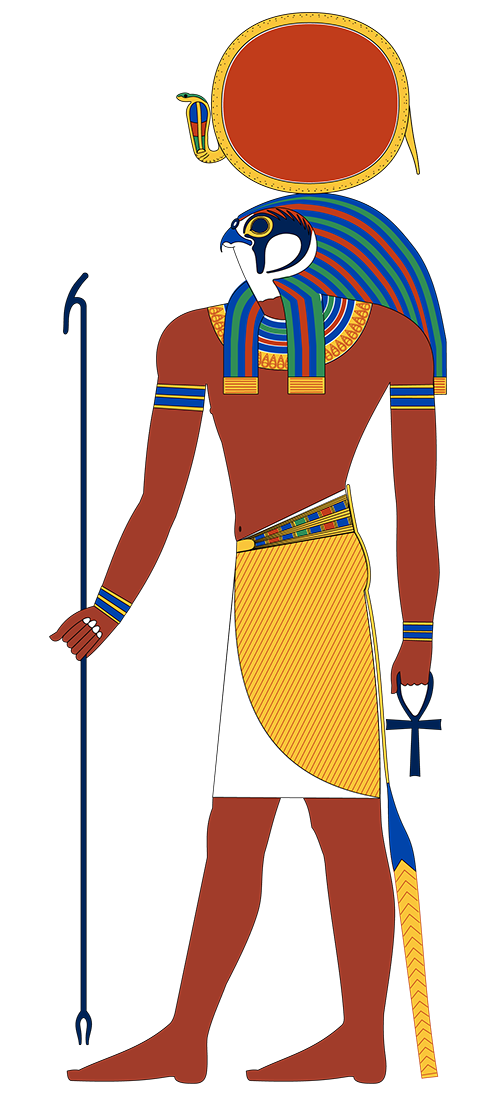
Egyptologists disagree about exactly where Ra first appears in the written records of Egypt. Early candidates include the name of the king of Second Dynasty conventionally called Raneb or Nebra around 2880 BCE. This name is preserved inside royal serekhs on stelae, stone vessels and seal impressions; clear surviving evidence is a granite stele in Metropolitan Museum of Art object 60.144.
Jochem Kahl argued at length that the name reads Rꜥ nb meaning "Lord Ra" and that this serekh marks the first known appearance of Ra as a named deity. Ronald Leprohon translates similarly. Readers who are more careful maintain Nb ra ꜥ, meaning "Lord of the Sun," under which reading the sign still refers to the visible disk rather than an independent deity.1,2,3,4
The earliest reference that no one disputes belongs to the beginning of the Third Dynasty, in the reign of Djoser, when personal names compounded with the god appear. The senior official and royal scribe Ḥsy-Rꜥ, "He whom Ra favours," left his name across the carved wooden panels of his mastaba S 2405 at Saqqara, and a divine name embedded in a human theophoric name cannot readily be explained away as the mere sun.
Modern surveys of Old Egypt have treated the names of officials like Hesy-Ra as the earliest accepted examples that an actual cult of the sun god existed. However, there is an argument based on a re-evaluation of the Netjerikhet Stela that organized solar worship also began around the same time. Older objects, such as the First Dynasty ivory comb of King Djet, which depicts a winged barque crossing the heavens, depict Ra's imagery but they do not write his name..2,5,6,7
The etymology of the theonym is, by Egyptian standards, plain. Rꜥ is the common noun for the sun itself; the god has the name of the thing he is, written with the mouth and arm signs and sealed with the sun-disk 𓇳, the sign Gardiner catalogued as N5. At the other end of the tradition stands Coptic ⲣⲏ (rē).8,9,10
The cuneiform version of the treaty between Ramesses II and Hattusili III, sealed in approximately 1259 BCE, writes the Egyptian king as Riamašeša and his throne name as Wašmuaria, so that the syllable ria preserves the living vocalization of Rꜥ in the thirteenth century BCE.11,12,13
Starting with Herodotus, the Greeks usually substituted their own Helios for Ra. On the Rosetta Stone, immortal royal titles such as Son of Ra became υἱὸς τοῦ Ἡλίου, meaning "Son of the Sun." Nonetheless Ra's name slips into royal names: Herodotus tells a treasure story of King Rampsinit, or Ramesses, meaning "Ra has borne him" sometime in the fifth century B.C.E. Only in the Magical Papyri from Roman Egypt does Ra finally appear invoked in Greek by his own name, Phre (Φρῆ); one recipe cries out "Listen to me, Helios, Phre!"14,15,16
When Tacitus told the story of Germanicus visiting Thebes in its ruinous state circa 19CE, an elderly priest read the hieroglyphics aloud to him and said that King Rhamses had 700,000 men, while the Kings of Napata and Meroe wrote Ra with Egyptian characters into their own title documents as sons of Ra in Ra-extended throne titles from approximately 727 BC on the Victory Stele of Piye until Teqorideamani who ruled from 253 AD and used Ḥpr-Kꜣ-Rꜥ for his first name.
However, the Meroitic language itself never translated his name either because in Meroe, the sun was worshiped under the indigenous name Mash (MS) like in the inscription of official Haramadeye at Karanog, where it is also linked to the imperial god as Mash Amani (Mash + Amani), a Meroitic version of Amun-Ra.17,18,19,20,21
The twelfth month of the Egyptian civil year was named mswt-Rꜥ, "the Birth of Ra," after the feast of the sun's renewal that opened the year; the month passed into Greek as Μεσορή and lives on in the Coptic ecclesiastical calendar as ⲙⲉⲥⲱⲣⲏ to the present day, so that the name of the god is still spoken wherever the Coptic year is kept.13,22,23
Sources: Thesaurus Linguae Aegyptiae, rꜥw; Kahl, "Ra Is My Lord", 2007; Metropolitan Museum of Art, "Stela of King Raneb"; Beckman, Hittite Diplomatic Texts, 1999; Herodotus, Histories, 1920; Betz, The Greek Magical Papyri in Translation, 1992; Tacitus, Annals, 1931; Griffith et al., The Demotic Magical Papyrus of London and Leiden, 1904; Crum, A Coptic Dictionary, 1939; Griffith, Karanòg, 1911.1,3,8,11,12,15,16,17,21,23
II. Ra in the Egyptian World
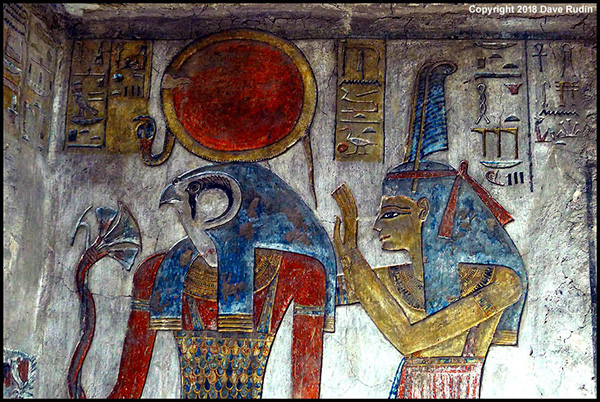
Ra, Mural from the Tomb of Tausert and Setnakht
The Old Kingdom
Ra is invariably bound to Egypt as a rising power. Beginning with the Fourth Dynasty, the Pharaohs were tied to the god by name; Djedefre (the second king after Khufu) was the first to place the title sꜣ Rꜥ ("son of Ra") within the royal titulary, while his brothers who held the throne during this time (Khafre and Menkaure), included the god's name as part of their own names. The practice of using Ra in conjunction with the throne name taken at accession continued from the Fifth Dynasty until it had become customary throughout all dynasties. Even the foreign Assyrian, Kushite, Persian, Greek, Roman and other powers over Egypt used the name like this over a span of nearly three millennia.4,10
Six Pharaohs of the Fifth Dynasty are recorded as having built sun temples, while two have been found: Userkaf built Nekhen-Ra and Niuserre built Shesepu-ib- Ra at Abu Ghurab. Open courts face up around low obelisks on podiums and there is a large altar made of alabaster that shines in bright light. Later legend in the Papyrus Westcar explains this dynasty as they understood themselves: the first three Pharaohs were born directly by Ra to Ruddedet, wife of one of his priests.24,25,26
At the close of the dynasty the god enters the oldest religious corpus of mankind. In the Pyramid Texts of Unas, Ra stands at the summit of the resurrection machinery as father, ferryman and goal, the one to whom the dead king ascends:
"O Ra-Atum, this Unas comes to you, an imperishable akh; your son comes to you, this Unas comes to you."
Pyramid Texts, Utterance 217, trans. after Allen27
In these spells the king crosses to the eastern horizon, joins the crew of the solar barque and circles the sky in the following of Ra forever. The solar destiny and the Osirian destiny already sit side by side in the pyramid, and their long negotiation would occupy Egyptian religion to its end.27,28
The Middle Kingdom
The First Intermediate Period taught Egypt to speak of Ra as a moral creator. The Instruction for Merikare contains the most humane theology the Old Kingdom tradition produced: mankind are the cattle of the god, and for their sake he made heaven and earth, drove back the water-monster, made the breath of life for their nostrils, and rises in the sky according to their desire, for they are his images who came from his body. When Egyptians of the Twelfth Dynasty described the death of Amenemhat I, they said what the Pyramid Texts had promised, now in courtly prose, telling how the dead king flew to heaven and united with the sun-disk.29
The same age prepared the greatest of all the syntheses of Ra. At Thebes the dynastic god Amun was joined to the sun as Amun-Ra, a compound attested at Karnak by the early Middle Kingdom, and the new double name began the career that would carry it to the kingship of the gods.30,31
The New Kingdom
The New Kingdom is the imperial noon of the god. Amun-Ra of Karnak became the state god of the empire and the theology of the sun's daily course was elaborated into a literature of its own. The royal tombs of the Valley of the Kings received the Amduat, the "Writing of the Hidden Chamber," first complete in the tomb of Thutmose III, which maps the twelve hours of the night hour by hour; beside it the Litany of Ra invoked the sun in seventy-five forms and identified the dead king with the god in each of them. Jan Assmann has reconstructed from the hymn corpus of this age a solar religion of extraordinary intellectual refinement, in which the priest, speaking as the king, accompanies the constellation of the sun through its phases.28,31,32,33
The city of the god shared the noon. Under Ramesses II, whose very name proclaimed that Ra had borne him, Heliopolis was among the largest temple establishments in Egypt, staffed by a prosopography of priests and officials that modern scholarship has patiently recovered, and royal sons were sent to hold its highest office. What the Amarna interlude did to this world, and how the order of Ra broke the disturbance, is told below in its own place.34
Late, Ptolemaic and Roman Periods
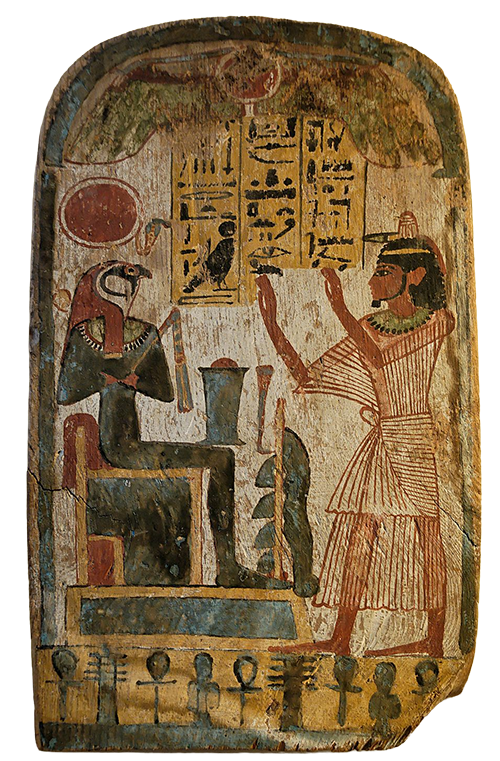
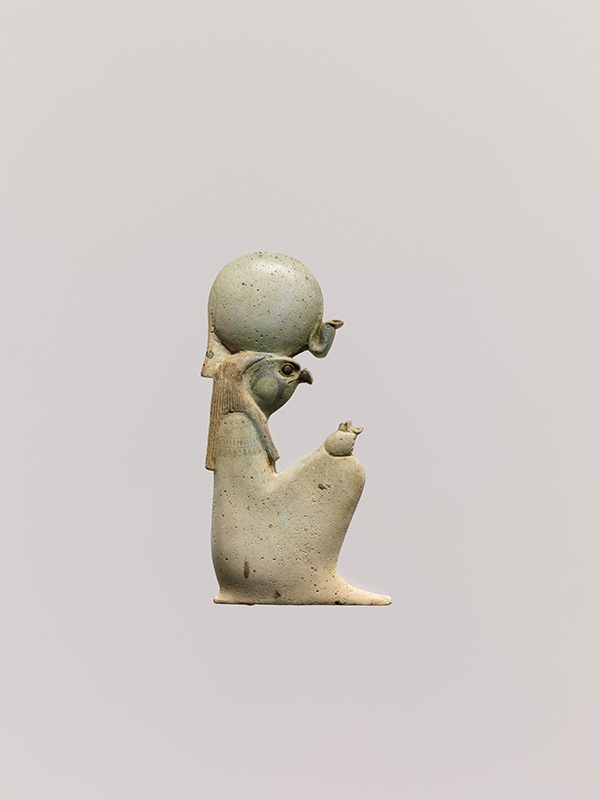
The cult of Ra expanded after the New Kingdom. Although he still remained the direct object of worship at Heliopolis, his presence was now seen in other temples. For example, he was worshipped as Amun-Ra at Tanis and Karnak. Similarly, in addition to being a funerary deity on the stelae of individuals (Ra-Horakhty), he was referred to as Atum or Atum-Khepri in the morning rituals. Furthermore, he has become the solar dimension of local creator gods, for instance Banebdjed at Mendes, where Amasis erected four monumental naoi to Shu, Geb, Ra and Osiris as the four bases of the ram god.35,36,37,38,39
Under the Persians, Darius I had himself remembered beside Atum, Lord of Heliopolis, and Ra-Horakhty, and the temple of Hibis in Kharga Oasis preserved five monumental hymns in which Amun-Ra is awakened by his priests and becomes radiant as Ra at dawn.
The Ptolemies built grand houses for other gods related to Ra where the late theology of the sun reached its fullest elaboration: Edfu for the solar Horus and Dendera for Hathor, the Eye of Ra. During the Roman period , the cult of Khnum Ra continued at Esna until Decius reign from 249 to 251CE whose cartouche closed the decoration of hieroglyphic writing there. Strabo who saw Heliopolis around 25BCE already found the city of the god deserted; the longest inscription in hieroglyphs carved at Philae beside image of solar god Mandulis seems to indicate the traditions associated with him did not dissipate.40,41,42,43,44,45
III. The Epithets of Ra
| Epithet | Meaning | Domain |
|---|---|---|
| Rꜥ-Ḥr-ꜣḫty | Ra-Horakhty, Ra who is Horus of the Two Horizons | The risen and reigning sun; solar kingship |
| Rꜥ-Jtm | Ra-Atum | The completed creator; the evening sun; head of the Heliopolitan Ennead |
| Ḫprj | Khepri, the Becoming One | The scarab of dawn; self-generation and renewal |
| Jmn-Rꜥ nswt nṯrw | Amun-Ra, King of the Gods | The hidden creator made visible as the sun |
| nb-r-ḏr | Lord to the Limit | Universal sovereignty over all that the disk encircles |
| jt-nṯrw | Father of the Gods | Progenitor of the Ennead; source of gods and men |
| nṯr-ꜥꜣ | The Great God | Supreme divine rank |
| nb-pt | Lord of Heaven | Celestial dominion |
| nb-Jwnw | Lord of Heliopolis | The ancestral cult city and its temple |
| ꜥnḫ-m-Mꜣꜥt | Who Lives on Maat | The order of the world as the god's sustenance |
| ḥry-jb-wjꜣ.f | Who is in the Midst of his barque | The daily voyage; the god enthroned in the solar boat |
| Rꜥ m ḥtp.f | Ra in his Setting | The western descent; entry into the Duat |
| Ζεὺς Ἥλιος μέγας Σάραπις | Zeus Helios, Great Sarapis | Imperial-age composite carrying the solar inheritance |
| παντεπόπτης | The All-Seeing | Mandulis-Helios-Aion |
Sources: Leitz, Lexikon der ägyptischen Götter und Götterbezeichnungen, 2002; Quirke, The Cult of Ra, 2001; Wilkinson, The Complete Gods and Goddesses of Ancient Egypt, 2003; Betz, The Greek Magical Papyri in Translation, 1992; Bricault, The Sword and the Patera, 2024; Nock, A Vision of Mandulis Aion, 1934.10,16,30,46,47,48
The ranking of these titles follows their weight in the cult. Ra-Horakhty stands first because he is the god as the ritual day actually met him, the risen sun to whom the morning service and the great hymns were addressed; Ra-Atum holds the evening as Khepri holds the dawn, the three names dividing one circuit among themselves without dividing the god. Amun-Ra, King of the Gods, is placed among the epithets of Ra rather than beside them because the compound was precisely a title that Ra conferred: the hidden one becomes worshippable by becoming the sun. The universal styles, Lord to the Limit and Father of the Gods, belong to the creator of the Heliopolitan cosmogony, who arose alone upon the primeval mound and wept mankind from his Eye. The Greek epithets at the foot of the table are late and few, for the Greeks preferred translation to naming; yet Phre in the magical papyri, the sword-bearing Zeus Helios Great Sarapis of the Eastern Desert, and the all-seeing Sun-Aion of the Mandulis vision each carry a recognizable inheritance of the Heliopolitan god into another tongue.10,31,47,48,49
IV. The Temples and Sacred Sites of Ra
Iunu, the City of the Pillar
Every road in Ra's cult lead to Heliopolis, also known as Egyptian Jwnw, "the pillar". Ra was the recipient of a city that worshipped him. Here stood the central house of Ra, the pr-Rꜥ, and its holiest place, the Mansion of the Benben (ḥwt-bnbn), where a pyramid stone marked the mound from which the creator first rose from waters. Tradition says that at first sunrise this bird called the Bennu alights on that stone; Herodotus also records the Greek tradition of this same bird, the phoenix, which carries father's body to the Temple of Sun at Heliopolis once every five hundred years.10,15,34
Sacredness of Iunu was matched by a timelessness that even the Egyptians considered eterna. The priests were revered for their knowledge everywhere.
The inheritance we have now of the sun city are its obelisks. They were made to be dedicated to the divinity of the sun as an image of his rays. A pair were erected in front of the Temple by Sesostris I during his jubilee celebration in the early twentieth century B.C.E., with one standing today at Al Matariya (the only great monument of the city standing upright). While the others have been removed from Egypt via Rome and Constantinople, they continue to represent Heliopolis in Italy's great capital, London and New York, a kind of transferrence of their greatness to the metropolis of the modern world.10,50,51,52
Much of the temple itself has been lost because Cairo was quarried during late antiquity and the Middle Ages. Excavations by Egyptians and Germans at Matariya continue to recover colossal royal sculpture and basalt paving, along with reliefs from many different dynasties. In 2022, the mission reported new finds from this temple city among them pieces naming the Pharaohs from the Old Kingdom right up to Ramesside Dynasty. The recovered plan shows an enclosure that rivals Karnak in scope and the biographies of staff from New Kingdom fill a volume.34,53
As said, by Strabo's time, Iunu was deserted, but the reasons for this are unclear. It may be for the exact same reason Apollo's oracle shut down some time during the fourth century.
The Sun Temples of the Old Kingdom
The sun temples of the Fifth Dynasty, of which Userkaf's Nekhen-Ra and Niuserre's Shesepu-ib-Ra at Abu Ghurab survive, inverted the logic of every later Egyptian sanctuary. Other gods dwelt in darkness in a closed naos, but Ra, being the sun, was worshipped in an open court under his own light, before a squat obelisk on a podium and a great altar of alabaster carved as four ḥtp signs facing the four quarters.
Beside Niuserre's temple lay a full size brick boat, the barque of the god left on the desert shore. Temples associated with royal pyramid complexes fed together economically with offerings so both cults of the passed Pharaoh and the cult of the renewing sun supported each other.10,24,25
The Estate of Amun-Ra
From the New Kingdom onward the largest single house of the god was Karnak, where Ra was served inside the name of Amun-Ra. The scale of that estate, its festivals and its priestly state within the state belong to the history of Amun; what must be said here is that its solar character was never ornamental. The axis of the temple runs to the horizon, obelisks stood in pairs at its gates, and by the sacred lake Taharqo sank his strange subterranean edifice, whose rooms join Amun-Ra to Osiris and inscribe the Litany of Ra, so that even at Thebes the nightly death and rebirth of the sun was the deep grammar of the cult. Tanis in the north was built as a second Thebes for Amun-Ra by Psusennes I and enlarged by Osorkon II, its gates likewise marked with pairs of obelisks in the Heliopolitan manner.37,42,54
Ra-Horakhty of the Great Temples
At Abu Simbel, Ramesses II cut the greatest of his temples into the Nubian cliff for Amun-Ra and Ra-Horakhty together with his own deified self, and set the axis so that on two mornings of the year the rising sun penetrates the whole depth of the mountain to rest on the statues of the sanctuary. Above the entrance the god stands in high relief as the falcon-headed Ra-Horakhty, and the colossal facade is in effect a hieroglyph of the king's throne name spelled with the sun. Nowhere is the theology of light as architecture stated more plainly.55
The Late Houses of the Sun
At Esna, the temple that Romans built for Khnum-Ra (Lord of the Fields), "who lights up Egypt with his light," preserved nearly complete the ancient Egyptian temple ceremonies and rituals, the temple being painted under emperors Claudius to Decius. The hymns at Hibis awakened Amon-Ra, but more importantly they celebrated how he transformed himself into Ra each morning. At Dendera the idea of Hathor as the Eye of Ra and daughter of Ra developed over time during both Ptolemies and Romans; her rite of union with the sun disk in the New Year's festival took the goddess to the roof where she could be revitalized by the living sun rays. The name of Ra became a suffix attached to other gods' names, and the suffix contained all their heritage.41,43,56
V. Ra and the Pharaoh
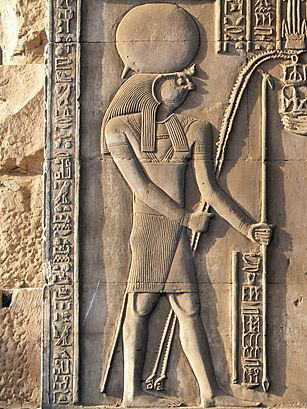
Ra and Ptolemy VIII, Kom Ombo
Kings were referred to as the Sun's son, Sꜣ Rꜥ (The Son of Ra) by all Pharaohs from Djedefre, all the way back to the Fourth Dynasty. The title also included the birth name in the titular list for all kings, but the title did include the birth name for all Pharaohs until the end of hieroglyphic writings. It is standard practice for each new Pharaoh to have an additional title known as his throne name that he took upon his ascension to the throne. In most cases, this throne name includes the addition of Ra starting in the Fifth Dynasty and continued through all subsequent dynasties. This institution of kingship is described as being the earthly position of the sun and its role as the ruler and renewer of the world. As the sun rules and renews the universe, so too did the Pharaoh rule and renew Egypt.4,57
Papyrus Westcar tells us that Ra had sons by his own priestess, the Pharaohs of the Fifth Dynasty. The divine birth stories of both Hatshepsut and Amenhotep III during the New Kingdom transferred this concept of divine birth to Amon-Ra, who would visit the Queen in the form of her husband. Accession to the throne was described as when a new Pharaoh "arises in Glory," through use of the verb ḫꜥj which describes how the sun rises from the horizon. In addition to the royal names appearing on them, each temple in all of Egypt had an annual ritual for each deity within it done for the Pharaoh, using his name as the Sun-Priest of his Father.26,33 The tomb told the same story from the other side:
"The god ascended to his horizon; the King of Upper and Lower Egypt Sehetepibre flew to heaven and united with the sun-disk, the divine body merging with its maker."
The Story of Sinuhe, on the death of Amenemhat I, trans. Lichtheim29
Piye of Kush, conquering Egypt in the eighth century BCE, proved his legitimacy precisely at Heliopolis: his Victory Stela describes his purification in the Lake of Cool Water where Ra was believed to wash his face, his offerings of white cattle and milk upon the High Sand at sunrise, his solitary ascent of the stairway to break the seals and see his father Ra, and his consecration of the morning barque of Ra and the evening barque of Atum. Darius the Persian had his statue made so that his name would endure beside Atum Lord of Heliopolis and Ra-Horakhty. The Ptolemies were crowned as Sons of Ra by the priesthoods whose synodal decrees they endowed, and the Roman emperors, who mostly never saw Egypt, were nonetheless carved on every temple wall in the ancient office, offering Maat to the gods as sꜣ Rꜥ. The ritual fiction was the last form of the oldest doctrine: the gods require a king, and the king belongs to the Sun.18,40,58,59,60
VI. The Mnevis Bull
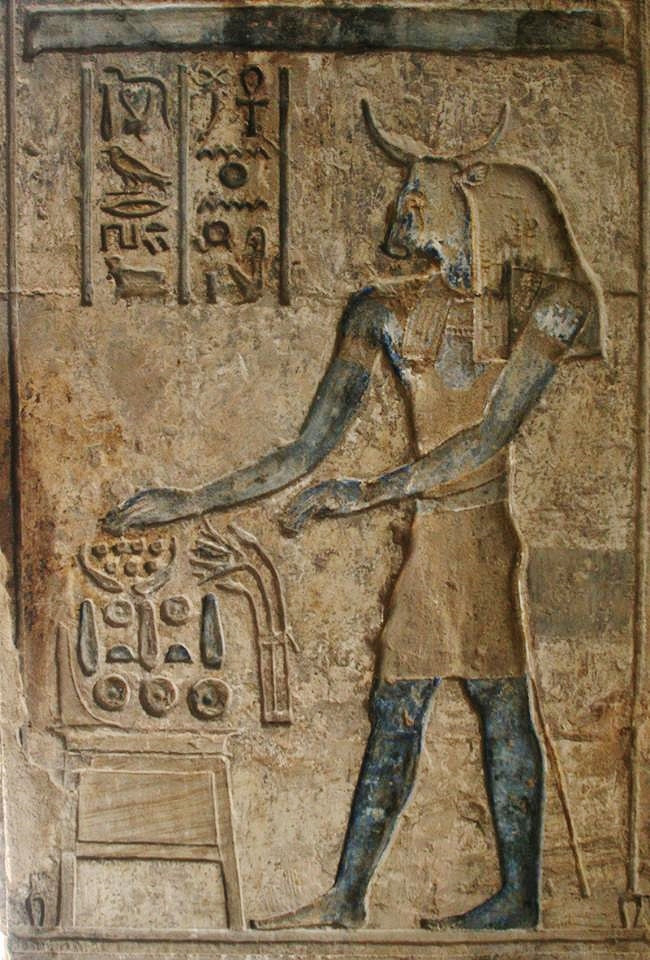
At Heliopolis the god had its earthly sign as the Mnevis (Egyptian Mr-wr), black, unblemished, was a bull and was preserved in the temple complex as the herald of Ra. The bull wore a sun-disk and uraeus between its horns in art. There was never more than one Mnevis at a time. Upon the death of the bull, it was mummified and buried in a grand burial with royal honors in the bull cemetery located at Arab al-Tawil, north-east of the temple. Burials belonging to the reign of Ramses II and a sarcophagus dating to the time of Merenptah have been discovered. After this bull died, the Egyptians searched for a new bull and replaced it. The female parent of the bull was worshipped as the cow goddess Hesat, while the females consorting with the bull were associated with Hathor and Iusa-as, both major deities of the Heliopolitan sanctuary.30,61
Manetho credited the First Dynasty Pharaoh Kaiechus with establishing the sacred bulls: Apis at Memphis and Mnevis at Heliopolis. The Egyptians believed that the bull and the god existed in antiquity. The classical authors also reported that the cult was still active. Strabo reported that the ox Mnevis was kept at Heliopolis, while Diodorus wrote that both Apis and Mnevis were honored as gods by order. Additionally, Plutarch stated that the Mnevis kept at Heliopolis and second in honor only to Apis, was believed by some to be the father of Apis. The Canopus Decree of 238 BCE, praised Ptolemy III and Berenice for providing for Apis and Mnevis, therefore demonstrating that royal support of the bull continued until the end as a demonstration of piousness.44,62,63,64,65
The symbolisms of the bull contain all of the theology of Ra in an animal form. The disk placed between the horn represent that the bull is a walking representation of the Sun moving across the horizon. Since he was herald or wḥm, he served as Ra's living oracle, being the voice by which Ra would answer those inside his sanctuary. A mythological handbook from the Delta region known as Papyrus Brooklyn 47.218.84, describes how Mnevis would carry all of the parts of Osiris to Heliopolis, or rather, the Sun's own beast will bear Osiris, God of the Dead to the City of Light. It demonstrates how the same interwoven theology of Ra and Osiris governs their daily journey by boat is now demonstrated by Mnevis.10,66
Nothing shows more clearly how highly regarded Mnevis was than by one king who attempted to destroy all gods. Although Akhenaten built his horizon-city, the Boundary Stela promises a grave site for the Mnevis Bull in the eastern Mmuntain. He was unable to eliminate that part of Egyptian religion, even though he did everything he could to eliminate every other practice in Egypt, he left alone the one traditional cult that he had no choice but to allow to continue, the cult of Mnevis.67
VII. The Eye of Ra
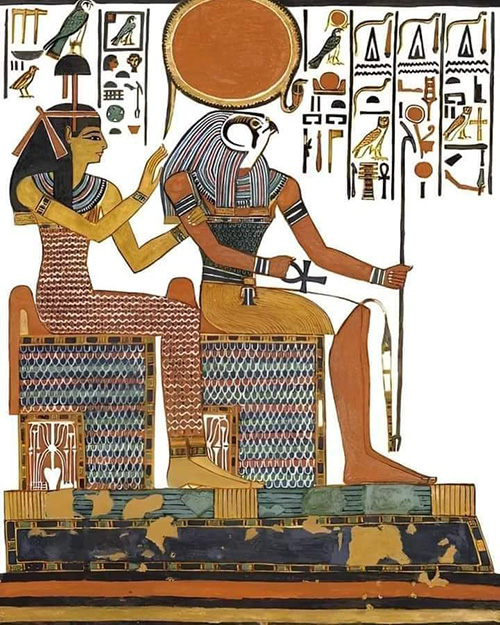
Ra and Hathor, Tomb of Nefertari, 19th Dynasty
The Eye of Ra represents the god's power sent out into the world as a goddess. Although the Eye (jrt) grammatically is female, theologically she is an aspect of the sun god's power, specifically his uraeus or flame and the daughter of the sun god. Therefore, nearly all major Egyptian goddesses (Hathor, Sekhmet, Tefnut, Mut, Bastet, Wadjet, and ultimately Isis herself) can be placed in this role. The serpent that sits atop the Pharaoh's brow is a small version of the Eye of Ra and the blazing protector that left the foreheads of both gods and men.10,30
According to the Book of the Heavenly Cow, first recorded in the tombs of Tutankhamen but completed in the tomb of Seti I, Ra learns that man has plotted against him and sends his Eye (in the form of Hathor), who becomes Sekhmet ("the powerful"), to destroy them. She slaughters with impunity until Ra repents and has seven thousand barrels of beer colored red with ochre delivered to the countryside overnight and then floods the areas where she had been drinking "blood." When she awakens she believes it to be blood and is intoxicated and is thus returned to gentleness. Man is saved. The closely related cycle of the "Distant Goddess" describes how when angered by humanity, the Eye departs to the south as a raging lioness and must be coaxed back home using music, dance and wine. This arrival is then celebrated as the beginning of the flood season and the start of the new year. It is based upon this homecoming of the Eye to her father that much of the later mythology of Dendera was developed.28,56,68
The Eye represents everything that the Sun does in the world, destroying and creating as needed. The power that causes crops to ripen and also kills those same crops through drought is the same force, much like Apollo's ability to send plagues and relief. Therefore, the festival celebrations of intoxication represented salvation..36,56
VIII. Amon-Ra, the Hidden Sun
Amun is the Hidden One of Thebes, imperceptible by definition; Ra is the most visible thing there is. Joined at Thebes by the early Middle Kingdom and raised by the New Kingdom empire to Amun-Ra nswt nṯrw, King of the Gods, the double name asserts that the concealed source of all things and the daily light are one god apprehended at two depths.30 The hymns of Papyrus Leiden I 350 press the thought to its limit:
"All gods are three: Amun, Ra and Ptah, who have no equal. He who hides his name as Amun, he appears to the face as Ra, his body is Ptah."
Papyrus Leiden I 350, chapter 300, trans. after Assmann31,69
The compound never abolished either partner. Ra kept his own city, his bull and his priesthood; Amun kept his ithyphallic and his hidden forms; and the theologians could uncouple and recombine them at need, as the Edifice of Taharqo and the Hibis hymns show, where Amun-Ra passes into an Osirian hiddenness by night and is praised as he becomes Ra at dawn. For the worshipper the sum was simple and remains moving: whatever is ultimate is not other than the light one sees.31,41,54
IX. The Amarna Heresy, the Triumph of Invincible Ra
Egyptian history suffered from one great upheaval. The word jtn meaning disk predates this heresy; it already appears in the Story of Sinuhe where a dead Pharaoh unites with it. Under Thutmose IV and Amenhotep III, the Aten began to be honored as a distinct presence alongside other forms of sun worship. Akhenaten forced development into a curious monotheistic terror. The disk received cartouches and a didactic name that begins within old theology: "Ra Horakhty who rejoices on horizons and in name of light which is in disk," and he built temples for this to Karnak and also to his new city of Akhetaten.29,67,70
The name of Amun was hacked away from monuments in Egypt. They also removed the words speaking of the gods wherever they were able to do so. The old cults had their temple incomes removed. In addition, the later version of the Aten's name would even have Horakhty removed. The barque was removed, the ascent was removed, abstraction was forced onto Egyptian religion, a pattern of interference that would prove paradigmatic for a fallen and ignorant humanity later.31,68,70
The order of Ra prevailed within a generation. Under Tutankhamun the court returned to Thebes and the Restoration Stela published the indictment of Akhenaten:
"The temples of the gods and goddesses, from Elephantine down to the marshes of the Delta, had fallen into ruin; their shrines had fallen into decay, having become mounds overgrown with weeds. The land was in distress; the gods had abandoned this land."
Restoration Stela of Tutankhamun, trans. after Murnane67
Akhetaten was abandoned and dismantled, its blocks buried as fill inside the pylons of Horemheb at Karnak and one Ramesside legal inscription dates events by "the criminal of Akhetaten" rather than speak the name of Akhenaten. The offering lists of Abydos passed from Amenhotep III directly to Horemheb as though the intervening reigns had never been. Heliopolis itself flourished again under the Ramessides, its high-priesthood held by a son of Ramesses II, its Mnevis buried once more in the ancestral cemetery instead of the heretic's eastern mountain. The judgement of the tradition was exact: Ra exists within a plurality to bring unity, never as a sterile unity.34,61,70
X. Ra and Horus: The Two Horizons
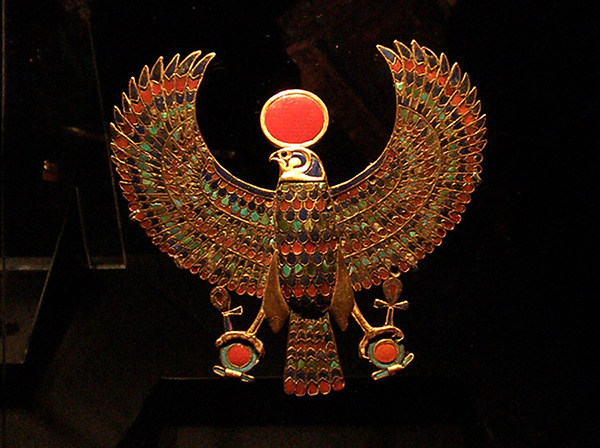
The chief instrument of articulation between the two falcon-headed sun gods is the name Ra-Horakhty meaning "Ra who is Horus of Two Horizons." ꜣḫt meaning horizon is written with a sign of a sun cradled between two peaks and dual ꜣḫty names both eastern and western mountains together: the gates of rising and the gates of setting. The Horus of Two Horizons is thus the sun as a falcon that possesses the arc between those mountains and compound Ra states that this celestial Horus and sun god fly together as one lord of the day with heads of a falcon and disks on their crowns.9,30,31
Two Horizons signify completion in the respect that any god only on the eastern horizon alone would be a god of birth only and no death; and a god confined to the western horizon would be a god of tombs. Ra-Horakhty spans this circuit with the falons gripping both ends. The horizon became Egypt's figure for place of transformation itself where effective transformed spirits and their akh are born. Temple pylons were built as stone horizons with two towers through which the sun passes, rehearsing sunrise.31,55,71
In the New Kingdom the Great Sphinx of Giza, carved a millennium earlier, was worshipped as Ḥr-m-ꜣḫt, Horemakhet, "Horus in the Horizon," the beast of the sun couched between the two pyramid-peaks of its own horizon. The Dream Stela set between its paws tells how the young Thutmose IV, sleeping in its shadow at noon, heard the god, naming himself Horemakhet-Khepri-Ra-Atum in a single breath, promise him the kingship in exchange for clearing the sand; the stela is at once a monument of royal legitimation and the plainest statement in Egypt that the falcon of the horizon and the sun in his three names are one. At Edfu the same theology wears its Ptolemaic dress: Horus of Behdet, the winged disk itself, spears the enemies of Ra, and the crowned living falcon of the temple's festival manifested the god and the reigning king together.72,73
XI. Festivals of Ra
| Ra Ritual Days | Place | Description | Events | Date Recorded |
|---|---|---|---|---|
| The Assembly at Heliopolis | Heliopolis | One of the six great festival gatherings of Egypt | Pilgrims converge | Herodotus (5th century BCE) |
| The Birth of Ra (Mswt-Rꜥ) | Reported for Egypt at large | Feast of the sun's renewal at the turn of the year | The feast that named the twelfth month, surviving as Coptic Mesore | Civil calendar; Parker (month-name tradition) |
| New Year, Union with the Sun Disk | Dendera | Renewal of the divine image by the living rays | Hathor, Eye of Ra, roof kiosk, unveiled to the risen sun | Ptolemaic–Roman Dendera texts |
| The Festival of the Living Falcon | Edfu | Coronation of the solar falcon | A falcon chosen by oracle is crowned, manifesting Horus, Ra and the king | Ptolemaic Edfu texts |
| The Festival of the Beautiful Reunion | Dendera and Edfu | Marriage-voyage of the Eye of Ra | Hathor to Edfu to meet Horus | Ptolemaic Edfu and Dendera calendars |
| Raising the Sky and Installing the Potter's Wheel | Esna | Renewal of creation by Khnum-Ra | Processions and litanies; the wheel borne into the sanctuary by night with song | Roman Esna texts (1st–3rd century CE) |
Sources: Herodotus, Histories; Parker, The Calendars of Ancient Egypt; Richter, The Theology of Hathor of Dendera; Coppens, Temple Festivals of the Ptolemaic and Roman Periods; Hallof, Esna.15,22,43,56,74
Truthfully, the festivals of Ra were daily events matching the ascent and descent of the sun. Herodotus showed that the city of the Sun drew one of the six great pilgrim assemblies of the land in the fifth century BCE, though he tells us nothing of its rites. The Ptolemaic and Roman entries show the late shape of the god's feast: wherever the image of a solar deity was carried from darkness into light, on the roof at Dendera, at the gate at Edfu, in the court at Esna, the procession itself was a sunrise, and the congregation saw with its own eyes what the theologians wrote of the horizon.15,74,75
XII. The Priesthood of Heliopolis
The Great High Priest of Ra was the dignified and unusual title given to a member of the Egyptian clergy; he was called wr-mꜣw or the Greatest of Seers (he who beholds the god whom all behold). There were documents showing this position was held as far back as the Early Dynastic period through to the New Kingdom in the collection of biographies assembled by Moursi. Additionally, there have been several tombs of the Great Priests of the Old Kingdom discovered from the temple area at Matariyah. The first members of the position were at the pinnacle of power. Prince Rahotep, son of King Snefru, with his famous painting on stone statue at Meidum is one of the treasures of Egyptian art, and according to legend so too was the sage Imhotep, architect and advisor to King Djoser, deified for his wisdom and associated with the solar goddess Sekhmet.34,76,77
The role of High Priest during the New Kingdom was worthy of a member of the blood line of Pharaohs. The son of Ramesses II and Nefertari, Meryatum, is known to have held this position. During the Third Intermediate Period, a "Greatest of Seers" can be found among those who received donations that resulted in the settlement of land to support the cult of Ra-Horakhty, such as the stela made during year six of Osorkon I.
The High Priests were supported by all the usual personnel of large temples including God's Fathers (a type of priest), Lector Priests (priestly officials responsible for reading sacred texts), Hour-Priests (responsible for performing various rituals at specific times) and a group known as the College of Sky Observers. It was their duty to record when celestial bodies rose above the horizon; these observations were considered scientific knowledge belonging to the Temple. Every day the College would perform the daily ritual service to open up the Shrine, purify it, incense it, dress its statues, and present its offerings in the name of the Pharaoh.34,75,78
Herodotus, who questioned these Clergy, called the Heliopolitans the most learned in the traditions of all the Egyptians. Strabo arrived approximately four hundred years after these events, when the very homes of the priests were pointed out by his local tour guides. The tour guides told Strabo that they believed that this was also the home where both Plato and Eudoxus spent years studying. A spurious letter written to begin the Book of Sothis describes the Egyptian holy writer Manetho as being High Priest and scribe living at Heliopolis.
Similarly, the scriptures of Israel even provide evidence regarding this practice, as it states that Joseph, who is described as the most intelligent minister and who married Asenath, daughter of Potiphera was the son-in-law of a priest named Potiphera from On. The Greek translation of this name, Πετεφρῆ, contains Pꜣ-dj-pꜣ-Rꜥ "the one who Ra gave". Even rulers submitted themselves to the disciplines of the house: before he could enter into the Benben temple to see Ra, Piye had to first purify himself in the Lake of Cool Water and be incensed in the estate of the solar god.15,44,50,58,62
By the time Strabo wrote, the learning had migrated to Alexandria. The priesthood of the sun did not so much perish as disperse: the temple scribes of Esna composing their litanies for Khnum-Ra under Decius, the Greatest of Seers was still active somewhere.43,44,79,80
XIII. The Barque of Millions of Years: the 12 Gates of Ra
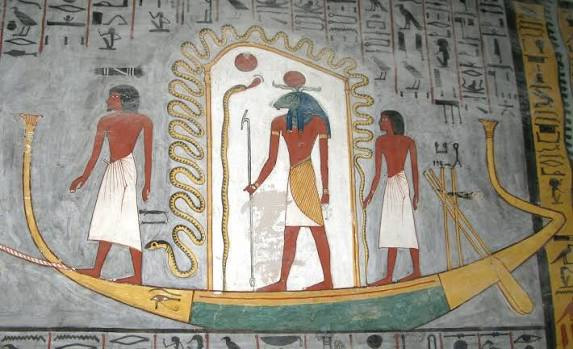
The most famous story of Ra involves his solar barque sailing out as ms.ktt, the Night Boat, and as mn.ddt, the Day Boat. On these voyages, the deceased Pharaoh asks for a berth and position with the oarsmen of this heavenly vessel.
It seemingly answers an ancient cosmological problem: Why does the Sun not just stay there, burning? Because of its journey; because the light is being continually traveled across by the oarsmen who row and steer it back into being. Thus the Cosmos continues to exist because the daily passage occurs. At later stages in development the god is seated in an open shrine, the Shrine of Creation, in the middle of the boat. The persons around Him are His powers personified: Sia (Perception), Hu (Creative Utterance), Heka (Magic), with Maat at the prow of the ship and Thoth standing beside her. The reformed Set spears the Serpent from the bow of the ship, performing the one necessary act of violence to continue the cosmic order.10,27,81
The serpent Apophis, personification of chaos, waits at sunrise and dusk to drink the flood upon which the barque sails. He cannot be finally defeated because chaos is not a creature within this world; it is the enemy of there being any world. Every night he is repelled, stabbed, bound and cut into pieces.
Huge liturgies of his defeat were performed in temples and one great surviving example is Book of Overthrowing Apep on Bremner Rhind papyrus. Directions in rubrics instruct that the enemy be drawn in green on new papyrus, bound, trampled, spat upon and then set alight. Every rising sun is thus a declaration of victory and reddened eastern sky is read as adversary's blood.28,82
The night journey was said to be a mysterious thing, and the Pharaoh's tombs were the initiation texts. The Amduat, or “Writing of the Secret Chamber,” as it was named in the tomb of Thutmose III, described the twelve hours of the night and stated many times that if one knew the forms and names of the things depicted within those hours then one could benefit from such knowledge both while alive on earth and after death.
The ram-headed (night) form of Ra joins Osiris at the bottom of the Duat where the wandering Ba joins the sleeping body and from such a meeting, the cycle of rebirth begins until Khepri is cast onto the arms of Shu at the twelfth hour. The painting in Nefertari's tomb presents the idea clearly: it is Ra who sleeps within Osiris, and Osiris who sleeps within Ra. Death, as taught by the compositions, occurs at one point on the circuit of the sun, a single hour of night time but never ultimately a permanent state.28,71
The doctrine's acceptance among Egyptian society followed. What began as a royal prerogative with the Amduat and Litany of Ra in the Valley of the Kings (the Books of Gates, Caverns, Day and Night which are found throughout the ceiling of Ramesses VI), then spread to coffins and papyri belonging to the priestly families of Thebes, holy families who included pieces from each of the royal underworld texts used in their own burial process so that they could also join the barque, traverse the serpent and ascend with Khepri.
By the Ptolemaic period, the hypocephalus, a disk of linen or bronze inscribed and placed under the head of a mummy, contained all of the solar cycle and served as an amulet to warm the deceased with flames from the eye of Ra. From the very start, the boats were being buried: such as, the full size mud brick barques alongside the sun temple of Niuserre, and the disassembled cedar ships in pits located at the base of the Great Pyramid, excavations which continue to debate whether Khufu received the barque even back then for use during his funeral procession for his long trip of millions of years.24,83,84,85,86,87
Oddly, the barque itself survived the temples. In the magical papyri of Roman Egypt, Helios was still using his oar as a rudder and holding back the snake, and the hours of the night still had animal forms. Those who were practicing the last remnants of Egyptian religion, by lamp light invoking Phre, were also traveling along this path.16,49
XIV. Mnevis and the Foreign Interpretation
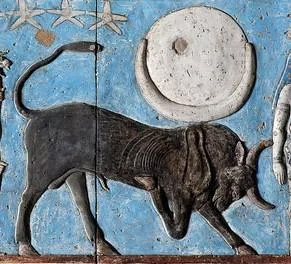
Mnevis, the bull living at Heliopolis, was considered the herald or manifestation of the god Ra (wḥm n Rꜥ,) in Egyptian accounts or (in Plutarch's account) was consecrated to Osiris. Plutarch claimed it was only secondary in importance to the Apis bull of Memphis. Macrobius speaking directly about Egyptian religion, on the other hand, claimed the Egyptians especially worshipped a sacred bull at Heliopolis which was consecrated directly to the Sun.
The bull had to have four specific characteristics. Porphyry, as transmitted through the invective of Eusebius, provides solar allegories for each characteristic of the bull: the largeness is evocative of the sun itself, its blackness is associated with the darkening effect of intense sunlight, the reversed bristles of its coat mirrored the Sun's motion contrary to the revolution of the heavens and the unusually large testes signified the Sun's fertilizing heat.88,89
Many modern resources confuse the Mnevis with being the Ba of Ra due to the overstatements of historians; this concept is actually given to Bennu in Egyptian accounts.90,91,92,93
Sources and Bibliography
- Kahl, Jochem. "Ra Is My Lord": Searching for the Rise of the Sun God at the Dawn of Egyptian History. Menes: Studien zur Kultur und Sprache der ägyptischen Frühzeit und des Alten Reiches 1. Wiesbaden: Harrassowitz, 2007.
- Wilkinson, Toby A. H. Early Dynastic Egypt. London: Routledge, 1999.
- Metropolitan Museum of Art. “Stela of King Raneb.” Granite, Dynasty 2, ca. 2880 BCE. Accession no. 60.144. New York: Metropolitan Museum of Art.
- Leprohon, Ronald J. The Great Name: Ancient Egyptian Royal Titulary. Writings from the Ancient World 33. Atlanta: Society of Biblical Literature, 2013.
- Quibell, James Edward. Excavations at Saqqara, 1911–1912: The Tomb of Hesy. Cairo: Imprimerie de l’Institut français d’archéologie orientale, 1913.
- Sabbahy, Lisa K. Kingship, Power, and Legitimacy in Ancient Egypt: From the Old Kingdom to the Middle Kingdom. Cambridge: Cambridge University Press, 2020.
- Reader, Colin. “The Netjerikhet Stela and the Early Dynastic Cult of Ra.” Journal of Egyptian Archaeology 100 (2014): 421–35.
- Berlin-Brandenburg Academy of Sciences and Humanities and Saxon Academy of Sciences and Humanities, “rêw (the sun),” Thesaurus Linguae Aegyptiae. For the common noun rê behind the theonym.
- Gardiner, Alan H. Egyptian Grammar: Being an Introduction to the Study of Hieroglyphs, 3rd rev. ed. (Oxford: Griffith Institute, 1957), sign-list N5–N6.
- Quirke, Stephen. The Cult of Ra: Sun-Worship in Ancient Egypt. London: Thames & Hudson, 2001.
- Beckman, Gary. Hittite Diplomatic Texts. 2nd ed. Writings from the Ancient World 7. Atlanta: Scholars Press, 1999. No. 15, the treaty of Ramesses II and Hattusili III, for the cuneiform renderings of the royal names.
- Crum, Walter E. A Coptic Dictionary (Oxford: Clarendon Press, 1939), 287.
- Koptische/Coptic Electronic Language and Literature International Alliance (KELLIA), “ⲱⲩ,” lemma C3034, and “Ⲭⲥⲵⲯⲱⲩ,” lemma C2050, Coptic Dictionary Online.
- Quirke, Stephen, and Carol Andrews. The Rosetta Stone: Facsimile Drawing with an Introduction and Translations. London: British Museum Publications, 1988.
- Herodotus. Histories 2.3, 2.59, 2.73, 2.121; trans. A. D. Godley, Loeb Classical Library 117. Cambridge, MA: Harvard University Press, 1920.
- Betz, Hans Dieter, ed. The Greek Magical Papyri in Translation, Including the Demotic Spells. 2nd ed. Chicago: University of Chicago Press, 1992. See PGM V.24–30 for the invocation of Helios-Phre.
- Tacitus. Annals 2.60. Translated by Clifford H. Moore and John Jackson. Loeb Classical Library 249. Cambridge, MA: Harvard University Press, 1931.
- Grimal, Nicolas-Christophe. La stèle triomphale de Pi(ʻankh)y au Musée du Caire, JE 48862 et 47086–47089. Mémoires publiés par les membres de l’Institut français d’archéologie orientale 105. Cairo: Institut français d’archéologie orientale, 1981.
- Török, László. The Kingdom of Kush: Handbook of the Napatan-Meroitic Civilization. Handbuch der Orientalistik 31. Leiden: Brill, 1997.
- Eide, Tormod, Tomas Hägg, Richard Holton Pierce, and László Török, eds. Fontes Historiae Nubiorum: Textual Sources for the History of the Middle Nile Region between the Eighth Century BC and the Sixth Century AD. Vol. 3, From the First to the Sixth Century AD. Bergen: University of Bergen, 1998, 954–55. For the Meroitic sun-god Mash and Mash-Amani.
- Griffith, Francis Llewellyn. Karanòg: The Meroitic Inscriptions of Shablûl and Karanòg. Eckley B. Coxe Junior Expedition to Nubia 6. Philadelphia: University Museum, 1911.
- Parker, Richard A. The Calendars of Ancient Egypt. Studies in Ancient Oriental Civilization 26. Chicago: University of Chicago Press, 1950.
- Griffith, F. Ll., and Herbert Thompson. The Demotic Magical Papyrus of London and Leiden. London: H. Grevel, 1904.
- Lehner, Mark. The Complete Pyramids. London: Thames & Hudson, 1997.
- Nuzzolo, Massimiliano. The Fifth Dynasty Sun Temples: Kingship, Architecture and Religion in Third Millennium BC Egypt. Prague: Charles University, Faculty of Arts, 2018.
- Simpson, William Kelly, ed. The Literature of Ancient Egypt: An Anthology of Stories, Instructions, Stelae, Autobiographies, and Poetry. 3rd ed. New Haven: Yale University Press, 2003. For the tales of Papyrus Westcar.
- Allen, James P. The Ancient Egyptian Pyramid Texts. Atlanta: Society of Biblical Literature, 2005.
- Hornung, Erik. The Ancient Egyptian Books of the Afterlife. Translated by David Lorton. Ithaca, NY: Cornell University Press, 1999.
- Lichtheim, Miriam. Ancient Egyptian Literature: A Book of Readings. Vol. 1, The Old and Middle Kingdoms. Berkeley: University of California Press, 1973. For the Instruction for Merikare and the Story of Sinuhe.
- Wilkinson, Richard H. The Complete Gods and Goddesses of Ancient Egypt. London: Thames & Hudson, 2003.
- Assmann, Jan. Egyptian Solar Religion in the New Kingdom: Re, Amun and the Crisis of Polytheism. Translated by Anthony Alcock. London: Kegan Paul International, 1995.
- Piankoff, Alexandre. The Litany of Re. Egyptian Religious Texts and Representations 4, Bollingen Series XL.4. New York: Pantheon Books, 1964.
- Assmann, Jan. Der König als Sonnenpriester: Ein kosmographischer Begleittext zur kultischen Sonnenhymnik. Abhandlungen des Deutschen Archäologischen Instituts Kairo 7. Glückstadt: J. J. Augustin, 1970.
- Raue, Dietrich. Heliopolis und das Haus des Re: Eine Prosopographie und ein Toponym im Neuen Reich. Abhandlungen des Deutschen Archäologischen Instituts Kairo 16. Berlin: Achet, 1999.
- Zivie-Coche, Christiane. “Late Period Temples.” In UCLA Encyclopedia of Egyptology, edited by Willeke Wendrich. Los Angeles: University of California, 2008.
- Dunand, Françoise, and Christiane Zivie-Coche. Gods and Men in Egypt: 3000 BCE to 395 CE. Translated by David Lorton. Ithaca, NY: Cornell University Press, 2004.
- Kitchen, Kenneth A. The Third Intermediate Period in Egypt, 1100–650 BC. 3rd ed. Warminster: Aris & Phillips, 1996.
- Metropolitan Museum of Art. “Funerary Stela of the God’s-Father, Nesikhonsu.” Dynasty 26, ca. 664–525 BCE. Accession no. 25.3.29. New York: Metropolitan Museum of Art.
- Munro, Peter. Die spätägyptischen Totenstelen. 2 vols. Ägyptologische Forschungen 25. Glückstadt: J. J. Augustin, 1973.
- Klotz, David. “Persian Period.” In UCLA Encyclopedia of Egyptology, edited by Wolfram Grajetzki and Willeke Wendrich. Los Angeles: University of California, 2015.
- Klotz, David. Adoration of the Ram: Five Hymns to Amun-Re from Hibis Temple. Yale Egyptological Studies 6. New Haven, CT: Yale Egyptological Seminar, 2006.
- Arnold, Dieter. Temples of the Last Pharaohs. New York: Oxford University Press, 1999.
- Hallof, Jochen. “Esna.” In UCLA Encyclopedia of Egyptology, edited by Willeke Wendrich. Los Angeles: University of California, 2011.
- Strabo. Geography 17.1.22 and 17.1.27–29. Vol. 8, Book 17 and General Index. Translated by Horace Leonard Jones. Loeb Classical Library 267. Cambridge, MA: Harvard University Press, 1932.
- Dijkstra, Jitse H. F. Philae and the End of Ancient Egyptian Religion: A Regional Study of Religious Transformation (298–642 CE). Orientalia Lovaniensia Analecta 173. Leuven: Peeters, 2008.
- Leitz, Christian, ed. Lexikon der ägyptischen Götter und Götterbezeichnungen. 7 vols. Orientalia Lovaniensia Analecta 110–116. Leuven: Peeters, 2002. For the Egyptian epithets of Ra.
- Bricault, Laurent. “The Sword and the Patera: Zeus Helios Great Sarapis.” In The Names of the Gods in Ancient Mediterranean Religions, edited by Corinne Bonnet, translated by Ralph Häussler, 129–56. Cambridge: Cambridge University Press, 2024.
- Nock, Arthur Darby. “A Vision of Mandulis Aion.” Harvard Theological Review 27, no. 1 (1934): 53–104.
- Pachoumi, Eleni. “The Religious and Philosophical Assimilations of Helios in the Greek Magical Papyri.” Greek, Roman, and Byzantine Studies 55 (2015): 391–413.
- Septuaginta. Edited by Alfred Rahlfs, revised by Robert Hanhart. Stuttgart: Deutsche Bibelgesellschaft, 2006. See Genesis 41:45 for Πετεφρῆ the priest of On.
- Biblia Hebraica Stuttgartensia. 5th ed. Stuttgart: Deutsche Bibelgesellschaft, 1997. See Jeremiah 43:13 on the pillars of Beth-Shemesh in Egypt.
- Pliny. Natural History 36.64. Vol. 10, Books 36–37. Translated by D. E. Eichholz. Loeb Classical Library 419. Cambridge, MA: Harvard University Press, 1962.
- Leipzig University. “New Finds at Temple City of Heliopolis.” June 17, 2022.
- Parker, Richard A., Jean Leclant, and Jean-Claude Goyon. The Edifice of Taharqa by the Sacred Lake of Karnak. Brown Egyptological Studies 8. Providence, RI: Brown University Press, 1979.
- Wilkinson, Richard H. The Complete Temples of Ancient Egypt. London: Thames & Hudson, 2000.
- Richter, Barbara A. The Theology of Hathor of Dendera: Aural and Visual Scribal Techniques in the Per-Wer Sanctuary. Wilbour Studies in Egyptology and Assyriology 4. Columbus, GA: Lockwood Press, 2016.
- Frankfort, Henri. Kingship and the Gods: A Study of Ancient Near Eastern Religion as the Integration of Society and Nature. Chicago: University of Chicago Press, 1948.
- Lichtheim, Miriam. Ancient Egyptian Literature: A Book of Readings. Vol. 3, The Late Period. Berkeley: University of California Press, 1980. For the Victory Stela of King Piye.
- Hölbl, Günther. A History of the Ptolemaic Empire. Translated by Tina Saavedra. London: Routledge, 2001.
- Minas-Nerpel, Martina. “Egyptian Temples.” In The Oxford Handbook of Roman Egypt, edited by Christina Riggs, 362–82. Oxford: Oxford University Press, 2012.
- Dodson, Aidan. “Rituals Related to Animal Cults.” In UCLA Encyclopedia of Egyptology, edited by Jacco Dieleman and Willeke Wendrich. Los Angeles: University of California, 2009.
- Manetho. Aegyptiaca. Translated by W. G. Waddell. Loeb Classical Library 350. Cambridge, MA: Harvard University Press, 1940. Frs. 8–9 for the institution of the bull cults under Kaiechos, with the pseudepigraphic letter to Ptolemy in the appended Book of Sothis material.
- Diodorus Siculus. Library of History 1.21, 1.84–85, and 1.88. Vol. 1. Translated by C. H. Oldfather. Loeb Classical Library 279. Cambridge, MA: Harvard University Press, 1933.
- Plutarch. De Iside et Osiride 33. Edited and translated with an introduction and commentary by J. Gwyn Griffiths. Cardiff: University of Wales Press, 1970.
- Bagnall, Roger S., and Peter Derow, eds. The Hellenistic Period: Historical Sources in Translation. 2nd ed. Malden, MA: Blackwell, 2004. For the Canopus Decree.
- Meeks, Dimitri. Mythes et légendes du Delta d’après le papyrus Brooklyn 47.218.84. Mémoires publiés par les membres de l’Institut français d’archéologie orientale 125. Cairo: Institut français d’archéologie orientale, 2006.
- Murnane, William J. Texts from the Amarna Period in Egypt. Writings from the Ancient World 5. Atlanta: Scholars Press, 1995.
- Lichtheim, Miriam. Ancient Egyptian Literature: A Book of Readings. Vol. 2, The New Kingdom. Berkeley: University of California Press, 1976. For the Great Hymn to the Aten and the Destruction of Mankind.
- Zandee, Jan. De Hymnen aan Amon van Papyrus Leiden I 350. Oudheidkundige Mededelingen uit het Rijksmuseum van Oudheden 28. Leiden: Brill, 1948.
- Redford, Donald B. Akhenaten: The Heretic King. Princeton, NJ: Princeton University Press, 1984.
- Hornung, Erik. Conceptions of God in Ancient Egypt: The One and the Many. Translated by John Baines. Ithaca, NY: Cornell University Press, 1982.
- Zivie-Coche, Christiane. Sphinx: History of a Monument. Translated by David Lorton. Ithaca, NY: Cornell University Press, 2002.
- Institute for the Study of Ancient Cultures. “Temple of Horus.” Tell Edfu Project. Chicago: University of Chicago.
- Coppens, Filip. “Temple Festivals of the Ptolemaic and Roman Periods.” In UCLA Encyclopedia of Egyptology, edited by Willeke Wendrich. Los Angeles: UCLA, 2009.
- University College London. “Daily Cult.” Digital Egypt for Universities. London: University College London.
- Moursi, Mohamed I. Die Hohenpriester des Sonnengottes von der Frühzeit Ägyptens bis zum Ende des Neuen Reiches. Münchner Ägyptologische Studien 26. Munich: Deutscher Kunstverlag, 1972.
- Wildung, Dietrich. Egyptian Saints: Deification in Pharaonic Egypt. New York: New York University Press, 1977.
- Metropolitan Museum of Art. “Donation Stela of Osorkon I Dated to Year 6.” Dynasty 22. Accession no. 10.176.42. New York: Metropolitan Museum of Art.
- Frankfurter, David. Religion in Roman Egypt: Assimilation and Resistance. Princeton, NJ: Princeton University Press, 1998.
- Ruffini, Giovanni. “Late Antiquity.” In UCLA Encyclopedia of Egyptology, edited by Willeke Wendrich. Los Angeles: University of California, 2018.
- Faulkner, Raymond O. The Ancient Egyptian Book of the Dead. Rev. ed. Edited by Carol Andrews. London: British Museum Press, 1985.
- Faulkner, Raymond O. “The Bremner-Rhind Papyrus, III: D. The Book of Overthrowing ʻApep.” Journal of Egyptian Archaeology 23 (1937): 166–85.
- Piankoff, Alexandre. The Tomb of Ramesses VI. Egyptian Religious Texts and Representations 1, Bollingen Series XL.1. New York: Pantheon Books, 1954.
- Niwiński, Andrzej. Studies on the Illustrated Theban Funerary Papyri of the 11th and 10th Centuries B.C. Orbis Biblicus et Orientalis 86. Fribourg: Universitätsverlag; Göttingen: Vandenhoeck & Ruprecht, 1989.
- Pozzi, Enrico. “The Amduat Papyri in the Museo Egizio: Tradition and Innovation between the Twenty-First and Twenty-Second Dynasties.” Rivista del Museo Egizio 8 (2024).
- Mekis, Tamás. The Hypocephalus: An Ancient Egyptian Funerary Amulet. Archaeopress Egyptology 28. Oxford: Archaeopress, 2020.
- Jenkins, Nancy. The Boat beneath the Pyramid: King Cheops’ Royal Ship. London: Thames & Hudson, 1980.
- Macrobius. Saturnalia 1.20.6-1.21–21. Edited and translated by Robert A. Kaster. Saturnalia, Volume I: Books 1–2. Loeb Classical Library 510. Cambridge, MA: Harvard University Press, 2011.
- Porphyry. On Cult Images (Περὶ ἀγαλμάτων), fragment preserved in Eusebius, Praeparatio evangelica 3.13.1. In Eusebius of Caesarea, Preparation for the Gospel, translated by Edwin Hamilton Gifford. Oxford: Clarendon Press, 1903. 3.13.1.
- Daressy, Georges. “La tombe d’un Mnévis de Ramsès II.” Annales du Service des Antiquités de l’Égypte 18 (1919): 196–210.
- Moursi, Mohamed. “Corpus der Mnevis-Stelen und Untersuchungen zum Kult der Mnevis-Stiere in Heliopolis II.” Studien zur Altägyptischen Kultur 14 (1987): 225–237.
- Kákosy, László. “Mnevis.” In Lexikon der Ägyptologie, vol. 4, edited by Wolfgang Helck and Wolfhart Westendorf, cols. 165–167. Wiesbaden: Otto Harrassowitz, 1982.
- Kootz, Anja. “Zur Bedeutung des Begriffes wḥm.” Afrikanistik-Aegyptologie-Online (2019). https://doi.org/10.18716/ojs/aaeo/2019_3468.