




| Language or Culture | Name | Earliest Secure Attestation |
|---|---|---|
| Etruscan | 𐌉𐌛𐌖𐌑 (Śuri) | Votive inscriptions at Pyrgi (fifth century BCE) |
| Faliscan and Sabine | Soranus | Cult on Soracte |
| Latin | Dis Pater / Apollo Soranus | Latin designations |
12 min read
SHURI
author: High Priest Zevios Metathronos
co-author: Novice Priest Karnonnos
Hieratic Information about Shuri
| Divine Symbols | |
|---|---|
|
I. The Name
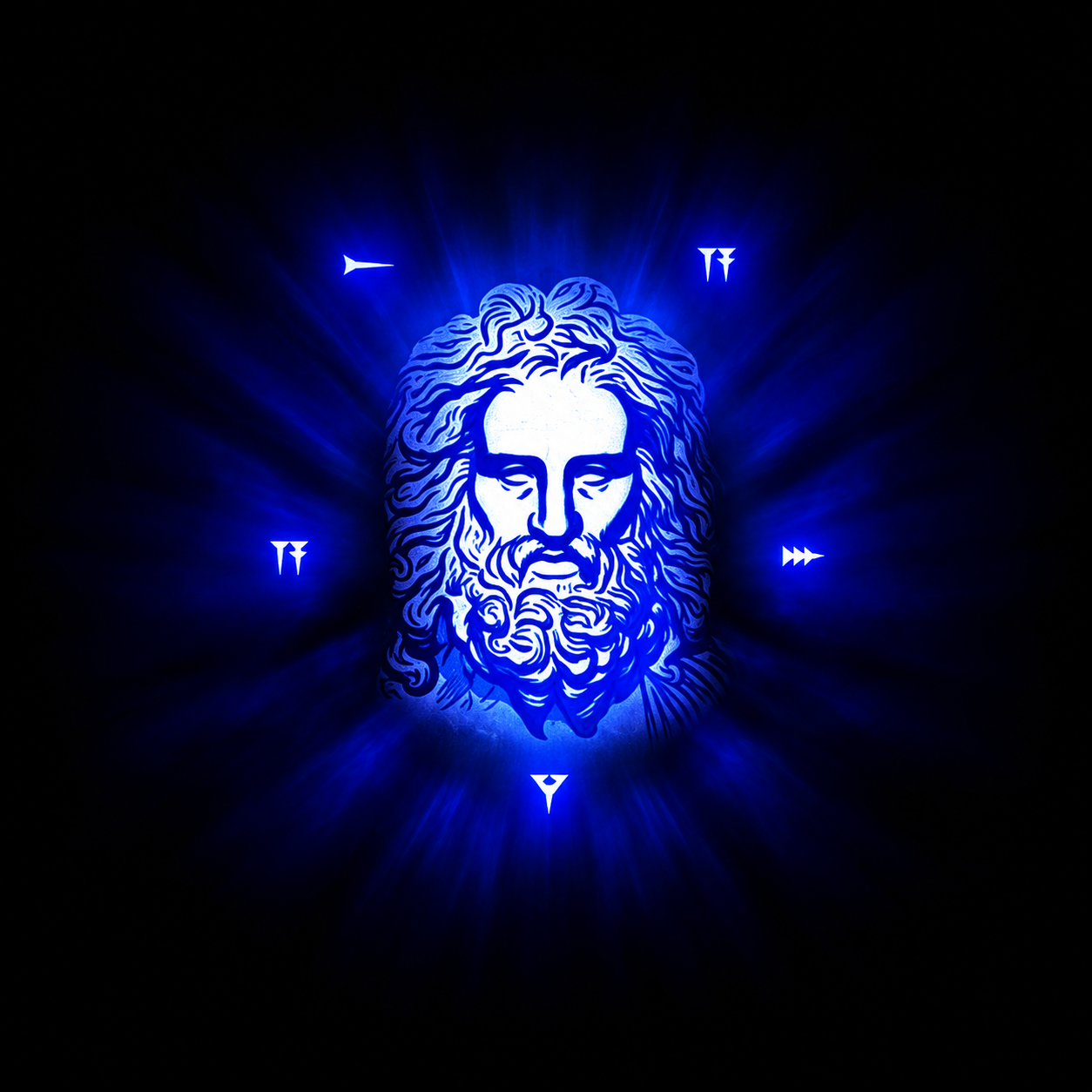
Shuri is the dark sun of the Etruscans, also worshipped as Soranus by the Latins. A god of fire, volcanic eruptions, the underworld, and also the sun (all at once) and one of the most unique and lesser-known deities in the Etruscan pantheon. The name is spelled out as 𐌉𐌛𐌖𐌑 using the Etruscan alphabet, which is translated into English as Shuri. The name can be interpreted as "black" if so then the name itself is an example of a paradoxical representation of what the god represents, a form of energy representing the sun but with a name that represents the darkness of the underworld.
The name of Shuri is found as a genitive theonym on votive offerings such as shuris = "a votive for Shuri" and through these dedications spread throughout the coastal regions the name to inland areas of Etruria where the god is mostly understood. Shuri was called Pater Shuri "Father Shuri", and there were several locations throughout the region named after him. For instance, Viterbo was originally called Surrina (from the Etruscan), and also the towns Sorano and Soriano, and even Mount Soracte north of Rome, all had long-standing cults.
As a member of the native family in the center of the pantheon, Shuri's parentage posits him as being the son of the sky-god Tinia and earth goddess Semla, brother to the wine-god Fufluns and twin to the huntress Aritimi. There are early certain references to Shuri's name through epigraphy and they date to the 5th century BCE, and they are referenced in votives from Pyrgi and Tarquinia sanctuaries. These references also identify Shuri as a masculine deity, and further reference indicates that his cult likely existed before the 6th century BCE, when the sanctuary that references him the most was built.1,2
Sources: Maras for the name, its reading as "the black," and the genitive śuris;1 Simon for the parentage, pater Śuri, the toponyms Surrina and Soracte, and the veneration of Soranus.2
II. The Many Names of One God
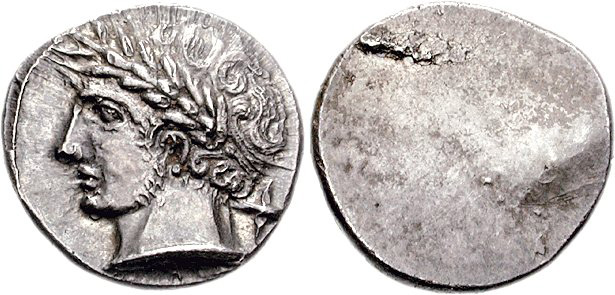
Coin of Apulu, Populonia, 3rd century BCE
One of the major issues in understanding Shuri is that he was only sometimes referred to to as "Shuri." An extensive body of research in Etruscan studies, primarily conducted by Giovanni Colonna, suggests that Shuri is actually the actual name for an entire group of deities, all of which were considered separately until it was realized they could be represented by different aspects of the same single divinity. The above table lists some common names associated with Shuri along with their respective meanings.3,4
| Name or Aspect | Sense | Standing of the Connection |
|---|---|---|
| Aita | The Etruscan Hades, lord of the dead, shown in a wolf-cap in the painted tombs | Grouped with Shuri as an underworld aspect; the wolf is shared |
| Calu | A native wolf-god of death, whose cap Aita wears | Grouped with Shuri as an infernal aspect |
| Manth | An underworld god, Latinized Mantus, tied to the city Mantua | Grouped as an infernal theonym |
| Vetis | An infernal god, spelled also Veivis, Latinized Vedius, Veiovis, Veive | Grouped as an infernal theonym; a Roman Veiovis stands beside him |
| Rath | The name under which the god was worshipped at Caere, read as Apollo | Equated with Apulu/Apollo at the San Antonio sanctuary |
| Usil | The sun as a body, equivalent of Helios and Sol | Grouped as a solar theonym; but Usil is also a distinct sun-god |
| Apulu | The Etruscan Apollo, god of light and prophecy | Equated with Shuri by the Romans and Colonna |
Sources: Maras and the Apollo-volume study for Shuri's epithets and infernal and solar theonyms;1,3,4
III. His Attributes
Shuri's domains span the seeming opposites of sun and shadow, and the sources are consistent about them even where they disagree about how many gods are involved. He is primarily a god of fire and the volcano, powers the Etruscans associated with the underworld; and he is at the same time a chthonic god of the sun and light, an oracular god, a power over health and plague.5
The Wolf and the Goat
His sacred animals are the wolf and the goat, and the wolf carries the most meaning. It is the animal of the death-god Aita, who wears a wolf-cap in the tomb paintings, and it is the animal of the priests who served Shuri on Soracte, the Hirpi Sorani, whose very name means "the wolves of Soranus."1,2 The wolf binds the fire-god to the underworld: the beast of the wild and the dead, serving a god whose fire is the fire of the mountain that is also a mouth into the earth.
IV. His Sanctuaries and Cult
Pyrgi
Pyrgi, which was a harbor at the city of Caere located on the Tyrrhenian sea, has the most information about Shuri. In Pyrgi, the sacred area contained two areas for worship: the large northern temple where Caere's power was represented by worshiping Uni whom the king Thefarie Velianas equated with Astarte on the Phoenician gold tablets, and the small southern temple for earth goddesses or Demeter-like deities. This is also the site of the first recorded area of Shuri worship alongside the earth-goddess Cavatha (probably the Etruscan variation of Kore/Persephone).6,7
An inscription dated to the fifth century BCE was located at the base of an Attic kylix (cup) which was discovered in the southern temple. This inscription read “mi śuris cavaθas” or “I am an offering to Shuri of Cavatha”, directly stating both the name of the deity and the name of his consort. At the same site, there was an altar that had a large hole drilled through it into a subterranean chamber; this would have been used to pour liquid offerings down into the underworld. It appears this is the type of worship system a chthonic deity would use. As such, within the same sacred space in southern temple where Shuri and his female companion were receiving their own joint cult, the Pyrgi inscriptions provide the written documentation for how Shuri’s name is linked to that of Apollo.3,7,8
The Reach of the Votives
There are many examples beyond Pyrgi that can be used to illustrate the votive offerings. An example would include a block of tufa from Tarquinia as well as an agricultural token from Arezzo both bear the genitive form "śuris". The bronze bar was discovered in Cipollara, close to Viterbo, and has written upon it "savcnes śuris" or a holy gift to Shuri. Some of the most important Etruscan artifacts bearing his name are the Lead Plaque of Magliano and the Tabula Capuana. Examples of votive offerings have been found along the coast at Pyrgi and inland areas such as Arezzo and Viterbo show evidence of Shuri being worshiped throughout Etruria rather than at only his two sites for religious worship (the cult-mountain and port).1,3,8
Caere and the Name Rath
At Caere (the mother city of Pyrgi), an important sanctuary was found by archaologists (San Antonio) where, for over three hundred years from the sixth to fourth century BC dedications were made to "apol", a shortened form of the word Aponi or Apollon; Colonna has written about this location concerning the divination and worship of the god Rath which can be translated from the Etruscan language as Apollo. Thus it would appear that the Etruscans had a lighter and darker side to their deity; both locations were part of a single civic cult.
V. Mount Soracte and the Fire-Walkers
The most vivid survival of Shuri is not a votive but a rite. It kept his cult alive under Latin names for centuries after the Etruscan cities had fallen.
Mount Soracte is north of Rome, an eroded limestone ridge containing many caves created by dissolution and many smaller volcanic vents. This was considered a mouth of the underworld by the ancients and was given to the gods of the dead. There the god was worshipped as Soranus, the Latin form of his name, and a group of families served him called the Hirpi Sorani, the "wolves of Soranus," from the Sabine word hirpus, wolf.9,10
These families were responsible for performing the rite of fire walking at the annual sacrifice. During this time, the Hirpi would walk barefoot over hot coals piled high from burning pine logs while carrying the internal organs of the sacrificial animals. In doing so, the Hirpi would emerge unburned. According to Pliny, the Hirpi received a permanent exemption from military duty and all other forms of civic obligation due to their service to the god, as declared by a decree of the Roman Senate. Virgil describes the rite in a prayer recited by a soldier who cries out to the guardian of Soracte. Servius, explaining the passage, interprets the fire-walking as a propitiation of Soranus, whom he identifies with Dis Pater, the lord of the dead9,10
This fire walk represents an entire rite within a single event. The flame itself belongs to Soranus, representing both the fiery volcano that lies beneath his sacred mountain and the fire that exists within the underworld. The wolves who traverse this flame represent Soranus' priests; they are the creatures of the death god. The fact that the wolves remain uninjured during the crossing demonstrates Soranus' control over the fires below. The fact that the cult continued beyond the period when its members were granted immunity by the Roman Senate and that an inscription dedicated to Sanctus Soranus Apollo was erected outside of Falerii indicates how firmly Soranus had embedded himself in the religious culture of Central Italy.9,10
VI. The Faces the Latins Gave Him
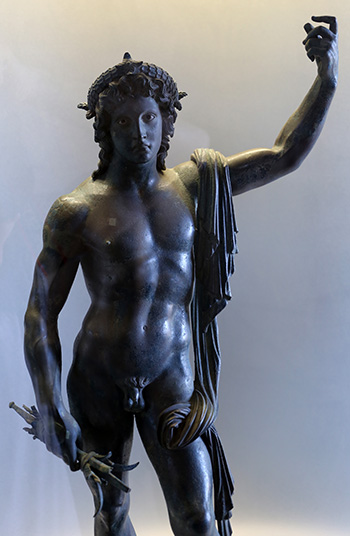
Vejovis, National Archaeological Museum of Viterbo
When the Romans and their neighbors met Shuri they did not meet him as one god, and the names they gave him fall on both sides of his double nature.
For Shuri's underworld face (Dis Pater), the Romans named him “the Roman Lord of the Dead” (Servius’ explanation of Soranus of Soracte). All of his infernal names cluster around these meanings: Manth is translated as Mantus, and Vetis or Veivis are next to the Veiovis of the Romans, an underworld deity whose Roman counterpart has the same dark connotation and a similar appearance to Soranus on coins.
On the other hand, for Shuri's solar and oracular face, the Romans used the name Apollo, and eventually after the cult of Shuri was merged with that of Apollo, they named him “Apollo Soranus” or “Apollo Soractis,” the “Apollo of Soracte.” As with all other gods of the sun and death, the Greek counterparts have a similar duality: Hades for his dominance over the dead, and Helios for the sun, but this discrepancy is explained by Macrobius in part.2,5,10,11
Sources and Bibliography
- Maras, Daniele F. "Suri: il nero signore degli inferi." Archeo, no. 305 (July 2010): 22–24. Cited for the transliteration of 𐌉𐌛𐌖𐌑 and the reading of the name as "the black," the character of the god as a lord of fire, the sun, and the underworld, the infernal theonyms Manth (Mantus), Vetis (Veivis), and Calu and the identification with Aita, the solar theonyms Rath and Usil, his sacred wolf and goat, his membership among the Novensiles, and his presence on the Pyrgi Tablets, the Lead Plaque of Magliano, and the Tabula Capuana. Bibliographic details, including exact pagination, to be verified by the author.
- Simon, Erika. "Gods in Harmony: The Etruscan Pantheon." In The Religion of the Etruscans, edited by Nancy Thomson de Grummond and Erika Simon, 45–65. Austin: University of Texas Press, 2006. Cited page: 59 in particular, for the placement of the god in the native family as son of Tinia and Semla and sibling of Fufluns and Aritimi, the god worshipped in votive inscriptions as father Śuri, the derivation of Surrina (Viterbo) and of Mount Soracte from his name, the veneration of Soranus there with reference to Virgil, Aeneid 11.785, and Colonna's equation of the god with Aplu, sharing the wolf attribute with Aita.
- Colonna, Giovanni. "L'Apollo di Pyrgi, Śur/Śuri (il «Nero») e l'Apollo Sourios." Studi Etruschi 73 (2007 [2010]): 101–34. Cited for the reading of Śuri as "the black," the argument that the god underlies a set of solar and infernal theonyms as aspects of one deity, the association of the names Śuri and Apulu on the Pyrgi inscriptions, the worship of Śuri with Cavatha in the southern sanctuary at Pyrgi, and the divinatory cult of the god at Caere under the name Rath.
- Gaultier, Françoise, and Laurent Haumesser, eds., with the relevant chapter by the volume's contributors. "Śuri et al.: A Chthonic Etruscan Face of Apollon?" In Apollo: Origins and Influences. Cited for the survey of the Śuri evidence, the inscriptions naming the god in the genitive śuris across Etruria, the framing of the Śuri-Apollo identification as an open question, and the collection of the infernal and solar theonyms. Bibliographic details to be verified by the author.
- Krauskopf, Ingrid. "The Grave and Beyond in Etruscan Religion." In The Religion of the Etruscans, edited by Nancy Thomson de Grummond and Erika Simon, 66–89. Austin: University of Texas Press, 2006. Cited for Śuri as primarily a god of fire and the volcano associated with the underworld and at the same time a chthonic god of the sun and light and an oracular god with power over health and plague, and for the interpretatio identifying him with Hades for his chthonic dominion and with a solar god for his light.
- Colonna, Giovanni. "Il santuario di Pyrgi dalle origini romane all'abbandono." In Riflessioni su Pyrgi: Scavi e ricerche nelle aree del santuario, edited by Maria Paola Baglione and Daniele F. Maras. Rome: L'Erma di Bretschneider, 2013. Cited for the division of the Pyrgi sanctuary into the monumental northern sector dedicated to Uni-Astarte, established by Thefarie Velianas, and the smaller southern sanctuary given over to the chthonic cult of Śuri and Cavatha, the oldest Demeter-like cult known in Etruria.
- Baglione, Maria Paola. "The Sanctuary of Pyrgi." In The Etruscan World, edited by Jean MacIntosh Turfa, 613–31. Routledge Worlds. London and New York: Routledge, 2013. Cited for the southern sanctuary at Pyrgi dedicated to Śuri and Cavatha, its chthonic and Demeter-related character, and the altar in area C pierced with a central hole communicating with an underground cavity for offerings to the powers below.
- Rix, Helmut, ed. Etruskische Texte: Editio minor. 2 vols. Tübingen: Gunter Narr, 1991. Cited for the inscription on the Attic kylix foot from the southern sanctuary at Pyrgi (Py co.17), mi śuris cavaθas, and for the further dedications carrying the genitive śuris from Tarquinia (Ta co.19), Arezzo (Ar co.3), and Cipollara near Viterbo (AT co.2, savcnes śuris).
- Pliny the Elder. Natural History. Translated by H. Rackham. Loeb Classical Library 352. Cambridge, MA: Harvard University Press, 1942. Cited: 7.19, for the Hirpi near Mount Soracte walking unscorched over the charred pyre at the yearly sacrifice to Apollo and their consequent perpetual exemption from military service and other public burdens by decree of the Senate.
- Virgil. Aeneid. In Virgil, translated by H. Rushton Fairclough, revised by G. P. Goold. 2 vols. Loeb Classical Library 63–64. Cambridge, MA: Harvard University Press, 1999–2000. Cited: 11.785–88, for Arruns's prayer to the god as guardian of Soracte, first among the gods, for whom the heaped pine burns and through whose fire the worshippers plant their feet on the embers; with Servius ad loc. for the fire-walking as a propitiation of Soranus identified with Dis Pater, the Hirpi Sorani as the "wolves of Soranus," and the survival of the cult as Apollo Soranus near Falerii.
- Virgil. Aeneid. In Virgil, translated by H. Rushton Fairclough, revised by G. P. Goold. 2 vols. Loeb Classical Library 63–64. Cambridge, MA: Harvard University Press, 1999–2000. Cited: 11.785–88, for Arruns's prayer to the god as guardian of Soracte, first among the gods, for whom the heaped pine burns and through whose fire the worshippers plant their feet on the embers; with Servius ad loc. for the fire-walking as a propitiation of Soranus identified with Dis Pater, the Hirpi Sorani as the "wolves of Soranus," and the survival of the cult as Apollo Soranus near Falerii.
- Macrobius. Saturnalia, Volume I: Books 1–2. Edited and translated by Robert A. Kaster. Loeb Classical Library 510. Cambridge, MA: Harvard University Press, 2011. The proximity of Helios-Apollo, Zeus, Hades and Dionysus is explained.