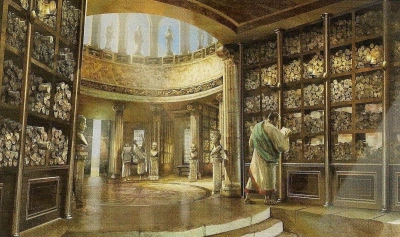
SOBEK
author: High Priest Zevios Metathronos
co-author: Novice Priest Karnonnos
Hieratic Information about Sobek
| Divine Names |
|---|
| Sobek (Σοῦχος, Souchos) | the crocodile god of the waters. |
|---|
| Sbk | the ancient Egyptian theonym, written with the crocodile sign. |
|---|
| These names carry the dread and the fertile power of the river and are held potent for invocation of the Lord of the Waters. |
| Divine Symbols |
|---|
- The Nile Crocodile
- The Atef Crown with Solar Disk
- The Ram Horns of Khnum
- The Was-Sceptre and Ankh
- The Egg upon the Waters
- Green Skin
- Crocodile-Tooth Pendant
|
| Divine Numbers and Attributes |
|---|
| Sacred Number | 42 (the deities of the lake in the Book of the Faiyum) |
|---|
| Sacred Animal | the Nile crocodile |
|---|
| Elements | Water and the solar Fire of Ra |
|---|
| Sacred Colour | the green of the river |
|---|
| Cardinal Region | the Faiyum and the southern frontier |
|---|
| Divine Forces |
|---|
- The Inundation and Fertility
- Solar Regeneration (Sobek-Ra)
- Kingship and Virility
- Protection of the Waterways
- Vigilance and Retribution
- Aggressive Healing
|
| Important Titles |
|---|
- Sobek of Shedet
- Lord of the Waters and the Inundation
- Sobek-Ra, Lord of Kom Ombo
- Son of Neith
- Father of the Gods who came forth from Nun
- Great of Might, Great of Awe
- The Raging One
|
| Names Across Civilizations |
|---|
| Egyptian | Sbk (𓆊) |
|---|
| Demotic | sbk |
|---|
| Koine Greek | Σοῦχος (Souchos) |
|---|
| Latin | Suchus |
|---|
| Coptic | ⲥⲟⲩⲕ (Souk) |
|---|
| Meroitic | , (not attested) |
|---|
I. Name and Etymology
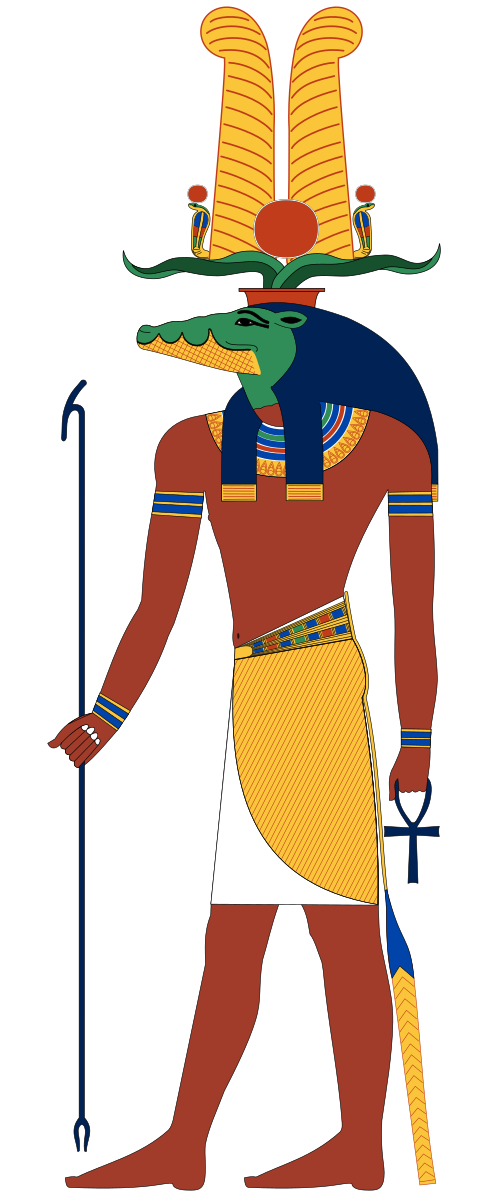
Sobek
Sobek (Egyptian Sbk) is the great crocodile god of Egypt, and his name is first securely written in the Pyramid Texts of the late Old Kingdom, where the dead king Unis is identified with the god and named the son of the goddess Neith. The theonym is written with the image of the crocodile itself; its exact meaning is uncertain, and the god carried the fierce by-name qnd, "the Raging One."1,2,3,4,5
In Coptic the name survives as ⲥⲟⲩⲕ (Souk), preserved in the Faiyum onomastics of Christian Egypt. The Greeks called the god Σοῦχος (Souchos, Latin Suchus): Strabo records the tame sacred crocodile Souchos of Arsinoe, and the name is embedded in the countless theophoric names of Graeco-Roman Egypt, Petesouchos and Sisouchos among them. In the Meroitic south no distinct name of Sobek is attested; he remained an Egyptian god of the river and the Faiyum, reaching only as far as his frontier temple at Kom Ombo.2,6,7,8
Sources: Zecchi, Sobek of Shedet, 2010; Kockelmann, Der Herr der Seen, Sümpfe und Flußläufe, 2017; Crum, A Coptic Dictionary, 1939; Strabo, Geography; Herodotus, Histories.1,2,6,7,8
II. History
Sobek is a powerful god of Egypt who functioned as a symbol of extreme power and gravity manifesting the Pharaoh's prerogatives. The crocodile belongs to the oldest stratum of Egyptian religious imagery, and the cult of the crocodile in the Faiyum was reckoned immemorially old, its roots reaching back toward the very formation of the Egyptian state; the god's name Sobek, however, is first securely fixed in writing in the Pyramid Texts of the Old Kingdom.
He also functioned as a major god of the Sun, a deity of fertility and as a custodian of the waterways of Lower Egypt who protected the denizens of the Nile, beheld as an awesome symbol of power of nature. The oldest Pyramid Texts give reference to Sobek who is named as providing all kinds of masculine virility to the Pharaoh in a rather graphic manner:1,3,5
Unis is Sobek, green of plumage, with alert face and raised fore, the splashing one who came from the thigh and tail of the great goddess in the sunlight ... Unis has appeared as Sobek, Neith's son. Unis will eat with his mouth, Unis will urinate and Unis will copulate with his member. Unis is lord of semen, who takes women from their husbands to the place Unis likes according to his heart's fancy.
Pyramid Texts of Unis, trans. Allen3
Sobek's connection to his mother, Neith, is also attested to in these texts. At this point, however, the Faiyum cult seems to have predominated above his place in other areas.
The decisive change in Sobek's imagery came in the Middle Kingdom, when the crocodile god rose from a regional power to a deity of the crown. The kings of the Twelfth Dynasty turned toward the Faiyum, and Amenemhat III drove great building and reclamation works around Lake Moeris. Sobek was now fused with Horus as Sobek-Horus, binding the crocodile to kingship itself, and the god's name entered the royal titulary in the line of Sobekhotep, "Sobek is satisfied," and in Sobekneferu, "the beauty of Sobek," who closed the dynasty.1,9,10,11
In the New Kingdom Sobek was drawn fully into the solar orbit as Sobek-Ra, the crocodile as a form of his brother the sun god, and he was worshipped across Egypt beyond his Faiyum home to the north. Sobek became a symbol of the Nile more generally rather than just being consigned to the Delta of Lower Egypt.
His southern seat at Sumenu near Thebes flourished and like many Egyptian deities, he became associated with the power of royalty. A great dyad of Amenhotep III standing beside Sobek-Ra, lord of Sumenu, was recovered from a water-filled chamber at Dahamsha, one of the masterpieces of Egyptian statuary. It is in this period, too, that the mythological tales place Sobek among the actors of the Osirian cycle, tasked with retrieving from the water the severed hands of Horus.2,11,12
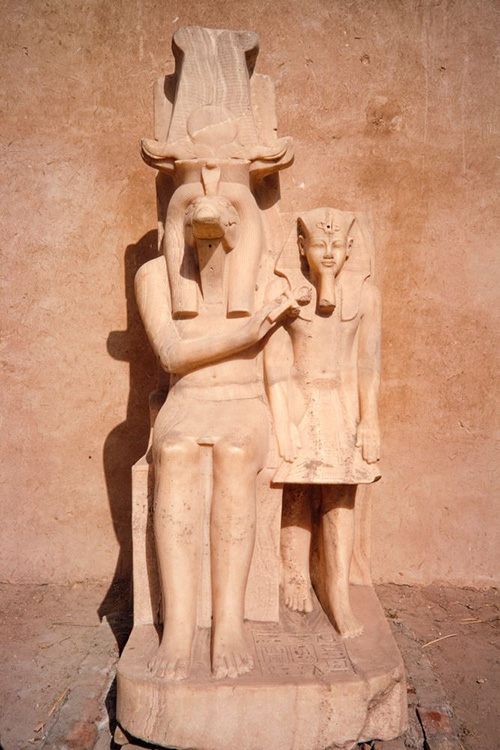
Calcite-alabaster group of Sobek embracing the Pharaoh Amenhotep III, 18th Dynasty, Luxor Museum
Far from fading, Sobek's cult remained a living power into the last native ages. His Faiyum temples multiplied, his solar and creator theology deepened, and his name persisted in personal piety across Egypt; the god passed intact from the Saite and Persian centuries into the world the Ptolemies would inherit.1,2,13
Under the Ptolemies and Rome the crocodile god reached his widest documented extent. His theology was gathered into the great local monograph modern scholars call the Book of the Faiyum, while at Kom Ombo on the Nubian frontier the Ptolemies raised him a vast temple beside Horus the Elder. Sobek remained a living power to the end of the Roman period, when the classical authors describe his sacred crocodiles and list him among the beast-gods of Egypt.14,15,16,17
A plethora of similar crocodilian imagery appears from the Late to Roman periods, often depicting Neith with crodociles, the child Horus and Khonsu and other deities riding crodociles and a litany of other imagery related to the fearsome animal of the Nile. These themes, even echoed on the magical amulets and gems of Egypt exported throughout the Mediterranean, appear to be connected quite deeply to Sobek in some fashion.
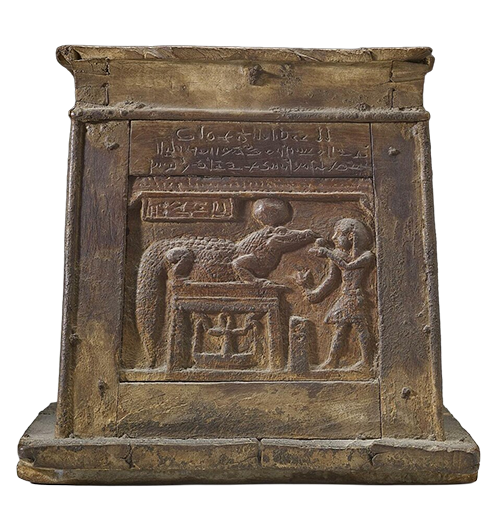
Chest with Writing, 1st century BCE, Walters Museum
III. Epithets
Sources: Zecchi, Sobek of Shedet, 2010; Gutbub, Textes fondamentaux de la théologie de Kom Ombo, 1973; Leitz, Lexikon der ägyptischen Götter und Götterbezeichnungen, 2002; Wilkinson, The Complete Gods and Goddesses of Ancient Egypt, 2003; Bresciani, Sobek, Lord of the Land of the Lake, 2005; Herodotus, Histories; Strabo, Geography.1,4,5,7,8,18,19
IV. His Temples
His cult center was located in Shedhyet (modern day Faiyum), which the Greeks named Krokodeilopolis in Lower Egypt, at the widest branch of the Nile Delta. The cult site of Sobek was known to be extremely old, dating as far back or further than the ancient Pharaoh Narmer, whose seal features a crocodile deity.1,20,21
Shedyet was of a huge size. Flinders Petrie estimated that when Sobek's Great Temple was first built, it occupied an area equal to what is now most of the modern town and fields which cover it. He believed that the enclosure for the temple, known as a temenos, measured over 1000 feet north-south and around 750 feet east-west. The mud walls which formed part of this temenos were between thirty and forty feet thick. They remained close to forty feet high in many places.1,20
The importance of Shedet also lay in the fact that it stood at the theological center of the whole Faiyum system of Sobek cults. There, at least in Roman times, as a symbol of Sobek, a tamed crocodile lived there named the Petsoukhos, a special animal resident and clothed with gold and various precious stones there, as Strabo noted in his work. The Petsoukhos lived in a special pond created in the environs of the temple, and it was fed by the priests with donated food provided by the pilgrims to the site.7,1
Another major site of Sobek was Sumenu near Thebes, which was considered to be a focal point of his cult in Upper Egypt. His importance as a God to the Dynasty of Amenemhet I and the Twelfth Dynasty is suggested by the fact that Egypt's capital was moved from Thebes to Itjtawy, a locality near the Fayyum, during Amenemhet I's reign. The strongest early evidence is associated with Iny of Gebelein, whose coffin belongs around the First Intermediate Period–Eleventh Dynasty transition and recorded an official connected with the “Temple of Sobek, Lord of Sumenu.”2,9,11
Royal investment shows the importance of New Kingdom Sumenu. The historian Bakry recovered monuments naming Thutmose III, Amenhotep III and Ramesses II, indicating repeated royal investment in Sobek's sanctuary.22
The third major area of worship for Sobek was Narmouthis, established by his successor Pharaoh Amennemhat III and his daughter Sobekneferu, who built a temple to Sobek and the cobra-headed goddess named Renenutet there. The symbolism of Renenutet and Narmouthis is suggestive of sustenance. Early scenes from the Middle Kingdom show Sobek and Anubis anointing the Pharaoh.1,23,24
It was expanded during the Ptolemaic era, something discussed on the Renenutet page. Like the snake goddess, Sobek at Narmouthis was the recipient of several hymns by the resident priest, Isidoros. At the Ptolemaic Temple C, a remarkably well-preserved mud-brick crocodile sanctuary was built where at the rear was a naos containing two long stone compartments or loculi, each equipped with sockets for wooden rollers apparently intended to facilitate the insertion of litters bearing the bodies of two sacred crocodiles. Eggs were also found at the site.25,26
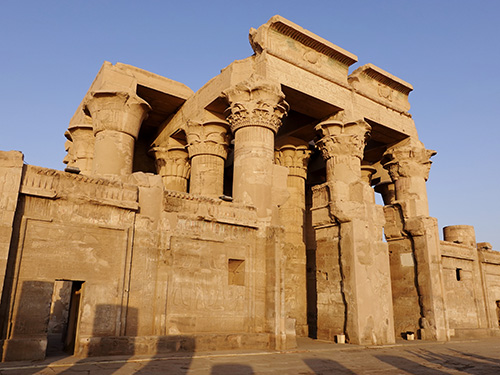
Temple of Kom Ombo
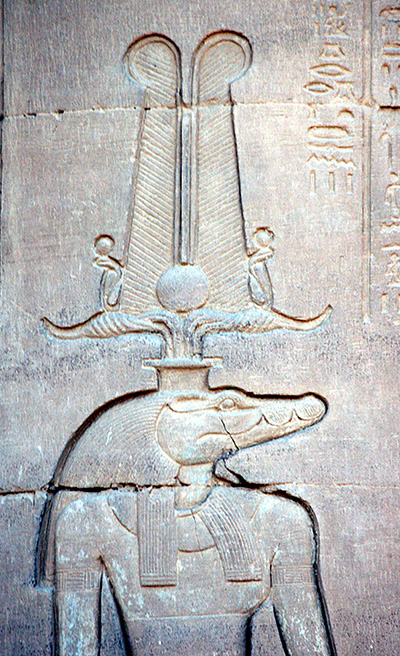
Sobek, intercolumnar wall at the Ptolemaic Temple of Kom Ombo
The final major site was at Nubt (Kom Ombo) leading to Nubia as a garrison town. Sobek shared a famous temple with Horus the Elder or Arueris as a total dual sanctuary, with the crocodile god occupying the southern half of the site. Many of the examples of crocodile imagery have been retrieved from this site, and several hundred crocodile mummies have been recovered from the Kom Ombo area and its surrounding graveyards. The great surviving temple began construction under Ptolemy VI Philometor (180–145 BCE), received extensive decoration under later Ptolemies, especially Ptolemy XII, and continued to be decorated under Roman emperors as late as Trajan.19,27,28
Here, Sobek was often assimilated to the earth god Geb, while Horus the Elder was equated with the air god Shu. A very deep water installation was built on the western side of the complex with a nearby small pond whhich has traditionally been interpreted as an enclosure where sacred crocodiles may have been kept. The site is also unique for its medical imagery involving surgical instruments and other pieces of medical paraphernalia, perhaps suggestive of Sobek's connection to surgery and aggressive healing.19,29
The family of Sobek at this site consisted of Hathor and Khonsu, while the site had an official dedication to him as being the co-Lord of the shared complex with Arueris. The temple at Gebel el-Sisila also had many of these conventions.18,30,31,32,33
V. His Priesthood
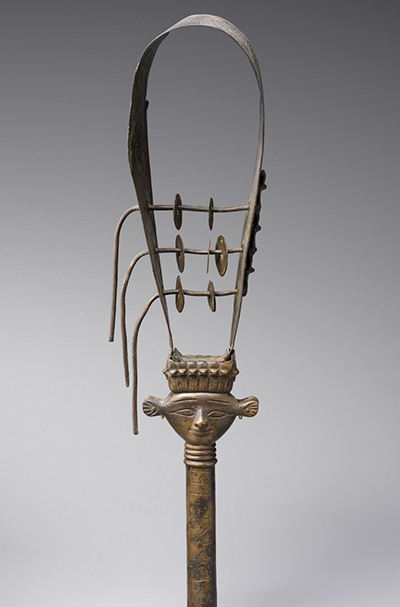
Arc sistrum of Tapenu, chantress of Sobek of Khenyt, (1200-600BCE), the Met
Despite the ancient pedigree of this god, the worship of Sobek was a major feature of Egyptian life, even at the end of the Roman period. Papyri and ostraca from towns such as Tebtunis (Tebtynis), Soknopaiou Nesos (Dimeh), Bakchias, Narmouthis (Medinet Madi), and Theadelphia, surrounding Shedhyet, document the temples and priests of this God at that advanced point.34,35,36,37,38
Archeological retrievals of papyri were interpreted and show the existence of various offerings, inventories, processions and celebrations, including the hieratic use of complex instructions involving priestly rotations. For example, at Soknopaiou Nesos in the 1st–2nd century CE, the temple employed priests organized into five phyles, which were groups of about 30 men each, who served in rotation for the purpose of every lunar month.35,39,40
Evidence suggests Sobek's priesthood was deeply embedded in day-to-day life and seemed to function as a public liaison of sacred religion among the masses. Priests of Sobek leased temple lands, collected rents and public donations, and they supervised the proceedings of public festivals. Greek papyri mention specific titles given to priests like "prophet of the Crocodile-Gods" and "the one who buries the bodies of the Crocodile-Gods of the Land of the Lake."35,41,42
How truly the Agathosdaimon, mighty Sokonopis
dwells as your temple mater, that goodly Bestower of wealth
Creator of both earth and the starry heaven.24
Greek Isiac hymns of Isidoros, inscribed on Mednet Madi temple column, trans. Vanderlip
VI. Water God
Sobek was a God of water and of fertility. As the deification of the fearsome Nile crocodile, he personified the life-giving and life-destroying power of the river. Egyptians observed how the Nile's annual inundation brought fertile silt, so in myth they attributed the flood to Sobek. One epithet called him "Lord of the Waters" and "Lord of the Inundation" . Priests taught that the Nile's flood was caused by Sobek's sweat, a vivid metaphor that appears in Greek-era texts, such as the Ptolemaic hymn.2,5,14,43
In the creation myths, Sobek emerged from the primordial waters on the first mound of earth and laid the eggs that hatched creation. Here, the fertilizing waters and the generative egg adjacent to them are both the domains of the crododilian God, two symbols that reinforce him as a God of procreation, fecundity, and rebirth. Farmers in the Faiyum and along the Nile would pray to Sobek for a proper inundation each year.14,1,44
Mythologically, Sobek was recounted in specific tales from the New Kingdom, such as the episode where he is tasked with finding the severed hands of Horus. His worship was not consigned to temples or specific rituals in papyri. The immense popularity of Sobek is shown in how commoners named their children after him with names like "Sobekemheb" or "Esokari".12,45,46
A major monographic work concerning Sobek that was popular during Ptolemaic and Roman times was named the Book of the Faiyum, recorded on various recovered kinds of papyri that show evidence of a wide scope of production. In this account, Ra-Sobek makes his journey through Lake Moeris at the center of the Faiyum Oasis at night, while encountering several of the serpent and frog-headed deities of Hermopolis. Stories of the creation of the world as well as the nightly regeneration of the sun God are told. Each of the forty-two deities of the lake described in the myth indicate a particular cult site in Egypt.14,15,2
VII. Fearsome Imagery
The Egyptians did not take Sobek lightly as a deity, however. Many of his epithets indicate the cruelty of the side of nature that the deity personifies.2,5
In the anthropomorphic form above, the way in which Sobek's jaw is depicted emphasizes the surface of the water and waves. The qualities of furious water and waves were ascribed to him, sometimes symbolically suggestive of purification and repentance. Variously, Sobek was described as the son of Set or Khnum, both of whom share certain aspects of natural generation and protection of the devout with him, and he is commonly depicted with the ram horns of Khnum. His mother as the war goddess Neith who was also associated with rapid waters; the watery symbolism developing from the androgynous Khnum-Neith gave birth to Sobek's representation of creative power.2,6,47
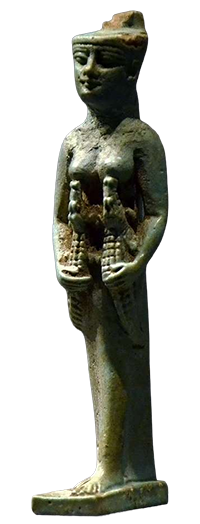
Faience statuette of Neith suckling crocodiles, Late Period (circa 664–332 BCE)
Sobek had name of "He who Made the Plants Green", as one of his Late Period epithets and through water, he was said to bring all vegetation to life. The green color of his skin represents the Nile, all rivers and lakes; it was also a hint towards purification spiritually and towards his powers of natural generation, particularly combined with his magnificent solar crown.5,2,48
VIII. Crocodilian Imagery
Sobek was always represented as a crocodile, one of the most fearsome beings of the animal kingdom. The apex predator of the rivers, is, however, diligent when taking care of its young; it transports them from area to area in its fearsome maw. These animals demonstrate complex behaviors to control their eggs and nurture the young, particularly in their tireless pursuit to keep both at the correct temperature, in order to avoid death. A parallel can be drawn to the careful activities of Sobek's priests to cultivate religion among the inexperienced and naïve.2,49
It was said that crocodiles could predict the flood's height by nesting above the coming waterline, hence Sobek was consulted as a sort of prognostic entity for the inundation season by the farmers of the great civilization. This, too, shows the need for the initiate to be far-seeing and to take consequences for wrongful actions.2,12
The fertility of the crocodile is shown in the extreme amount of eggs laid by a female. That quality was reinforced in the constant Egyptian textual references to Sobek endowing the Pharaohs with masculine virility, and the power to conceive endless children. The shape of the crocodile from a side view was considered to be a phallic symbol by the Egyptians.3,2,49
Perhaps no predator is as rapid when seizing its prey as the crocodile, and so the crocodilian symbolism of being able to snap with rapid speed related to the ultimate punishing powers of the Pharaoh to use Sobek's powers when absolutely necessary. Sobek was also considered to relate to the bloodiest prerogatives of Egypt's army when facing desperate situations.2,5
Crocodiles are also some of the most ancient animals in existence, in form if not in precise evolution, which is why one of the words to describe them was 'stone animal' or 'stone beak'. This pedigree linked into the esteemed antique symbolism of Sobek. On the other hand, crocodiles, then as now, gained a perverse reputation for being representative of liars, given their ability to snap. All of these meanings are represented in one of Aesop's fables:2,50
Aesop's fables, the Fox and the Crocodile
Ἀλώπηξ καὶ κροκόδειλος περὶ εὐγενείας ἤριζον. Πολλὰ δὲ τοῦ κροκοδείλου διεξιόντος περὶ τῆς τῶν προγόνων λαμπρότητος καὶ τὸ τελευταῖον λέγοντος ὡς γεγυμνασιαρχηκότων ἐστὶ πατέρων, ἡ ἀλώπηξ ἔφη· «Ἀλλὰ κἂν σὺ μὴ εἴπῃς, ἀπὸ τοῦ δέρματος φαίνῃ ὅτι ἀπὸ πολλῶν ἐτῶν εἶ γεγυμνασμένος.»
Οὕτως καὶ τῶν ψευδολόγων ἀνθρώπων ἔλεγχός ἐστι τὰ πράγματα.
A fox and a crocodile were arguing about nobility of their birth. While the crocodile was going on at length about the splendor of his ancestors, and finally claiming that his fathers had even served as gymnasiarchs [high officials designed to overlook gyms, NOT ATHLETES], the fox said: "Even if you hadn't told us, from your skin it's obvious you've 'trained in the gymnasium' for many years."
Accordingly, the facts themselves are the refutation of lying men.50
IX. Retribution and Crocodile of the Cosmos
So one of the darker meanings of Sobek indeed related to where lying leads and to the typhonic harshness of the truth. Interestingly, Sobek was often considered the inhabitant of the Isheru, the lake from which enraged Goddesses such as Hathor (in the form of Sehkmet, the Eye of Re) or Tefnut would be cooled around, suggestive of sudden realization.2,51
Crocodiles never truly 'sleep' in the same way as humans; they operate unihemispherically, meaning one half of their brain is always awake at all times in a state of constant vigilance. This watchfulness was ascribed to Sobek too. The atef crown of dual feathers and a central solar disk was commonly represented in Sobek's iconography, suggestive of his divine union with Re. The paradoxical diurnal faculty of the sun with a nocturnal animal like the crocodile contains its own code about the vigilance necessary to unify the two sides of the brain.2,1
Late Period Hymn to Sobek, Divine Creatures: Animal Mummies in Ancient Egypt
... his right eye that shines during the day, and his left eye during the night
[...]
Scares the evil ones with his appearance
In his name of Sobek Ra that is in his lake.
...
He is the most prestigious God for his strength, Sobek-Ra, Lord of Kom-Ombo, who loves clemency after rage.19
Much like in regard to Bastet with cats and Anubis with dogs, crocodiles were meticulously mummified at certain Egyptian cult sites in honor of him. The main Temple of Shedhyet shows the widest participation in this practice in archeological record. Even the eggs of the crocodile were mummified and cast into ritualized areas for deliberate reasons. There is an indication that this practice was seen as broadly protective of the Egyptian people.52,53,54
As far as spiritual ascension is concerned, the symbolism behind the crocodile's egg was also related to the idea of not cracking it prematurely and inadvertently activating the devouring mechanism that causes dangers, but to gauge the temperature carefully and to 'smite' it with heat to harness its powers safely. This idea is echoed in the occult Atalanta Fugiens work by Michael Maier.55
A lighter side to the crocodile god was enshrined in his role as guardian and origin of the waters, particularly as the protective deity of the Nile. Even common Nilometers found at Kom Ombo, used to measure flood levels, were found to be sacred to Sobek. He was said to help travelers, and in a holy context, the initiates of the Gods in traveling allegorically from the precarious start to their spiritual journey to the end point.28,2
Faience amulets of Sobek or any crocodile were often worn casually by Egyptians as protective symbols, suggestive of mass production and popularity. Crocodile tooth pendants were also popular items for laypeople, many of which were retrieved by archeologists in excavated Egyptian households.56,57
X. Damascius and Souchos
The crocodile god drew the reflection of the last pagan philosophers. Writing in the sixth century CE, Damascius, the final head of the Athenian school, set down in his Philosophical History a striking judgment on the god of the Faiyum, preserved for us in the epitome of Photius: that Souchos is just, since no animal acts unjustly. In the Neoplatonist's reading the crocodile, acting always by its nature and never against it, becomes a figure of the incorruptible justice of the cosmos, the very sense of righteous inevitability that this page has traced through the fable and the harshness of truth.58,59
Souchos is just, for no animal acts unjustly.
Damascius, Philosophical History, in Photius, Bibliotheca 24258,59
The classical world had long puzzled over the Egyptian worship of so terrible an animal. Cicero cited the crocodile as the very type of the strangeness of Egyptian animal cult; Diodorus and Aelian reported at length the honours paid to the sacred crocodile and the reasons the priests gave for them; and Juvenal made the crocodile-worship of Ombos the occasion of his fifteenth satire, in which the crocodile-revering men of Ombos and the crocodile-eating men of Tentyra fall to slaughter over their rival beasts. Behind the satire lay a real theological fault-line, and the Roman coins of the Ombite nome duly bore the crocodile and the effigy of Sobek.60,61,62,63,19
XI. Festivals of Sobek
The god's festivals turned on the sacred crocodile and the rhythm of the temple year. At Shedet and Arsinoe the tame crocodile was displayed, adorned, and fed by priests and pilgrims alike, and the Fayum temple archives record a dense calendar of processions, offerings, and vigils served by the rotating priestly phyles; at Kom Ombo the temple's own festival calendar was carved upon its walls. The record below gathers what can be securely reconstructed and is not exhaustive.7,35,64,19
Sources: Strabo, Geography 17.1.38; Sippel, Gottesdiener und Kamelzüchter, 2020; Perpillou-Thomas, Fêtes d'Égypte ptolémaïque et romaine, 1993; Gutbub, Textes fondamentaux de la théologie de Kom Ombo, 1973.7,35,64,19
Sources and Bibliography
- Zecchi, Marco. Sobek of Shedet: The Crocodile God in the Fayyum in the Dynastic Period. Todi: Tau Editrice, 2010.
- Kockelmann, Holger. Der Herr der Seen, Sümpfe und Flußläufe: Untersuchungen zum Gott Sobek und den ägyptischen Krokodilgötter-Kulten von den Anfängen bis zur Römerzeit. 3 vols. Ägyptologische Abhandlungen 74. Wiesbaden: Harrassowitz, 2017.
- Allen, James P. The Ancient Egyptian Pyramid Texts. Writings from the Ancient World 23. Atlanta: Society of Biblical Literature, 2005.
- Leitz, Christian, ed. Lexikon der ägyptischen Götter und Götterbezeichnungen. 8 vols. Orientalia Lovaniensia Analecta 110–116, 129. Leuven: Peeters, 2002–2003.
- Wilkinson, Richard H. The Complete Gods and Goddesses of Ancient Egypt. London: Thames & Hudson, 2003.
- Crum, Walter E. A Coptic Dictionary. Oxford: Clarendon Press, 1939.
- Strabo. Geography, Volume VIII: Book 17, General Index. Translated by Horace Leonard Jones. Loeb Classical Library 267. Cambridge, MA: Harvard University Press, 1932.
- Herodotus. The Persian Wars, Volume I: Books 1–2. Translated by A. D. Godley. Loeb Classical Library 117. Cambridge, MA: Harvard University Press, 1920.
- Shaw, Ian, ed. The Oxford History of Ancient Egypt. Oxford: Oxford University Press, 2000.
- Ryholt, Kim S. B. The Political Situation in Egypt during the Second Intermediate Period, c. 1800–1550 B.C. Copenhagen: Museum Tusculanum Press, 1997.
- O'Connor, David, and Eric H. Cline, eds. Amenhotep III: Perspectives on His Reign. Ann Arbor: University of Michigan Press, 1998.
- Lichtheim, Miriam. Ancient Egyptian Literature. 3 vols. Berkeley: University of California Press, 1973–1980.
- Bagnall, Roger S. Egypt in Late Antiquity. Princeton: Princeton University Press, 1993.
- Beinlich, Horst. Das Buch vom Fayum: Zum religiösen Eigenverständnis einer ägyptischen Landschaft. Ägyptologische Abhandlungen 51. Wiesbaden: Harrassowitz, 1991.
- Beinlich, Horst, Regine Schulz, and Alfried Wieczorek, eds. Egypt's Mysterious Book of the Faiyum. Dettelbach: J. H. Röll, 2013.
- Redford, Donald B., ed. The Oxford Encyclopedia of Ancient Egypt. 3 vols. Oxford: Oxford University Press, 2001.
- Manetho. History of Egypt and Other Works. Translated by W. G. Waddell. Loeb Classical Library 350. Cambridge, MA: Harvard University Press, 1940.
- Gutbub, Adolphe. Textes fondamentaux de la théologie de Kom Ombo. 2 vols. Bibliothèque d'étude 47. Cairo: Institut français d'archéologie orientale, 1973.
- Bresciani, Edda. “Sobek, Lord of the Land of the Lake.” In Divine Creatures: Animal Mummies in Ancient Egypt, edited by Salima Ikram, 199–206. Cairo: American University in Cairo Press, 2005.
- Petrie, W. M. Flinders. Hawara, Biahmu, and Arsinoe. London: Field & Tuer, 1889.
- Kockelmann, Holger. Der Herr der Seen, Sümpfe und Flußläufe, vol. 1, on the Predynastic and Early Dynastic crocodile record; with Zecchi, Sobek of Shedet, on the earliest attestations. [The draft's Narmer-seal claim is unverified, see wrap-up note.]
- Bakry, Hassan S. K. “The Discovery of a Temple of Sobk in Upper Egypt (1966–1969).” Mitteilungen des Deutschen Archäologischen Instituts, Abteilung Kairo 27 (1971): 131–146, pls. XXIII–XXXV.
- Vogliano, Achille. Rapporto degli scavi condotti dalla Missione archeologica d'Egitto della R. Università di Milano nella zona di Madînet Mâdi. 2 vols. Milan: Regia Università di Milano, 1936–1937.
- Vanderlip, Vera Frederika. The Four Greek Hymns of Isidorus and the Cult of Isis. American Studies in Papyrology 12. Toronto: A. M. Hakkert, 1972.
- Bresciani, Edda, and Antonio Giammarusti. I templi di Medinet Madi nel Fayum. Pisa: Pisa University Press, 2012.
- Bresciani, Edda, Ali Radwan, Antonio Giammarusti, and Hisham el-Leithy. Medinet Madi: Archaeological Guide. Verona: Geodia, 2010.
- de Morgan, Jacques, U. Bouriant, G. Legrain, G. Jéquier, and A. Barsanti. Kom Ombos. 2 vols. Vienna: Adolphe Holzhausen, 1895–1909.
- Wilkinson, Richard H. The Complete Temples of Ancient Egypt. London: Thames & Hudson, 2000.
- Hölbl, Günther. A History of the Ptolemaic Empire. Translated by Tina Saavedra. London: Routledge, 2001.
- Arnold, Dieter. Temples of the Last Pharaohs. New York: Oxford University Press, 1999, 187–89.
- Porter, Bertha, and Rosalind L. B. Moss. Topographical Bibliography of Ancient Egyptian Hieroglyphic Texts, Reliefs and Paintings. Vol. 6, Upper Egypt: Chief Temples (Excluding Thebes): Abydos, Dendera, Esna, Edfu, Kôm Ombo, and Philae. Oxford: Griffith Institute, Ashmolean Museum, 1991, 186–201.
- Derbyshire, Joanne. “The Cult of Sobek at Gebel el-Silsila, A Study of the Relief Scene Fragments of the Recently Rediscovered Temple of Sobek of Kheny within the Context of New Kingdom Crocodile Cults.” In Current Research in Egyptology 2024: Proceedings of the Twenty-Fourth Annual Symposium, edited by John Rogers, Catherine Bishop-Allen, Henry Bohun, Reuben G. Hutchinson-Wong, and Marina Sartori, 62–82. Oxford: Archaeopress, 2025.
- Forstner-Müller, Irene, and Pamela Rose. The Town of Kom Ombo I. Untersuchungen der Zweigstelle Kairo des Österreichischen Archäologischen Instituts 42. Vienna: Austrian Academy of Sciences Press, 2024.
- Sippel, Benjamin. Gottesdiener und Kamelzüchter: Das Alltags- und Sozialleben der Sobek-Priester im kaiserzeitlichen Fayum. Philippika 144. Wiesbaden: Harrassowitz, 2020.
- Frankfurter, David. Religion in Roman Egypt: Assimilation and Resistance. Princeton: Princeton University Press, 1998.
- Rondot, Vincent. Tebtynis II: Le temple de Soknebtynis et son dromos. Fouilles de l'Institut français d'archéologie orientale 50. Cairo: Institut français d'archéologie orientale, 2004.
- Davoli, Paola. L'archeologia urbana nel Fayyum di età ellenistica e romana. Naples: Generoso Procaccini, 1998.
- Capasso, Mario, and Paola Davoli, eds. Soknopaiou Nesos Project I (2003–2009). Biblioteca degli Studi di Egittologia e di Papirologia 9. Pisa: Fabrizio Serra, 2012.
- Grenfell, Bernard P., Arthur S. Hunt, and J. Gilbart Smyly. The Tebtunis Papyri, Volume I. London: Egypt Exploration Fund, 1902.
- Widmer, Ghislaine. “On Egyptian Religion at Soknopaiou Nesos in the Roman Period (P. Berlin 6750).” In Tebtynis und Soknopaiou Nesos: Leben im römerzeitlichen Fajum, edited by Sandra Lippert and Maren Schentuleit, 171–184. Wiesbaden: Harrassowitz, 2005.
- Frankfurter, David. Religion in Roman Egypt: Assimilation and Resistance. Princeton: Princeton University Press, 1998. On the crocodile-god priesthoods and titles of the Faiyum.
- Clarysse, Willy, and Dorothy J. Thompson. Counting the People in Hellenistic Egypt. 2 vols. Cambridge: Cambridge University Press, 2006.
- Bagnall, Roger S., and Dominic W. Rathbone. Egypt from Alexander to the Copts: An Archaeological and Historical Guide. London: British Museum Press, 2004.
- Quirke, Stephen. Ancient Egyptian Religion. London: British Museum Press, 1992.
- Faulkner, R. O., trans. The Ancient Egyptian Book of the Dead. Edited by Carol Andrews. London: British Museum Publications, 1985.
- Meeks, Dimitri, and Christine Favard-Meeks. Daily Life of the Egyptian Gods. Translated by G. M. Goshgarian. Ithaca, NY: Cornell University Press, 1996.
- Zivie-Coche, Christiane, and Françoise Dunand. Gods and Men in Egypt: 3000 BCE to 395 CE. Translated by David Lorton. Ithaca, NY: Cornell University Press, 2004.
- Vernus, Pascal, and Jean Yoyotte. Bestiaire des pharaons. Paris: Perrin, 2005.
- Wilkinson, Richard H. Reading Egyptian Art: A Hieroglyphic Guide to Ancient Egyptian Painting and Sculpture. London: Thames & Hudson, 1992.
- Aesop. Fables. Edited by Émile Chambry. Paris: Les Belles Lettres, 1927. Fable of the Fox and the Crocodile (Perry 32).
- Kockelmann, Holger. Der Herr der Seen, Sümpfe und Flußläufe, vol. 1, on Sobek at the Isheru and the pacification of the raging goddess. Wiesbaden: Harrassowitz, 2017.
- Kessler, Dieter. Die heiligen Tiere und der König, Teil I: Beiträge zu Organisation, Kult und Theologie der spätzeitlichen Tierfriedhöfe. Ägypten und Altes Testament 16. Wiesbaden: Harrassowitz, 1989.
- Ikram, Salima, ed. Divine Creatures: Animal Mummies in Ancient Egypt. Cairo: American University in Cairo Press, 2005.
- De Cupere, Bea, Wim Van Neer, Alejandro Jiménez-Serrano, et al. “Newly Discovered Crocodile Mummies of Variable Quality from an Undisturbed Tomb at Qubbat al-Hawâ (Aswan, Egypt).” PLOS ONE 18, no. 1 (2023): e0279137.
- Maier, Michael. Atalanta Fugiens. Oppenheim: Johann Theodor de Bry, 1617.
- Andrews, Carol. Amulets of Ancient Egypt. London: British Museum Press, 1994.
- Pinch, Geraldine. Magic in Ancient Egypt. London: British Museum Press, 1994.
- Damascius. The Philosophical History. Text with translation and notes by Polymnia Athanassiadi. Athens: Apamea Cultural Association, 1999.
- Photius. Bibliothèque. Edited and translated by René Henry. 8 vols. Paris: Les Belles Lettres, 1959–1977. Codex 242.
- Cicero. On the Nature of the Gods; Academics. Translated by H. Rackham. Loeb Classical Library 268. Cambridge, MA: Harvard University Press, 1933.
- Diodorus Siculus. Library of History, Volume I: Books 1–2.34. Translated by C. H. Oldfather. Loeb Classical Library 279. Cambridge, MA: Harvard University Press, 1933.
- Aelian. On the Characteristics of Animals. Translated by A. F. Scholfield. 3 vols. Loeb Classical Library 446, 448, 449. Cambridge, MA: Harvard University Press, 1958–1959.
- Juvenal. Juvenal and Persius. Edited and translated by Susanna Morton Braund. Loeb Classical Library 91. Cambridge, MA: Harvard University Press, 2004. Satire 15.
- Perpillou-Thomas, Françoise. Fêtes d'Égypte ptolémaïque et romaine d'après la documentation papyrologique grecque. Studia Hellenistica 31. Leuven: Peeters, 1993.