




| Language / Tradition | Name of the Sphinx | Attestation |
|---|---|---|
| Boeotian Greek | Φίξ (Phix) | Hesiod, Theogony 326 (c. 700 BCE) |
| Classical Greek | Σφίγξ (Sphinx) | Aeschylus, Seven against Thebes 541 (467 BCE) |
| Egyptian | šzp (šesep), “image, statue” | Middle Kingdom onward; can denote a sphinx-statue in context |
| Egyptian | šzp-ꜥnḫ (šesep-ankh), “living image” | New Kingdom royal usage; “sphinx (?)” only in Ptolemaic–Roman texts, 116 BCE–138 CE |
| Egyptian (Giza cult-name) | Ḥr-m-ꜣḫt (Horemakhet), “Horus in the Horizon” | New Kingdom onward; proper name of the Great Sphinx |
| Hellenized Egyptian | Harmachis / Harmais | Greco-Roman period (Pliny, Natural History 36.77) |
| Arabic | أبو الهول (Abū al-Hawl), “Father of Terror” | Medieval and modern Egypt |
30 min read
SPHINX
author: High Priest Zevios Metathronos
co-author: Novice Priest Karnonnos
I. The Name of the Sphinx
The Greek Word and Hesiod's Phix
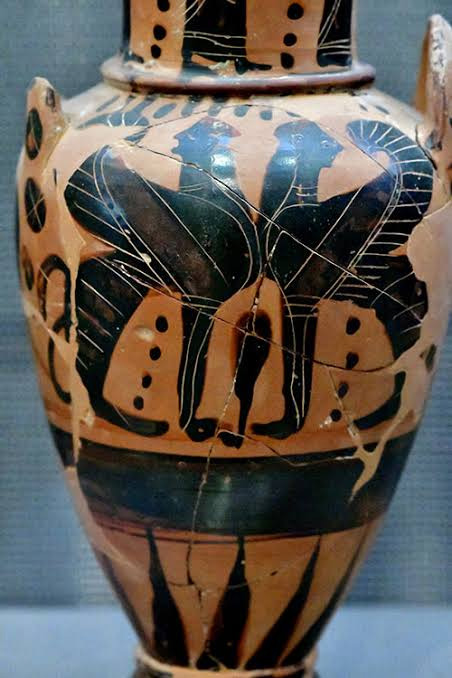
Tyrrhenian amphora, Attica, 6th century BCE
The earliest attestation of the lexeme Σφίγξ, Σφιγγός, ἡ is in Aeschylus. In his Seven against Thebes (c. 467 BCE), Aeschylus depicts the mechanism fastened to the shield of Parthenopaeus as "a flesh-eating Sphinx", Σφίγγ᾽ ὠμόσιτον, the elided accusative of Σφίγγα. The date is certain because the ancient didascalic hypothesis reports that Aeschylus won at the festival during the archonship of Theagenides with Laius, Oedipus, the Seven, and the satyr-play Sphinx, all of the same year; a surviving fragment of that lost satyr play named her the "hound ruling over ill omens". 1,2
The monster, however, is older in Greece than the word itself as Hesiod named the Theban beast about 250 years earlier than Aeschylus and called her Φίξ instead of Σφίγξ. At Theogony 326 Hesiod writes of "deadly Phix" and describes her as "ruin of the Cadmeans" using the accusative Φῖκ᾽. The lexicographers consider Φίξ to represent the Boeotian variant of the name and warn that Σφίγξ might represent the later shape of the name, and thus, the well-known Attic word can serve as evidence of a secondary evolution of a name already local to the area surrounding Thebes. 3,4
Traditional Greek etymologies derive Σφίγξ from σφίγγω, to bind tightly or to throttle, which offers a sense of "the strangler." However, Robert Beekes has doubts regarding this connection and considers it probably a secondary folk-etymology rather than an inherited derivation, and therefore treats the word as most likely belonging to the Pre-Greek substratum.5
The Egyptian Terms
Egyptian did not have a single word consistently referring to what we translate by Greek Σφίγξ. Instead, they had several words that could be used to refer to a sphinx. The most commonly cited Egyptian word is šzp (šesep). Its base meaning is image, likeness, or statue. The Thesaurus Linguae Aegyptiae defines the relevant masculine noun as image, likeness, sphinx, etc. and includes its attestations from c. 1939 BCE to 161 CE. The older Wörterbuch der Ägyptischen Sprache contains this under Wb IV, 536. Faulkner lists the statuary meaning as one possible meaning of šzp. Therefore a sphinx represents a specific type of šzp (a statuary representation), and the Egyptian mind viewed the human-headed lion mainly as a royal image rather than as a zoologically definable animal species which required its own taxonomic word.6,7,8
Henry George Fischer proposed an internal etymology connecting the statuary šzp with the frequent verb šzp, i.e., to receive or accept. Therefore a šzp-statue was conceived as a statue able to receive offerings and participate in a cult. Marianne Eaton-Krauss liked this idea since Egyptian statues are actively accepting offerings instead of merely serving as portraits. The uncertainty regarding this proposal persists and Andrey Bolshakov considered this idea interesting, although questionable.9,10,11
The compound often cited as the Egyptian word for sphinx is šzp-ꜥnḫ (šesep-ankh), transparently image plus living, so living image. In New Kingdom royal language the phrase designates the Pharaoh as the living image of a god, as in a Thutmose III titulary that styles the ruler the living image of Atum, šzp ꜥnḫ n Jtmw<; nothing in that expression requires a leonine form. The current Thesaurus Linguae Aegyptiae does record a separate compound lemma šzp-ꜥnḫ translated Sphinx (?), the question mark being the editors' own, with five attestations dated between about 116 BCE and 138 CE and referred to Penelope Wilson's Ptolemaic lexicon of the Edfu texts. Two distinct propositions must therefore be kept apart. The phrase living image existed as a general royal and statuary expression long before the Greco-Roman period, and only in late, Ptolemaic and Roman, Egyptian does it appear to be used specifically for a sphinx..12,13,14
The appropriate cult-name of the Giza colossus is something else entirely. From the New Kingdom onwards the monument is called Ḥr-m-ꜣḫt (Horemakhet), the Horus of the Horizon, which is the title of the large statue and not a generic word for every sphinx. Christiane Zivie-Coche emphasizes that Egyptian terminology for these monuments belonged to the larger vocabulary of representations and royal statues. Furthermore, she states that šzp-ꜥnḫ was assigned to representations of various types rather than exclusively to sphinxes.15
A Possible Greco-Egyptian Etymology
Popular claims assert Egyptian šzp-ꜥnḫ, living image, translates directly into Greek Σφίγξ. Zivie-Coche rejects this claim based on phonetic considerations stating that such a derivation is barely imaginable on phonetic grounds. Additionally there is chronological difficulties. Greek Φίξ existent by approximately 700 BCE and Greek Σφίγξ existent by approximately 467 BCE while the special lexical entry Šzp-Ánh representing sphinx exists only in Ptolemaic and Roman Egypt from approximately 116 BCE to approximately 138 CE.
Therefore, it would be difficult to show an existing Egyptian name for this creature as the source for the Greek word.1,3,5,13,15
Sources: Schweitzer et al., Thesaurus Linguae Aegyptiae, lemmata šzp and šzp-ꜥnḫ; Zivie-Coche, Sphinx: History of a Monument (2002); Liddell, Scott, and Jones, A Greek-English Lexicon (1940); Beekes, Etymological Dictionary of Greek (2010).4,5,6,13,15
II. The Sphinx of Thebes and Oedipus
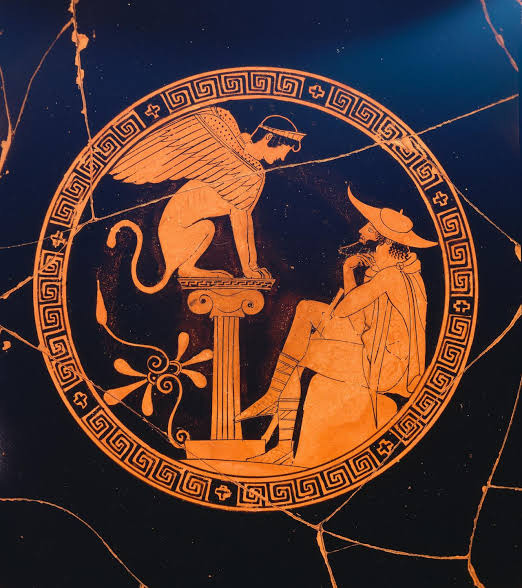
Kylix, Oedipus and Sphinx, 470BCE, Vatican Museum
A Sphinx is a story of Thebes and the accounts of her can only differ on nearly each point, but it is this difference that is most informative regarding her. Timothy Gantz collected the accounts and showed how loose they are in their coherence. Lowell Edmunds argued that the Sphinx was a late addition to a much earlier tale of the hero who kills the monster and then marries, and possibly also late for the addition of the riddle.16,17
"And she bore deadly Phix, a destruction to the Cadmeans."
Hesiod, Theogony 326 (trans. of the author)
Her Parentage
Hesiod describes her as being born to Orthos, the dog of Geryon, but the syntax leaves it ambiguous if she is born of either Echidna or the Chimera. Pseudo-Apollodorus states that she is instead the daughter of Typhon and Echidna, placing her with other children including the Nemean Lion and the Hydra. The Scholia of Euripides record yet another variation of Typhon and Chimera. Another tradition simply omits having her be a child of monstrous parents and declares her to be a natural child of Laius himself, as described by Pausanias.18,19,20
Who Sent Her, and Why
Pseudo-Apollodorus reported that Hera sent the Sphinx upon Thebes, that she took her seat on Mount Phikion, and that she had learned her riddle from the Muses. The scholia supply the motive and the alternatives. Hera was angry with the Thebans for failing to punish Laius, who had carried off Chrysippus, the son of Pelops, out of illicit desire; the abduction was dramatized in the lost Euripidean Chrysippus. Other scholastic accounts assign her sending to Ares, to avenge the dragon that Cadmus killed, or to Dionysus, or to Hades. The diversity in divine patron indicates how easily a non-specific monster could be assigned to the specific guilt of the House of Laius.18,19,21
The Rationalized Sphinx
Ancient authors who were uncomfortable with a speaking hybrid created rationalizations of her, as in how Pausanias tells us that there existed a version where she was a bastard daughter of Laius to whom he confessed the secret oracular messages that Cadmus previously received at Delphi. She utilized that information to kill her half-brothers because they could not answer what she claimed was said by the oracle, and ultimately was killed by Oedipus at the head of an army.
Palaephatus rationalized her differently as a foreign wife of Cadmus who removed to the mountain with a group of followers and robbed the Thebans from it until Oedipus destroyed her with a force from Corinth. Jean-Marc Moret’s analysis of images cautions us that while many vases appear to show Oedipus confronting the Sphinx do not in reality depict that confrontation so that the literary ambiguity exists in conjunction with an iconographic ambiguity.20,22,23
Her Death
The dominant account has the Sphinx destroy herself. When Oedipus answered the riddle, she flung herself from her rock or from the citadel and perished, and Thebes with its kingdom and its widowed queen passed to the solver. Some tellings instead have Oedipus kill her outright.17,18
III. Epithets of the Sphinx
The Greek literary adjectives below are drawn from the tragedians and from Hesiod.1,2,3,24,25
| Epithet | Meaning | Attested in |
|---|---|---|
| ὠμόσιτος (ōmósitos) | Raw-flesh-eating | Aeschylus, Seven against Thebes 541 |
| ὀλοή (oloḗ) | Deadly, baneful | Hesiod, Theogony 326 |
| κύων δυσαμεριᾶν πρύτανις | Hound presiding over evil days | Aeschylus, Sphinx fr. 236 Radt |
| ποικιλῳδός (poikilōidós) | Singer of intricate songs | Sophocles, Oedipus Tyrannus 130 |
| σκληρὰ ἀοιδός (sklērà aoidós) | The harsh singer | Sophocles, Oedipus Tyrannus 36 |
| ῥαψῳδὸς κύων (rhapsōidòs kýōn) | The riddle-chanting hound | Sophocles, Oedipus Tyrannus 391 |
| γαμψῶνυξ παρθένος | The crook-taloned maiden | Sophocles, Oedipus Tyrannus 1199 |
| χρησμῳδός (chrēsmōidós) | Chanter of oracles | Sophocles, Oedipus Tyrannus 1200 |
Sources: Aeschylus, Seven against Thebes, ed. Sidgwick; Radt, Tragicorum Graecorum Fragmenta III; Hesiod, Theogony; Sophocles, Oedipus Tyrannus, ed. and trans. Lloyd-Jones; Demisch, Die Sphinx (1977).1,2,3,24,25
IV. The Sphinx as an Emblem of Chios and Thebes
The winged female Sphinx was used widely throughout ancient Greece prior to being used as a symbol for any specific city. In addition, Jeremy McInerney describes how the Winged Female Sphinx was but one example of many examples in the broader Greek tradition of using hybrid figures to define the boundaries of humanity.26
In the Aegean, Chios adopted the seated Sphinx as their civic emblem. Chian money (coins) featured a wide variety of seated sphinx images on the front side of their silver and bronze money. These sphinx images were often paired with other symbols such as an amphora or a bunch of grapes. The fact that these sphinx images continued to be produced from the Archaic period to the Roman imperial period demonstrates that she could become a neutral and positive civic trademark.
For Thebes, the Sphinx was etched into the eternal memory of the city as the city's own resident terror, seated on Mount Phikion above the plain, and the Theban story made her the emblematic monster of the Cadmean house rather than a coin device. The point could be turned into an insult: Aeschylus has Parthenopaeus, one of the seven attackers, carry a Sphinx clamped in relief on his shield, clutching a Theban victim, so that Thebes' own monster is borne against Thebes; Pausanias saw a Sphinx set at the center of the helmet of the Athena Parthenos, flanked by griffins, and Euripides too saw the creature as a shield-device.1,20,27,28,29
Sphinxes on Temple Roofs
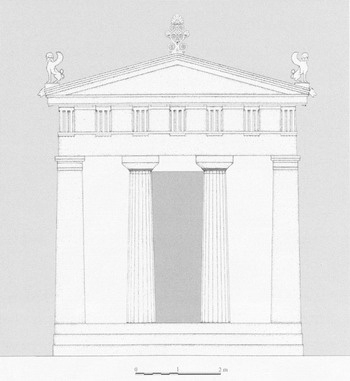
Sphinxes flanking Temple of Themis at Rhamnous, 5th century BCE temple
Above temple and sanctuary walls, there existed a consistent architectural design that incorporated the winged female sphinx. Typically, sphinxes are placed at both ends of temple rooftops surrounding a central floral or figurative acroterion. These designs typically depict a heraldic motif with two monsters framing a central icon. Thierry Petit interprets this architectural design as an eschatological representation, marking the entrance to the Tree of Life, a sacred borderland, although he concedes that the architectural placement is certain. The likelihood is that these figures functioned as boundary-markers and guardians of what was sacred, similar to what the Sphinx herself is representative of in myth.28,30
V. The Sphinx on Greco-Roman Cups and Furniture
Away from graves and temples the Sphinx served the table, the toilet, and the household, where a single small figure could beautify an object, conceal a join, display the metalworker's skill, and metaphorically guard the contents at once. Kiki Karoglou stresses that decorative and apotropaic were never mutually exclusive in this material.28
The Predatory Sphinx
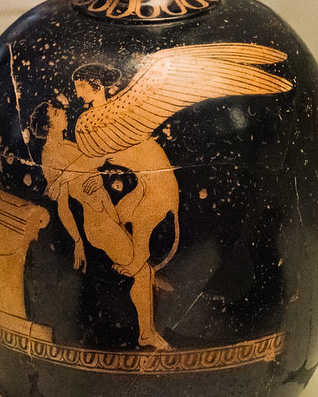
Vase painting of sphinx seizing youth (possibly Oedipus), Attica, 450-440BCE
Vase painters created a more sinister version of the creature for the drinking cup and oil jug. Painters depicted a Sphinx attacking a youth, standing over dead bodies, or grasping naked youths in their paws. Such depictions of the creature brought sex-related dangers, premature death, and supernatural predatory power to both sympotic and funeral contexts. While these works may have been inspired by the Theban monster, the lack of identifiable characters (i.e., Oedipus) or landmarks makes identification difficult. Some works depict creatures similar to the death figures known as Keres28
Furniture, Supports, and Vessels
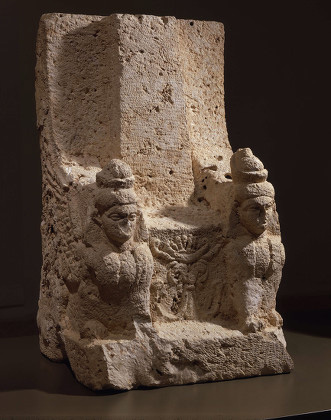
Throne of Astarte with Sphinxes, Phoenician-Hellenistic, Sidon
A lion's paw shaped table leg or stool leg could morph into a Sphinx's body thereby transforming the creature into the actual foot of a table, stand, basin or throne, which is characteristic of the Greeks' ability to animate a useful item. A type of bronze support of early Greek manufacture, featuring a lion's paw developing into a Sphinx, was found by Joan Mertens. Metal tripods from the 6th century BCE featured cast sphinxes and palmettes on each ring of the upper section.
An example is a bronze rod tripod from the late 6th century that physically held a vessel. Cast sphinxes were attached to the rims of bronze vessels. Here, there is an especially Archaic combination of a practical piece of hardware (the lid fastener) and protective monster. Gold jewelry makers created miniature versions of the creature. Hellenistic artists freely intermingled traditions. For instance, a 1st century gold earring features a female Greek sphinx with a bird-like body and the solar crown horns of the Egyptian goddess Hathor or Isis.31,32,33,34
The Roman Sphinx and the Seal of Augustus
Roman craftspeople continued to create animated supports like those of their predecessors but created sphinxes that spoke to luxury and Egyptianizing tastes. Small Egyptianizing sphinxes were used as furniture legs and as bases for candlesticks/censors (an example can be seen in an Augustan bronze male sphinx at the Metropolitan Museum that likely belonged to a censer stand). Sphinxs were also painted as small figures supporting non-existent architectural structures within Egyptianizing paneling featuring floral motifs and Nile-scene imagery. Such imagery would remind viewers of Egypt's antiquity and Rome's conquest of it after 31BCE. The sphinxes also appeared as seals. Pliny reported that Augustus initially used one of two nearly identical sphinx rings he inherited from his mother as a seal on his letters. Thus, she was used as an identifier because multiple people could wear the matching ring; essentially it acted as an administrative seal representing another symbolic sense of boundary margin.35,36,37,38
VI. The Naxian Sphinx
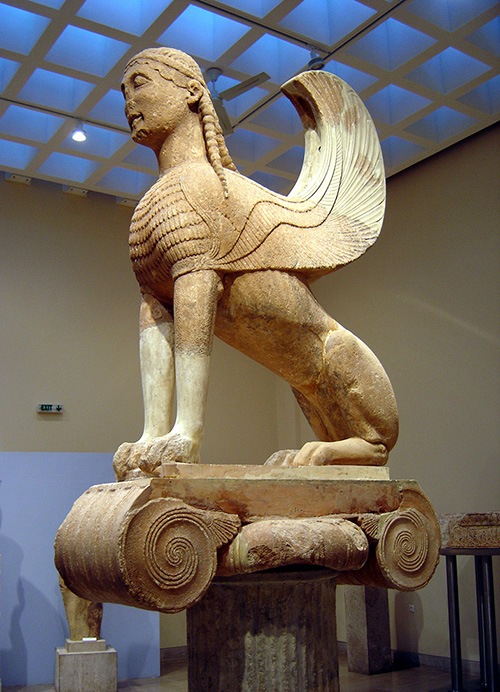
Sphinx of Naxos, 560 BCE, Delphi Archaeological Museum
The largest surviving Greek Sphinx that was not either a tombstone or decoration sat atop a column at Delphi. Around 560 BCE, the island of Naxos donated a colossal marble Sphinx to Apollo that sat atop an extremely tall Ionic column so that both the image and column stood approximately twelve meters high above the temple complex. This donation was done by the city of Naxos as a way to demonstrate their wealth/presence at Panhellenic sites and they were able to use their Naxian promanteia to consult the Oracle before other visitors to Delphi. The height at which the Sphinx sat allowed it to take on its older apotropaic purpose as a guardian over the temple grounds. The Naxian Sphinx represents the hybrid at its most visible and dignified; it is part of a group of large scale images at sanctuaries including treasury buildings, and it should be placed in the same repertoire as Karoglou aaand McInerney describe without recognizing the Sphinx itself as being worshiped.26,28,39
VII. The Great Sphinx of Giza
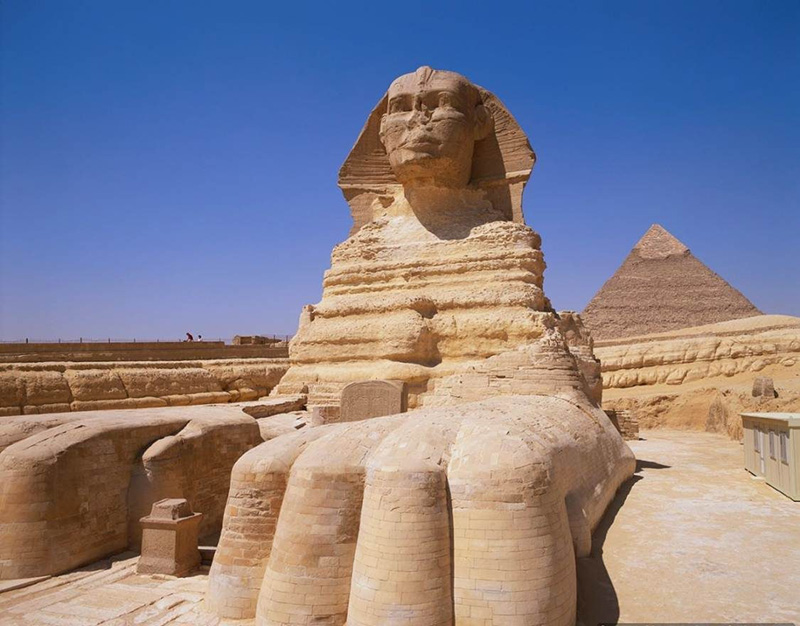
The Great Sphinx of Giza
Horemakhet, Khepri, Re, and Atum
The Giza Colossus was created from the natural bedrock of the plateau during the Old Kingdom, possibly in the reign of Khafre; however, there are no signs of an active cult for the Colossus in that time. Instead, its renown came about in the New Kingdom when Egyptians revered the ancient monument as the solar god, Horemakhet or Horus of the Horizon, later known as Harmachis by the Greeks. The greatest testament to the reverence given to the Sphinx is the granite Dream Stela placed by Thutmose IV among the paws of the statue around 1400 BCE. The Stela contains the account of Thutmose IV stating that while he lay sleeping in the shade of the monument at noon as a young prince, he heard the voice of the god speaking to him, promising him the throne in exchange for clearing away the sand. Within the Stela, the Sphinx is referred to as an embodiment of the sun in all its aspects, as Horemakhet (Khepri, Ra, Atum) representing morning, mid-day and evening sun combined, with Atum being the setting and self-created sun standing at the head of the compound as the direction toward which the old sun returns.12,15,40,41
"I am thy father, Horemakhet-Khepri-Re-Atum. I shall give thee the kingship upon the land before the living."
Dream Stele of Thutmose IV (trans. after Breasted, Ancient Records of Egypt II)
The Hauron Connection
Into this solar representation, the New Kingdom incorporated a foreign deity. Amenhotep II erected a mud brick temple on a flat area northeast of the Sphinx and consecrated it to the monument using a dual designation: Hauron-Horemakhet. Thus, Amenhotep II linked the Egyptian solar title to Hauron (the Canaanite god of the underworld) who had been introduced to Egypt by Levantine workers. The association has been recorded through numerous votive stelai set up by individual worshipers-many of whom were originally from Syria/Palestine-before the Sphinx and in the worker community where the reclining Sphinx itself acts as a representative of Hauron receiving veneration from the worshiper. Selim Hassan, who conducted excavations surrounding the Sphinx during the New Kingdom era, collected this documentation and assigned a common modern name to the temple as Hauron-Haremakhet. This nomenclature exists today in various forms as part of the medieval and modern Arabic name for the monument, wherein the element from Hauron remains present. Kings subsequent to Amenhotep II contributed to additions to the shrine; Seti I enlarged it and Ramesses II left his own stele before the Sphinx.15,42,42
The Greeks, the Romans, and the Painted Face
Classical writers say surprisingly little. Pliny the Elder gives the earliest surviving Greco-Roman notice, remarking that the Egyptians pass the Sphinx over in silence, that the local inhabitants regard it as a divinity, that they hold a king Harmais to be buried within it, and that the face of the monster is painted with red ochre out of reverence. The name Harmais has the Hellenized Horemakhet, Harmachis, and the reddened face recalls the traces of red pigment still visible on the stone. Roman engineers cleared and repaired the monument more than once, and imperial patronage kept its precinct in order into the second century.15,37
Offerings in Muslim Egypt
The worship of the Sphinx was far from over when ancient times ended. Al-Maqrizi, who wrote about Egypt during the time of the Mamelukes, states that many rural Egyptians would make sacrifices to it. They thought the Sphinx acted as a good luck charm to ensure that the waters of the Nile would rise (and therefore their crops would grow) and thus were revering it as a deity. In 1378, a Sufi named Muhammad Sa’aim al-Dahr from the Khanqah of Said al-Su’uda destroyed the nose of the Sphinx and knocked down its face because he was so disgusted by all the reverence being paid to it.
Al-Maqrizi reports that the man who committed this destruction was also killed reportedly as punishment by the gods. The local population believed that after the destruction, the sands of the desert began to cover up the area where the Sphinx sat. According to Ulrich Haarmann and Okasha El Daly, there is evidence that Muslims continued to write about the Sphinx throughout the Middle Ages. During that period, the Sphinx served two purposes. It represented something to be hated as an idol and yet it was still considered a wonder. Mark Lehner has studied the surfaces of the Sphinx and concludes that the nose was removed using mechanical tools sometime between the third and tenth century CE, possibly by either Christians or Muslims.43,44,45,46
VIII. Funerary Representations in Greece and Egypt
The only representation of the Sphinx that survived the passage of time better than its role as a symbol of death was its association with death dating back to the Archaic period in Greece. This relationship remained throughout the Archaic, Classical and Hellenistic periods, even while the representations became more ornate.28
The Greek Grave-Guardian
The best-known example of a Greek funerary use of the Sphinx is the seated grave-guardian. In this case, the Sphinx was placed atop a tall grave-marker, with its height allowing it to be seen by visitors walking through the cemetery. At this point, the Sphinx acted as a visual reminder of the separation between life and death. Additionally, it served as a way to honor the family that erected the monument. One of the larger examples of this can be found in the New York City Metropolitan Museum of Art. The statue, made of Attic Marble, stands over 13 feet tall, retains much of its original coloration (red, blue, black) and represents the ideal type specimen. While there have been smaller versions of Sphinx statues used on funerary vessels or next to graves as bronze sentinels, they also served to guard against loss or theft of the contents of these vessels including cremated remains. These guardians and their associations with the Underworld continued in Hellenistic and Roman funerary architecture, on grave naiskoi caps and on other items such as altar tops, urns and sarcophagi. Even during this period, however, the image of the Sphinx had become part of a well-established set of motifs used in sepulchral decoration. 28,47,48
The Egyptian Recumbent Guardian
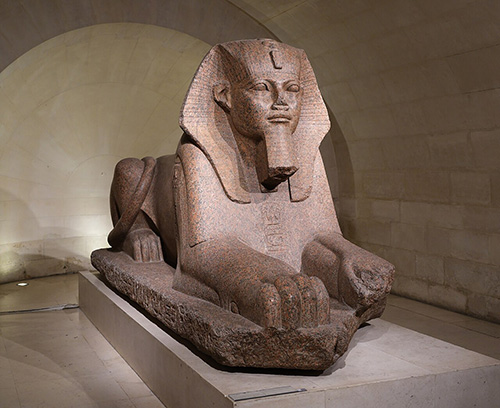
Great Sphinx of Tanis, Louvre
Egyptian sphinxes act as guardians of space very differently than those used in Greece. Most often depicted as a recumbent human-headed lion, they are usually assumed to be male and represent royalty. They line temple and tomb approach roads that lead to sacred spaces and channel visitors toward those spaces. Zivie-Coche identifies this tradition as beginning with images of the kingship of the Old Kingdom, but continues beyond the Egyptian tradition into its extended existence as protectors at the threshold to the necropolis. Their form was adopted by the Greeks who modified it into a winged female creature that sat upright. Both traditions are different in principle; the Greek winged female sits upright while the Egyptian is wingless and lies down. Despite this difference, Hellenistic and Roman artists intentionally combined elements of each tradition.15,28
IX. The Riddle Itself
The available ancient evidence about how the riddle was worded breaks down into a five-line hexameter complete version preserved in three variations of text, two shorter prose formulations in Diodorus and Pseudo-Apollodorus, and a Latin poetic paraphrase in Ausonius. The longest version is what Athenaeus quotes from the fourth century BCE mythographer Asclepiades of Tragilus:49
"There is upon the earth a thing two-footed and four-footed, whose voice is one, and three-footed too. Alone among all the moving creatures that come into being upon the earth, in the air, and in the sea, it changes its nature. But whenever it walks supported upon the greatest number of feet, then the speed of its limbs is at its weakest."
Asclepiades of Tragilus, in Athenaeus, Deipnosophistae 10.456b (trans. of the author)
The order in which the feet are named was never fixed, and the several witnesses arrange two, three, and four differently, as the table below shows. The logically chronological order, four then two then three, appears explicitly only in the prose question of Pseudo-Apollodorus; the verse riddle deliberately opens with two feet, describing the creature's possible forms rather than narrating them in sequence. Two clues carry the sense. The phrase one voice, μία φωνή, insists that the differently footed beings are a single kind of creature with a single power of speech, and the closing paradox, that the thing is weakest when it has the most feet, points to the crawling infant.49,50
| Ancient witness | Original Greek or Latin | English translation | Distinctive features |
|---|---|---|---|
| Asclepiades of Tragilus, in Athenaeus, Deipnosophistae 10.456b | ἔστι δίπουν ἐπὶ γῆς καὶ τετράπον, οὗ μία φωνή, / καὶ τρίπον, ἀλλάσσει δὲ φύσιν μόνον ὅσσ᾽ ἐπὶ γαῖαν / ἑρπετὰ γίνονται καὶ ἀν᾽ αἰθέρα καὶ κατὰ πόντον· / ἀλλ᾽ ὁπόταν πλείστοισιν ἐρειδόμενον ποσὶ βαίνῃ, / ἔνθα τάχος γυίοισιν ἀφαυρότατον πέλει αὐτοῦ. | “There is upon the earth a thing two-footed and four-footed, whose voice is one, and three-footed too. Alone among all the moving creatures that come into being upon the earth, in the air, and in the sea, it changes its nature. But whenever it walks supported upon the greatest number of feet, then the speed of its limbs is at its weakest.” | The fullest ancient form. Order: two, four, three. Adds the one-voice clue, the unique change of nature, and the paradox of least speed on the most feet. |
| Diodorus Siculus, Bibliotheca historica 4.64.3 | ἦν δὲ τὸ προτεθὲν ὑπὸ τῆς Σφιγγός, τί ἐστι τὸ αὐτὸ δίπουν, τρίπουν, τετράπουν. | “What the Sphinx had proposed was: What is the same thing that is two-footed, three-footed, and four-footed?” | Very compressed. Order: two, three, four. Omits the one-voice clue. |
| Pseudo-Apollodorus, Bibliotheca 3.5.8 | ἦν δὲ τὸ αἴνιγμα· τί ἐστιν ὃ μίαν ἔχον φωνὴν τετράπουν καὶ δίπουν καὶ τρίπουν γίνεται; | “The riddle was: What is it that, having one voice, becomes four-footed, two-footed, and three-footed?” | The clearest prose version. Order: four, two, three. Preserves μίαν ἔχον φωνήν, having one voice. |
| Ausonius, Griphus ternarii numeri 39–41 | qui bipes et quadrupes foret et tripes, omnia solus, / terruit Aoniam, volucris, leo, virgo, triformis / Sphinx, volucris pinnis, pedibus fera, fronte puella. | “What single being could be two-footed, four-footed, and three-footed, all by itself? The three-formed Sphinx terrified Aonia: bird, lion, and maiden, bird in her wings, beast in her feet, and girl in her face.” | A Latin poetic recollection, not a verbatim speech. Order: two, four, three. Ties the three forms to the Sphinx's own composite body. |
| Greek Anthology 14.64 | ἔστι δίπουν ἐπὶ γῆς, καὶ τετράπον, οὗ μία φωνή, / καὶ τρίπον· ἀλλάσσει δὲ φυὴν μόνον, ὅσσ᾽ ἐπὶ γαῖαν / ἑρπετὰ κινεῖται, ἀνὰ τ᾽ αἰθέρα καὶ κατὰ πόντον. / ἀλλ᾽ ὁπόταν πλείστοισιν ἐρειδόμενον ποσὶ βαίνῃ, / ἔνθα τάχος γυίοισιν ἀφαυρότατον πέλει αὐτοῦ. | “There is upon the earth a thing two-footed and four-footed, whose voice is one, and three-footed too. Alone among all the moving creatures upon the earth, through the air, and in the sea, it changes its form. But whenever it walks supported upon the greatest number of feet, then the speed of its limbs is at its weakest.” | Almost the same poem as Athenaeus. Chief variants: φυήν, form, for φύσιν, nature, and κινεῖται, moves, for comes into being. |
| Scholia to Euripides, Phoenissae 50 | ἔστι δίπουν ἐπὶ γῆς καὶ τετράπον, οὗ μία φωνή, / καὶ τρίπον· ἀλλάσσει δὲ φυὴν μόνον ὅσσ᾽ ἐπὶ γαῖαν / ἑρπετὰ γίνονται ἀνά τ᾽ αἰθέρα καὶ κατὰ πόντον. / ἀλλ᾽ ὁπόταν πλεόνεσσιν ἐρειδόμενον ποσὶ βαίνῃ, / ἔνθα μένος γυίοισιν ἀφαυρότατον πέλει αὐτοῦ. | “There is upon the earth a thing two-footed and four-footed, whose voice is one, and three-footed too. Alone among all the moving creatures that come into being upon the earth, through the air, and in the sea, it changes its form. But whenever it walks supported upon more feet, then the strength of its limbs is at its weakest.” | Chief differences: πλεόνεσσιν, more feet, for the greatest number, and μένος, strength, for τάχος, speed. |
Sources: Athenaeus, ed. Kaibel; Diodorus Siculus, ed. Vogel; Pseudo-Apollodorus, ed. Wagner; Ausonius, ed. Peiper; Greek Anthology, ed. Paton; Scholia in Euripidem, ed. Schwartz.18,19,49,50,51,52
The Answer
Pseudo-Apollodorus supplies the fullest solution, and Diodorus gives the same sense in fewer words.18,51
"When Oedipus heard it, he solved it, saying that the riddle spoken by the Sphinx meant a human being: as an infant it becomes four-footed, being carried upon its four limbs; when fully grown it is two-footed; and when growing old it takes up a third support, the staff."
Pseudo-Apollodorus, Bibliotheca 3.5.8 (trans. of the author)
The Morning, Noon, and Evening Wording Is Not Classical
The wording of the riddle as we know it today (i.e., in the form "what goes on four feet in the morning, on two at noon, and on three in the evening?") does not appear in any of the surviving Greek or Latin manuscripts of the riddle. No known manuscript from Antiquity refers to a single day ("morning," "noon," "evening"); these terms were apparently added later as an explanation for "infancy" (four feet), "adulthood" (two legs), and "old age" (three legs). Possibly this form fo the riddle was confused with the myth of the three heads of Cerberus or some other explanation, or they are poetic variations.49
Authors Who Mention the Riddle Without Preserving Its Wording
Sophocles, who repeatedly alluded to the Sphinx’s song and Oedipus’ triumph over her intellectually, never actually stated the riddle. Euripides also describes in his Phoenissae how Oedipus solves the riddle as told to him by Jocasta. The five lines of the riddle that do exist come from the Scholium to this play. Ovid simply reports that Oedipus solved the unknown songs of the Sphinx, with no numbers involved. Similarly, Hyginus and Seneca describe the mysterious words of the Sphinx, and their solution, but do not provide what was even said.25,53,54,55,56
| Classical source | What survives |
|---|---|
| Sophocles, Oedipus Tyrannus | Repeated references to the Sphinx's song and Oedipus's victory; the question itself is never quoted. |
| Euripides, Phoenissae 45–50 | Jocasta reports that Oedipus solved the riddle; the words are supplied only by the later scholia. |
| Ovid, Metamorphoses 7.759–61 | The Laiades solved the “songs not understood by those before him,” with no numerical clue. |
| Hyginus, Fabulae 67 | States only that Oedipus came and interpreted the song; no wording is given. |
| Seneca, Oedipus 92–102 | Describes the Sphinx's tangled words and Oedipus's solution without quoting the question. |
Sources: Sophocles, Oedipus Tyrannus; Euripides, Phoenissae; Ovid, Metamorphoses; Hyginus, Fabulae; Seneca, Oedipus.25,53,54,55,56
X. The Sphinx as Boundary Defender
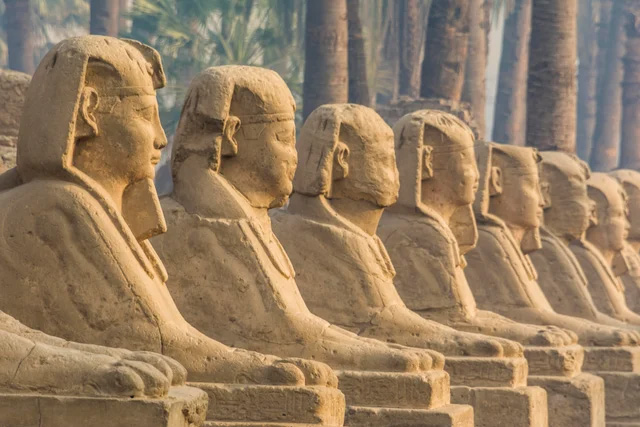
Avenue of the Sphinxes, Luxor
Although there are many ways the Sphinx has been used throughout history, there is really just one underlying concept of how it exists spatially. No matter where it is located, it always is found on an edge atop a roof line or capital, upon a tomb or a vessel, at entrances or handles and thresholds, and wherever it is placed it separates two spaces.26
McInerney sees the Greek hybrids as boundary beings, and he says the Sphinx represents this type of being better than anything else. He states that the hybrid animals (such as the Sphinx) exist exactly where one type of space becomes another. This can be clearly seen with heraldic compositions. For example, paired sphinxes placed opposite of one another on either side of a palmette, a tree, or a doorway, represent a common eastern Mediterranean guarding method. This method involves placing two monsters (or beasts) on both sides of a central object.
In addition to guarding objects, these same principles apply to the acroteria which Petit studied. These acroteria have sphinxes positioned along them to provide protection to the roofs and boundaries which they define. The funerary sphinxes also serve as guardians of the most important boundary (between life and death), and they watch over graves and avenues in ancient Egypt leading visitors through the secular world to the temple28,30,42
The Great Sphinx gives this idea its monumental form. It faces the sunrise at the eastern edge of the Giza plateau, on the threshold between the cultivated valley and the desert of the dead. The New Kingdom knew its enclosure by a name meaning the Chosen, as though the monument itself ordained who might cross into royalty when a new Pharaoh came before it. The Sphinx endured for three thousand years and more as a keeper of thresholds, and the offerings that Egyptian country people still laid before it in the fourteenth century of our era were made to a guardian.15,42,44
Sources and Bibliography
- Aeschylus. Aeschyli Tragoediae. Edited by Arthur Sidgwick. Oxford: Clarendon Press, 1902. Seven against Thebes 539–44, esp. 541.
- Radt, Stefan, ed. Tragicorum Graecorum Fragmenta. Vol. 3, Aeschylus. Göttingen: Vandenhoeck & Ruprecht, 1985. Hypothesis to Seven against Thebes, 50–51; Sphinx fr. 236, 342.
- Hesiod. Theogony 326. In Hesiodi Theogonia, Opera et Dies, Scutum, edited by Friedrich Solmsen. Oxford: Clarendon Press, 1970.
- Liddell, Henry George, Robert Scott, Henry Stuart Jones, and Roderick McKenzie. A Greek-English Lexicon. Revised edition. Oxford: Clarendon Press, 1940. S.v. “Σφίγξ.”
- Beekes, Robert S. P., with Lucien van Beek. Etymological Dictionary of Greek. 2 vols. Leiden Indo-European Etymological Dictionary Series 10. Leiden: Brill, 2010. Pp. 1431–32, s.vv. “σφίγγω” and “Σφίγξ.”
- Schweitzer, Simon D., et al. “šzp” (Lemma ID 157210). Thesaurus Linguae Aegyptiae, Corpus issue 20. Edited by Tonio Sebastian Richter, Daniel A. Werning, Hans-Werner Fischer-Elfert, and Peter Dils. Accessed August 20, 2026.
- Erman, Adolf, and Hermann Grapow, eds. Wörterbuch der ägyptischen Sprache. Vol. 4. Leipzig: J. C. Hinrichs, 1930. 536.1–11.
- Faulkner, Raymond O. A Concise Dictionary of Middle Egyptian. Oxford: Griffith Institute, 1962. P. 272.
- Fischer, Henry George. “Varia Aegyptiaca.” Journal of the American Research Center in Egypt 2 (1963): 17–51, esp. 24–28.
- Eaton-Krauss, Marianne. The Representations of Statuary in Private Tombs of the Old Kingdom. Wiesbaden: Otto Harrassowitz, 1984. Pp. 85–88.
- Bolshakov, Andrey O. “What Did the Bust of Ankh-haf Originally Look Like?” Göttinger Miszellen 117/118 (1990): 13–20.
- Leprohon, Ronald J. The Great Name: Ancient Egyptian Royal Titulary. Atlanta: Society of Biblical Literature, 2013. P. 99 (Thutmose III, Urkunden der 18. Dynastie IV, 600.5–6).
- Schweitzer, Simon D., et al. “šzp-ꜥnḫ” (Lemma ID 886589). Thesaurus Linguae Aegyptiae, Corpus issue 20. Accessed August 20, 2026.
- Wilson, Penelope. A Ptolemaic Lexikon: A Lexicographical Study of the Texts in the Temple of Edfu. Orientalia Lovaniensia Analecta 78. Leuven: Peeters, 1997. Pp. 1028–29.
- Zivie-Coche, Christiane. Sphinx: History of a Monument. Translated by David Lorton. Ithaca, NY: Cornell University Press, 2002.
- Gantz, Timothy. Early Greek Myth: A Guide to Literary and Artistic Sources. Baltimore: Johns Hopkins University Press, 1993. Vol. 2, pp. 494–98.
- Edmunds, Lowell. The Sphinx in the Oedipus Legend. Beiträge zur klassischen Philologie 127. Königstein/Ts.: Verlag Anton Hain, 1981.
- Pseudo-Apollodorus. Apollodori Bibliotheca 3.5.8. Edited by Richard Wagner. Leipzig: B. G. Teubner, 1894.
- Euripides. Scholia in Euripidem. Edited by Eduard Schwartz. Vol. 1, Scholia in Hecubam, Orestem, Phoenissas. Berlin: Georg Reimer, 1887. Ad Phoen. 46, 50.
- Pausanias. Description of Greece 1.24.5; 9.26.2–4. Translated by W. H. S. Jones. Loeb Classical Library. Cambridge, MA: Harvard University Press, 1918–35.
- Euripides. Chrysippus. In Tragicorum Graecorum Fragmenta, vol. 5, Euripides, edited by Richard Kannicht. Göttingen: Vandenhoeck & Ruprecht, 2004.
- Palaephatus. On Unbelievable Tales 4. Translated by Jacob Stern. Wauconda, IL: Bolchazy-Carducci, 1996.
- Moret, Jean-Marc. Œdipe, la Sphinx et les Thébains: Essai de mythologie iconographique. 2 vols. Bibliotheca Helvetica Romana 23. Rome and Geneva: Institut Suisse de Rome, 1984.
- Demisch, Heinz. Die Sphinx: Geschichte ihrer Darstellung von den Anfängen bis zur Gegenwart. Stuttgart: Urachhaus, 1977.
- Sophocles. Oedipus Tyrannus 36, 130, 391, 1199–1200. Edited and translated by Hugh Lloyd-Jones. Loeb Classical Library 20. Cambridge, MA: Harvard University Press, 1994.
- McInerney, Jeremy. Centaurs and Snake-Kings: Hybrids and the Greek Imagination. Cambridge: Cambridge University Press, 2024. Pp. 1–23.
- British Museum. “Coin: Sphinx Seated Left; Amphora.” Minted at Chios, ca. 190–84 BCE. Museum no. 1995,0605.178. Accessed August 3, 2026.
- Karoglou, Kiki. Dangerous Beauty: Medusa in Classical Art. Metropolitan Museum of Art Bulletin 75, no. 3. New York: Metropolitan Museum of Art, 2018. Esp. 29–33.
- Euripides. Electra 464–71. In Euripides III, edited and translated by David Kovacs. Loeb Classical Library 9. Cambridge, MA: Harvard University Press, 1998.
- Petit, Thierry. “The Sphinx on the Roof: The Meaning of the Greek Temple Acroteria.” Annual of the British School at Athens 108 (2013): 201–234.
- Mertens, Joan R. “An Early Greek Bronze Sphinx Support.” Metropolitan Museum Journal 37 (2002): 23–33.
- Metropolitan Museum of Art. “Bronze Rod Tripod Stand.” Greek, Archaic, early sixth century BCE. Object no. 1997.145.1. Accessed August 3, 2026.
- Metropolitan Museum of Art. “Bronze Sphinx.” Greek, late sixth–early fifth century BCE. Object no. 2021.40.14. Accessed August 3, 2026.
- Walters Art Museum. “Sphinx.” Greek, Hellenistic, first century BCE. Gold and garnet. Accession no. 57.1490. Accessed August 3, 2026.
- Metropolitan Museum of Art. “Bronze Ornament in the Form of a Seated Male Sphinx.” Roman, Augustan, ca. 27 BCE–14 CE. Object no. 2006.514.2. Accessed August 3, 2026.
- Metropolitan Museum of Art. “Wall Painting on Black Ground: Egyptianizing Scene and Pair of Swans, from the Imperial Villa at Boscotrecase.” Roman, Pompeian, last decade of the first century BCE. Accessed August 3, 2026.
- Pliny the Elder. Natural History 36.77; 37.10. Translated by D. E. Eichholz. Loeb Classical Library 419. Cambridge, MA: Harvard University Press, 1962.
- Simpson, Christopher J. “Rome's ‘Official Imperial Seal’? The Rings of Augustus and His First Century Successors.” Historia: Zeitschrift für Alte Geschichte 54, no. 2 (2005): 180–88.
- Ephorate of Antiquities of Phocis. “Sphinx of the Naxians.” Archaeological Site of Delphi. Accessed August 3, 2026.
- Breasted, James Henry. Ancient Records of Egypt. Vol. 2, The Eighteenth Dynasty. Chicago: University of Chicago Press, 1906. §§810–15 (Dream Stele of Thutmose IV).
- Kozloff, Arielle P. Amenhotep III: Egypt's Radiant Pharaoh. Cambridge: Cambridge University Press, 2012. Pp. 32–41.
- Hassan, Selim. Excavations at Gîza. Vol. 8, 1936–1937: The Great Sphinx and Its Secrets. Cairo: Government Press, 1953.
- El Daly, Okasha. Egyptology: The Missing Millennium; Ancient Egypt in Medieval Arabic Writings. London: UCL Press, 2005.
- Al-Maqrīzī, Taqī al-Dīn Aḥmad. al-Mawāʿiẓ wa-al-iʿtibār fī dhikr al-khiṭaṭ wa-al-āthār (The Khiṭaṭ). Bulaq, 1853. On the Sphinx (Abū al-Hawl), the Nile talisman, and Muhammad Saʾim al-Dahr (1378).
- Haarmann, Ulrich. “Regional Sentiment in Medieval Islamic Egypt.” Bulletin of the School of Oriental and African Studies 43, no. 1 (1980): 55–66.
- Lehner, Mark. The Complete Pyramids. London: Thames & Hudson, 1997. Pp. 127–135 (the Sphinx; condition of the face).
- Metropolitan Museum of Art. “Marble Stele (Grave Marker) with a Youth and Little Girl, and a Capital and Finial in the Form of a Sphinx.” Greek, Attic, ca. 530 BCE. Object no. 11.185a–d, f, g, x. Accessed August 3, 2026.
- Walters Art Museum. “Sphinx.” Greek, Archaic, ca. 550 BCE. Bronze. Accession no. 54.770. Accessed August 3, 2026.
- Athenaeus. Athenaei Naucratitae Dipnosophistarum libri XV 10.456b. Edited by Georg Kaibel. Vol. 2. Leipzig: B. G. Teubner, 1887. Quoting Asclepiades of Tragilus, Tragodoumena, FGrHist 12 F 7a.
- The Greek Anthology 14.64. Edited and translated by W. R. Paton. Vol. 5. Loeb Classical Library 86. London: William Heinemann, 1918.
- Diodorus Siculus. Diodori Bibliotheca Historica 4.64.3–4. Edited by Friedrich Vogel. Vol. 1. Leipzig: B. G. Teubner, 1888.
- Ausonius. Griphus ternarii numeri 39–41. In Decimi Magni Ausonii Burdigalensis Opuscula, edited by Rudolf Peiper. Leipzig: B. G. Teubner, 1886.
- Euripides. Phoenissae 45–50, 806, 1019–42. In Euripides V, edited and translated by David Kovacs. Loeb Classical Library 11. Cambridge, MA: Harvard University Press, 2002.
- Ovid. Metamorphoses 7.759–61. Edited by R. J. Tarrant. Oxford Classical Texts. Oxford: Clarendon Press, 2004.
- Hyginus. Fabulae 67. Edited by Peter K. Marshall. 2nd ed. Munich and Leipzig: K. G. Saur, 2002.
- Seneca. Oedipus 92–102. In Seneca: Tragedies, vol. 2, edited and translated by John G. Fitch. Loeb Classical Library 78. Cambridge, MA: Harvard University Press, 2018.