SPRING GODDESSES
author: High Priest Zevios Metathronos
co-author: Novice Priest Karnonnos
I. The Names: Etymology and First Attestation
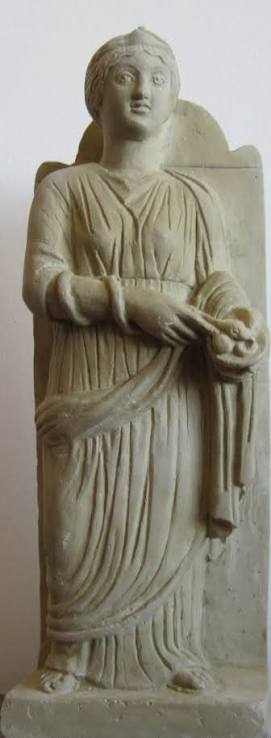
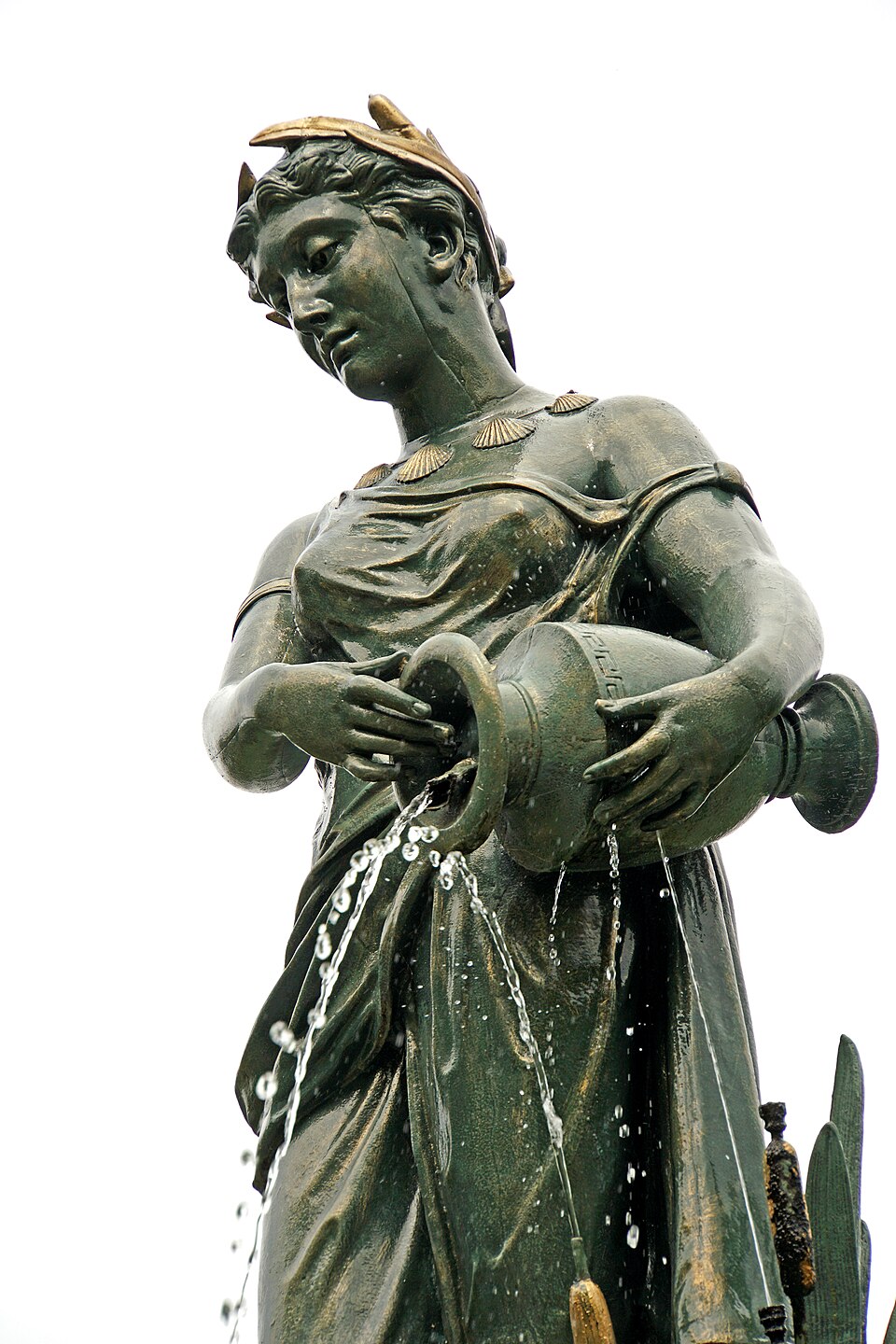
The five female goddesses who appear on this page have a commonality, they were all either goddesses of water and/or of thermal springs, wells etc., and, except for Egeria, all of these goddesses are well-known to scholars today because of their presence on stone carvings rather than in literature written about them by poets. For four of the five (Sulis, Coventina, Sirona and Arnomecta) we know very little about them except through epigraphy and archaeology. We do not have much information about them from the literature. Egeria, however, is a deity of Roman literature. We find references to her in many works of history and poetry, but there is very little reference to her in archeological records. They thus represent the two different ways an ancient deity can be discovered.1,3,9,16
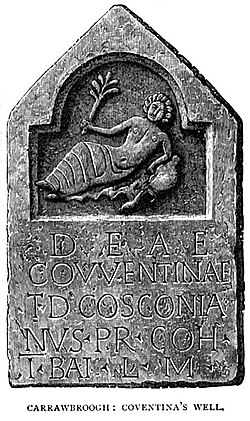
We do not know what the etymology of Coventina is. There is no accepted way to derive the Celtic origins of Coventina, and the name may contain elements that are so localized or so old that they cannot be clearly analyzed. However, what we can say with certainty is that the name Coventina has been documented. The theonyms appear on a group of votive altars from Coventina’s Well at Carrawburgh (Roman Brocolitia) located near Hadrian’s Wall. These are numbered RIB 1522–1535 and are dated based on internal evidence to the second and third centuries. The stones document the name in a wide variety of spellings including Coventina, Covventina, Covontina, Conventina, Countina. This variety reminds us that orthography at shrines along the frontiers was often flexible. With respect to documentation outside of the above mentioned location, there are only two possible contenders in two disputed altars from Roman Galicia. Neither contender has been proven to be associated with Coventina nor have they been demonstrated to be earlier than those from Carrawburgh.3
Sulis is somewhat easier to understand. The name Sulis is generally related to a Proto-Celtic root *sūli- and therefore to the sun as well as to the eyesight and sight. Given that Sulis is a goddess of a light-producing, healing spring, it fits perfectly. She is first recorded in the Flavian period dedications made to the sanctuary at Bath (Aquae Sulis). The Temple of Sulis Minerva was erected during the late-first century CE. It is likely that she would have had a large number of devotees living nearby. In fact, the earliest-datable fragment from the complex mentions Sulis’ seventh consulship of Vespasian. The name also appears alone (deae Suli) as well as in a syncretic pair with Minerva.1,4
Sirona is named using a root *ster- “star.” Her initial letter is represented by the tau gallicum (“Gallic tau”), a letter that does not lend itself easily to representation within the Latin alphabet; hence we see variations in spelling such as Sirona, Đirona, Thirona, and Serona. Unlike the other three figures discussed in this section she represents a truly pan-regional figure being referenced across approximately 40 to 50 inscriptions in Eastern Gaul to the Danube. While we are unable to pinpoint exactly when Sirona was first worshipped via inscription; the earliest inscription that can be tied to a specific consulate date is an altar from Großbottwar in Germania Superior dating back to AD 201.7,8,9,10
Arnomecta, the actual carvings found on stone, comes from the Celtic word ar-nemeton meaning "beside," or "in front of," the sacred grove (nemeton, meaning sacred grove). The more commonly known name of Arnemetia has been made normal through recent scholarly work with reference to the Roman city of Aquae Arnemetiae (Buxton) that was listed only in the Ravenna Cosmography of the seventh century as Aquis Arnemeza. There is one inscription that documents Arnomecte which is documented on a Roman altar discovered at Brough-on-Noe (Navio).1,13,14
Both ancient and modern scholars have different theories regarding the origin of Egeria's name. Georges Dumézil believed it came from e-gerere meaning “to bring forth,” thus relating Egeria to both birth and flowing waters. Other scholars have linked the origins of Egeria’s name to that of the Arician family named Egerius. Regardless of where Egeria got her name from, the earliest documentation of Egeria does not come from any physical source, but rather from literature. She falls into the category of legend associated with king Numa Pompilius who was written about in the works of the Republican annalists of Rome, and his stories were passed down to us by two authors: Livy (Book I Chapters 19, 21) and Dionysius of Halicarnassus (Book II Chapter 60-61).16,17,18,22
Sources: Collingwood and Wright, The Roman Inscriptions of Britain, vol. 1 (1965); Jufer and Luginbühl,
Répertoire des dieux gaulois (2001); Delamarre, Dictionnaire de la langue gauloise (2003); Rivet and Smith,
The Place-Names of Roman Britain (1979); Dumézil, Archaic Roman Religion (1970).1,9,10,14,22
It is worth dwelling on the contrast that structures this page. Coventina, Sulis, Sirona, and Arnomecta were recovered by the spade: no ancient
author names Coventina or Arnomecta at all, and Sulis appears in literature only obliquely, through Solinus's third-century notice of the "Minerva"
of the British hot springs. Egeria is exactly the reverse, celebrated by Livy, Dionysius, Ovid, Plutarch, and Juvenal, yet unattested in any
secure early inscription of her own. The frontier goddesses live in stone and are silent in books; the Roman nymph lives in books and is silent in
stone.3,6,16,24
II. The Altars of Coventina
Everything we know about Coventina is derived from an isolated source at a spring along the Hadrian’s Wall border. The walled spring at Carrawburgh, the Roman fort of Brocolitia, was a place where people could make votive offerings by throwing items into the water over the course of several generations. The antiquarian and landowner John Clayton uncovered the spring in 1876 and unearthed a rich deposit of ritual objects. This included tens of thousands of coins ranging from those issued by Mark Anthony during the late Roman republic to coins from the last few decades of the 4th century CE, as well as various types of jewelry, such as brooches and pins, glass, ceramics, a bronze mask, and a number of sculptures and stones bearing inscriptions that identify Coventina as a goddess.3
The majority of the inscriptions have been edited as RIB 1522–1535 and represent vow-making by soldiers and their commanders to dea Coventina. There are no inscriptions with a consular date, thus the chronology of the collection has been established on other criteria, specifically the auxiliary units mentioned on the inscriptions (First Cohort of Batavians, First Cohort of Cugerni, First Cohort of Frisiavones) and the extensive series of coins in the second and third centuries CE. A typical dedicatory inscription is that made by a commander of the First Cohort of Batavians to the goddess by name. Other inscriptions were much less formal, and written using hands with limited Latin literacy, which explains the numerous variations of the goddess’s name.1,2,3
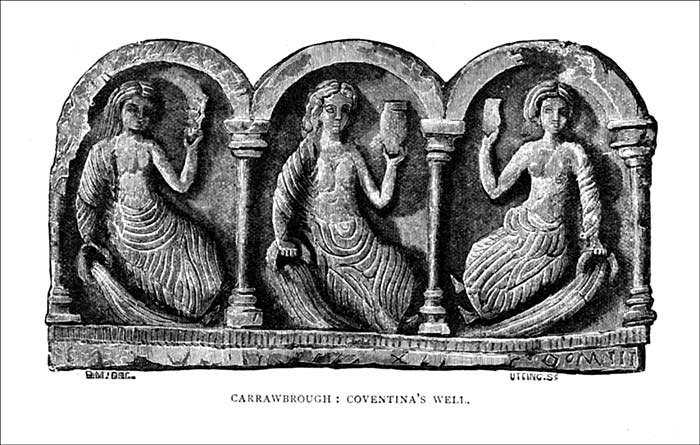
Two sculptured reliefs provide the shrine with an enduring visual identity. One depicts Coventina reclined as a classical water-nymph, supported by an extended arm, and carrying a water lily leaf while water pours from a vessel below her. In a similar manner, three identical nymphs are depicted seated on the other, each holding a beaker and an urn from which water flows. This representation of three nymphs is characteristic of Celtic water-cults and blurs the distinction between a single goddess and a collective of spring spirits. The reservoir setting, the act of throwing coins into the reservoir, along with the reclined nymph imagery collectively present Coventina as the most clear example of a Romano-British spring deity to survive, while her name and origins remain ambiguous3
III. Roman Bath and Sulis Minerva
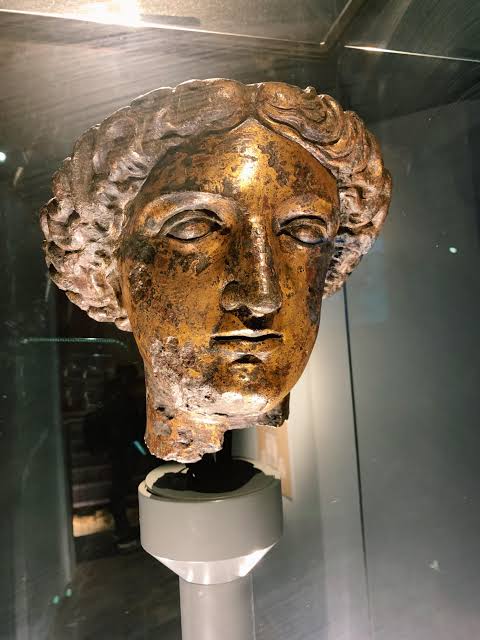
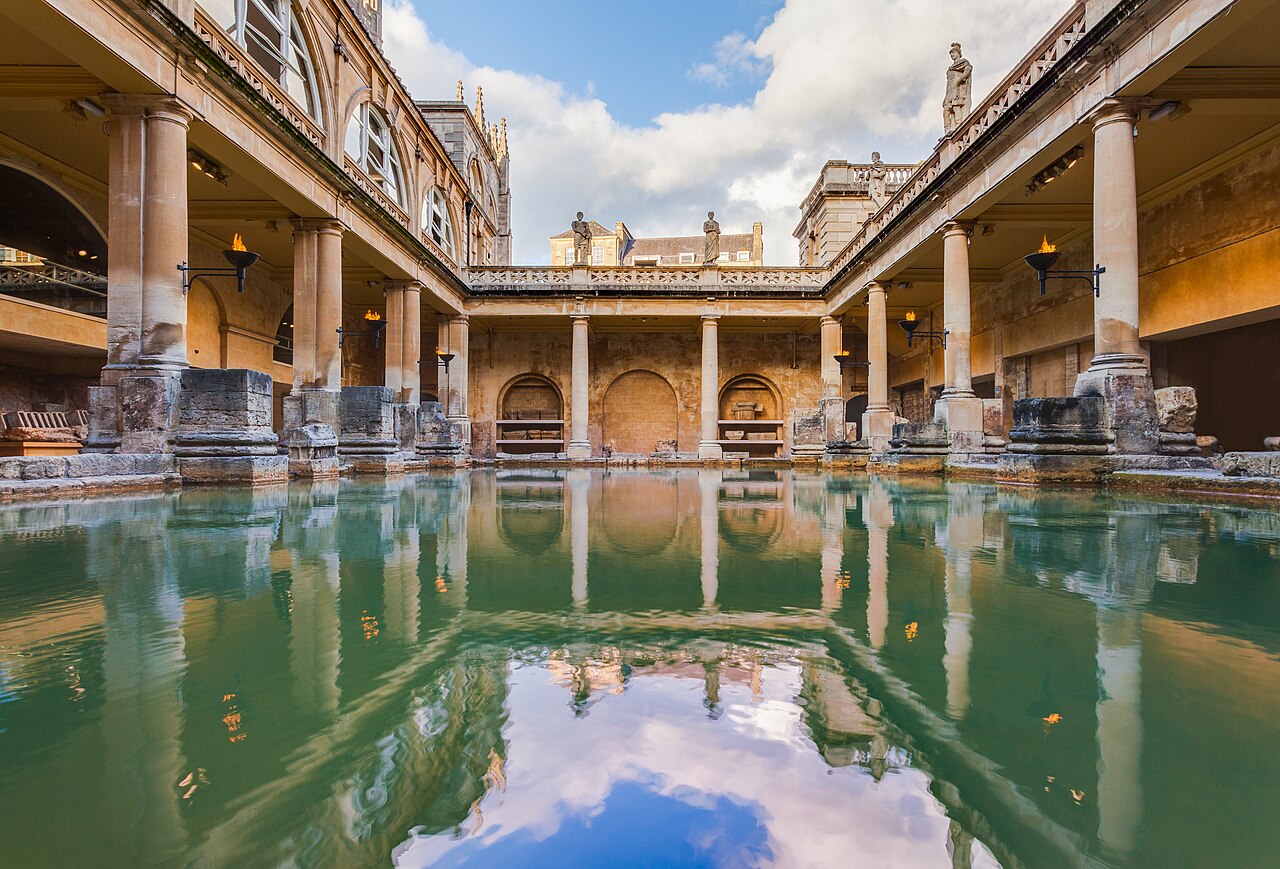
At Roman Bath, the hot springs produce approximately one-quarter million gallons of mineral-rich water daily at a consistent temperature. Around the largest of these baths, the Romans constructed Aquae Sulis. This included a large bathing complex and a classical style temple dedicated to Sulis Minerva. The pairing of Sulis Minerva represents a well-documented instance of interpretatio Romana. However, the evidence provided through epigraphy indicates that Sulis was never simply subsumed under Minerva. Sulis is invoked alone much more frequently than Minerva. When both names appear in conjunction, Sulis typically appears before her, suggestive of the separate nature of the spring deity in herself.1,4,5
Remaining components of the bath complex are among the best examples preserved from Roman Britain. These include the gold-plated bronze head of the cult statue of Sulis Minerva, the temple pediment depicting a striking central figure, part Gorgon and part god of water surrounded by a wreath, and the large altar. There are two inscriptions providing insight into named individuals involved within the cult. An individual named Lucius Marcius Memor who served as a haruspex (a high-ranking religious authority) dedicated an object to the goddess. Another named individual is Gaius Calpurnius Receptus who functioned as priest of Sulis (sacerdos deae Sulis). He also had his freedwoman and wife Calpurnia Trifosa memorialized there.1
The most significant discoveries found at the site were the Tabellae Sulis. The Tabellae Sulis consists of approximately 130 lead curse tablets that were deposited into the spring and published by R. S. O. Tomlin. While most of these curses request restitution for minor forms of theft (cloaks, gloves, coins etc.), they demonstrate how ordinary individuals directly interacted with Sulis; not as a remote Minerva but as an imminent force adjacent to the water. The sole reference to Sulis outside of Bath occurs in Solinus' Collectanea from the third century CE. It describes Sulis Minerva as presiding over the perpetual fires surrounding the hot springs and identifies Sulis as a 'Minerva'4,6
Sulis is, to an almost unique degree, a one-place goddess: virtually every securely read dedication to her comes from Bath. The single firm exception is
an altar from Alzei (Roman Alteium) in Germania Superior, inscribed dea Sul(is), CIL XIII 6266 – most plausibly
set up by a Briton, or by someone with a personal tie to the Bath cult, rather than evidence of any wider worship.7 She should not be confused
with the Suleviae, the plural mother-goddesses whose name is etymologically related and who are attested widely across Gaul, Britain, and the
Rhineland (a certain Sulinus dedicated to them at Bath itself); despite the shared root, the Suleviae are a distinct cult, not multiple Sulises.1,9
IV. Sirona: A Goddess of the Provinces
Sirona may be the most travelled and therefore the most telling of these goddesses. While Coventina and Sulis were attached to a single spring, Sirona’s name was scattered throughout the western and central Provinces of the Empire from the Treveran heartland around Trier, to westwards along the Rhine and northwards up the Danube. Thus her cult can be seen as a model of how an indigenous healing goddess could travel through the Roman world without losing her Celtic character or a very popular goddess prior to Roman conquest.9,10,11
The spellings used by Latin writers who transcribed the “tau Gallicum” (Gaulish letter combination) are varied: Sirona, Djirona, Thirona, Serona and ohers. Approximately forty to fifty inscriptions name her. The inscription locations follow a wide arc from Trier to Bordeaux, and Corseul in Gaul, the Hunsrück and Rhineland fortifications, and as far east as Aquincum (Budapest) and Sarmizegetusa in Dacia. All of the locations have their distributions in the second and third centuries CE. There is no evidence of her worship prior to the Roman occupation which supports the idea that the “star” of her name is a Gaulish inheritance carried over into a thoroughly Roman writing style, though the lack of writing among Celts makes that a possibility only.9,10
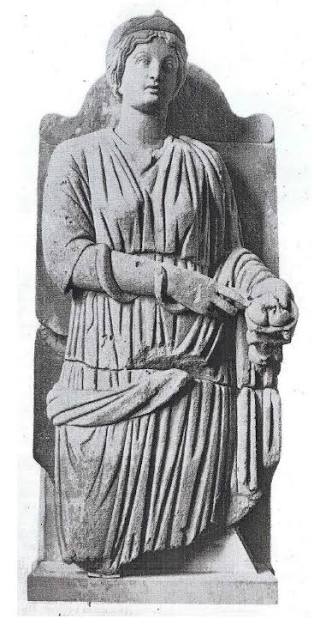
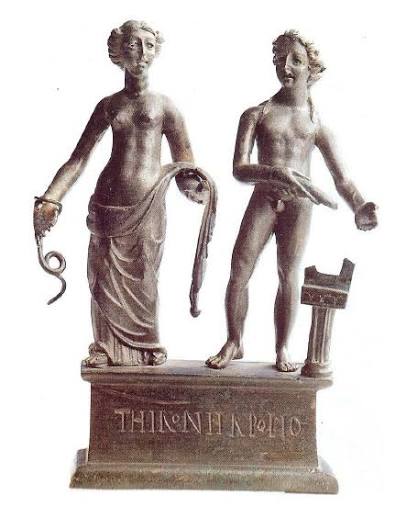
Hochscheid is the richest location for Sirona located in the Hunsrück area of what would become Germany, Hochscheid was once part of the Treveri tribal territory. At Hochscheid, archeologists excavated a small temple which encircled a spring. Cult statues of the divine pair, Apollo holding a lyre and Sirona wearing a crown with a serpent wrapped around her upper body and carrying a bowl containing eggs, were also discovered. The statues are dedicated to both as Deo Apollini et sanctae Sironae, (“to God Apollo and Holy Sirona”). The temple was constructed during the second century AD. Although it was destroyed during the middle of the third century CE (during the Germanic invasions in the late 250s-early 260s), it provides further insight into Sirona’s iconography.11,12
As depicted in art, Sirona represents a healing and fertility goddess. The serpent, which is associated with renewal of life from underground and is commonly associated with Asclepius, wraps around her arm. Eggs in her patera symbolize birth and rebirth. Ears of corn or stars may appear in addition to a diadem. The use of stellar motifs may represent the star in her name. However, regardless of other elements appearing with her, Sirona remains visually recognizable as an independent, indigenous goddess assimilated into the artistic vocabulary of classical healing cults without becoming indistinguishable from them.9,11
In almost every instance, Sirona is depicted with Apollo, particularly Apollo Grannus. He is considered to be the Celtic version of Apollo, a god known for healing in thermal waters, worshipped by numerous tribes including those located in the Vosges mountains, Aquae Granni (Aachen), and others. According to legend, Emperor Caracalla sought relief from Grannus. This pattern is consistent with broader patterns among the ancient Celts of pairing therapeutic water deities such as a male healing god and his female goddess of the spring. These pairs include Borvo and Damona at Bourbonne-les-Bains and Apollo Moritasgus and Damona at Alesia. When Sirona appears alone (as in Trier, Bordeaux, and Corseul), she is clearly a spring goddess in her own right. The partnership between Sirona and Celtic Apollo highlights her role as goddess of the healing waters combined with the male instrument of healing light.9,10,11
Because many of Sirona’s inscriptions do not provide specific dates for when they were erected, defining her chronological data is difficult. One inscribed altar from Großbottwar in Germania Superior provides a clear reference point. The altar was dedicated to Apollo and Sirona by their worshipper Aelius Motio, using his consular year to date it, Mucianus and Fabianus in 201CE. This inscribed altar does not confirm that she began to be worshipped at that time; it merely shows that by the beginning of the third century AD her combined cult with Apollo had flourished throughout much of Gaul away from her home region.7,8
V. Arnemetia
Arnemetia has the most slender corpus of all, one single altar. In 1903 a Roman altarpiece was discovered in the vaulted chamber beneath the Roman fort headquarters in Derbyshire. The stone altarpiece reads: “Deae Arnomecte, Aelii Moti votum solvit laetus libens merito.” Translated this becomes “To the Goddess Arnomecta, Aelius Motio has made good upon his vow with joy and free will and in merit.” The lettering of the inscription is somewhat weathered and there is little doubt that previous scholars were incorrect in their interpretation of the deity’s name. It was R.P. Wright who first read the correct form of the deity’s name as being Arnomecte.1,2
The Peak District is home to the sacred thermal springs at Buxton, which were known to the Romans as Aquae Arnemetiae, the Waters of Arnemetia, or the spa by the Sacred Grove. This form does not appear as a divine epithet on any stone, but rather as a place-name within the Ravenna Cosmography of the seventh century. Buxton is listed as Aquis Arnemeza. Editors of the Ravenna Cosmography generally agree that the goddess mentioned on the Navio Altar is likely to be the same deity referred to in the name of Buxton’s spa.1,13,14
The etymology of her name is clear. The prefix arnemo- can be traced back to the ancient Celtic term for ‘sacred’, are-, combined with nemeton, the ancient Celtic term for a ‘sacred grove’ thus are-nemeton = before/within the sacred grove. Therefore, Arnomecta would be placed in the same class of grove-and-spring numina as Nemetona, goddess of the sacred grove. Her presence has been attested both at Bath and in the Rhine area. Some scholars have suggested that Arnomecta may well have functioned as a local byname for Nemetona. The Fort of Navio was established during the reign of Claudius (41-54CE), but was rebuilt using stone during the time of Hadrian (117–138CE) and Antoninus Pius (138–161CE). As such, the general time frame for when she might have been worshipped would likely be similar to that of Nemetona.1,14
VI. Egeria, the Nymph of Numa
In the legendary history of Rome, Egeria was the goddess and divine advisor to Numa Pompilius, the second Sabine king of Rome, the divine lawgiver, whose alleged contributions to Rome include giving Rome its priesthoods, calendar, civic law and sacred law. Tradition claims that Numa met Egeria under cover of darkness in a sacred grove, and that it was her counsel upon which rested many of the institutions he created for Rome, many of which lasted until the end of the state.16,17
The tradition itself is quite old and far older than the authors who recorded it. It passed down through the ancient Republican annalists to reach the Augustan period. Both Livy and Dionysius of Halicarnassus received it from their predecessors rather than creating it themselves. What is remarkable is how the authors treated the tale of Egeria. When writing about the time when Numa supposedly met with the goddess every night under the light of the moon, Livy describes Numa as pretending to meet with the goddess in order to lend divine authority to the various religious institutions he established among the Romans that they might have been unwilling to accept because of their martial, vicious origins:
... since he could not instil [religious awe] without inventing some marvel, pretended that he held nightly meetings with the goddess Egeria, and
that it was on her advice that he instituted the rites most acceptable to the gods."
Livy, Ab urbe condita 1.19
The exact role that Egeria played is somewhat enigmatic. She is said to be able to decipher the enigmatic statements made by Faunus to Numa herself, and secured with Numa a ritual to avert thunder from Jupiter Himself. Whether or not the goddess actively assisted Numa at all, and how much, is also unknown as well as to what degree her involvement was; the word conuincta is somewhat ambiguous. Numa reportedly recorded his teachings from Egeria into “sacred books” which he then buried with him. At least 500 years later, a random event brought them back out into public view. The Senate decided they were too improper to share with the people of Rome and thus ordered their destruction. Dionysius of Halicarnassus, however, claimed that the pontifices actually took the books for themselves.
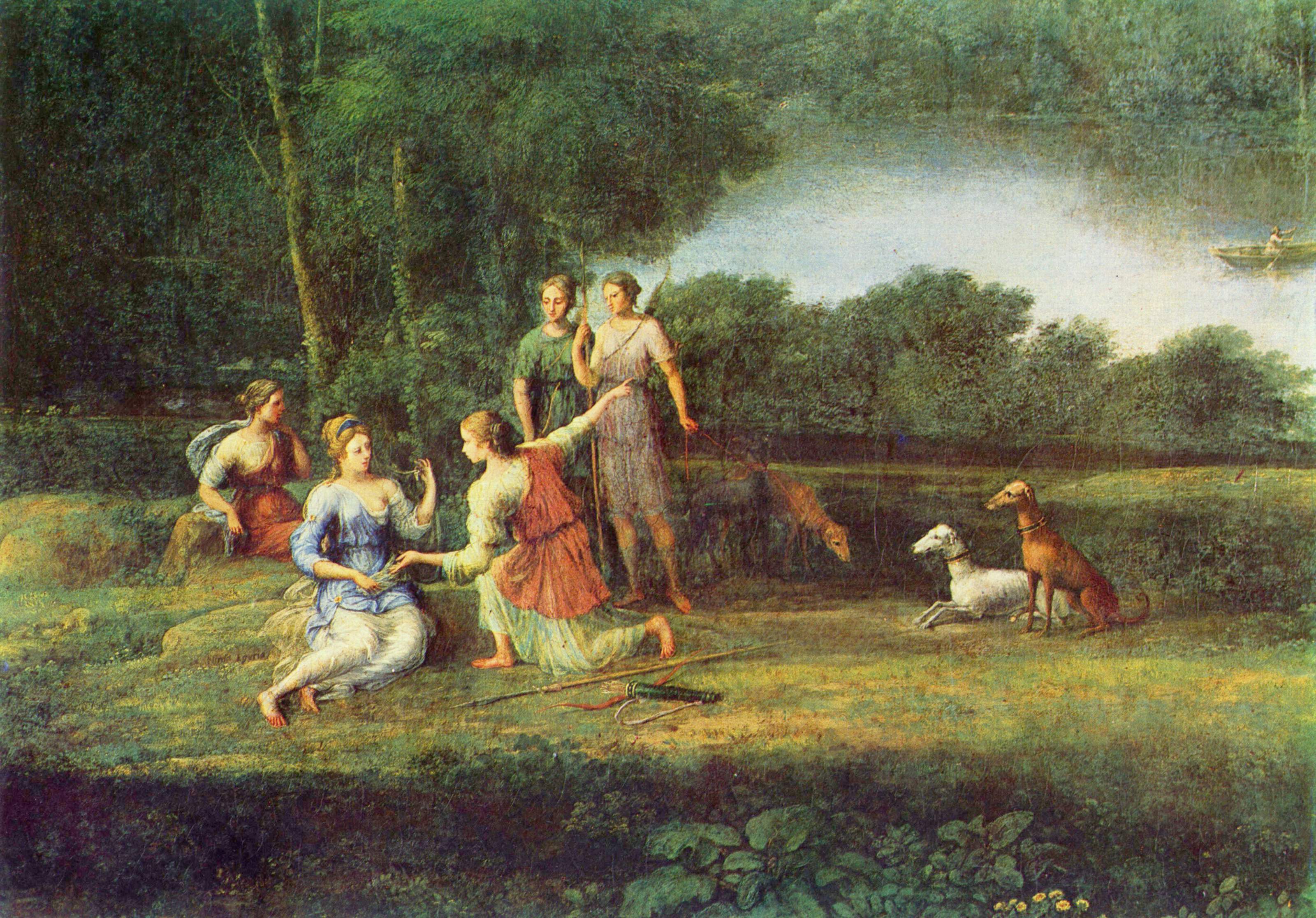
Also, Dionysius (2.60-61), while being less skeptical than Livy, provides a longer version of the antiquarian account and mentions all the different possible interpretations that existed during his lifetime: that Egeria was a divine being, a mountain nymph, or just a fabrication and treats this account as a subject for rationalizing commentary. Later writers added to this account rather than questioned it: Plutarch described the meeting as a mystical marriage in his life of Numa, while Ovid described, in the Fasti and Metamorphoses how, after Numa's death, Egeria retreated to the grove of Diana at Aricia and there became a spring.17,23
Something troubling also was that Egeria's apparent connection to the goddess Diana could not be explained away as fanciful per se. The Vestal Virgins also drew their sacred water from her shrine following the conventions that Numa supposedly set down. In some ways, Egeria's tale lay at the heart of Roman religion.
VII. Egeria's Cult in Rome
If the narrative provoked skepticism, does Egeria leave any physical evidence behind to go along with the border goddesses? Yes and no. Her Roman residence was located near the spring and grove of the Camenae, the prophetic water-nymphs, outside the Porta Capena, where according to tradition Numa met with Egeria and from which the Vestals drew their sacred living water for their rituals. The grove and spring are real and ancient; however Juvenal, in his third satire, mournfully remembers their conversion to commerce..21,24
In addition to her connection with Rome via her association with the Camenae spring/grove, there is another location traditionally linked with Egeria, the grotto attributed to her in the Caffarella Valley. This location continues to be shown off to tourists today. Unfortunately this too is a double mistake. The structure itself is a nymphaeum built in the second century AD as part of the vast suburban estate of Herodes Atticus and features a reclining statue representing a river god (the Almo).
The identification with Numa's nymph is due to humanistic renaissance thinking and not based on any ancient testimony. Hr other traditional residence, Diana's grove at Aricia/Nemi is heavily archeological; however, archeological evidence associated with this site does not begin until the fourth century BCE and is not entirely convincing.19,21
The one "inscription" ever associated with the site is instructive precisely because it is not hers. Cato, in the Origines, quoted the
dedication of the Arician grove:
"Egerius Baebius of Tusculum, Latin dictator, dedicated the grove of Diana in the wood of Aricia."
Cato, Origines fr. 58 Peter (preserved by Priscian; cf. Festus)
The dedication to Diana from a certain Egerius Baebius a male magistrate, has also been connected to Manius Egerius, another male figure. The possibility of a theonym connected to Diana is another part of the evidence.19,20,22
VIII. The Healing Goddesses of Springs in Classical Europe
The above five illustrations show a unified religious phenomenon that spanned along the entire Celto-Roman West: the worship of the holy spring and the residing goddess. The perception among Celtic and Italic Europeans alike was that water which arose from the earth warmed up, or flowed continuously from a source, was a divine being, most often a female deity, one associated with healing, prophecy, eloquence and child birth. A wide variety of rituals accompanied this perception such as making vows to the deity, offering coins, and dropping small objects into the body of water. 25
Sulis was responsible for receiving both curses and wishes of those who were wronged. Coins and vows were offered to Coventina over the course of three hundred years. Eggs and serpents representing health and rebirth were found in front of Sirona who stood beside her healing Apollo. Arnomecta was responsible for the hot springs of Buxton. In legend, Egeria was represented as both a spring and a source of divine knowledge protecting women during childbirth. Supporting these is an extensive array of similar spirits such as the the plural Suleviae and Camenae, Nemetona of the forest, Damona beside Borvo, Icovellauna at Metz, Verbeia of the Wharfe, Ancasta, Coventina's own three nymphs. All regional, each related to specific bodies of water. 9,25
Interpretatio Romana allowed the native goddesses to be paired with their Roman counterparts such as Sulis with Minerva, Sirona with the companion of Apollo, the nymphs of Egeria with the Muses and most importantly gave them the lasting medium of stone on which they could be recorded. This is ultimately the greatest lesson we can learn from examining the similarity between these goddesses. The epigraphic habit that the empire introduced to the provinces is why we know about Coventina, Sulis, Sirona, and Arnomecta today as a nature deity.1,9,22,25
Sources and Bibliography
- Collingwood, R. G., and R. P. Wright. The Roman Inscriptions of Britain. Vol. 1, Inscriptions on Stone. Oxford: Clarendon
Press, 1965. Nos. 155, 281, 1522–1535, 3049.
- Roman Inscriptions of Britain (online). Edited by Scott Vanderbilt et al. Accessed 2026. romaninscriptionsofbritain.org.
- Allason-Jones, Lindsay, and Bruce McKay. Coventina's Well: A Shrine on Hadrian's Wall. Oxford: Oxbow Books for the Trustees of the
Clayton Collection, Chesters Museum, 1985.
- Tomlin, R. S. O. "The Curse Tablets." In The Temple of Sulis Minerva at Bath, Vol. 2, The Finds from the Sacred Spring, edited
by Barry Cunliffe, 59–277. Oxford University Committee for Archaeology Monograph 16. Oxford, 1988.
- Cunliffe, Barry, and Peter Davenport. The Temple of Sulis Minerva at Bath. Vol. 1, The Site. Oxford University Committee for
Archaeology Monograph 7. Oxford, 1985.
- Solinus, C. Julius. Collectanea rerum memorabilium 22.10. Edited by Theodor Mommsen. 2nd ed. Berlin: Weidmann, 1895.
- Corpus Inscriptionum Latinarum. Vol. 13, Inscriptiones trium Galliarum et Germaniarum. Berlin: Reimer, 1899–1943. Nos.
6266 (Alzei), 6458 (Großbottwar).
- L'Année épigraphique. Paris: Presses Universitaires de France / CNRS, 1888–. Esp. AE 1941, 89 (Hochscheid);
AE 1994, 1305 (Großbottwar).
- Jufer, Nicole, and Thierry Luginbühl. Répertoire des dieux gaulois: les noms des divinités celtiques connus par
l'épigraphie, les textes antiques et la toponymie. Paris: Errance, 2001.
- Delamarre, Xavier. Dictionnaire de la langue gauloise. 2nd ed. Paris: Errance, 2003.
- Weisgerber, Gerd. Das Pilgerheiligtum des Apollo und der Sirona von Hochscheid im Hunsrück. Bonn: Rudolf Habelt, 1975.
- Cüppers, Heinz, ed. Die Römer in Rheinland-Pfalz. Stuttgart: Theiss, 1990.
- Richmond, I. A., and O. G. S. Crawford. "The British Section of the Ravenna Cosmography." Archaeologia 93 (1949): 1–50.
- Rivet, A. L. F., and Colin Smith. The Place-Names of Roman Britain. London: Batsford, 1979.
- Stillwell, Richard, William L. MacDonald, and Marian Holland McAllister, eds. The Princeton Encyclopedia of Classical Sites. Princeton:
Princeton University Press, 1976. Entry: "Aquae Arnemetiae (Buxton)."
- Livy. Ab urbe condita 1.19, 1.21. Trans. B. O. Foster. Loeb Classical Library, 1919.
- Dionysius of Halicarnassus. Roman Antiquities 2.60–61. Trans. Earnest Cary. Loeb Classical Library, 1937.
- Cornell, T. J. The Beginnings of Rome: Italy and Rome from the Bronze Age to the Punic Wars (c. 1000–264 BC). London: Routledge,
1995.
- Green, C. M. C. Roman Religion and the Cult of Diana at Aricia. Cambridge: Cambridge University Press, 2007.
- Cato. Origines, fr. 58 Peter (preserved by Priscian, Institutiones grammaticae; cf. Festus, De verborum significatu
128 L).
- Richardson, L., jr. A New Topographical Dictionary of Ancient Rome. Baltimore: Johns Hopkins University Press, 1992. Entry: "Egeria,
Lucus et Fons."
- Dumézil, Georges. Archaic Roman Religion. Trans. Philip Krapp. 2 vols. Chicago: University of Chicago Press, 1970.
- Ovid. Fasti 3.259–298; Metamorphoses 15.479–551. Trans. A. J. Boyle and A. D. Melville. Oxford, 2000/1986.
- Juvenal. Satires 3.10–20. Trans. Susanna Morton Braund. Loeb Classical Library, 2004.
- Green, Miranda J. Dictionary of Celtic Myth and Legend. London: Thames & Hudson, 1992.
- Tomlin, R. S. O. Britannia Romana: Roman Inscriptions and Roman Britain. Oxford: Oxbow Books, 2018.