



38 min read
Satya, Ma'at and Arete: The Cosmos Around the Throne of Zeus
author: High Priest Zevios Metathronos
Egypt named the cosmic Order Ma'at, with a word that also means Truth. The Vedic seers set Satya, the Truth, beside Ṛta, the Order. The Greeks spoke of Aletheia, Themis and Dike, and gave the name Arete to the power that lifts a soul toward the Gods. Across these civilizations one structure holds: a Sovereign at the center, a Truth that issues from him, an Order that flows out of that Truth, and a road of ascent that ethical life builds. Each part runs through the Hellenic, Egyptian and Vedic sources, and all 3 set the same King on the throne.
The 4 Pillars in Plain Words
The cosmology has 4 parts, and each one answers a simple question.
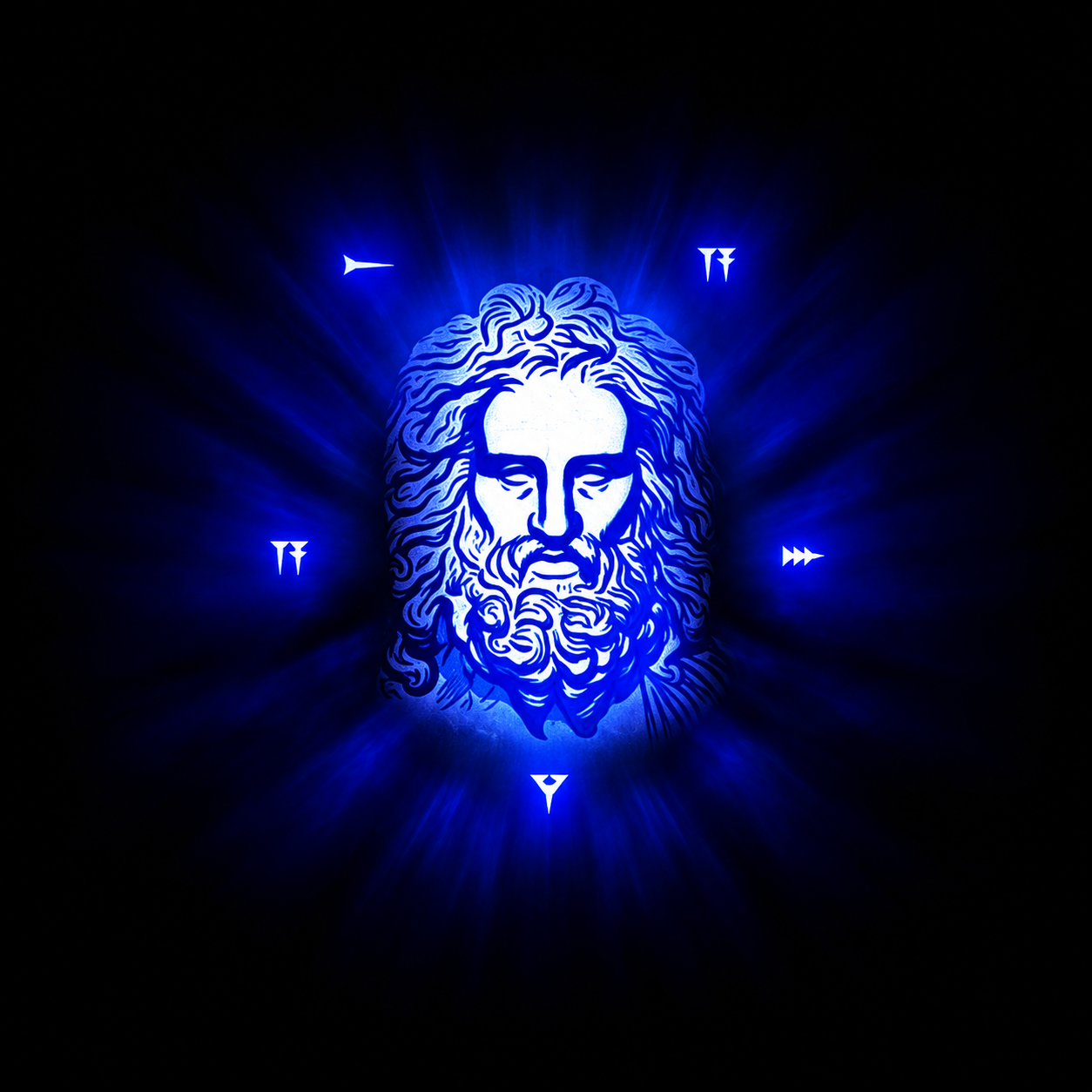
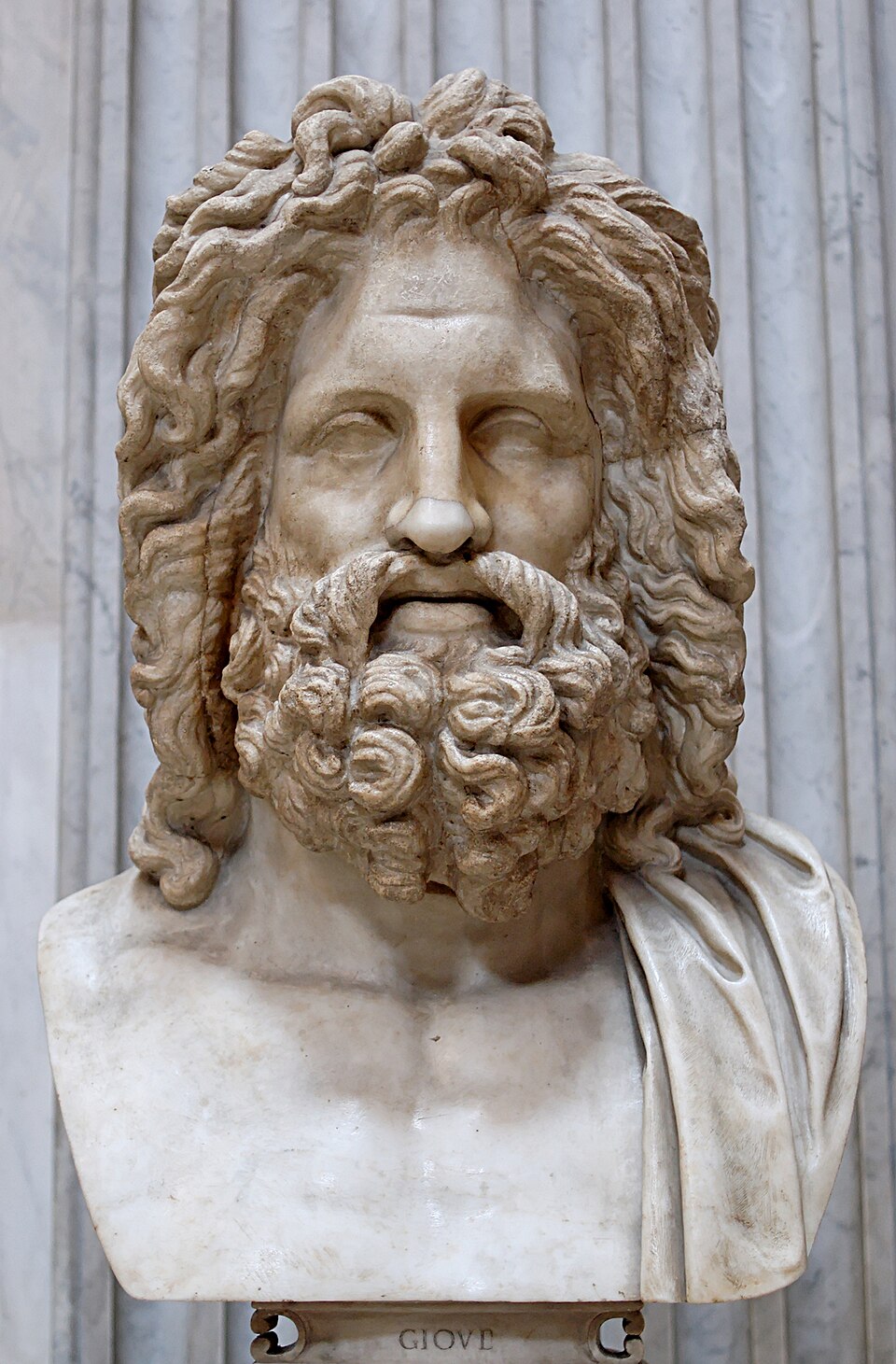
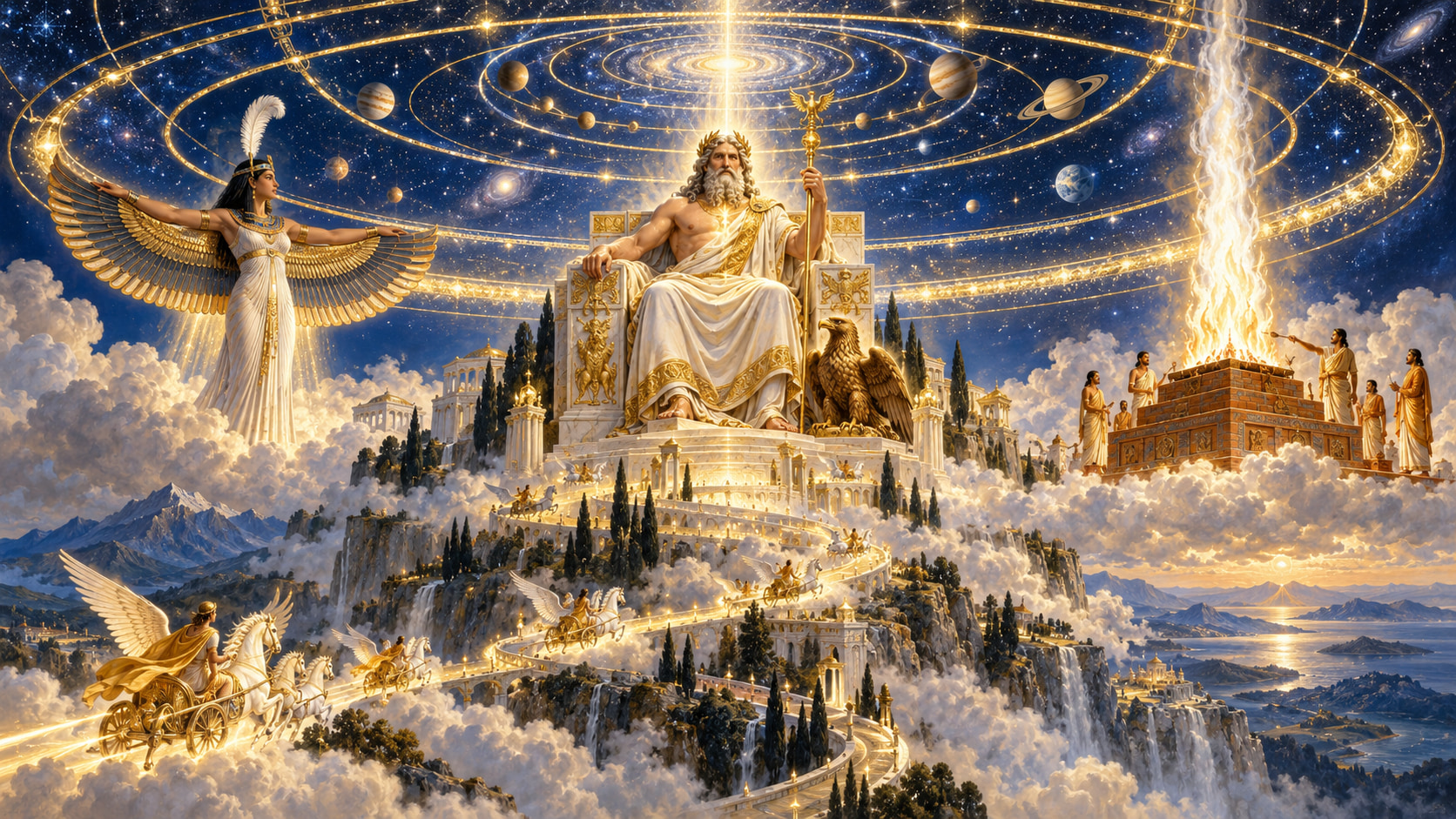
Zeus is the Sovereign. He's the one who rules. The cosmos has a center, and a King holds it. He orders the world, keeps it and leads it, and every other part of this teaching stands around his throne.
Satya is the Truth. The Sanskrit word means what truly is, the real. In the old texts the real and the good turn out to be one thing, and the Zevist Greek formula τὸ ἀληθὲς καὶ ἀγαθόν, the True and the Good, says the same. Truth in this sense is the standard every opinion gets measured against.
Ma'at is the Order. The Egyptian word names the right arrangement that holds the world together: the stars on their courses, the Nile in its season, the just verdict, the honest weight, the kept word. Ma'at is Satya put to work as structure, the way the source runs through the world.
Arete is the Vehicle. The Greek word means excellence of soul, and it's how a soul rises. Ethical action builds it act by act, and the result is power. That power raises the soul up the ranks of existence toward the Gods, the way a wing lifts a body off the ground.
The Sovereign holds the Truth, the Truth pours out as Order, and a soul that lives by the Order builds the Arete that carries that soul back up to him. Picture a kingdom: the King, the truth held in his mind, the law that carries that truth into every province, and the loyal service by which a subject rises to stand in his court.
Greece, Egypt and India each give the 4 pillars their own names:
| Pillar | In Plain English | Hellenic | Ancient Egyptian | Vedic and Sanskrit |
|---|---|---|---|---|
| The Sovereign | The supreme ruler at the center, who orders and keeps all things. | Zeus, "the great leader in heaven" (μέγας ἡγεμὼν ἐν οὐρανῷ).10 | Amun-Ra, "King of the Gods" (nswt nṯrw), whom the Greeks called Zeus.23, 27 | Dyauṣ Pitā, the same name as Ζεὺς πατήρ; Varuṇa the samrāj, universal sovereign.40, 56 |
| The Truth | What truly is: the real, the true and the good as one. | Aletheia, "daughter of Zeus" (θυγάτηρ Ἀλάθεια Διός), who leads all goods for Gods and men.4, 14 | mꜣꜥ, "true, real"; the Truth the chief judge wore, which Greek writers rendered as Aletheia.24, 60 | Satya (सत्य), "what belongs to Being," from sat, "that which is."58 |
| The Order | The lawful arrangement of cosmos, nature and society that flows from the Truth. | Themis and Dike (Θέμις, Δίκη), and the Kosmos that Zeus orders (διακοσμῶν).2, 10 | Ma'at (mꜣꜥt), set "in place of Isfet."28 | Ṛta (ऋत), and in later texts Dharma (धर्म).40, 43 |
| The Vehicle | The power that ethical life builds, which carries the soul upward. | Arete; in Plato the soul's wing (πτέρωμα), fed by the beautiful, the wise and the good.10 | Doing Ma'at (jrj mꜣꜥt); the justified soul, "true of voice" (mꜣꜥ-ḫrw), boards the Bark of Ra.34, 35 | The "divine endowment" (daivī saṃpad); the chariot of the Self; the road of the Gods that Satya lays out.46, 47, 49 |
Zeus: The Sovereign at the Center
Homer calls Zeus "father of men and Gods" (πατὴρ ἀνδρῶν τε θεῶν τε) and measures the throne in a single scene. Zeus dares the whole company of Olympus to hang a golden cord from heaven and pull on it together, every God and every Goddess. They couldn't drag him down to the plain, he tells them, however hard they strained, and he could haul all of them up on it, earth and sea along with them. "By so much am I above Gods and above men" (τόσσον ἐγὼ περί τ’ εἰμὶ θεῶν περί τ’ εἴμ’ ἀνθρώπων).1
Hesiod gives the throne its law. Zeus beat Kronos by strength, and then "he arranged all things well for the immortals alike and declared their honors" (εὖ δὲ ἕκαστα ἀθανάτοις διέταξεν ὁμῶς καὶ ἐπέφραδε τιμάς).2 His sovereignty is an act of ordering. Every God receives a domain, and "from Zeus come kings" (ἐκ δὲ Διὸς βασιλῆες).2
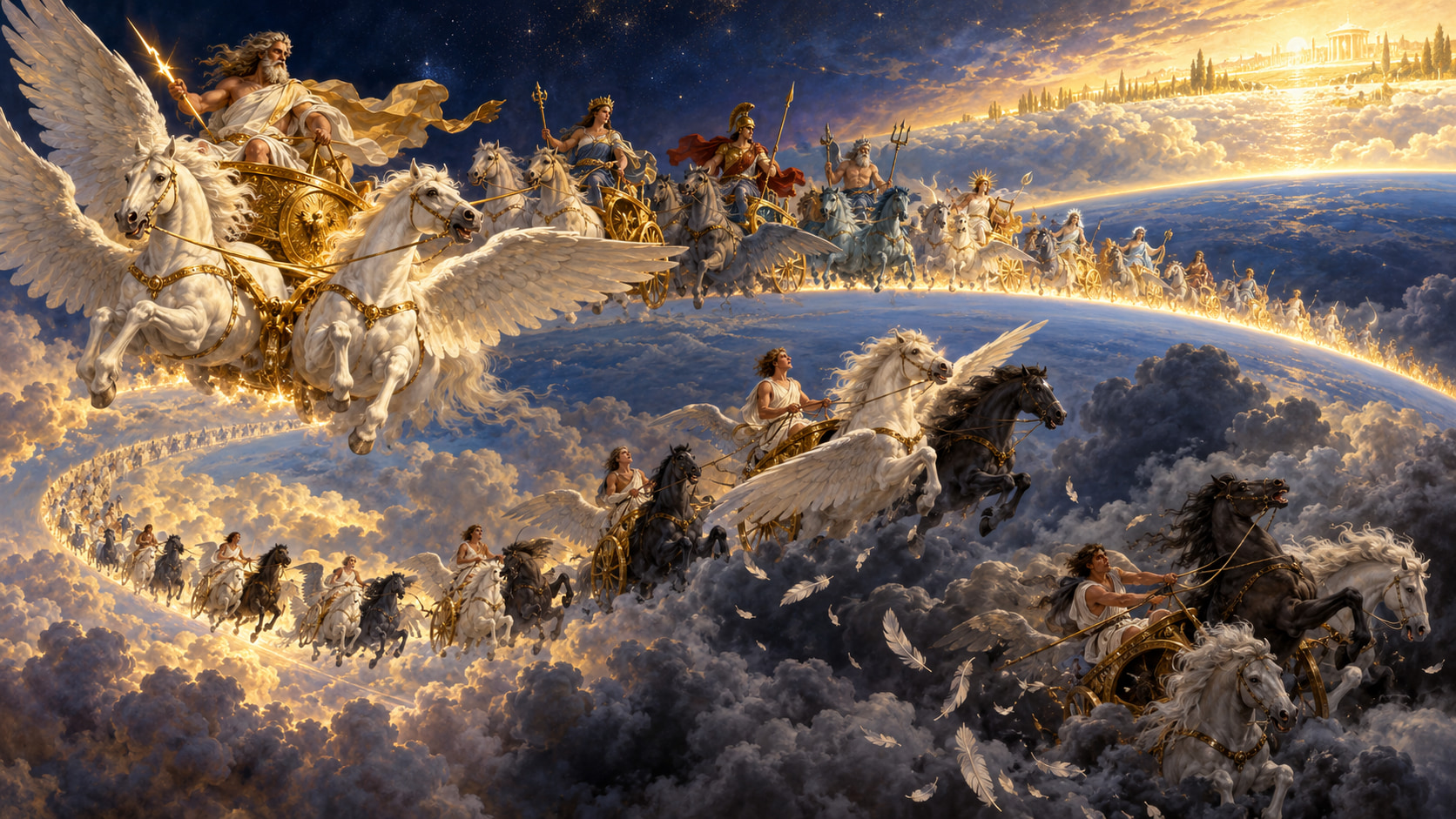
The philosophers kept the throne and widened its reach. In the Phaedrus Plato shows the whole of heaven in procession, with Zeus at its head:
Plato, Phaedrus 246e10
ὁ μὲν δὴ μέγας ἡγεμὼν ἐν οὐρανῷ Ζεύς, ἐλαύνων πτηνὸν ἅρμα, πρῶτος πορεύεται, διακοσμῶν πάντα καὶ ἐπιμελούμενος.
"Zeus, the great leader in heaven, driving a winged chariot, goes first, ordering all things and caring for all."
The verb is διακοσμεῖν, to set in order, formed from the word κόσμος itself. In the Laws Plato cites "the ancient saying" that God holds "the beginning, the end and the middle of all that is," and that Justice always follows him, "avenger of those who fall short of the divine law."14 The Orphic verse that states the same doctrine is preserved in the Derveni papyrus, the oldest Greek book that survives: "Zeus the head, Zeus the middle, from Zeus all things are fashioned" (Ζεὺς κεφαλή, Ζεὺς μέσσα, Διὸς δ’ ἐκ πάντα τέτυκται).8
Aeschylus packed the same claim into 2 lines: "Zeus is the aether, Zeus the earth, Zeus the heaven; Zeus is all things, and whatever is higher still."7 Cleanthes the Stoic opened his hymn by hailing Zeus as "first principle of nature, steering all things with law" (Ζεῦ, φύσεως ἀρχηγέ, νόμου μέτα πάντα κυβερνῶν).16
Egypt's Sovereign had names of his own, and the Greeks read them correctly. Amun-Ra of Thebes bore the title "King of the Gods" (nswt nṯrw). Herodotus states the equation bluntly: "the Egyptians call Zeus Amun" (Ἀμοῦν γὰρ Αἰγύπτιοι καλέουσι τὸν Δία).23 In Greek, Amun's city became Diospolis, the Great City of Zeus.24, 26
A Greek inscription set up at Thebes in the 1st century BCE hails "the greatest God Amonrasonther," the Egyptian title carried whole into Greek.27 Pindar dedicated a statue of Ammon in his own city and sent a hymn to the Ammonians of Libya. Its opening words survive: "Ammon, master of Olympus" (Ἄμμων Ὀλύμπου δέσποτα).6
The Vedic poets kept the name itself. Dyauṣ Pitā, the Sky-Father, is word for word the Greek Ζεὺς πατήρ and the Latin Iuppiter, all 3 descended from one inherited form, *Dyēus ph₂tēr.56, 57 "Dyauṣ is my father, my begetter," sings the Ṛgveda (dyaúr me pitā́ janitā́).40 In the hymns the office of King passes to the Gods who wield it. Varuṇa is samrāj, the universal sovereign, and ṛtāvan, possessor of the cosmic Order. Indra, armed with the thunderbolt, is "king of what moves and of what rests" (índro yātó 'vasitasya rā́jā).40
The Greeks who reached India recognized the throne. Strabo reports that the Indians worship "Zeus the Rain-bringer" (τὸν ὄμβριον Δία).26 A bronze coin of the Greek king Eucratides I shows Zeus enthroned, with a legend in the Indian Kharoṣṭhī script naming the God "the city deity of Kāpiśa."55
For Zevism: the throne sits at the center, and the texts of 3 civilizations place a sovereign King of the Gods on it. Truth, Order and Arete issue from that seat and return to it.
Satya: The Truth That Is
The Sanskrit word carries its own definition. Satya is formed from sat, the participle of the verb as, "to be." Sat means "that which is," and satya means what belongs to what is: the real, the true.58 The Greek participle of the same verb is ὤν, neuter ὄν, in the epic form ἐόν that the Goddess of Parmenides used for Being. The English word "sooth," Old English sōþ, grows from the same participle as satya and τὸ ὄν.58
The Upaniṣads build their theology on it. "In the beginning, dear one, this was Being alone, one only, without a second" (sad eva somyedam agra āsīd ekam evādvitīyam).44 The teacher Uddālaka leads his son Śvetaketu down to the finest essence of all things and names what he finds there: "That is the Truth. That is the Self. You are that, Śvetaketu" (tat satyaṃ sa ātmā tat tvam asi śvetaketo).44 The Taittirīya defines the absolute by 3 terms: "Brahman is Truth, knowledge, the infinite" (satyaṃ jñānam anantaṃ brahma).45 The Bṛhadāraṇyaka calls it "the Truth of Truth" (satyasya satyam).43
In these texts the True and the Good are one substance. The Bṛhadāraṇyaka says it outright: "That which is Dharma is Truth. So of a man who speaks Truth they say, 'He speaks Dharma,' and of a man who speaks Dharma, 'He speaks Truth.' Both are the same thing."43 The Mahābhārata draws the rule of conduct that follows: "There is no Dharma higher than Truth, and no sin greater than falsehood" (nāsti satyāt paro dharmo nānṛtāt pātakaṃ param).48 Zevism gives Satya exactly this sense: τὸ ἀληθὲς καὶ ἀγαθόν, the True and the Good.
The Vedic ritual texts draw the line between Gods and men along the axis of Truth. At the start of the new- and full-moon rite the sacrificer takes a vow, and the Śatapatha Brāhmaṇa explains its force:
Śatapatha Brāhmaṇa 1.1.1.442
dvayaṃ vā idaṃ na tṛtīyam asti satyaṃ caivānṛtaṃ ca satyam eva devā anṛtaṃ manuṣyā idam aham anṛtāt satyam upaimīti tan manuṣyebhyo devān upaiti.
"Twofold is this, there is no third: Truth and untruth. The Gods are Truth, and men are untruth. In saying, 'Here I pass from untruth into Truth,' he passes from men to the Gods."
The Gods keep this vow themselves, the text adds, since they speak the Truth, and the man who does the same becomes glorious as they are.42
Greece names the same Truth and gives her a father. Pindar calls on "the Muse, and you, Truth, daughter of Zeus" (θυγάτηρ Ἀλάθεια Διός).4 In another song he makes Truth the source of Arete: "Beginning of great Arete, Queen Truth" (Ἀρχὰ μεγάλας ἀρετᾶς, ὤνασσ’ Ἀλάθεια).5
Plato sets Truth at the head of all goods: "Truth leads all good things, for Gods and for men" (ἀλήθεια δὴ πάντων μὲν ἀγαθῶν θεοῖς ἡγεῖται, πάντων δὲ ἀνθρώποις).14 In the Republic the Good itself is "the cause of knowledge and truth," and in the Philebus the Good is caught in 3 forms at once: "beauty, proportion, truth."11, 13 Plutarch, writing on the Egyptian Gods, says there's nothing greater for a man to receive, and nothing more august for God to grant, than Truth. He calls the striving for Truth "a longing for divinity" (θειότητος ὄρεξις).19
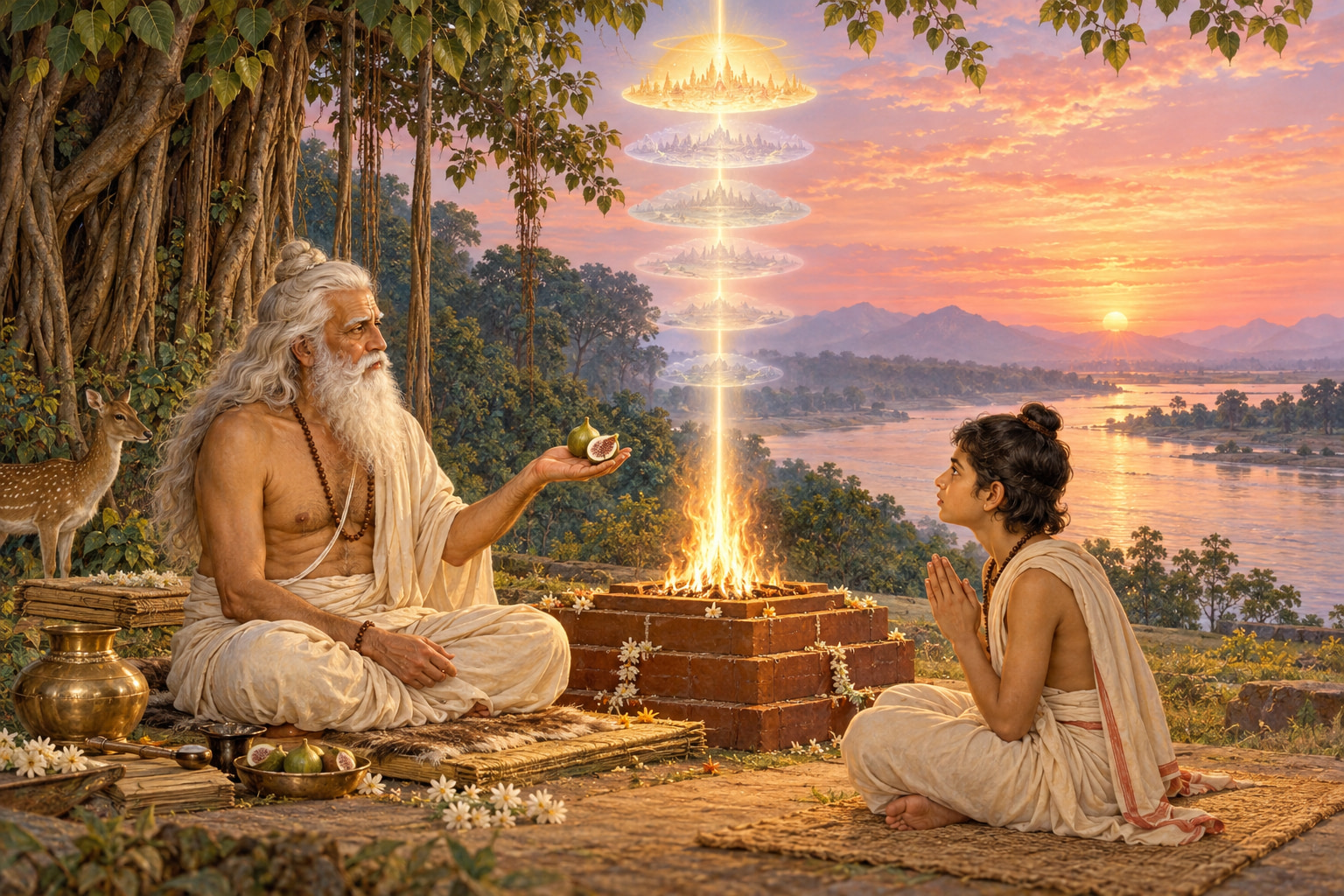
Satya also marks the summit of the worlds. Vedic and Purāṇic cosmology counts 7 worlds from the earth upward, bhūḥ, bhuvaḥ, svaḥ, mahaḥ, janaḥ, tapaḥ, satyam, and the highest is Satyaloka, the World of Truth, where those who arrive don't die again.51 Plato sets the same summit above heaven. Beyond the vault stands "being that really is" (οὐσία ὄντως οὖσα), without color or shape, visible to Nous alone. Every soul strains to see "the Plain of Truth" (ἀληθείας πεδίον), because the pasture that feeds its wings grows there.10
For Zevism: Satya is the Truth that stands in the Nous of the Sovereign and is born of him, as Pindar's Aletheia is born of Zeus. The Gods live by it as their standard, and the soul climbs to it as its summit.
Ma'at: The Order That Flows from Truth
Egypt used a single word where India used 2. Mꜣꜥt means truth, justice and cosmic order at once, and its adjective mꜣꜥ means true, real and correct.60 The hieroglyphs write her name with a feather and with a raised platform sloping at the front, the sign Egyptologists read mꜣꜥ.62
The theology of the Middle Kingdom makes her the Creator's own child. In Coffin Text 80 the primeval water Nun speaks to Atum, the first God: "Kiss your daughter Ma'at, put her at your nose, that your heart may live." Atum names his 2 children: Shu, whose name is Life, and Tefnut, whose name is Ma'at.29 The Creator lives by breathing his own Order. Later theology calls Ma'at the daughter of Ra, and the tomb inscriptions say of the Sun God that he lives on Ma'at.60, 61
Kingship existed to carry that Order into the world. The Pyramid Texts say of King Unas that he "has come out of the Isle of Fire, having set Ma'at there in place of Isfet."28 A Theban temple text sums up the king's whole office: Ra has placed the king on the earth of the living forever and ever, "judging mankind, satisfying the Gods, making Ma'at come to be and annihilating Isfet."38
The throne names carry the same doctrine. Hatshepsut ruled as Maatkare, "Ma'at is the Ka of Ra," the Sun God's living essence. Amenhotep III was Nebmaatre, "the Lord of Ma'at is Ra," and Ramesses II was Usermaatre, "the Ma'at of Ra is strong."39
Isfet is her opposite: falsehood, violence and the dissolution of what's been built. The Creator of Coffin Text 1130 lists his good deeds. He made the 4 winds so that every man could breathe, made the great flood so the poor could use it like the great, and "made every man like his fellow." Then he fixes where the fault lies: "I did not command that they do Isfet. It was their hearts that disobeyed what I said."30
Egypt's teaching texts and hymns carry the cosmic Order into conduct. Ptahhotep teaches: "Great is Ma'at, lasting in effect, unchallenged since the time of Osiris."32 The Eloquent Peasant presses a high official: "Do Ma'at for the Lord of Ma'at," and warns him that "Ma'at is for eternity. It goes down with the one who does it into the necropolis."34 The Memphite Theology writes judgment into the act of creation itself: "Thus life is given to the peaceful and death is given to the criminal."31 The great hymn to Amun-Ra of Thebes hails him as "Lord of Ma'at, father of the Gods, maker of men."36
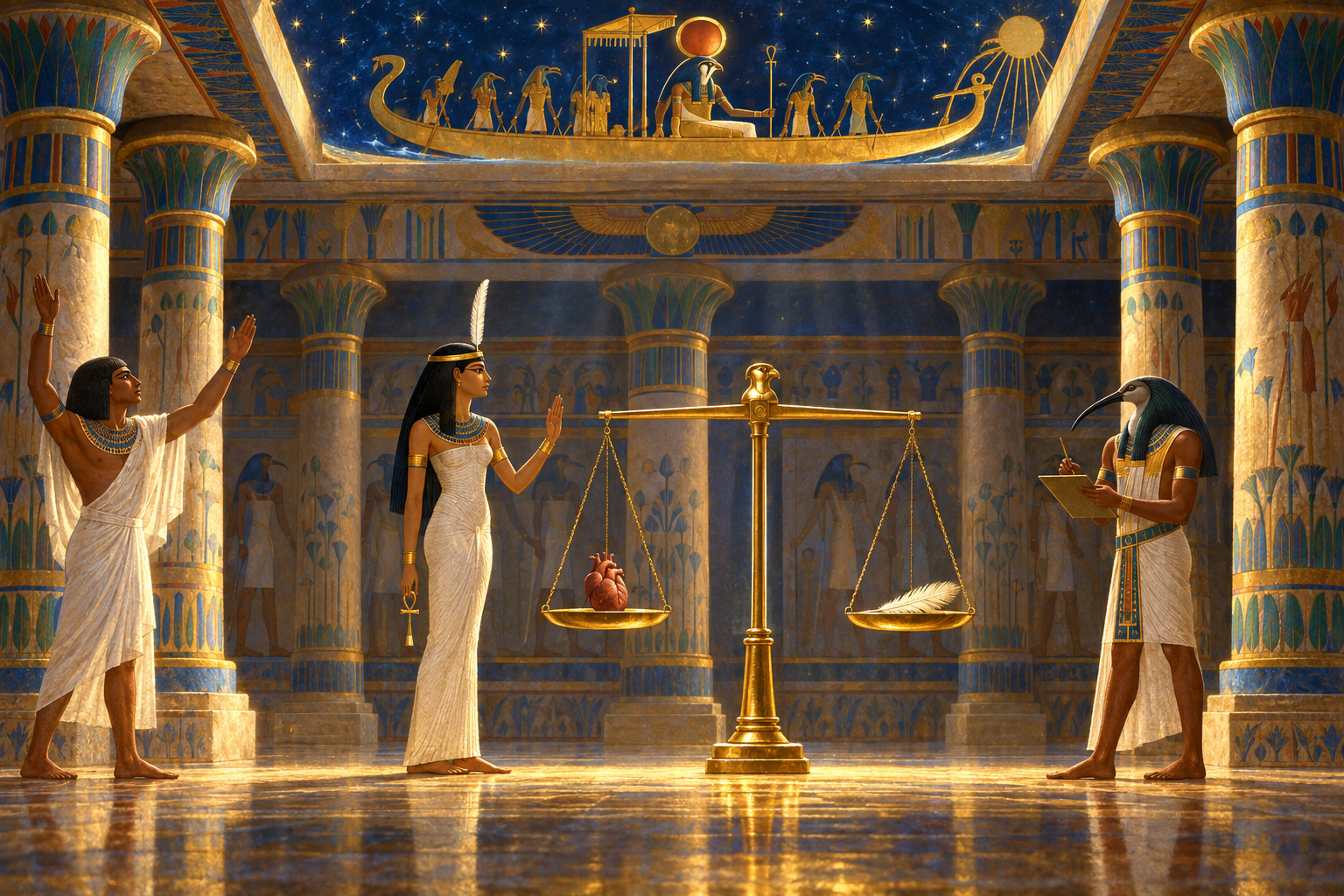
The Greek writers on Egypt translated this Order with a single word. Diodorus reports that Egypt's chief judge wore around his neck, on a golden chain, an image made of precious stones, "which they called Aletheia" (ὃ προσηγόρευον ἀλήθειαν).24 Aelian describes the same image cut from sapphire: "and the image was called Aletheia."25 Both witnesses gave Ma'at, Goddess of Egyptian justice, her Greek name.
India kept Truth and Order as twins. "Order and Truth were born from kindled tapas" (ṛtáṃ ca satyáṃ cābhī̀ddhāt tápasó 'dhy ajāyata), says a hymn in the last book of the Ṛgveda.40 Ṛta, the Vedic Order, comes from a root meaning to fit and to join, the root that also stands under Greek ἁρμονία. Its Avestan cognate, aša, names the Truth-Order of ancient Iran.58 Mitra and Varuṇa are "guardians of Ṛta" (ṛ́tasya gopau), and their laws are true (sátyadharmāṇā).40
Scholars have argued for more than a century over whether Ṛta should be translated "order" or "truth," and Heinrich Lüders gave a whole volume to the case for truth.59 The argument itself shows the doctrine: the 2 words describe one reality seen from 2 sides. Another hymn assigns each its work:
Ṛgveda 10.85.140
satyénóttabhitā bhū́miḥ sū́ryeṇóttabhitā dyaúḥ
ṛténādityā́s tiṣṭhanti diví sómo ádhi śritáḥ"By Truth the earth is upheld; by the Sun the sky is upheld. By Ṛta the Ādityas stand, and Soma is set in heaven."
Truth is the ground, and Order is the structure that holds the Ādityas in their places. The Atharvaveda lists the powers that bear the earth and puts Truth first: "great Truth, mighty Ṛta, consecration, tapas, prayer and sacrifice uphold the earth."41
Greece gave the Order a seat beside the throne. The second wife of Zeus was Themis, divine Right, and she bore him the Horai: Eunomia, Good Order; Dike, Justice; and Eirene, Peace. She also bore the Moirai, who give mortals their share of good and ill.2 Dike, "born of Zeus," sits "beside Father Zeus, son of Kronos" and tells him of the unjust minds of men.3 Pindar calls Themis the Savior, "assessor of Zeus of Strangers" (Διὸς ξενίου πάρεδρος).4
Hesiod makes Dike the gift that sets humans apart from animals. Zeus let fish, beasts and birds eat one another, "since there is no Dike among them, but to men he gave Dike, which is by far the best."3
For Zevism: Ma'at is the structured Order of Cosmic Existence, held by Zeus as Sovereign of the Cosmos. It flows from Satya as light flows from the sun, and Isfet is the pull away from it, back toward dissolution.
Arete: The Vehicle of Ascent
Plato gave the soul's vehicle its clearest image, and Zevism reads its plumage as Arete. In the Phaedrus every soul is a winged chariot, and "it is the wing's nature to lift what is heavy upward, carrying it aloft to where the race of the Gods dwells." The wing feeds on the divine, and "the divine is beautiful, wise, good." By these the soul's plumage "is nourished and grows," and by the ugly and the bad "it wastes and perishes" (φθίνει τε καὶ διόλλυται).10
The wings carry the soul in the train of the Gods. Zeus drives first, and the Gods follow with their companies. The soul that follows best lifts its charioteer's head above the rim of heaven and barely glimpses what truly is; the rest sink back.10
Then the ordinance of Adrasteia assigns the ranks. The soul that has seen the most is born as a philosopher, the next as a lawful king, and so on down to the tyrant in the 9th rank. An ordinary soul needs 10,000 years to grow its wings again. The soul that chooses the philosophic life 3 times in succession regains them in 3,000.10
Arete is built. Aristotle says ethical virtue "comes from habit, and its name is a slight variation of ἔθος" (ἡ δ’ ἠθικὴ ἐξ ἔθους περιγίνεται).15 Hesiod, centuries earlier, put the cost in plain view: "Before Arete the immortal Gods have set sweat. Long and steep is the path to it, and rough at first, but when a man reaches the top it becomes easy, hard though it was."3 Each right act lays one more step of that road.
Prodicus, in the fable Xenophon retells, gives Arete her own voice. She keeps company with the Gods and with good men, she's honored above all among both, and through her, she tells Heracles, men become "dear to the Gods" (δι’ ἐμὲ φίλοι μὲν θεοῖς ὄντες).9
Plato shows where that road ends: "The Gods never neglect the man who is eager to become just and, by practicing Arete, to be made like God as far as is possible for a man" (ἐπιτηδεύων ἀρετὴν εἰς ὅσον δυνατὸν ἀνθρώπῳ ὁμοιοῦσθαι θεῷ).11 The Theaetetus gives the formula: flight from this world is "likeness to God as far as possible," and likeness is "to become just and holy with wisdom."12 The Republic closes on the same resolve: "we shall keep always to the upward road and practice justice with wisdom in every way."11
Aristotle tells men to "make themselves immortal, so far as possible" (ἐφ’ ὅσον ἐνδέχεται ἀθανατίζειν), since the life of Nous is divine compared with human life.15 Zeno set the goal of life as living in agreement with nature, "which is to live by Arete" (ὅπερ ἐστὶ κατ’ ἀρετὴν ζῆν).17 The Platonic successors counted the ranks. Plotinus opens his treatise on the virtues with the Theaetetus and states the goal plainly: "our concern is not to be without sin, but to be God" (ἡ σπουδὴ οὐκ ἔξω ἁμαρτίας εἶναι, ἀλλὰ θεὸν εἶναι).20
Porphyry sets the virtues on a ladder of 4 grades. The civic virtues make a good man, the purifying virtues a daimonic man or a good daimon, the contemplative virtues a God, and the paradigmatic virtues a "father of Gods" (θεῶν πατήρ).21 Marinus writes the life of Proclus as a climb through natural, ethical, civic, purifying, contemplative and theurgic virtue, with higher grades still beyond.22 The Pythagorean Golden Verses close at the top: "If you leave the body behind and come to the free aether, you will be an immortal God, undying, no longer mortal."18
Egypt measured the same climb against a single lifetime. The Instruction for Merikare tells a king, "Do Ma'at, that you may endure on earth," and bids him "make excellent your seat in the necropolis by uprightness, by doing Ma'at." It warns him that before the tribunal of the dead "a man remains after death, and his deeds are set beside him in heaps."33 It ranks conduct above offerings: "the character of the upright is preferred to the ox of the evildoer."33
In the Hall of the Two Truths the dead man declares to the Lord of Ma'at: "I have brought you Ma'at, I have driven off Isfet for you." He answers before 42 judges, denying each wrong in turn. The one who passes is mꜣꜥ-ḫrw, "true of voice," and the Book of the Dead gives him spells to board the Bark of Ra and sail with the Sun.35
The Indian path runs the same way. The Śatapatha vow carries a man from untruth into Truth, from men to the Gods.42 Patañjali lists the ethical restraints and the power each one yields once it's established. When a man is grounded in truthfulness, action and its fruit rest on him; when he's grounded in continence, "vigor is gained" (vīryalābhaḥ).50 The Bhagavad Gītā gives the qualities of the divine nature, Truth among them, and rules: "The divine endowment leads to liberation, the demonic to bondage."49 Its yogi climbs across lifetimes: "perfected through many births, he then reaches the highest goal."49
Muṇḍaka Upaniṣad 3.1.646
satyam eva jayate nānṛtaṃ satyena panthā vitato devayānaḥ
yenākramanty ṛṣayo hy āptakāmā yatra tat satyasya paramaṃ nidhānam"Truth alone conquers, not untruth. By Truth is laid out the road that leads to the Gods, by which the seers, their desires fulfilled, ascend to where the highest treasure of Truth is kept."
The Republic of India still carries its opening words, satyam eva jayate, beneath its state emblem.52 The verse before it gives the means: this Self "is won by Truth, by tapas, by right knowledge and by chastity."46 The Kaṭha Upaniṣad uses the same image as Plato. "Know the Self as the rider in a chariot, and the body as the chariot. Know the intellect as the charioteer, and the mind as the reins." The senses are the horses, and the man whose charioteer is understanding "reaches the end of the road, that highest step of Viṣṇu."47
The Mahābhārata supplies the team that pulls the chariot. Self-restraint, generosity and vigilance are the qualities in which immortality is set, and the epic calls them "the horses of Brahman."48 Those who venerate Truth, adds the Bṛhadāraṇyaka, go to the worlds of Brahman, "and for them there is no return."43
For Zevism: Arete is the Vehicle. Ethics generates the spiritual power of the Zevist path, and that power carries the soul up the ranks of existence.
The Cosmos Whole: The Road Down and the Road Up
The 4 pillars drive the cosmology in 2 directions. On the road down, Truth issues from the Sovereign as Order, and the Order shapes the stars, the seasons, the cities and the souls. On the road up, Arete carries the soul back through the ranks to the Truth and into the company of the Sovereign. Greece, Egypt and India mark each stage of both roads:
| Stage | Hellenic | Ancient Egyptian | Vedic and Sanskrit |
|---|---|---|---|
| The Sovereign holds the center | Zeus leads the procession of heaven, "ordering all things and caring for all."10 | Amun-Ra, King of the Gods, "Lord of Ma'at, father of the Gods."36 | Dyauṣ Pitā; Varuṇa the samrāj, possessor of Ṛta.40 |
| Truth issues from him | Aletheia, daughter of Zeus, "beginning of great Arete."4, 5 | Ma'at as Truth, daughter of the Creator, the breath at his nose.29 | Satya, "the Truth of Truth."43 |
| Truth becomes Order | Themis and her daughters Eunomia, Dike and Eirene.2 | Ma'at set in place of Isfet.28 | By Truth the earth is upheld; by Ṛta the Ādityas stand.40 |
| The soul chooses | Dike given to men alone among living things.3 | "Speak Ma'at, do Ma'at"; the hearts that disobey.30, 34 | "From untruth into Truth."42 |
| Arete lifts | The wing nourished by the beautiful, the wise and the good.10 | The justified soul boards the Bark of Ra.35 | The chariot of the Self on the road the Gods travel.46, 47 |
| Arrival at the summit | The Plain of Truth, in the train of Zeus.10 | Sailing with Ra in the Great Bark.35 | Satyaloka, the World of Truth; "for them there is no return."43, 51 |
Falsehood has no stage on either road, because it refuses the whole movement. Egypt called it Isfet, the Vedas anṛta, untruth, and Pindar "rough falsehood" (τραχεῖ ποτὶ ψεύδει).5, 28, 42 It pulls downward, away from the throne, toward the dissolution of every order that's been built. Its source is the heart that turns away, as the Creator of Coffin Text 1130 declares.30
The Ancients Drew the Lines Themselves
The ancients themselves drew these equations first, in stone and in writing, while all 3 traditions were alive.
On the Egyptian side Herodotus and Plutarch give Amun as the Egyptian name of Zeus, Pindar hymns Ammon as master of Olympus, and Diodorus and Aelian write down the Ma'at of the chief judge as Aletheia.6, 19, 23, 24, 25 The priests of Amun at Thebes wrote their own theology of one God behind many names: "All Gods are 3: Amun, Ra and Ptah, who have no second. His identity is hidden as Amun, he is Ra in face, his body is Ptah."37
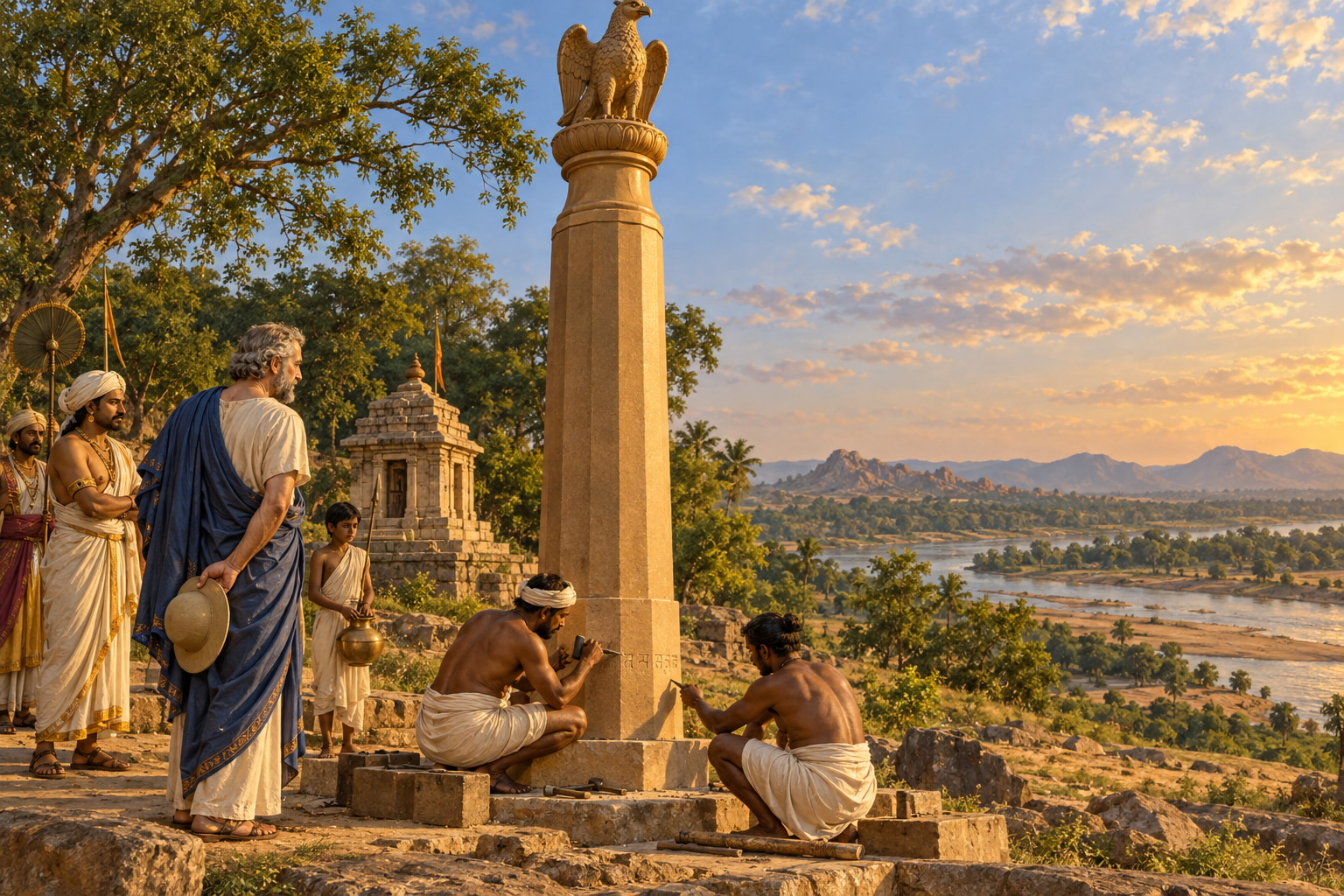
On the Indian side the equations went into law and stone. Around 260 BCE the Mauryan king Aśoka carved an edict at Kandahar in Greek and Aramaic. His Dhamma appears in the Greek as εὐσέβεια, piety, and the Aramaic renders the same idea as qšyṭʾ, Truth.53 Late in the 2nd century BCE Heliodorus son of Dion, a Greek of Taxila and envoy of King Antialcidas, set up a column to the God Vāsudeva at Vidisha and cut this inscription into it:
Heliodorus Column, Besnagar (Vidisha), Inscription B54
trini amutapadāni (ia) [su]anuṭhitāni neyaṃti svaga dama cāga apramāda
"The 3 immortal steps, when well practiced here, lead to heaven: self-restraint, generosity, vigilance."
Those are the 3 horses of Brahman in the Mahābhārata, cut in Prakrit by a Greek envoy.48 Megasthenes, the Seleucid ambassador at the Mauryan court, reported that the Brahmins agree with the Greeks on many points: that the cosmos came to be, that it's spherical, and "that the God who made it and governs it pervades the whole of it."26
Between Greece and India the bond is older than any embassy. Dyauṣ Pitā and Ζεὺς πατήρ are one inherited name, and Ṛta and Avestan aša are one inherited word for the cosmic Order.56, 58 One of the most quoted verses of the Ṛgveda states the principle behind all these equations: "They call it Indra, Mitra, Varuṇa, Agni ... the One Being the sages call by many names" (ékaṃ sád víprā bahudhā́ vadanti).40 Cleanthes greeted Zeus in the same spirit, as the "many-named" (πολυώνυμε).16
What This Cosmology Gives Zevism
The 4 pillars map onto the 4 dimensions of the Zevist path.
Meditation: Standing in the Truth
Meditation builds δυνατόν, the capacity of power, and its object is Satya: the mind stilled until it rests on what is. Uddālaka points his son to the finest essence of things and says "That is the Truth," and the soul of the Phaedrus lifts its head above the rim of heaven to see "being that really is." Practice keeps the mind there, on the Truth held in the Nous of Zeus.
Ethics: Doing Ma'at
Zevism defines the Good as the conjunction of Ma'at and Right. The Egyptian command "speak Ma'at, do Ma'at" and the Upaniṣadic identity of Dharma and Truth give that definition its ancient form.34, 43 A good act joins a true heart to a right deed. A right deed done from a false heart fails the test, and so does a true intention carried out wrongly. Each act that passes adds to Arete, the spiritual power that ethics forges.
The Existential Dimension: Following the Sovereign
The Phaedrus shows every soul in the train of a God, with Zeus driving first. A life lived in service of ὁμοίωσις θεῷ keeps that procession in view. It places its choices inside the Order that flows from the throne and measures them against the Truth that stands above that Order. Every life moves up or down the ranks that Plato, Porphyry and the Purāṇas describe.
Theurgy: The Company of the Gods
Theurgy joins human intelligence to the intelligence of the Gods. Marinus sets theurgic virtue near the summit of Proclus' climb, and the justified soul of Egypt sails in the Bark of Ra among the Gods. Arete gives the soul its rank, and theurgy brings it into their company, where it reaches the Truth the Gods keep as their vow.22, 42
Objections and Replies
Objection I: "Similar ideas in distant cultures are coincidence. There's no single cosmology here."
Greece stood in contact with both of the other traditions, and its writers read their theology directly. Greeks hymned Ammon and translated Ma'at as Aletheia; a Greek envoy inscribed Indian ethics in Prakrit, and an Indian king rendered his Dhamma in Greek.6, 24, 53, 54 Between Greece and India the link also runs through a common inheritance, the name of the Sky-Father and the word for cosmic Order.56, 58
Objection II: "Ma'at already means truth. Setting Satya above Ma'at imposes a hierarchy the Egyptians never had."
The hierarchy is in the Egyptian texts. Ma'at is the daughter of the Creator in Coffin Text 80 and the daughter of Ra in later theology, and she sustains the God who breathes her.29, 60 In both she comes from a higher source. The Vedic hymn draws the same line inside one verse, with Truth upholding the earth and Ṛta holding the Ādityas in their places.40 Egypt's single word shows how close the 2 stand, since the Order is the Truth at work. Zevism names the source Satya and its working Ma'at.
Objection III: "Satya in the Upaniṣads is the impersonal Brahman. A Sovereign God at the center distorts it."
The Vedic tradition joins Truth to sovereign Gods from its oldest layer. Varuṇa is samrāj and possessor of Ṛta, and Mitra and Varuṇa guard Ṛta with laws that are true.40 The verse of the One Being gives that Being the names of Gods.40 Greek philosophy made the same join: Plato places a kingly soul and a kingly Nous in the nature of Zeus, and the Stoics called the right reason that pervades all things "the same as Zeus."13, 17 Zevism reads Satya as the Truth held in that sovereign Nous.
Conclusion: One Truth Given to Every Civilization
The Hellenic, Egyptian and Vedic sources describe one cosmos. A Sovereign stands at its center: Zeus in Greece; in Egypt Amun-Ra, whom the Greeks called Zeus; in India the Sky-Father who bears Zeus' own name. From the Sovereign issues Truth: Aletheia the daughter of Zeus, Ma'at in her aspect as Truth, the Creator's daughter, and Satya the Truth of Truth.
Truth pours out as Order, with Themis and Dike beside the throne, Ma'at set in place of Isfet, and Ṛta holding the Ādityas in their places. The soul rises through that Order by Arete: the wing of the Phaedrus, the justified soul in the Bark of Ra, the chariot of the Kaṭha on the road that Truth laid out.
The sources trace this knowledge to divine teachers. The Muses taught Hesiod on Helicon.2 A Goddess took Parmenides by the right hand and spoke the teaching on Being. The Creator of the Coffin Texts states his law in his own voice.30 A Vedic hymn tells how the poets tracked Vāk, sacred Speech, and "found her harbouring within the Ṛṣis," the seers.40 Each civilization received the teaching from the Gods, in its own language, and wrote it down.
Zevism reads that agreement as evidence of a single source. The Gods gave the same eternal truths to every civilization, and in each tradition the Truth, the Order and the road of ascent stand around one sovereign throne. The Greek texts know its holder as Zeus. The Egyptian and Vedic witnesses use their own tongues: Amun, whom Herodotus calls Zeus, and Dyauṣ, whose name is Zeus' own.
High Priest Zevios Metathronos
Temple of Zeus Foundation
Sources & References
- Homer, Iliad 1.544 (πατὴρ ἀνδρῶν τε θεῶν τε, a formula repeated through both epics); 8.17-27. Zeus dares the Gods to hang a golden cord (σειρὴν χρυσείην) from heaven and pull: "by so much am I above Gods and above men" (τόσσον ἐγὼ περί τ’ εἰμὶ θεῶν περί τ’ εἴμ’ ἀνθρώπων, 8.27). Greek text: D.B. Monro and T.W. Allen, Oxford Classical Texts.
- Hesiod, Theogony 22-34 (the Muses teach Hesiod on Helicon); 73-74 (Zeus "arranged all things well for the immortals alike and declared their honors"); 96 (ἐκ δὲ Διὸς βασιλῆες); 885 (the distribution of honors); 901-906 (Themis, second wife of Zeus, bears the Horai, Eunomia, Dike and Eirene, and the Moirai). Ed. H.G. Evelyn-White, Loeb Classical Library, 1914.
- Hesiod, Works and Days 256-262 (Dike, "born of Zeus," sits beside Father Zeus, son of Kronos); 276-280 (Zeus gives Dike to men and withholds it from fish, beasts and birds); 289-292 (τῆς δ’ ἀρετῆς ἱδρῶτα θεοὶ προπάροιθεν ἔθηκαν; the long and steep path). Ed. Evelyn-White, Loeb, 1914.
- Pindar, Olympian 8.21-23: Themis the Savior, Διὸς ξενίου πάρεδρος. Olympian 10.3-6: ὦ Μοῖσ’, ἀλλὰ σὺ καὶ θυγάτηρ Ἀλάθεια Διός (numbered Olympian 11 in older editions). Ed. J.E. Sandys, Loeb Classical Library, 1915 (rev. 1919).
- Pindar, fr. 205 Snell-Maehler, preserved by Stobaeus, Anthology 3.11.18 Hense: Ἀρχὰ μεγάλας ἀρετᾶς, ὤνασσ’ Ἀλάθεια, μὴ πταίσῃς ἐμὰν σύνθεσιν τραχεῖ ποτὶ ψεύδει, "Beginning of great Arete, Queen Truth, do not let my compact stumble against rough falsehood."
- Pindar, fr. 36 Snell-Maehler, from the Hymn to Ammon, preserved in the scholia on Pythian 9.53 (A.B. Drachmann, Scholia vetera in Pindari carmina II, Teubner, 1910, p. 248): Ἄμμων Ὀλύμπου δέσποτα. Pausanias, Description of Greece 9.16.1: Pindar dedicated the statue of Ammon at Thebes, the work of Calamis, and sent a hymn to the Ammonians of Libya, which stood in Pausanias' day on a triangular stele beside the altar dedicated by Ptolemy son of Lagus.
- Aeschylus, fr. 70 Radt (Heliades), preserved by Clement of Alexandria, Stromateis 5.14.114.4: Ζεύς ἐστιν αἰθήρ, Ζεὺς δὲ γῆ, Ζεὺς δ’ οὐρανός, Ζεύς τοι τὰ πάντα χὤτι τῶνδ’ ὑπέρτερον.
- Derveni Papyrus, col. XVII.12 (= Orphicorum Fragmenta 14 Bernabé), text of K. Tsantsanoglou and G.M. Parássoglou in T. Kouremenos, G.M. Parássoglou and K. Tsantsanoglou, The Derveni Papyrus, Olschki, 2006: Ζεὺς κεφαλή, Ζεὺς μέσσα, Διὸς δ’ ἐκ πάντα τέτυκται. The fuller hymn in [Aristotle], On the Cosmos 7, 401a (= OF 31 Bernabé). The papyrus, carbonized on a funeral pyre at Derveni near Thessaloniki in the 4th century BCE, was entered in UNESCO's Memory of the World Register in 2015 as the oldest surviving book of Europe.
- Xenophon, Memorabilia 2.1.21-34 (Prodicus, the Choice of Heracles); 2.1.32: ἐγὼ δὲ σύνειμι μὲν θεοῖς, σύνειμι δὲ ἀνθρώποις τοῖς ἀγαθοῖς; 2.1.33: δι’ ἐμὲ φίλοι μὲν θεοῖς ὄντες. Ed. E.C. Marchant, Oxford Classical Texts.
- Plato, Phaedrus 246d-249a. 246d-e: the wing lifts the heavy upward to the dwelling of the Gods and is nourished by the beautiful, wise and good (τὸ δὲ θεῖον καλόν, σοφόν, ἀγαθόν); 246e: ὁ μὲν δὴ μέγας ἡγεμὼν ἐν οὐρανῷ Ζεύς; 247c: οὐσία ὄντως οὖσα; 248b-c: the Plain of Truth and the ordinance of Adrasteia; 248d-e: the 9 ranks of lives; 248e-249a: 10,000 years, and 3,000 for the soul that chooses the philosophic life 3 times in succession. Greek text: J. Burnet, Oxford Classical Texts.
- Plato, Republic 508e (the Idea of the Good, αἰτίαν δ’ ἐπιστήμης οὖσαν καὶ ἀληθείας); 613a-b (ἐπιτηδεύων ἀρετὴν εἰς ὅσον δυνατὸν ἀνθρώπῳ ὁμοιοῦσθαι θεῷ); 621c (τῆς ἄνω ὁδοῦ ἀεὶ ἑξόμεθα καὶ δικαιοσύνην μετὰ φρονήσεως παντὶ τρόπῳ ἐπιτηδεύσομεν).
- Plato, Theaetetus 176a-b: φυγὴ δὲ ὁμοίωσις θεῷ κατὰ τὸ δυνατόν· ὁμοίωσις δὲ δίκαιον καὶ ὅσιον μετὰ φρονήσεως γενέσθαι.
- Plato, Philebus 30d (in the nature of Zeus βασιλικὴν μὲν ψυχήν, βασιλικὸν δὲ νοῦν come to be "through the power of the cause"); 65a (the Good taken in 3 forms, κάλλει καὶ συμμετρίᾳ καὶ ἀληθείᾳ).
- Plato, Laws 715e-716a (God, "as the ancient saying has it," holds beginning, end and middle of all that is, and Justice follows him, τῶν ἀπολειπομένων τοῦ θείου νόμου τιμωρός); 730c (ἀλήθεια δὴ πάντων μὲν ἀγαθῶν θεοῖς ἡγεῖται, πάντων δὲ ἀνθρώποις).
- Aristotle, Nicomachean Ethics II.1, 1103a14-18 (ἡ δ’ ἠθικὴ ἐξ ἔθους περιγίνεται); X.7, 1177b26-34 (the life of Nous divine compared with human life; ἐφ’ ὅσον ἐνδέχεται ἀθανατίζειν). Ed. I. Bywater, Oxford Classical Texts, 1894.
- Cleanthes, Hymn to Zeus 1-2 and 20-21, preserved by Stobaeus, Eclogae 1.1.12: Κύδιστ’ ἀθανάτων, πολυώνυμε, παγκρατὲς αἰεί, Ζεῦ, φύσεως ἀρχηγέ, νόμου μέτα πάντα κυβερνῶν. Ed. J.C. Thom, Cleanthes' Hymn to Zeus, Mohr Siebeck, 2005.
- Diogenes Laertius, Lives of the Eminent Philosophers VII.87 (Zeno's end: τὸ ὁμολογουμένως τῇ φύσει ζῆν, ὅπερ ἐστὶ κατ’ ἀρετὴν ζῆν); VII.88 (Stoic doctrine, after Chrysippus, On Ends I): the common law, ὅσπερ ἐστὶν ὁ ὀρθὸς λόγος, διὰ πάντων ἐρχόμενος, ὁ αὐτὸς ὢν τῷ Διί. Ed. R.D. Hicks, Loeb, 1925.
- Golden Verses of the Pythagoreans 70-71: ἢν δ’ ἀπολείψας σῶμα ἐς αἰθέρ’ ἐλεύθερον ἔλθῃς, ἔσσεαι ἀθάνατος θεὸς ἄμβροτος, οὐκέτι θνητός. Ed. J.C. Thom, The Pythagorean Golden Verses, Brill, 1995.
- Plutarch, On Isis and Osiris 1-2, 351c-e: nothing greater for man to receive or more august for God to grant than truth; θειότητος ὄρεξίς ἐστιν ἡ τῆς ἀληθείας μάλιστα δὲ τῆς περὶ θεῶν ἔφεσις. 9, 354c-d: most people hold Amoun to be the Egyptian name of Zeus. Ed. G.N. Bernardakis, Teubner, 1889.
- Plotinus, Enneads I.2.1 (flight as likeness to God, after Theaetetus 176a-b); I.2.6.2-3: ἡ σπουδὴ οὐκ ἔξω ἁμαρτίας εἶναι, ἀλλὰ θεὸν εἶναι.
- Porphyry, Sentences 32 (ed. E. Lamberz, Teubner, 1975). The grades of virtue: civic (πολιτικαί), purifying (καθαρτικαί), contemplative (θεωρητικαί) and paradigmatic (παραδειγματικαί); their possessor is a good man, a daimonic man or good daimon, a God, and a father of Gods.
- Marinus, Proclus, or On Happiness 3: the natural, ethical, civic, purifying, contemplative and theurgic virtues, with the higher grades beyond them. Ed. H.D. Saffrey and A.-Ph. Segonds, Les Belles Lettres, 2001.
- Herodotus, Histories 2.42.5: Ἀμοῦν γὰρ Αἰγύπτιοι καλέουσι τὸν Δία.
- Diodorus Siculus, Library of History 1.45.4 (Thebes, Διὸς πόλιν τὴν μεγάλην); 1.48.6 (relief of the chief judge, ἔχοντα τὴν ἀλήθειαν ἐξηρτημένην ἐκ τοῦ τραχήλου); 1.75.5 (on a golden chain, an image of precious stones, ὃ προσηγόρευον ἀλήθειαν). Ed. F. Vogel, Teubner.
- Aelian, Varia Historia 14.34: εἶχε δὲ καὶ ἄγαλμα περὶ τὸν αὐχένα ἐκ σαπφείρου λίθου, καὶ ἐκαλεῖτο τὸ ἄγαλμα Ἀλήθεια. Ed. R. Hercher, Teubner.
- Strabo, Geography 15.1.59 (Megasthenes on the Brahmins, who agree with the Greeks on many points: ὅ τε διοικῶν αὐτὸν καὶ ποιῶν θεὸς δι’ ὅλου διαπεφοίτηκεν αὐτοῦ); 15.1.69 (σέβονται μὲν τὸν ὄμβριον Δία Ἰνδοί); 17.1.46 (Thebes, now called Διὸς πόλις). Ed. A. Meineke, Teubner, 1877; trans. H.L. Jones, Loeb.
- Orientis Graeci Inscriptiones Selectae 194 (Thebes, c. 39 BCE): μεγίστου θεοῦ Ἀμονρασωνθήρ, from Egyptian Jmn-Rꜥ nswt nṯrw, "Amun-Ra, King of the Gods." Ed. W. Dittenberger, Leipzig, 1903-1905.
- Pyramid Texts, Utterance 249, §265b-c (Unas): the king comes out of the Isle of Fire having set Ma'at there in place of Isfet. Trans. S.A.B. Mercer, The Pyramid Texts, 1952; A. Piankoff, The Pyramid of Unas, Princeton, 1968; J.P. Allen, The Ancient Egyptian Pyramid Texts, Society of Biblical Literature, 2005.
- Coffin Texts, Spell 80 (A. de Buck, The Egyptian Coffin Texts II, OIP 49, Chicago, 1938). Nun to Atum: "Kiss your daughter Ma'at, put her at your nose, that your heart may live"; Shu is Life (ꜥnḫ), Tefnut is Ma'at. Trans. R.O. Faulkner, The Ancient Egyptian Coffin Texts I, Aris & Phillips, 1973.
- Coffin Texts, Spell 1130 (de Buck, The Egyptian Coffin Texts VII, OIP 87, 1961). The good deeds of the All-Lord: the 4 winds, the great flood, "I made every man like his fellow"; "I did not command that they do Isfet; it was their hearts that disobeyed what I said." Trans. M. Lichtheim, Ancient Egyptian Literature I, University of California Press, 1973, from p. 131.
- The Memphite Theology (Shabaka Stone, British Museum EA 498), line 57: "Thus life is given to the peaceful and death is given to the criminal." Trans. Lichtheim, Ancient Egyptian Literature I, from p. 51.
- The Instruction of Ptahhotep, maxim 5 (P. Prisse 6,3-6,7): wr mꜣꜥt wꜣḥ spdt n ẖnn.tw=s ḏr rk Wsjr, "Great is Ma'at, lasting in effect, unchallenged since the time of Osiris." Trans. Lichtheim, Ancient Egyptian Literature I, from p. 61, who renders mꜣꜥt "justice."
- The Instruction for Merikare (P. Petersburg 1116A), E 46-47 (jrj mꜣꜥt wꜣḥ=k tp tꜣ, "Do Ma'at, that you may endure on earth"); E 53-56 (the tribunal of the dead; "his deeds are set beside him in heaps"); E 127-129 ("make excellent your seat in the necropolis by uprightness, by doing Ma'at"; šzp bjꜣt nt ꜥqꜣ-jb r jwꜣ n jrj jsft, "the character of the upright is preferred to the ox of the evildoer"). Trans. Lichtheim, Ancient Egyptian Literature I, from p. 97.
- The Eloquent Peasant, 8th petition: B1 334-335 (jr mꜣꜥt n nb mꜣꜥt); B1 338-339 ("Ma'at is for eternity; it goes down with the one who does it into the necropolis"); B1 351 (ḏd mꜣꜥt jr mꜣꜥt). Trans. R.B. Parkinson, The Tale of Sinuhe and Other Ancient Egyptian Poems 1940-1640 BC, Clarendon Press, 1997; Lichtheim, Ancient Egyptian Literature I, from p. 169.
- Book of the Dead, chapter 125: the Hall of the Two Truths (wsḫt mꜣꜥty), the 42 assessors, and the declaration "I have brought you Ma'at, I have driven off Isfet for you"; the justified dead are mꜣꜥ-ḫrw, "true of voice." Chapters 100 and 102 (going down into the Bark of Ra) and 136B (sailing in the Great Bark of Ra). Trans. R.O. Faulkner, The Ancient Egyptian Book of the Dead, ed. C. Andrews, British Museum Publications, 1985; Lichtheim, Ancient Egyptian Literature II, 1976, from p. 124.
- Hymn to Amun-Ra, P. Boulaq 17 (Cairo CG 58038): Amun-Ra, "Lord of Ma'at, father of the Gods, maker of men." Ed. M.M. Luiselli, Der Amun-Re Hymnus des P. Boulaq 17 (P. Kairo CG 58038), Kleine ägyptische Texte 14, Harrassowitz, 2004.
- Leiden Hymns to Amun (P. Leiden I 350), chapter 300: "All Gods are 3: Amun, Ra and Ptah, who have no second. His identity is hidden as Amun, he is Ra in face, his body is Ptah." After S. Morenz, Egyptian Religion, trans. A.E. Keep, Cornell University Press, 1973 (repr. 1992), pp. 144-145.
- J. Assmann, Der König als Sonnenpriester, ADAIK Ägyptologische Reihe 7, J.J. Augustin, 1970: "Ra has placed the king on the earth of the living forever and ever, judging mankind and satisfying the Gods, making Ma'at come to be and annihilating Isfet." Cited in Assmann, Ma'at, 2nd ed., 1995, p. 206.
- J. von Beckerath, Handbuch der ägyptischen Königsnamen, 2nd ed., Münchner Ägyptologische Studien 49, Philipp von Zabern, 1999: Mꜣꜥt-kꜣ-Rꜥ (Hatshepsut), Nb-mꜣꜥt-Rꜥ (Amenhotep III), Wsr-mꜣꜥt-Rꜥ (Ramesses II).
- Ṛgveda 1.32.15 (índro yātó 'vasitasya rā́jā); 1.164.33 (dyaúr me pitā́ janitā́); 1.164.46 (ékaṃ sád víprā bahudhā́ vadanti); 2.28.6 (Varuṇa sámrāṭ and ṛ́tāvan); 5.63.1 (ṛ́tasya gopāv, sátyadharmāṇā); 10.71.3 (Speech "harbouring within the Ṛṣis"); 10.85.1; 10.190.1. Text: T. Aufrecht, Die Hymnen des Rigveda, 2nd ed., 1877; trans. R.T.H. Griffith, 1896; S.W. Jamison and J.P. Brereton, The Rigveda, Oxford University Press, 2014.
- Atharvaveda (Śaunaka) 12.1.1: satyáṃ bṛhád ṛtám ugráṃ dīkṣā́ tápo bráhma yajñáḥ pṛthivī́ṃ dhārayanti. Trans. M. Bloomfield, Hymns of the Atharva-Veda, Sacred Books of the East 42, 1897.
- Śatapatha Brāhmaṇa 1.1.1.4-5 (Mādhyandina). Trans. J. Eggeling, Sacred Books of the East 12, Oxford, 1882, p. 4.
- Bṛhadāraṇyaka Upaniṣad 1.4.14 (yo vai sa dharmaḥ satyaṃ vai tat); 2.3.6 (satyasya satyam); 6.2.15 (those who venerate Truth go to the worlds of Brahman; teṣāṃ na punar āvṛttiḥ). Trans. P. Olivelle, The Early Upaniṣads, Oxford University Press, 1998.
- Chāndogya Upaniṣad 6.2.1 (sad eva somyedam agra āsīd ekam evādvitīyam); 6.8.7 (tat satyaṃ sa ātmā tat tvam asi śvetaketo). Trans. Olivelle, 1998.
- Taittirīya Upaniṣad 2.1.1: satyaṃ jñānam anantaṃ brahma. Trans. Olivelle, 1998.
- Muṇḍaka Upaniṣad 3.1.5-6: satyena labhyas tapasā hy eṣa ātmā samyagjñānena brahmacaryeṇa nityam; satyam eva jayate nānṛtaṃ satyena panthā vitato devayānaḥ. Trans. Olivelle, 1998.
- Kaṭha Upaniṣad 3.3-9 (1.3.3-9 in the older numbering): ātmānaṃ rathinaṃ viddhi śarīraṃ ratham eva tu; so 'dhvanaḥ pāram āpnoti tad viṣṇoḥ paramaṃ padam. Trans. Olivelle, 1998.
- Mahābhārata, Critical Edition (Bhandarkar Oriental Research Institute, 1933-1966): 5.43.14 (damas tyāgo 'pramādaś ca eteṣv amṛtam āhitam); 11.7.19-20 (damas tyāgo 'pramādaś ca te trayo brahmaṇo hayāḥ); 12.156.24 (nāsti satyāt paro dharmo nānṛtāt pātakaṃ param).
- Bhagavad Gītā 6.45 (anekajanmasaṃsiddhas tato yāti parāṃ gatim); 16.1-5 (the daivī saṃpad, with satyam at 16.2; daivī saṃpad vimokṣāya nibandhāyāsurī matā). = Mahābhārata 6.28.45 and 6.38.1-5.
- Patañjali, Yoga Sūtra 2.30 (the 5 restraints), 2.35-2.39. 2.36: satyapratiṣṭhāyāṃ kriyāphalāśrayatvam; 2.38: brahmacaryapratiṣṭhāyāṃ vīryalābhaḥ.
- Viṣṇu Purāṇa 2.7.12-19; 2.7.15: ṣaḍguṇena tapolokāt satyaloko virājate / apunarmārakā yatra brahmaloko hi saṃsmṛtaḥ. The 7 vyāhṛtis (bhūḥ, bhuvaḥ, suvaḥ, mahaḥ, janaḥ, tapaḥ, satyam) in the Mahānārāyaṇa Upaniṣad (Taittirīya Āraṇyaka 10).
- The State Emblem of India (Prohibition of Improper Use) Act, 2005 (Act 50 of 2005), Schedule: the State Emblem with the motto Satyameva Jayate in Devanagari script, from Muṇḍaka Upaniṣad 3.1.6.
- Kandahar Bilingual Rock Inscription of Aśoka (Chehel Zina), c. 260 BCE: δέκα ἐτῶν πληρη[θέντ]ων βασιλεὺς Πιοδάσσης εὐσέβεια[ν ἔδ]ειξεν τοῖς ἀνθρώποις; the Aramaic renders the same concept qšyṭʾ, "truth." D. Schlumberger, L. Robert, A. Dupont-Sommer and É. Benveniste, "Une bilingue gréco-araméenne d'Asoka," Journal Asiatique 246 (1958): 1-48; F. Maniscalco, "A New Interpretation of the Edicts of Aśoka from Kandahar," Annali di Ca' Foscari, Serie orientale 54 (2018): 239-264, at p. 247.
- Heliodorus Column, Besnagar (Vidisha), late 2nd century BCE. Inscription A: Heliodorus son of Dion, of Taxila, Greek envoy (Yona-dūta) of King Antialcidas, sets up a Garuḍa column to Vāsudeva, God of Gods. Inscription B: trini amutapadāni (ia) [su]anuṭhitāni neyaṃti svaga dama cāga apramāda. L.D. Barnett, Journal of the Royal Asiatic Society 1909: 1093-1094; R. Salomon, Indian Epigraphy, Oxford University Press, 1998, pp. 265-267.
- Bronze of Eucratides I from Kāpiśa: enthroned Zeus with the Kharoṣṭhī legend Kaviśiye nagaradevata, "city deity of Kāpiśa." E.J. Rapson, Journal of the Royal Asiatic Society 37 (1905): 783-814; A.K. Narain, The Indo-Greeks, Oxford, 1957, pp. 63-64.
- M.L. West, Indo-European Poetry and Myth, Oxford University Press, 2007, ch. 4, "Sky and Earth," from p. 166: *Dyēus ph₂tēr, Vedic Dyauṣ pitā, Greek Ζεῦ πάτερ, Latin Iuppiter.
- J.P. Mallory and D.Q. Adams, The Oxford Introduction to Proto-Indo-European and the Proto-Indo-European World, Oxford University Press, 2006.
- M. Mayrhofer, Etymologisches Wörterbuch des Altindoarischen, 3 vols, Carl Winter, 1986-2001, s.vv. AS¹, ṛtá-, satyá- (with Avestan haiθiia-, "true," and aša-); R. Beekes, Etymological Dictionary of Greek, Brill, 2010, s.v. ἀραρίσκω.
- H. Lüders, Varuṇa, ed. L. Alsdorf, 2 vols, Vandenhoeck & Ruprecht, 1951-1959; vol. II, Varuṇa und das Ṛta.
- J. Assmann, Ma'at: Gerechtigkeit und Unsterblichkeit im Alten Ägypten, C.H. Beck, 1990 (2nd ed. 1995).
- E. Teeter, The Presentation of Maat: Ritual and Legitimacy in Ancient Egypt, Studies in Ancient Oriental Civilization 57, Oriental Institute, 1997.
- A.H. Gardiner, Egyptian Grammar, 3rd ed., Griffith Institute, 1957, Sign-list H6 (feather) and Aa11 (platform with sloping front, phonetic mꜣꜥ).