




| Language | Name of Amphion | Name of Zethus | Attestation |
|---|---|---|---|
| Epic Greek | Ἀμφίων (Amphion) | Ζῆθος (Zethos) | Homer, Hesiod (8th century BCE onwards) |
| Latin | Amphion | Zethus | Hyginus, Fabulae 7–8; Horace, Ars Poetica; Ovid |
22 min read
Amphion and Zethus
author: High Priest Zevios Metathronos
co-authors: Karnonnos
Hieratic Information about Amphion and Zethus
| Divine Names | |
|---|---|
| Amphion (Ἀμφίων) | the ancient Hellenic name |
| Zethos (Ζῆθος) | the ancient Hellenic name |
| These hieratic names carry strong spiritual resonance and are recommended for summoning and invocation practices. | |
| Divine Symbols | |
| |
| Divine Numbers and Attributes | |
| Sacred Numbers | 40, 50, 60 |
| Runes | Thurisaz, Tiwaz, Sowilo (in order of importance) |
| Zodiac Sign of Power | Aries |
| Sacred Animals | The Great Eagle, the Bull, the Hawk, the Serpent |
| Element | Fire, Aether |
| Divine Forces | |
| |
| Important Titles | |
| |
| Names Across Civilizations | |
| Greek | Amphion (Ἀμφίων), Zethos (Ζῆθος) |
| Roman | Amphion, Zethus |
I. The Names
τὴν δὲ μετ' Ἀντιόπην εἶδον, Ἀσωποῖο θύγατρα,
ἣ δὴ καὶ Διὸς εὔχετ' ἐν ἀγκοίνῃσιν ἰαῦσαι,
καί ῥ' ἔτεκεν δύο παῖδε, Ζῆθόν τ' Ἀμφίονά τε,
οἳ πρῶτοι Θήβης ἕδος ἔκτισαν ἑπταπύλοιο
After her I saw Antiope, daughter of Asopus,
who claimed that she had slept in the arms of Zeus,
and bore two sons, Zethus and Amphion,
who first established the seat of seven-gated Thebes...
Homer, Odyssey 11.260–263, trans. Murray, rev. Dimock1
The name Ἀμφίων (Amphion) compounds the prefix ἀμφί, "on both sides" or "around," with a second element whose derivation remains contested. Robert Beekes treats the name as likely pre-Greek, finding no secure Indo-European etymology for the second member. Pierre Chantraine notes a possible but undemonstrated connection with a root related to resonance or vocal sound, which would give something like "he who resounds on all sides"; he assigns the derivation no certainty. The prefix alone is transparent, consequently ancient etymologist explains the compound.2,3
The name Ζῆθος (Zethus) is opaque. Beekes gives no secure Indo-European derivation and treats the name as probably pre-Greek. Some scholars have proposed a connection with ζητέω, "to seek," or with ζῆν, "to live," but Chantraine offers neither reading as more than a guess, and neither has found broad acceptance in the literature. Plato's Cratylus, which elsewhere mines heroic names for philosophical meaning, passes over both twins in silence.2,3
Both names first appear in the same Homeric line, paired as Ζῆθόν τ' Ἀμφίονά τε, with Zethus placed first in word order, an arrangement that later accounts would not consistently maintain. The earliest attestation is therefore a joint one, and the tradition, in its surviving evidence, never treats either brother independently of the other for long.
Sources: Homer, Odyssey 11.260–265; Beekes, Etymological Dictionary of Greek, s.v. Ἀμφίων, Ζῆθος; Chantraine, Dictionnaire étymologique de la langue grecque, s.v. ἀμφί, Ζῆθος.1,2,3
II. The Mythology
The Odyssey and Iliad
The twins enter the literary record through the Iliad or the Nekyia of the Odyssey, where Odysseus in the underworld encounters the shade of Antiope.1 She is called the daughter of Asopus, the Boeotian river god, and she claims to have lain in Zeus's arms and borne the twins. Homer assigns them jointly the founding and the walling of seven-gated Thebes. They could not, he says, dwell in the city unwalled. As with most Homeric allusions, the passage gives no account of childhood, no exposure on Cithaeron, no lyre, and no mechanism by which the walls were built.
Homer's identification of Antiope as daughter of Asopus is peculiar to this passage and to the archaic poet Asius of Samos; all other surviving accounts give her a different father altogether. The divergence is noted in ancient sources and has no ancient resolution. This minority tradition attaching Antiope to the river god Asopus rather than to Nycteus appears to have had no significant followers in the later tradition.
Amphion appears in the Iliad in Achilles' speech to Priam during the ransom of Hector's body, as the husband of the ill-starred Niobe and ruler of Thebes.4 The passage is concerned with Niobe, not with Amphion; he is named to anchor her in Thebes and plays no active part in the story. Homer gives Niobe twelve children, six sons and six daughters, all killed by Apollo and Artemis after Niobe boasted her superiority to Leto. Amphion is present as a civic marker, not as an actor.
The Odyssey contributes a distinct element. Penelope compares her grief to that of Aedon, the daughter of Pandareus, "who killed her dear son Itylos, son of Zethus the king."1 The phrase implies that Aedon was the wife of Zethus, or at least that Itylos was a son of Zethus, though Homer does not state the marriage outright. This is the earliest indication that a woman named Aedon belongs to Zethus's household, a detail that stands in tension with the later prose tradition assigning him a wife named Thebe.
Hesiodic Contexts
The Catalogue of Women (Ἠοῖαι) included Antiope among the women who bore children by Zeus, but the relevant section survives only in damaged papyrus fragments collected as the fr. 181 Merkelbach-West. A study of the Catalogue argues that the Hesiodic text placed Antiope within the Nycteus tradition, making her father Nycteus rather than Homer's Asopus, but the papyrus condition prevents certainty on this point. Some scholars like Timothy Gantz, surveying the variant genealogies in his guide to the literary sources, treats the Asopus parentage as a minority tradition that Homer alone among classical authors preserves; the Catalogue most likely followed the Nycteus branch that Euripides and Apollodorus would later also adopt.5,6,7
Euripides
The most influential single treatment of the myth was Euripides' lost Antiope, probably staged in the late fifth century BCE. It survives strongly in papyrus fragments, above all in P.Berol. 9908, and in the summary preserved by Hyginus, and its text is assembled by Richard Kannicht in Tragicorum Graecorum Fragmenta volume five, frr. 179–227 among others.8,9,10,11,12
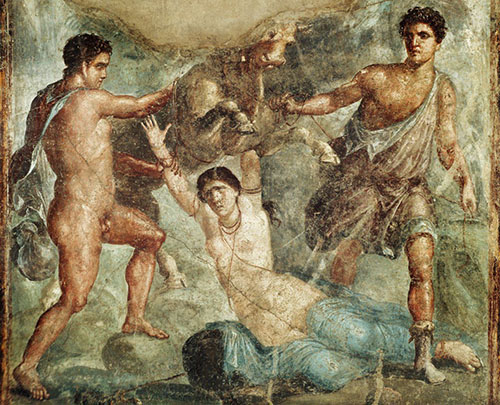
Amphion and Zethus subject Dirce to the bull, from the House of the Vettii, Pompeii, 1st century CE
In the reconstruction of the play, Antiope is the daughter of Nycteus. She becomes pregnant by Zeus and flees to Epopeus, king of Sicyon. Nycteus kills himself in shame and charges his brother Lycus with revenge. Lycus destroys Sicyon, brings Antiope back, and she gives birth to the twins on Mount Cithaeron. Exposed and raised by a herdsman, the brothers do not know their own origin. Antiope, enslaved under Dirce (Lycus's wife), eventually escapes and encounters her sons on the mountain.
The surviving fragments show that the agon between the two brothers stood at the play's heart: Zethus argues that Amphion's musical life is impractical and unmanning, that the herdsman's outdoor work has produced a capable man while song has produced a dreamer unfit for the world. Amphion defends contemplation and intelligence as superior to brute effort. Plato in the Gorgias has Callicles explicitly adopt Zethus's argument against Socrates which is suggestive of a strong link to the play.13
Aeschylus and Sophocles
Euripides was not the only tragedian to handle the Theban myth. Aeschylus composed a Niobe, the fragments of which are collected as frr. 154–162 in Stefan Radt's Tragicorum Graecorum Fragmenta volume three; Sophocles wrote both an Amphion and a Niobe, their fragments assembled in Radt's volume fourf, frr. 225–230 and frr. 441–449 respectively but all are lost in bulk. The survival of Euripides' Antiope is unfortunately an anomaly.14, 15
Later Accounts
Apollodorus provides the fullest surviving prose summary of the myth. The twins are born on Mount Cithaeron, exposed, and raised by a herdsman. Dirce maltreats Antiope; Antiope escapes and finds her sons; they tie Dirce to a bull. Hermes gives Amphion a lyre, and at the sound of his playing the stones of Thebes's future wall fall into place; Zethus carries stones by his own strength. Zethus marries Thebe, after whom the city is named. The children of Amphion and Niobe are then slain by Apollo and Artemis. Hyginus in Fabulae 7 and 8 gives a parallel summary with minor divergences, including a version in which Zeus approaches Antiope while she sleeps rather than in an open seduction.16,17
In his Argonautica, Apollonius of Rhodes, describing Orpheus singing of past wonders, gives the earliest surviving explicit account of Amphion charming the stones with his lyre. The retelling of Apollonius is the lyre and wall story in its clearest early form. Palaephatus again rationalizes the same tradition: Amphion was a musician who hired stonemasons by paying them with the proceeds of his art, and the saying that stones moved at his music was a figure of speech derived from this practice. Diodorus Siculus at 4.9.3–6 treats the slaughter of Niobe's children in the context of Apollo's punishments but adds nothing new to the twins' own history.18,19,20
III. The Epithets of Amphion and Zethus
Formal cult epithets do not exist. In Homer's Iliad, Amphion receives no characterizing tag beyond the generic ἀντίθεον applied to heroes of rank. In the Odyssey 19 passage, Zethus is βασιλῆος, "the king," nothing further. Neither twin accumulated the appellative tradition that attaches to major Olympians or to widely diffused heroes such as Heracles. Pausanias attributes to Amphion two distinctions that are achievements rather than cult titles: he is said to have been the first Greek to sacrifice to the Muses and the first to practice the Lydian mode on the lyre.1,4,21
IV. Sacred Sites at Thebes
The Tomb of the Twins
Pausanias records seeing the tomb of Amphion and Zethus in his Boeotian account and adds a detail that distinguishes it from ordinary heroic graves: it was accessible to visitors on one day of the year only, and on that single day the people of Tithorea in Phocis would attempt to steal earth from the tomb for use on their own fields. The Thebans guarded against this accordingly. Historians treat what he says as an evidence for an active hero cult at the site rather than merely some notice.21,22
Near the tomb, a small stone was shown to visitors as the very stone that had moved at Amphion's lyre. Pausanias describes it as undistinguished in appearance. The practice of preserving the relic of a mythological act and assigning to a particular stone or spring some immense antiquity was common in Boeotia on account of the antiquity of Thebes.
The Spring of Dirce
The spring called the Dirce at Thebes took its name from the woman whose body was thrown into it after the twins' punishment, so the spring was a recognized landmark in the ancient center of the city. Propertius described the punishment in its Theban setting, treating the spring as the memorial to the myth, while Strabo's account of Boeotia notes the spring among the Theban geographical features without further comment.23,24
V. The Walls of Thebes
The founding and walling of seven-gated Thebes is the action that all surviving sources assign to the twins. But the accounts are most consistently in agreement and most interestingly divergent on the question of method of how they built it. Homer credits both twins jointly and specifies no mechanism. They walled the city, and without their wall the city could not be inhabited.
Apollodorus collections of myth divides the labor into two. Amphion's lyre moves the stones into place while Zethus carries them by hand. The division maps onto the brothers' contrasting identities, and the juxtaposition may have been established by Euripides, though the Antiope fragments do not preserve this moment directly.1,16
Apollonius of Rhodes gives the earliest surviving explicit description of the lyre-walls story, placing it in Orpheus's song of past marvels in the Argonautica.18 Pausanias provides the richest ancient discussion of the ancient musician's work. He records that Amphion used a seven-stringed lyre, the seven strings corresponding to the seven gates of Thebes, and that he had added three strings to the four strings of Hermes' original instrument.
A variant associated with by Pausanias attributed the extra strings to musical innovation in Lydian rather than to divine gift. The seven-to-seven correspondence between strings and gates appears in Pausanias alone among the preserved sources and may be a Hellenistic elaboration of the myth's arithmetic.
Palaephatus preserves a tradition that dispenses with the miraculous. Amphion, a highly skilled lyre-player, was well rewarded for his performances; with these earnings he hired stonemasons, and the saying that stones moved at his music was derived from this practice of payment.19,21
VI. Amphion
Amphion's defining attribute in all accounts is the lyre. Apollodorus gives it to him directly from Hermes who also teaches him to play out of fondness. The instrument is both the means by which the walls of Thebes are built and the center of the brothers' debate in Euripides. Zethus objects to its uselessness, while his brother defends it as the instrument of intelligence itself. In the Euripidean fragments, Amphion argues that a man who commands music commands more than a man who commands only muscle; the stones of Thebes are his evidence.8,9,16
His marriage to the vain Niobe, daughter of Tantalus, ended in catastrophe. The number of their children varies across sources. Homer in the Iliad gives twelve, six sons and six daughters; Apollodorus gives fourteen, seven of each; Hyginus's text varies across its recensions and offers different counts in different passages. Apollodorus says Amphion responded by attacking Apollo's temple and was killed by the god; other fragments imply death by grief rather than aggression.4,16,17
Pausanias attributes to Amphion the first sacrifice to the Muses and the introduction of the Lydian mode into Greek music, both claims belonging to Theban local tradition rather than to pan-Hellenic mythology.21 These distinctions situate him as the founding figure of a particular musical and religious practice. In the Roman tradition from Horace onward, Amphion becomes the paradigm of the musician-builder, the proof that vibration can accomplish much by itself.
VII. Zethus
Zethus in every account was the practical and hard-laboring twin. He tends the cattle on Mount Cithaeron in both Euripides and Apollodorus. From his upbringing he knows a hard graft. Euripides draws the terms of his argument against his brother in that sense because the outdoor life has produced a capable man, while the indoor life of music has produced someone who cannot function when action is required. His argument in the Antiope is the play's central agon, the formal debate through which the audience is made to weigh two ways of living against each other.8,9,16
His wife is Thebe in Apollodorus so from her the eponymous city takes its name. This genealogical tradition, in which the city of Thebes derives its name from Zethus' wife, is the dominant one in the prose sources and it provides a simple account of the city-name. The nightingale passage in the Odyssey complicates this picture. It places a woman named Aedon in connection with Zethus, as the mother of his son Itylos, killed in error. The two traditions, Thebe and Aedon, are not reconciled in any ancient source and seem to represent independent regional variants.1,16
Antoninus Liberalis in the Metamorphoses preserves a version of the Aedon story with fuller detail, including the motivation for the killing. Aedon, jealous of her sister-in-law Niobe's many children while she had only one son, planned in the dark to kill the eldest of Niobe's boys, but killed Itylos by mistake. The gods transform her into a nightingale. Zethus's fate after this event is not given in the sources; the tradition's interest in him ends with the punishment of Dirce and the building of the walls.25
VIII. Antiope and Dirce
The parentage of Antiope is the point at which the sources diverge. Homer gives her father as Asopus, the Boeotian river god. The Euripidean and prose tradition, as represented by Apollodorus and Hyginus, gives Nycteus, a Theban nobleman who kills himself in shame at her flight and charges his brother Lycus with punishing her. A third genealogy is preserved by Pausanias at 9.5.8, drawn from the epic poet Asius of Samos, who made Antiope the daughter of Phocus son of Ornytion; this variant attracted no other ancient adherents and is recorded by Pausanias without endorsement. The standard edition of Asius's fragments places this citation in its Samian epic context, collected by Martin West.1,8,16,17,21,26
Robert Fowler, in his commentary on the early Greek mythographic tradition, discusses the Antiope genealogical variants as evidence for competing local traditions about the prehistory of Thebes: the Asopus tradition tying her to the river valley, the Nycteus tradition rooting her in Theban noble lineage.27 Neither tradition is earlier than the other by any secure chronological argument; Homer's text is earlier, but that does not make the Asopus parentage the older local belief.
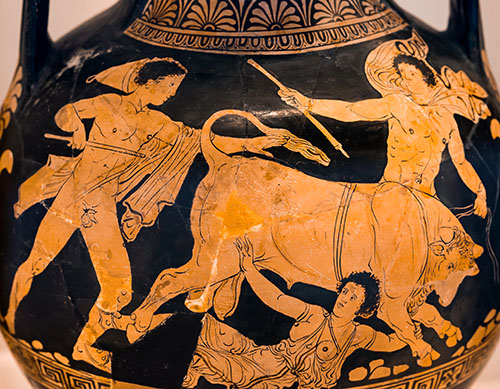
The punishment of Dirce, a common convention of Greek vases
The identity of the twins' father also carries a minor variant. Zeus is given in Homer, Apollodorus, and Hyginus as the standard, the divine inheritance of the Theban duo. Hyginus in one version attributes the seduction to Epopeus of Sicyon rather than to Zeus, removing the divine paternity. The mainstream tradition insisted on Zeus being the father, and the Epopeus variant leaves no trace, unless Epopeus is an epithet. The punishment of Dirce, tied to a bull that drags her until she dies and her body thrown into the spring that bears her name, is consistent across Euripides, Apollodorus, Hyginus, and Propertius.1,16,17
IX. The Agon and Its Afterlife
The agon between the brothers in Euripides' Antiope achieved a philosophical reach well beyond its dramatic context. The surviving fragments show Zethus pressing the case that music is impractical: a man who devotes himself to the lyre neglects his household, his city, and his capacity to act when action is required. Amphion counters that intelligence governs force, and that the arts are the means by which civilization is built, not merely ornamented. Neither position is given an unambiguous dramatic victory; the play ends with both brothers having demonstrated their claims: Amphion that music built the walls, Zethus that the practical man survived Cithaeron.8, 9, 10
Horace in his Ars Poetica 394–396 deploys Amphion as the paradigm of the practical power of art: the builder of Thebes moved stones by song, and this is proof that poetry has always done real work in the world. Propertius renders the Antiope myth its fullest surviving Latin treatment, dwelling on the contrast between the enslaved Antiope and the brutal Dirce. Ovid in Metamorphoses 6 covers the Niobe episode at Thebes with Amphion as its ruling king; the musician becomes a grieving father, and the walls he built stand as the frame for his family's destruction. William Smith's survey of the ancient accounts of Amphion and Zethus, old but compact, lists the variant forms of the myth.23,28,30
X. Sound versus Stone
The argument entered philosophy through Plato. Callicles in the Gorgias (484e–486d) adopts Zethus's position by way of the lost play of Euripides, telling Socrates that philosophy leaves a man helpless in any real contest of power, that he should grow up and learn the ways of the world instead of sitting with boys arguing abstractions. Socrates does not endorse Callicles' opinion.13
Olympiodorus, the Neoplatonist philosopher, took interest in this passage through his own analysis of the Gorgias. He stated what Amphion does is a world away from weakness: the point of sound, order, harmony is emblematic of a soul brought into proper proportion. The ideal political order can only come from the right frequency of soul, the right taxis and kosmos. Olympidorus goes one step further, likening the opinions of Callicles to that of the appetitive part of the soul always longing for physical
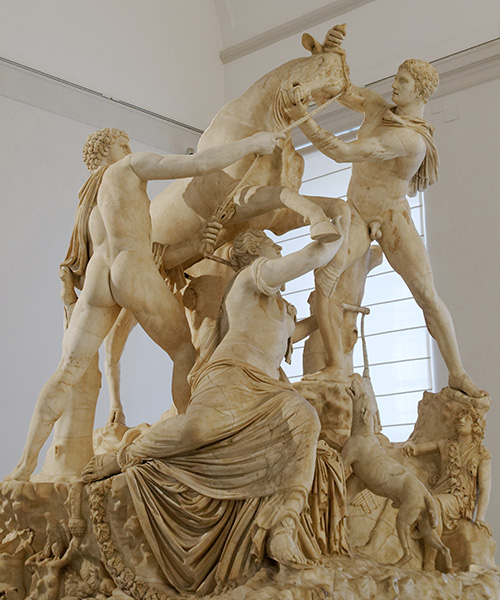
The Farnese Bull, copy of Roman original, Naples Museum
It is also made clear in the argument of Socrates and in Olympidorus' analysis of it that what Zethus does is important. Sound must be backed up with hard labor, initiative, physical movement and force. This is shown when Socrates says "by Zethus", indicating his belief that Callicles has drawn the wrong conclusion from the mythology.
In the life of Isidore, the next major Platonic philosopher, Damascius, indirectly compares his predecessor to Zethus. Isidore was a capable man in all practical manners while being a philosopher. The point is that the notion of philosophy cannot be understood as being incompatible with living a full life, a notion inviting true disaster.
For the context of the initiate of the Temple of Zeus, the myth of the Theban twins contains an important message about the properties of using magic. Invocation, mantra and affirmation (sound, light and frequency) manifest a result in higher levels, while the need to do practical work is still needed to bring that down to the earth among the stones. The twins also represent something of Apollo and Aphrodite in that respect.31,32
Sources and Bibliography
- Homer. The Odyssey. Edited and translated by A. T. Murray. Revised by George E. Dimock. 2 vols. Loeb Classical Library 104 and 105. Cambridge, MA: Harvard University Press, 1995. See 11.235–265 for the shade of Antiope in the underworld and the first mention of the twins; 19.518–523 for the nightingale simile and Aedon.
- Beekes, Robert S. P., with Lucien van Beek. Etymological Dictionary of Greek. 2 vols. Leiden Indo-European Etymological Dictionary Series 10. Leiden: Brill, 2010. See s.v. Ἀμφίων and Ζῆθος for the pre-Greek classification of both names.
- Chantraine, Pierre. Dictionnaire étymologique de la langue grecque: Histoire des mots. Paris: Klincksieck, 1968–1980. See s.v. ἀμφί for the prefix discussion and the note on Ἀμφίων; s.v. Ζῆθος for the unresolved derivation.
- Homer. The Iliad. Edited and translated by A. T. Murray. Revised by William F. Wyatt. 2 vols. Loeb Classical Library 170 and 171. Cambridge, MA: Harvard University Press, 1999. See 24.601–617 for Achilles' account of Niobe and the mention of Amphion as her husband and king of Thebes.
- Merkelbach, Reinhold, and Martin L. West, eds. Fragmenta Hesiodea. Oxford: Clarendon Press, 1967. Fragment 181, the Antiope section of the Catalogue of Women, in fragmentary papyrus form.
- West, Martin L. The Hesiodic Catalogue of Women: Its Nature, Structure, and Origins. Oxford: Clarendon Press, 1985. On the Nycteus tradition in the Catalogue and the reconstruction of the Antiope section.
- Gantz, Timothy. Early Greek Myth: A Guide to Literary and Artistic Sources. 2 vols. Baltimore: Johns Hopkins University Press, 1993. See vol. 1, 179–182, for the variant genealogies of Antiope and the analysis of divergent traditions on the twins' parentage and the building of the walls.
- Kannicht, Richard, ed. Tragicorum Graecorum Fragmenta. Vol. 5: Euripides. 2 parts. Göttingen: Vandenhoeck and Ruprecht, 2004. Euripides' Antiope is frr. 179–227 in part 1. The collection assembles all attested fragments including the Berlin papyrus P.Berol. 9908 containing the agon.
- Kambitsis, Jean. L'Antiope d'Euripide. Athens: Hellenic Society for Humanistic Studies, 1972. The standard edition of the play's fragments, with Greek text, French translation, and commentary.
- Collard, Christopher, and Martin Cropp, eds. Euripides: Fragments. 2 vols. Loeb Classical Library 504 and 506. Cambridge, MA: Harvard University Press, 2008. See vol. 1 for the Antiope, with Greek text and English translation.
- Collard, C., M. J. Cropp, and K. H. Lee, eds. Euripides: Selected Fragmentary Plays. Vol. 1. Warminster: Aris and Phillips, 1995. Contains the Antiope with introduction, text, translation, and commentary on the agon fragments and the reconstruction of the plot from Hyginus.
- Jouan, François, and Herman Van Looy. Euripide: Fragments. 4 vols. Collection des universités de France. Paris: Les Belles Lettres, 1998–2003. See vol. 1 for the Antiope, with French translation and commentary.
- Plato. Gorgias. Translated by Walter Hamilton and Chris Emlyn-Jones. Penguin Classics. London: Penguin, 2004. See 484e–486d for Callicles' adoption of Zethus's argument from the Antiope against Socrates and philosophy.
- Radt, Stefan, ed. Tragicorum Graecorum Fragmenta. Vol. 3: Aeschylus. Göttingen: Vandenhoeck and Ruprecht, 1985. For the fragments of Aeschylus's lost Niobe, frr. 154–162, which treated the Amphion myth from the angle of the Niobe catastrophe.
- Radt, Stefan, ed. Tragicorum Graecorum Fragmenta. Vol. 4: Sophocles. Göttingen: Vandenhoeck and Ruprecht, 1977. Revised edition 1999. For Sophocles' lost Amphion (frr. 225–230) and Niobe (frr. 441–449).
- Apollodorus. The Library. Translated by James G. Frazer. 2 vols. Loeb Classical Library 121 and 122. Cambridge, MA: Harvard University Press, 1921. See 3.5.5–6 for the fullest prose account of the myth, including the birth on Cithaeron, the Dirce punishment, the lyre-walls, and the children of Niobe.
- Hyginus. Fabulae. Edited by Peter K. Marshall. Stuttgart: Teubner, 1993. See Fabulae 7 (Antiopa) and 8 for the plot summary of the myth, including the variant on Zeus's approach during Antiope's sleep and the Dirce punishment.
- Apollonius of Rhodes. Argonautica. Translated by R. C. Seaton. Loeb Classical Library 1. Cambridge, MA: Harvard University Press, 1912. See 1.735–741 for the song of Orpheus, in which Amphion's charming of the stones with his lyre is named among past marvels. This is the earliest surviving explicit description of the lyre-walls story.
- Palaephatus. On Unbelievable Tales. Translated with introduction and commentary by Jacob Stern. Wauconda, IL: Bolchazy-Carducci, 1996. See chapter 41 for the rationalization of the lyre-walls tradition: Amphion hired stonemasons with earnings from his musical performances.
- Diodorus Siculus. Library of History. Translated by C. H. Oldfather et al. 12 vols. Loeb Classical Library. Cambridge, MA: Harvard University Press, 1933–1967. See 4.9.3–6 for the Niobe episode in the context of Apollo's punishments, treated independently of the twins' founding myth.
- Pausanias. Description of Greece. Translated by W. H. S. Jones and H. A. Ormerod. 4 vols. Loeb Classical Library. Cambridge, MA: Harvard University Press, 1918–1935. See 9.5.1–9 for the walls and the lyre, the addition of three strings, the Lydian variant, and the stone preserved as a relic; 9.17.4 for the tomb of the twins and the Tithorea earth-theft; 9.5.8 for the Asius variant on Antiope's parentage.
- Schachter, Albert. Cults of Boeotia. Vol. 1. Bulletin of the Institute of Classical Studies Supplement 38. London: University of London, 1981. On the hero cult of Amphion and Zethus at Thebes, with discussion of the annual tomb ritual and the earth-theft episode in Pausanias.
- Propertius. Elegies. Edited and translated by G. P. Goold. Loeb Classical Library 18. Cambridge, MA: Harvard University Press, 1990. See 3.15 for the Antiope narrative in Latin elegy, treating the contrast between the enslaved Antiope and the brutal Dirce in a Theban setting including the spring that bears Dirce's name.
- Strabo. Geography. Translated by Horace Leonard Jones. 8 vols. Loeb Classical Library. Cambridge, MA: Harvard University Press, 1917–1932. See 9.2 for the geographical account of Boeotia and the landmark features of Thebes, including the spring Dirce.
- Antoninus Liberalis. The Metamorphoses of Antoninus Liberalis: A Translation with Commentary. Translated by Francis Celoria. London: Routledge, 1992. See Metamorphosis 11 for the fuller version of the Aedon myth, including the jealousy of Niobe's fertility as the motive for the killing of Itylos and the transformation into a nightingale.
- West, Martin L., ed. and trans. Greek Epic Fragments from the Seventh to the Fifth Centuries BC. Loeb Classical Library 497. Cambridge, MA: Harvard University Press, 2003. For Asius of Samos fr. 1, the genealogy of Antiope as daughter of Phocus son of Ornytion, cited in context from Pausanias 9.5.8.
- Fowler, Robert L. Early Greek Mythography. Vol. 2: Commentary. Oxford: Oxford University Press, 2013. On the Antiope genealogical variants in the early mythographic tradition, treating the Asopus and Nycteus branches as regional competing traditions about the prehistory of Thebes rather than as corrections of Homer.
- Horace. Satires, Epistles and Ars Poetica. Translated by H. Rushton Fairclough. Revised by G. P. Goold. Loeb Classical Library 194. Cambridge, MA: Harvard University Press, 1926. See Ars Poetica 394–396 for Amphion as the builder of Thebes through the power of his lyre, cited as proof of the practical utility of poetry.
- Ovid. Metamorphoses. Translated by Frank Justus Miller. Revised by G. P. Goold. 2 vols. Loeb Classical Library 42 and 43. Cambridge, MA: Harvard University Press, 1977–1984. See 6.146–312 for the Niobe episode at Thebes, in which Amphion appears as the musician-king whose walls and family are destroyed together by the punishment of Apollo and Artemis.
- Smith, William, ed. A Dictionary of Greek and Roman Biography and Mythology. 3 vols. London: John Murray, 1849. See s.v. "Amphion" and "Zethus" for a compact survey of variant forms of the myth across classical and Hellenistic sources, useful for comparative reference.
- Olympiodorus. Commentary on Plato’s Gorgias. Translated with full notes by Robin Jackson, Kimon Lycos, and Harold Tarrant. Introduction by Harold Tarrant. Philosophia Antiqua 78. Leiden: Brill, 1998.
- Demulder, Bram. “Met Callicles tegen Callicles: Filosofie, gemeenschapsleven en Plato’s Gorgias in Damascius’ Leven van Isidorus.” Handelingen van de Koninklijke Zuid-Nederlandse Maatschappij voor Taal- en Letterkunde en Geschiedenis 67 (2013; published 2014): 5–27.