




| Language | Name of Valefor | Attestation |
|---|---|---|
| Classical Greek | Βελλεροφόντης (Bellerophontes) | Homer (8th century BCE onward) |
18 min read
Bellerophon
author: High Priest Zevios Metathronos
co-author: Novice Priest Karnonnos
I. Names
The Greek name of Valefor is normally written Βελλεροφόντης (Bellerophontes), with the shorter English form “Bellerophon” coming from the same heroic name rather than from a separate figure. The ending -φόντης was naturally understood by ancient and modern interpreters as “slayer” or “killer,” but the first half of the name is more difficult. One ancient-style explanation makes him “the slayer of Belleros,” treating Belleros as a person or local being killed by the hero; modern etymological discussion by Robert Beekes, an expert in Greek philology, also notes that the name has invited uncertainty rather than one universally secure derivation. A possibility is to the title of Zeus, Bel.1,2
The name also belongs to a broader pattern of renaming. Some ancient mythographers and scholia say that Valefor had first been called Hipponous, a name meaning something like “horse-minded” or “horse-knower,” before he received the Bellerophon name after he kills Belleros. The latter myth makes horse-mastery, especially the taming of Pegasus, one of his defining symbols, but also serves as a darker foreshadowing of the Pegasus myth.3
The earliest more literary attestation of Bellerophon is in the archaic Greek epics. The most important surviving early account is the embedded genealogy and myth in Iliad 6, where Glaucus tells Diomedes the story of his ancestor as part of his heroic lineage. The Iliad passage is therefore the first major extant Greek literary witness to the hero’s name. The name Valefor is Latin, but essentially a representation of real sound values beyond its Goetic designation, since it aligns with Velefor (Βελλεροφ).4
Sources: Kirk, The Iliad: A Commentary (1990); Beekes, Etymological Dictionary of Greek (2010); Fowler, Early Greek Mythography (2013); Gantz, Early Greek Myth (1993).1,2,3,4
II. Bellerophon Myth
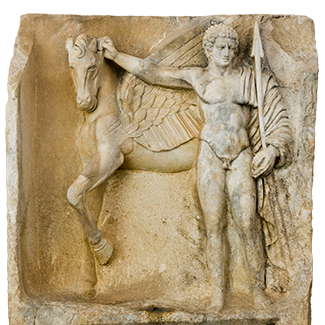
Valefor was said to be of the lineage of the great Kings of Corinth, one of the great ancient Greek city states possessing a powerful monarchy. Presented as the grandson of Sisyphus of Corinth, a particular amount of his story is relayed in an ancient format by his great-grandson, Glaucus, in the Iliad of Homer, meaning that it has a truly venerable antiquity to it indeed. The father of Valefor is named Glaucus. Glaucus tells Diomedes the story of his ancestor Bellerophon to explain his own lineage. His great-grandfather was a noble and exceptionally handsome man from Corinth, but he was falsely accused after the wife of king Proetus, Anteia, desired him and, when rejected, she claimed that he had wronged her.5, 6
Proetus did not kill him directly, because he feared the moral and religious consequences, so instead he sent Bellerophon to Lycia carrying a sealed message to the Lycian king, asking that Valefor be put to death. When Valefor arrived in Lycia, however, the Lycian king first welcomed him generously. Only after several days did he read the message, and then he tried to destroy Valefor by assigning him impossible tasks. First he ordered him to kill the Chimera, a monstrous creature that was part lion, goat, and serpent, breathing fire. The man succeeded and became a hero, because the Gods were with him. He then defeated the Solymi, a fierce people, and next fought the Amazons. Even after this, the king set an ambush of Lycia’s strongest men against him, but the immensely powerful Valefor killed them all. Realising that he was favored by the Gods, the king abandoned his hostility, gave him his daughter in marriage, and granted him honour, land, and high status in Lycia.
Although Bellerophon had risen to great glory, he later became disdained for reasons unelaborated and wandered alone over the Aleian plain, consumed by grief and cut off from other people. His children also suffered: one son was killed in battle by Ares, and a daughter was killed by Artemis. Glaucus’ retelling therefore presents his ancestor as a tragic hero whose life moves from innocence, to divine favour and triumph, and finally to isolation and ruin, which sets the later tone for other mythologies involving him and explains Glaucus' own desire for glory. Like with Ares and Set, i.e. divine figures disdained in mythology, the reader must bear in mind all of this is allegorical to instruct humans of an archetype of how the Magnum Opus can be pursued correctly and wrongly, not as a condemnation of Valefor, the deity, himself.
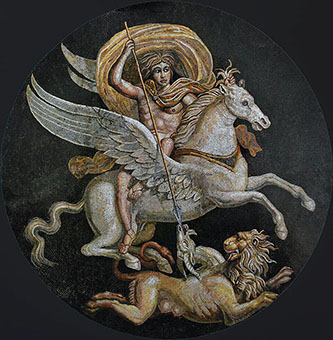
The later myths of this story diverge significantly from the Homeric context. The Theogony of Hesiod and a particular scholia on the Iliad mentions he is the son of Poseidon, and only brought up by Glaucus. The latter source also says he was named Hipponous, but became Valefor after killing Valeros, a Corinthian king. Pegasus is said to have been given to him by his true divine father, the god of the seas. Hesiod further mentions Pegasus by showing him and secondarily Valefor slaying the fire-breathing Echidna monster. Hesiod claims the Lycian king is called Iobates. Pindar in the Olympian Ode gives few details of his family origins and instead fixates on the locale of Corinth, elaborating that he was given a divine bridle by Athena and instructed on how to capture Pegasus at the Peirene spring; he also mentions him fighting the three armies with Pegasus while becoming a hero. The divine horse, however, does mysteriously end up in the Olympian stables.7,8,9,10
Other myths like the account of Pausanias, elaborated in a fragment of John of Antioch, claimed that Protaeus usurped the kingdom of Corinth, that Valefor was really a king, and the trials were all designed to kill off the rightful holder of the throne. In the account of Apollodorus, the Chimera is killed with arrows, rather than a spear. Many of these accounts treat Valefor as local to Corinth but not necessarily from it.11,12
III. The Epithets of Bellerophon
Bellerophon does not appear to have a stable list of cult epithets comparable to the divine cult titles of Olympian gods. He was honoured in heroic local topography, especially in Corinthian, Argive, Sicyonian, Lycian, and Carian contexts, but the surviving evidence does not preserve a formal sequence of temple titles like “Bellerophon X” or “Bellerophon Y.” The secure material is mainly literary: epic and archaic formulae describe him as blameless, noble, divinely favoured, war-minded, and exceptional among men.13,14
| Epithet | Meaning | Domain |
|---|---|---|
| ἀμύμων Βελλεροφόντης | Blameless Bellerophon | Excellence, aristocratic title |
| ἐσθλὸς Βελλεροφόντης | Noble Bellerophon | Confrontation of Chimera |
| δαΐφρων Βελλεροφόντης | Battle-minded Bellerophon | Heroic title |
Sources: Cunliffe, A Lexicon of the Homeric Dialect (1963); Farnell, Greek Hero Cults and Ideas of Immortality (1921).13, 14
IV. Temples
Valefor was worshiped in a temenos most notably near the cypress woods of Kraienos, near the temple of Aphrodite Melanis, as Pausanias attests to when he calls it a precinct. Pausanias also records several associated sacred sites that link Bellerophon to local cult topography, even if they are not his own shrine. At the spring Peirene near Corinth, he notes a Bellerophon image above the water, with the water flowing through Pegasus’ hoof; and nearby stood the temple of Athena Chalinitis (“Bridler”), because, as the Corinthians said, Athena helped Bellerophon most by taming and bridling Pegasus for him.11
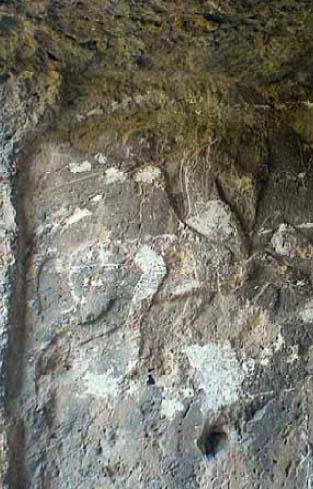
Sanctuaries to him existed in Argos and Sicyon. The inhabitants of the Carian cities of Aphrodisias and Halicarnassus rendered him the founder of their cities. Modern classical scholars see this as the basis for the territorial claims of the city-states to the lands of their neighbors, which were supposed to be ruled by their mythical founder, who, due to circumstances, did not occupy the throne. He also is said to have had a tomb at Tlos in Lycia, which has been identified and is shown to the right.15,16
V. Pegasus Myth
Seventh Isthmian Ode, Pindar17
The winged Pegasus overthrew
Bellerophon his lord, who flew
In thought the heavenly seats above
To the bright council hall of Jove;
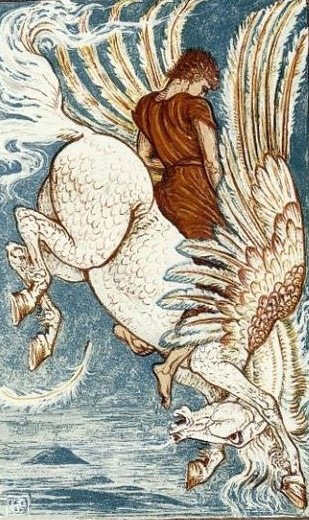
Pegasus was caught by Valefor at the Peirene spring, as Hesiod attests. Later mythological stories tie Valefor with riding the divine horse in giving particular reasons for the hero's later lack of divine favor and fatal fall from the flying horse onto the Aleian plain. While opting to remain explicitly silent on this in the Olympian Ode, the Isthmian Ode above gives an explicit reason: attempting to reach the abode of the gods, Olympus, before he was ready. The scholia on the Iliad also mentions the misuse of Pegasus being a divine punishment.7, 8
Euripides names the lustful wife as Stheneboea, making her the subject of a fragment-play where she schemes against him, leading to his exile until he returns from killing the evil Chimera, where she decides to tell him about King Proteus plot against his life. Her lust leads her to accept his scheme to ride on the Pegasus with her, where she is thrown off near the Island of Melos, her body being recovered by the fishermen of Tiryns. Another play by Euripides, known as Bellerophon, does not survive. A particularly distinct form occurs in the Fabulae of Hyginus; here, after the fall, Valefor simply dislocates his hip. This story adjusts the details more; again instead of being called Antaia, Stheneboea kills herself when hearing of his successes. Another tale of Hyginus, the Astronomica, claims he falls and dies out of fear of the height he sees and Pegasus becomes the eponymous constellation. Apollodorus fails to mention the ascent whatsoever, simply ending his story with Valefor being given the daughter of the king of Lycia, Philonoe.18,19,20,21,22
Beginning with Sophocles, the Lycian king is given his own drama involving Valefor that is now lost and was said to be tragic with Proteus and Antaia's son Megapenthes avenging them after he is thrown from the horse, a convention that Diodorus Siculus supports. Plutarch's rendition of the story, citing Nymphis in his catalogue of brave women throughout history, is drastically different. He claims Antaia approaches Valefor amorously, but she does not necessarily accuse him of anything. The Chimera is claimed by some other sources to be a mountain that was depeaked by the hero, or in Nymphis' account, a rampaging boar ruining the crops of the Lycian people that he took great pains to slay. The enemies are all pursued with Pegasus, whose association with the divine hero is not explained.23,24
No mention of his fall from Pegasus occurs anywhere. An enraged grievance against the people for not rewarding him properly is core to the narrative in this case; Valefor either tries to attack the Lycians, being driven back by the women among them, or demands and successfully prays to Poseidon to flood the Xanthians of Lycia with the cascading waves of the sea because he is given little recognition. In this version the landscape is also brutally transformed into a salt deposit, altering the story considerably. However, he relents when thinking of the women.25
Still others assert that the Chimaera, as it was called, was nothing but a mountain facing the sun, and that it caused reflexions of sunlight, fierce and fiery in the summer time, and by these, striking all over the plain, the crops were dried up, and that Bellerophon, sensing this, cut away the smoothest part of the precipice which mostly sent back the reflexions. When, however, he met with no gratitude, in anger he turned to avenge himself upon the Lycians, but was prevailed upon by the women. [...]
But the reason which Nymphis gives in the fourth book of his treatise about Heracleia is least mythical of all; for he says that Bellerophon killed a wild boar which was making havoc of the stock and crops in the land of the Xanthians, but obtained no fitting reward; whereupon he addressed to Poseidon imprecations against the Xanthians, and the whole plain suddenly became glittering with a salt deposit and was completely ruined, since the soil had become saline. This lasted until Bellerophon, out of respect for the women who besought him, prayed to Poseidon to give up his anger. For this reason it was the custom for the Xanthians to bear names derived not from their fathers but from their mothers. Bravery of Women, Plutarch25
Some renditions of the story show Zeus using a gadfly to attack Valefor on his steed, mirroring Hera's torment of Io. Later sources like John Tzetzes' late 12th century Byzantine rendition in the Book of Thousands shows Zeus sending a gadfly to distract Valefor, who, puffed up from ambition, tries to access the house of the Gods, and falls off the horse mid-flight. Tzetze's other depiction of this myth in his commentary Ad Lycophronem also includes the unique element that Valefor rides Pegasus and kills the Chimera by fixing lead to his spear and thrusting it into the Chimera’s fire-breathing mouth; the fire melts the lead and kills it.26, 27
In a Christianized setting, but drawing on the example of Plutarch's realism and the ancient account of Palaephatus, he also tries to deconstruct the myth as a real story about a trireme and a naval commander. However, Palaephatus' account where he describes Valefor as a pirate is a strangely occult one beyond the spare surface; Pegasus is represented as a ship and the Chimera as a mountain spitting flames in front of the river Xanthus guarded by a lion at the front end and serpent at the rear that attacked lumberjacks and herders.28
VI. Horse Rider
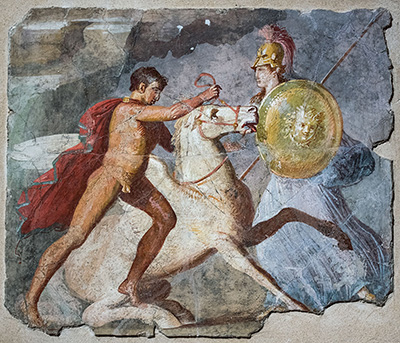
Valefor is often represented in Greek art as a knight wielding a great pike or lance on reliefs, pottery and friezes. Some of his iconography survives from Pompeii, but much of it is sourced from Asia Minor where it is said he confronted the evil Chimeric beast. On many Corinthian coins there are endless depictions associated with the myths of Bellerophon, in particular, the statue of Athena "the Bridler" with a bridle in her right hand. It is said the confrontation with the Chimera occurred because "she is a bane to many men". The Daemonic symbolism behind the stories above has been elaborated by High Priest Zevios Metathronos:6, 29
Valefor in Ancient Lore is Bellerephon, or Valerefontis in Ancient Greek. His Name in normal form is Velerefon or Valerefon, which has many mystical connotations. One of these is about the arrow, the arrow that one uses to strike evil. Valerefon, when he was a "human being", became one of the legendary Heroes of Greece, and he was a very powerful being that was called a Hero at first and later on a god. His journey in the metaphysical stories is kept alive by both the Homeric Epic and the writings of the legendary theatrical writer Euripides.
The most important story that he conveys is the one of where arrogance and lack of order leads, and where one is led by blasphemy to the gods but also when they disrespect the order the gods have established out of wrong feelings. As with other very important stories given by the Gods we are taught these to be instructed. These are NOT literal events between the Gods. These are metaphorical realities we have to learn from in order to avoid mistakes, but also very important Alchemical allegories. Alchemically, Valefor did the "mistake" of going to rise towards the Gods way earlier than his soul was "ready". This can have the devastating outcome that one "Falls from Heaven" if done improperly...
Valefor's story is a very important story. For one, it illustrates that a human being can really and fully achieve the Godhead, which in the mythology of Valefor is symbolized by Valefor taming the legendary Pegasus. Pegasus is a divine horse that represents the rising of the Serpent having done successfully. In the Myth [not literal events, but allegorical] Valefor after having achieved inconceivable deeds compared to all other human beings, starts considering himself a “God”. In symbolism, his story reflects except of strong alchemical knowledge, the knowledge of knowing one’s limits.
As Valefor in delusion started considering himself a God, he took Pegasus and tried to fly himself to mount Olympus to become “Equal to Zeus”. The Gods of course did not stop him from this path of ignorance and allowed his “protest”, but as he reached the mount in the form of forced invasion, Zeus decided to strike him down with thunder and throw him on earth to show him that his time is not yet. As one can understand, the position of the Gods is unalienable. We see numerous points that we must incorporate in our souls in this story.
In a world where arrogance and delusion are really popular mental illnesses, we must contemplate this myth. Behind this myth, we also have an important lesson: the health of the soul. When the soul is not healthy and is tormented by misplaced arrogance, delusion and other things, we will pay for this no matter who we are. Valefor in the Goetic lore that has very little Truth in it, has a connection with healing. Valefor is indeed a master healing God that can heal from all diseases of the mind, the body, the spirit and the soul. It’s very important for all Zevists to do this Ritual for the future of our glorious path. Valefor also is a Daemon that finished the Magnum Opus “recently” compared to many other Daemons, and is very sympathetic and kind towards humanity when he is approached respectfully and through the eternal path of Zeus. Among the hidden powers of Valefor, I will mention a few of the many that are nowhere and in any “Book”. These come from knowing Him personally. Valefor can protect from financial ruin that comes from theft, and can also help in legal matters. Another very important information on Valefor is that he works with Beelzebub. Under Beelzebub there are many healing Gods, including the legendary Asclepius and other healing deities.
Years ago, to relate a personal experience, I had an urgency for a loved person and decided to summon Valefor. As I was swimming on endless responsibilities and literally had no space further to work on anything more due to risk of exhaustion, Valefor said they would “Handle it”. The ailment was healed within a few weeks permanently, never to return again. I have heard similar stories of slower or even miraculous healing from other Zevists who approached him in the proper manner. On Valefor, High Priest Zevios Metathronos25
VII. Moralism
Some very late classical texts treated the Valefor cycle as a kind of moral fable. In Mythologies of Fulgentius, Valefor is not primarily a hero but “good counsel” or prudent intelligence. Anteia represents lust or corrupt desire, and Bellerophon’s refusal of her means that sound judgment resists sensual temptation. Proteus is interpreted as “heaviness,” and Anteia as the sordid lust attached to that heavy, bodily state where one is in the world. Pegasus becomes the intellectual vehicle of wisdom: Fulgentius says Pegasus is like an “everlasting fountain,” meaning that the wisdom of good counsel is a continually flowing source.31
Pegasus’ wings signify the mind’s swift ability to survey the nature of things, and Pegasus’ opening of the Muses’ spring means that wisdom nourishes culture and learning. Fulgentius also allegorizes the Chimera as the structure of desire itself. Its three heads represent the three phases of passion: the beginning, the continuation, and the end. The lion is the violent first assault of desire; the goat is the middle stage of lustful indulgence; the serpent is the final sting of remorse, sin, and moral poison after the act. In that scheme, Valefor’s slaying of the Chimera means that good counsel defeats destructive passions.
Sources and Bibliography
- Kirk, G. S. The Iliad: A Commentary. Volume II: Books 5–8. Cambridge: Cambridge University Press, 1990. See commentary on Iliad 6.152–211 and the name Βελλεροφόντης.
- Beekes, Robert S. P. Etymological Dictionary of Greek. 2 vols. Leiden: Brill, 2010. S.v. “Βελλεροφόντης.”
- Fowler, R. L. Early Greek Mythography. Volume 2: Commentary. Oxford: Oxford University Press, 2013. See discussion of Bellerophon, Hipponous, and Belleros traditions.
- Gantz, Timothy. Early Greek Myth: A Guide to Literary and Artistic Sources. Baltimore: Johns Hopkins University Press, 1993. See Bellerophon and the early epic evidence.
- EBSCO Information Services. “Bellerophon.” Research Starters: Religion and Philosophy. Ipswich, MA: EBSCO, n.d.
- Homer. Iliad, Volume I: Books 1–12. Translated by A. T. Murray. Revised by William F. Wyatt. Loeb Classical Library 170. Cambridge, MA: Harvard University Press, 1999. See 6.152–211, 6.216–221.
- Hesiod. Theogony. Works and Days. Testimonia. Edited and translated by Glenn W. Most. Loeb Classical Library 57. Cambridge, MA: Harvard University Press, 2018. See Theogony 319–325.
- Erbse, Hartmut, ed. Scholia Graeca in Homeri Iliadem (Scholia Vetera). Vol. 2. Berlin: Walter de Gruyter, 1971. See scholia on Iliad 6.155 and related Bellerophon traditions.
- Hesiod. The Shield. Catalogue of Women. Other Fragments. Edited and translated by Glenn W. Most. Loeb Classical Library 503. Cambridge, MA: Harvard University Press, 2018. See fragments on Bellerophon and Pegasus.
- Pindar. Olympian Odes. Pythian Odes. Edited and translated by William H. Race. Loeb Classical Library 56. Cambridge, MA: Harvard University Press, 1997. See Olympian 13.
- Pausanias. Description of Greece, Volume I: Books 1–2. Translated by W. H. S. Jones. Loeb Classical Library 93. Cambridge, MA: Harvard University Press, 1918. See 2.2.4, 2.4.1, 2.31.9.
- John of Antioch. Fragmenta Historicorum Graecorum. Vol. 4. Edited by Karl Müller. Paris: Ambroise Firmin-Didot, 1851. See fragment 9.
- Cunliffe, Richard John. A Lexicon of the Homeric Dialect. Norman: University of Oklahoma Press, 1963. S.vv. “ἀμύμων,” “ἐσθλός,” “δαΐφρων,” and related heroic vocabulary.
- Farnell, Lewis Richard. Greek Hero Cults and Ideas of Immortality. Oxford: Clarendon Press, 1921. See discussion of Greek hero cult and local heroic honours.
- Iozzo, Mario. “The Chimaera, Pegasus and Bellerophon in Greek Art and Literature.” In Pegasus and the Chimera: Greek Myth in Greek Art, edited by Mario Iozzo. Florence: Museo Archeologico Nazionale di Firenze, 2009.
- Linant de Bellefonds, Pascale. Pictorial Foundation Myths in Roman Asia Minor: Cultural Identity in the Ancient Mediterranean. Cambridge: Cambridge University Press, 2021. See discussion of Bellerophon as founder figure in Caria and Asia Minor.
- Pindar. Nemean Odes. Isthmian Odes. Fragments. Edited and translated by William H. Race. Loeb Classical Library 485. Cambridge, MA: Harvard University Press, 1997. See Isthmian 7.
- Euripides. Fragments: Aegeus–Meleager. Edited and translated by Christopher Collard and Martin Cropp. Loeb Classical Library 504. Cambridge, MA: Harvard University Press, 2008. See fragments and testimonia for Stheneboea.
- Euripides. Fragments: Oedipus–Chrysippus; Other Fragments. Edited and translated by Christopher Collard and Martin Cropp. Loeb Classical Library 506. Cambridge, MA: Harvard University Press, 2009. See fragments and testimonia for Bellerophon.
- Hyginus. The Myths of Hyginus. Translated and edited by Mary Grant. University of Kansas Publications in Humanistic Studies 34. Lawrence: University of Kansas Press, 1960. See Fabulae 57.
- Hyginus. Astronomica. Edited by Ghislaine Viré. Bibliotheca Teubneriana. Stuttgart: B. G. Teubner, 1992. See 2.18, “Pegasus.”
- Apollodorus. The Library, Volume I: Books 1–3.9. Translated by James G. Frazer. Loeb Classical Library 121. Cambridge, MA: Harvard University Press, 1921. See 2.3.1–2.
- Sophocles. Fragments. Edited and translated by Hugh Lloyd-Jones. Loeb Classical Library 483. Cambridge, MA: Harvard University Press, 1996. See fragments and testimonia for Iobates.
- Diodorus Siculus. Library of History, Volume III: Books 4.59–8. Translated by C. H. Oldfather. Loeb Classical Library 340. Cambridge, MA: Harvard University Press, 1939. See 6.9 and related mythographic material.
- Plutarch. “Bravery of Women.” In Moralia, Volume III: Sayings of Kings and Commanders; Sayings of Romans; Sayings of Spartans; Ancient Customs of the Spartans; Sayings of Spartan Women; Bravery of Women. Translated by Frank Cole Babbitt. Loeb Classical Library 245. Cambridge, MA: Harvard University Press, 1931. See 248A–B.
- Tzetzes, John. Histories: Chiliades. Edited by Pietro Luigi Maria Leone. Naples: Libreria Scientifica Editrice, 1968. See passages on Bellerophon and Pegasus.
- Tzetzes, John. Scholia in Lycophronem. Edited by Christian Gottfried Müller. Leipzig: F. C. G. Vogel, 1811. See scholia on Lycophron involving Bellerophon and the Chimera.
- Palaephatus. On Unbelievable Tales. Translated by Jacob Stern. Wauconda, IL: Bolchazy-Carducci, 1996. See the rationalized account of Bellerophon, Pegasus, and the Chimera.
- Stevenson, Seth William. A Dictionary of Roman Coins, Republican and Imperial. Edited by C. Roach Smith and F. W. Madden. London: George Bell and Sons, 1889. S.v. “Bellerophon.”
- Metathronos, Zevios. “On Valefor.” In private Zevist teaching text supplied in the source file.
- Fulgentius. Fulgentius the Mythographer. Translated by Leslie George Whitbread. Columbus: Ohio State University Press, 1971. See Mythologies 2.17.
- Thorburn, John E. The Facts on File Companion to Classical Drama. New York: Facts On File, 2005. S.vv. “Bellerophon,” “Stheneboea,” and related dramatic fragments.
- Aesop. Vita et Fabellae Aesopi cum Interpretatione Latina. Edited by Aldus Manutius. Venice: Aldus Manutius, 1505.