




| Form / Name | Attestation | Period |
|---|---|---|
| bnw (𓅣) | Giza Board CG 37734 | Fifth Dynasty (c. mid-25th century BCE) |
17 min read
BENNU
author: High Priest Zevios Metathronos
co-author: Novice Priest Karnonnos
Hieratic Information about Bennu
| Divine Names | |
|---|---|
| Bennu (bnw, 𓅣) | the self-created solar heron of Heliopolis |
| The name bnw is bound to the verb wbn, "to rise, to shine," and so to the daily emergence of the sun. The bird is written with the heron sign, and behind the heron stands the soul that renews itself: the Ba of Ra, the first thing to appear over the primeval waters. | |
| Divine Symbols | |
| |
| Divine Forces | |
| |
| Important Titles | |
| |
| Names Across Civilizations | |
| Egyptian | Bennu (bnw, 𓅣) |
| Greek | Phoinix (φοῖνιξ), the phoenix |
I. Names and Etymology
It is known that Bennu's name is connected to the Egyptian verb 'waben', which means alternatively 'to shine', 'to rise' or 'to multiply'. These verbs convey some of his faculties of major interest.1,2
The first secure attestation of the Egyptian phoenix is in a Fifth Dynasty Giza writing board CG 37734, mastaba G 1011, showing the divine bird sign written three times, maybe as far back as the early to mid-25th century BCE. A possible predecessor exists from the CG 1 statue in Cairo with a proposed reading involving (w)bn(.w) (m) bnbn from the Second Dynasty, but this is very ambiguous and not resolved. This instance involves a possible theophoric name. Whether Bennu appears in the Pyramid Texts is debated.1,3,4,5,6
mr bnw ꜥnḫ Ttj
approximately, "The bnw-birds desire that Teti live."
Pyramid Texts, Utterance 600 (§1652b)6,7
The strongest evidence is from the First Intermediate Period where Bennu's imagery becomes ubiquitous on artefacts from the Thinite region giving names like bnw-jw"The bnw has come". Schindler points out that this type of Egyptian personal-name formation normally expresses the name-bearer's relationship to a particular deity.1,3,8
The Coffin Texts ultimately establish Bennu as a full deity in his own right, such as Coffin Text 335:
jnk bnw (pw) ꜥꜣ ntj m Jwnw
"I am that great Bennu which is in Heliopolis"
Coffin Text 335 (de Buck IV 198a)9,1
Sources: Brovarski, "Two Old Kingdom Writing Boards from Giza," ASAE 71 (1987); Jacquet-Gordon, Les noms des domaines funéraires (1962); Schindler von Wallenstern, Die Reiher im Alten Ägypten (2002); Sethe, Die altägyptischen Pyramidentexte (1908–22); Allen, The Ancient Egyptian Pyramid Texts (2015); Fischer, "A Parental Link between Two Thinite Stelae" (1987–88); de Buck, The Egyptian Coffin Texts IV (1951); Colonna, Religious Practice and Cultural Construction (2021).1,3,4,5,6,7,8,9
II. History of Bennu
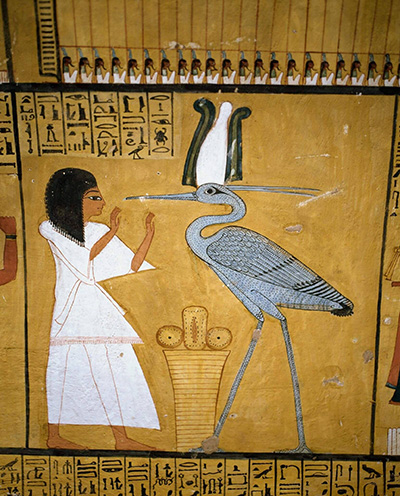
Bennu worshipped by Inherkhau. A wall relief piece from the Tomb of Inherkhau (TT359)
Bennu is a cryptic and enigmatic deity in Egyptian religion. He was represented in the form of a bird, and this deity was linked majorly into the worship and symbolism of Ra, Atum and Osiris. The Greeks cross-referenced him as being highly linked to the mythological phoenix of resurrection in their own culture.2,10,11
The Pyramid Texts refer to the ḥwt-bnw, an instance that is unclear in that it may refer to the Benben stone instead of the deity. In the simplest formulation stated plainly in the Coffin Texts, Bennu is stated to be the Ba of the solar god Ra. The Bennu was also associated with the potency of the Pharaoh and the rule of the aristocracy over Egypt. The heron symbol is often found in higher Egyptian contexts as a legitimizing symbol of everlasting and prudent rulership.10,11,12
The Ba is an important aspect of how Bennu was perceived because in this form was considered to represent the union of Ra and Osiris each daily cycle. Egyptian sources like the Coffin Texts explicitly tie the Bennu to concepts of eternity and the everlasting. The Heb-Sed processions were connected to this; symbolically the power projection of the Pharaoh was endowed over and over again onto new rulers by the God of the Sun.2,10,12
Ever-linked into the cycles of cultural feting among the Egyptians too, he was a mascot of the prestigious royal Heb-Sed festival that a Pharaoh hosted whenever he had reigned for thirty to thirty-three years. This festival was perhaps the most prestigious one that the monarch could hope to host; it signified the maturity and perfection of the monarch but also served as a symbolic reanimation of the realm.2,13
The bird was born from Osiris' heart, but he was also described as 'He Who Created Himself'. As a symbol of transformation, the Egyptians depicted the Bennu in numerous funerary contexts. In Tutankhamun's tomb (14th century BCE), for instance, a heart amulet was found decorated with a Bennu bird, underlining the point that Bennu's power ensured the resurrection of the deceased's personality.10,11
Other Egyptian sources like the Coffin Texts explicitly tie the Bennu to concepts of eternity and the everlasting. The Ba of the Sun God, Re, was said to be personified by the Bennu bird. The Heb-Sed processions were connected to this; symbolically the power projection of the Pharaoh was endowed over and over again onto new rulers by the God of the Sun.10,12
"I am the Bennu, the soul of Ra, and Osiris exceedingly glorious..."
Coffin Texts, Spell 61410,12
Bennu's association with the Ba was to such an extent that the hieroglyph for this concept became interchangeably used, and the Ba itself was portrayed as a bird, sometimes human headed.10,11
A close link was felt between the benu-heron and the ba-bird. In the Coffin Texts the benu secures unhindered passage through the underworld; in the Book of the Dead it is among the forms the deceased hopes to take; and by the Late Period the benu-sign could even stand for the word ba, so that the bird became an emblem of life renewing itself after death. This is a paraphrase of the account given in the Global Egyptian Museum's entry on the phoenix, which cannot be reproduced verbatim here.14
While perched atop the Benben Stone or holy persea tree of Heliopolis, the voice of Atum was relayed through an avian form: his call was the beginning of the world, and so in many other contexts, the heron deity represented the creative faculties of Atum.2,10,11
III. Epithets
Bennu's titles are around two poles that the god holds together: the solar creator who rises of his own accord the funerary soul that renews itself after death. The oldest of them is drawn straight from the Coffin Texts, where he names himself "that great Bennu which is in Heliopolis," and where he is the Ba of Ra; from the same soil grow "He Who Created Himself" and, in the ritual sphere, the striking "Lord of the Sed-festivals" treated below.10,11,2
| Epithet | Meaning | Domain |
|---|---|---|
| bꜣ Rꜥ | The Ba of Ra | Personality, endurance of essence |
| hpr ḏs=f | He who Created Himself | Creation out of the primeval waters |
| bnw ꜥꜣ ntj m Jwnw | The Great Bennu of Iunu | Heliopolis cult, sanctuary |
| nb ḥbw-sd | Master of the Heb-Sed renewal | Rulership renewal, eternity |
| nb ḥwt-bnw | Mastee of the Bennu House | His shrine at Heliopolis and Thebes |
Sources: Hart, The Routledge Dictionary of Egyptian Gods and Goddesses (2005); Wilkinson, The Complete Gods and Goddesses of Ancient Egypt (2003); van den Broek, The Myth of the Phoenix (1972); de Buck, The Egyptian Coffin Texts IV (1951).10,11,2,9
IV. Places of Worship
Heliopolis
Bennu possessed sanctuaries known as Ḥwt-bnw, the House of Bennu. The center of the great phoenix's worship was Iunu, the solar city dedicated to the god Ra and home of the ancient sun temples, which was called Heliopolis by the Greeks. The city also had a strong link to the cult of the primeval creator god Atum. This is where the majority of his imagery and symbolism comes from and seems to be the archetypal place of worship for him in any case.1,10,11
A particularly useful study of the lintel of Ptahemheb identified the Ḥwt-bnw at Iunu specifically as a chapel within the Ḥwt-sr, "House of the Prince". Herodotus also corroborated the existence of his cult at Heliopolis much later, claiming that the bird even visited the τοῦ Ἡλίου ἱρόν (temple of Helios). It is furthermore known that Bennu had a particular office associated with priesthoods of Ra, one that is discussed below.15,16
Thebes
Bennu almost certainly had a place of worship in Thebes as the Cairo JE 36938, belonging to Penoupoqer, attests to. Anthony Leahy notes a different block statue from the Karnak cachette in which the priest Bakenkhonsu says that he:17
made a report concerning his son and heir "to the phoenix [Bennu]."
, block statue of Bakenkhonsu, Karnak (Leahy)17
Leahy observed that a shrine within Karnak would provide the obvious setting in which this formal report could have been made. There are other pieces of evidence that something existed in Thebes. One comes from the Chronicle of Prince Osorkon. In year 29 of Sheshonq III, the prince recorded a renewal of offerings to the House of Bennu.17,18
A later Karnak statue, probably fourth century BCE or early Ptolemaic, records a priest who was the Priest of Amon-Ra in the House of the Bennu.19,20
V. Avian Symbolism
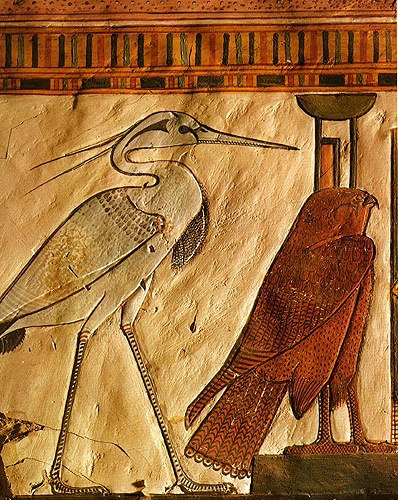
Bennu with Nephthys in kite form, Tomb of Nefertari
One candidate for the Bennu is the heron. The heron has an extremely special eye-sight and brain function which enables them to visually locate their prey. Even though the heron's eyes are positioned sideways from each other, the heron has the ability to obtain a large amount of forward and downward vision. This particular type of vision allows the bird to accurately place its strikes. It can compensate for the distortion of underwater objects created by refraction at the air and water boundary.21,22
Herons like many water-waders are uniquely carnivorous among birds and tend to wait for long periods in a static pose to catch incoming prey. They walk slowly and advance through shallow water with precision, suggestive of taking care of the appetitive desires as to not harm the soul.23,24
They depend strongly upon vision when foraging. Comparative studies of wading birds identify herons and egrets specifically as visual rather than primarily tactile feeders, with retinal adaptations differing according to whether species forage by day, twilight, or night.23,25
As a symbol of resurrection, herons are known to fly into wetlands and receding floodwaters after cataclysms en masse, waiting patiently. The vision of herons is so acute that even the most delicate flashes of movement stand out to them. The long legs of the bird above the waters suggest a disengagement with mortal life and readiness to fly above and beyond circumstances, while the feathers of the Bennu bird represent the evolution of each and every initiate and their increasing development.21,24
The heron is known to represent transformation in many cultures across the earth. Herodotus in his description of Egyptian myths from their own account equated the Bennu with the Greek phoenix. The Egyptians described it to him as eagle-like and claimed it came from Arabia every five hundred years, while carrying its father's body embalmed in an egg of myrrh. It would build a careful nest of incense-laden twigs, lie down on the pile and die, before a worm emerged from its corpse, which the sun sustained the new Bennu phoenix from.2,16
Manetho, in a fragment preserved by later authors, supposedly recorded that the phoenix appeared in Egypt in the reign of the mythical Pharaoh Sesostris and that it had come to mark a new era. In some cases, the Bennu is represented as a passerine songbird, particularly in the context of being associated with Atum directly. Use of this avian imagery as a visual set with the falcon or hawk of Re and Horus, and the ibis or pelican of Thoth, is also a deliberate choice from the Egyptian perspective.2,10,11
VI. Theology
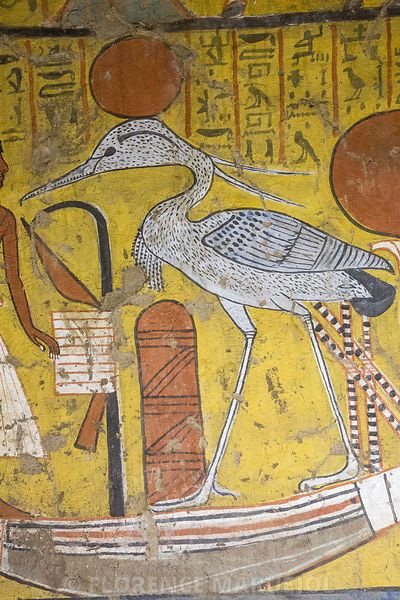
Bennu, tomb
As the Bennu flew from Osiris' chest, it represented the first awareness of the soul before distortion and izfet were created from separation and multiplicity. He could see beyond all illusions and fly past them, and the return of the Bennu to the solar city of Iunu or Heliopolis is like the return of the soul to ultimate reason and truth, where it achieves ultimate union with the divine. The Bennu's rebirth on the sacred persea or benben stone signified vision through the veil of mortality.2,10
Interestingly, the Egyptians named Venus as "the star of the ship of Bennu-Osiris", probably connected to his form at night. The phoenix represents the fire through which the cosmos dies and is reborn over and over again, alongside the potential immortality of the soul and its return into its perfected form.2,11
The phoenix symbolizes the rational soul's regeneration through divine contemplation. The Bennu's association with the sun itself indicates how the sun can be used as a source of power perpetually to renew oneself, including the all-important Solar Chakra.2
He also was associated with the date, the king of fruits. The ancient Egyptians used the dates to make date wine and ate them during the peak of harvest.10,11
VII. The Cult of Bennu
The High Priest of Ra is also referred to as the "Chief of Secrets in the Mansion of the Bennu-bird" in the case of Meryatum. This type of holy office is suggestive of Bennu being related to secrecy, possibly echoing the transmission of petitions to him. The records also show incense and other ritual tools for a ritual to Osiris inside the Mansion itself.20,26
The block statue Cairo JE 36938, a statue belonging to Penoupoqer and discovered in the Karnak cachette, lists rituals related to his worship and actually states that the statue had been installed inside the Ḥwt-bnw at Thebes.17
VIII. Lord of the Sed
Bennu received the special title "Lord of the Sed-festivals" (commonly referred to as "the Lord of Jubilees"). While some have suggested that this is a late inference from the phoenix of the Greeks, this title actually appears on the Egyptian Fayum Papyrus as shown by W. Pleyte. In this papyrus, Bennu is described as being the lord of the Heb-Sed festivals. Roel van den Broek has noted that this may be the sole currently known occurrence of the Egyptian heb-sed expression.2,27
Therefore, a good translation of "Lord of Jubilees," although convenient, would be "lord of the sed-festivals"; this latter rendering will allow us to capture more of the nuance present in the Egyptian ḥb-sd. While the Egyptian ḥb-sd was a grand ceremony in which the sacral authority of kingship was restored, and was not solely a ceremonial observance similar to anniversaries.2,13
We can see why Bennu's association with these celebrations was so suitable, since one of the major themes of the Sed festival was the possibility of renovation and rebirth without replacement. Instead of relinquishing their authority to a new ruler upon aging, monarchs were ritually revitalized, thereby establishing once again their existing kingship. Therefore, J.J. Bleeker saw "jubilee" or "thirty year festival" as insufficient designations for the ḥb-sd ceremonies; Bleeker argued that there was a deeper import to the Sed rituals, specifically in their restoration of the monarch's divine and especially sacerdotal capability.13
Consequently, these rituals restored the ruler, in a symbolic fashion, back into the state of a newly appointed Pharaoh. Van den Broek further elaborates upon this Egyptian conception: the restoration of kingship through succession or rejuvenation thus represents in microcosm a return to the origins of creation, and thus restores the harmony among gods, king, and cosmos. This is precisely the realm within which Bennu functioned. As the self generated solar bird of Heliopolis and as an associate of Atum-Ra (and thus the first manifestation of orderly existence) from primeval chaos, Bennu embodies the potential for life and cosmic order to appear anew, yet to remain continuous with what existed previously.2,10
It associated him with the principle that made rejuvenation possible. The sun itself provided the most obvious model: although it was the same sun, its appearance every morning constituted a fresh emergence after the darkness of night.2
Richard H. Wilkinson accordingly interprets the title "Lord of Jubilees" through Bennu's capacity for repeated renewal, comparable to the renewed rising of the sun. The king's Sed renewal therefore participated in the same larger religious logic: Bennu renewed cosmic and solar existence; the ḥb-sd renewed royal existence.11
In addition, Bennu's title explains how Bennu could serve as both an image of solar creation and Osirian resurrection. Just as the Sed festival was not a rite marking death and the enthronement of a new king, but rather the rejuvenation of the same royal person and office, similarly Bennu represents a form of continuity realized through renewal.2,11
It is reasonable to assume that Egyptian mortuary religion employed Bennu as an image for the deceased's revived existence, while Bennu's solar identity established the same process within a never-ending sequence of Ra's reappearance.10,11
Therefore, Bennu's title as lord of the Sed-festivals should be interpreted as a concise definition of his theology: the phoenix functions as lord of the Sed-festivals because he embodies primordial creation made capable of repetition. With each successful rejuvenation lies the conceptual potential for restoration of something akin to the first instant when order and life emerged from chaotic nothingness. One especially significant political and ritual expression of this principle is the royal heb-sed.2,13
However, it is necessary to note a certain limitation: the title proves that Bennu was not necessarily a chief cult-god officiating at every historic Sed-festival, nor is it acceptable to use this title as evidence that Bennu physically manifested himself at fixed thirty-year periods. Van den Broek explicitly rejected earlier attempts to demonstrate a derivation of the Greek phoenix's 500-, or 1461-year periodicity from this Egyptian epithet. Rather than occurring at fixed cycles, Egyptian Sed-celebrations occurred at variable intervals; and no evidence exists to indicate a fixed "cycle of Bennu".2
Sources and Bibliography
- Schindler von Wallenstern, Eleonore. Die Reiher im Alten Ägypten: Ornithologische Betrachtungen und religionsgeschichtliche Bedeutung. PhD diss., Eberhard Karls Universität Tübingen, 2002.
- van den Broek, Roel. The Myth of the Phoenix According to Classical and Early Christian Traditions. Études préliminaires aux religions orientales dans l'Empire romain 24. Leiden: E. J. Brill, 1972.
- Colonna, Angelo. Religious Practice and Cultural Construction of Animal Worship in Egypt from the Early Dynastic to the New Kingdom: Ritual Forms, Material Display, Historical Development. Oxford: Archaeopress Publishing, 2021, 78–79.
- Jacquet-Gordon, Helen K. Les noms des domaines funéraires sous l'Ancien Empire égyptien. Cairo: Institut français d'archéologie orientale, 1962, 262, no. 19.
- Brovarski, Edward. "Two Old Kingdom Writing Boards from Giza." Annales du Service des Antiquités de l'Égypte 71 (1987): 27–52.
- Allen, James P. The Ancient Egyptian Pyramid Texts. 2nd ed. Writings from the Ancient World 38. Atlanta: SBL Press, 2015, 265, PT 600.
- Sethe, Kurt. Die altägyptischen Pyramidentexte nach den Papierabdrücken und Photographien des Berliner Museums. 4 vols. Leipzig: J. C. Hinrichs, 1908–1922, Pyr. §1652b.
- Fischer, Henry G. "A Parental Link between Two Thinite Stelae of the Heracleopolitan Period." Bulletin of the Egyptological Seminar 9 (1987–88): 15–23.
- de Buck, Adriaan. The Egyptian Coffin Texts. Vol. 4. Chicago: University of Chicago Press, 1951, CT 335, IV 198a.
- Hart, George. The Routledge Dictionary of Egyptian Gods and Goddesses. 2nd ed. London and New York: Routledge, 2005.
- Wilkinson, Richard H. The Complete Gods and Goddesses of Ancient Egypt. London: Thames & Hudson, 2003.
- de Buck, Adriaan. The Egyptian Coffin Texts. Vol. 2. Chicago: University of Chicago Press, 1938, CT 76, II 3h–4c.
- Bleeker, C. J. Egyptian Festivals: Enactments of Religious Renewal. Studies in the History of Religions 13. Leiden: E. J. Brill, 1967.
- "Phoenix." Global Egyptian Museum. Accessed 2025. https://www.globalegyptianmuseum.org.
- Iskander, John M. "The Lintel of Ptahemheb in Cairo Museum (TR 22/3/25/10)." Studien zur Altägyptischen Kultur 39 (2010): 153–63.
- Herodotus. The Histories, Book 2.73.
- Leahy, Anthony. "In the House of the Phoenix at Thebes (Cairo JE 36938)." In Studies on Ancient Egypt in Honour of H. S. Smith, edited by Anthony Leahy and John Tait, 185–92. London: Egypt Exploration Society, 1999.
- Caminos, Ricardo A. The Chronicle of Prince Osorkon. Analecta Orientalia 37. Rome: Pontificium Institutum Biblicum, 1958.
- Altmann-Wendling, Victoria, and Fatma Hassan. "The Sarcophagus of Djedher (GEM 2756)." Study and publication of the Ptolemaic sarcophagus of Djedher.
- Moursi, Mohamed I. Die Hohenpriester des Sonnengottes von der Frühzeit Ägyptens bis zum Ende des Neuen Reiches. Münchner Ägyptologische Studien 26. Berlin: Deutscher Kunstverlag, 1972.
- Martin, Graham R., and Gadi Katzir. "Visual Fields and Eye Movements in Herons (Ardeidae)." Brain, Behavior and Evolution 44 (1994): 74–85.
- Katzir, Gadi, and Nathan Intrator. "Striking of Underwater Prey by a Reef Heron, Egretta gularis schistacea." Journal of Comparative Physiology A 160 (1987): 517–23.
- Kushlan, James A. "Feeding Behavior of North American Herons." The Auk 93, no. 1 (1976): 86–94.
- Mock, Douglas W., and Karilyn C. Mock. "Feeding Behavior and Ecology of the Goliath Heron." The Auk 97, no. 3 (1980): 433–48.
- Rojas, Luz Marina, Raymond McNeil, T. Cabana, and Pierre Lachapelle. "Behavioral, Morphological and Physiological Correlates of Diurnal and Nocturnal Vision in Selected Wading Bird Species." Brain, Behavior and Evolution 53, nos. 5–6 (1999): 227–42.
- Kitchen, Kenneth A. Ramesside Inscriptions, Translated and Annotated: Translations. Vol. 2, Ramesses II, Royal Inscriptions. Oxford: Blackwell, 1996.
- Pleyte, Willem. Over drie Handschriften op Papyrus: Bekend onder de Titels van Papyrus du Lac Moeris, du Fayoum et du Labyrinthe. Amsterdam: Johannes Müller, 1884.