




| Language | Name of Bes | Attestation |
|---|---|---|
| Middle Egyptian | Bes-Ihy (?) | BD spell 125, EA 10477,24 (1500-1400 BCE) |
| Demotic Egyptian | Bs | Mammisi of Ernant (44-30BCE) |
| Koine Greek | Βῆσ (Bis) | Greek Magical Papyri (100BCE-400sAD) |
| Old Coptic Egyptian | ⲃⲏⲥ (Bes) | Life of Moses of Abydos (550CE) |
19 min read
BES
author: High Priest Zevios Metathronos
co-author: Novice Priest Karnonnos
I. Etymology of Bes
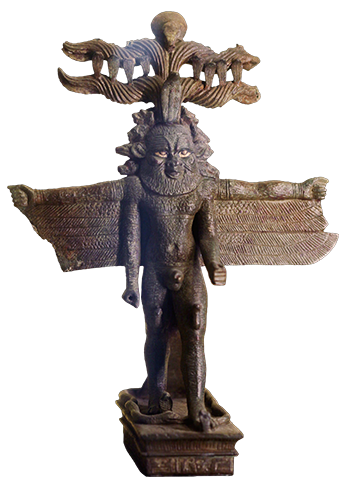
Bronze figurine of simian Bes-type entity, 664-610 BCE, Louvre
The name Bes officially occurs actually quite late in Egyptian history, as the name Bes is first securely attested in the New Kingdom, Eighteenth Dynasty, roughly around the sixteenth–fifteenth century BCE as the form Bes-Ihy on a painted foot depicted on the BD spell 125, EA 10477,24 which is now in the British Museum. However the various dwarf-like, leonine and monkey figures associated with him as a loose 'Bes-group' by historians are possibly Predynastic such as the plethora of Naqada dwarf-figurines recently found by archeologists.1, 2, 3
Mercer's older translation of the Pyramid Texts takes bs to refer to him, however, this is now considered unsupportable and is usually translated as foundling. Representations of these beings date to the earliest Egyptian periods such as the Giza relief BM EA 994 of the Old Kingdom. Archeologists refer to these depictions as being part of a Bes-group, as they lack a direct attestation of being Bes.4, 5
Bes-like imagery occurs with the name Aha throughout the Middle Kingdom on wands to protect infants. It is conventionally unknown whether Aha depicts an aspect of Bes or is simply one of the beings associated with him who is expressly dwarven. Much like with the foot of the BD Spell, references to the name Bes tend to occur with distinct and complex imagery superficially unrelated to the dwarf image. The first tie of the image of Bes to the name in tow unambigously, referring to one among seven depicted dwarf beings as "Bes who desires his Ka", dates from the mammisi of Ermant built by Cleopatra VII in the late Ptolemaic period.2, 5, 6
Etymologically, Bes' name is connected to the word 'flame' and 'to be introduced to' in Egyptian. He is sometimes assumed by modern historians to be a god from Nubia due to the stylistic conventions of how he and the dwarf gods are portrayed and their presence on Nubian temples: his feathery Nubian crown, his strong tie to Upper Egypt, and the fact that the word bes in the Nubian language means 'cat'. Donald Mackenzie in earlier Egyptology claimed Bes was an import from Punt during the Middle Kingdom.7, 8, 9
It is possible the Pyramid Texts do refer to Bes, and a millennia-old name was revived as was common in archaicizing Ptolemaic temple conventions. The Greek Magical Papyri (PGM) refer to him as Βῆσ, sometimes as Βῆσῆσ (Bisis). The worship of Bes was very popular in the centuries leading up to Christianization, and he remained one of the most commonly depicted gods afterwards despite being denounced as demonic in Coptic literature. The Copts called him ⲃⲏⲥ in Sahidic dialect. The last depiction of him is extremely late and occurs around the 10th century in Muslim Egypt.10, 11, 12
Sources: Thesaurus Linguae Aegyptiae. “Bs,” Lemma ID d1786.6 Pachoumi, Eleni. The Concepts of the Divine in the Greek Magical Papyri10 Volokhine, Youri. “Bès dans les temples égyptiens de l’époque gréco-romaine.”, 20105 Kilani, Marwan. Vocalisation in Group Writing: A New Proposal11
II. Bes in Egypt
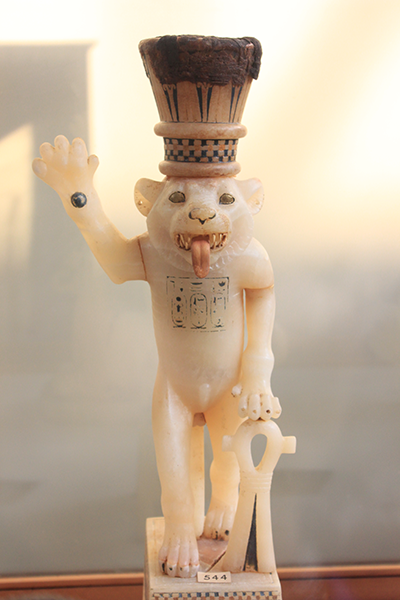
Calcite vase of feline Bes-type being, Egyptian Museum of Cairo, 1327-1336BCE
Bes does not occur as a distinct image in particularly important sacred literature like the Pyramid Texts (other than the dispute around whether bs means 'foundling') or Coffin Texts for the above reasons. As stated, dwarven symbolism goes back to the Old Kingdom. During the Middle Kingdom, he is likely called Aha and represented on the numerous wands, though some Egyptologists believe this to be a separate dwarf god. The most mature advancement of the Bes image where it acquires all the characteristics known to us, albeit not the name, comes from Hatnefer’s chair from the New Dynasty. Conversely, some historians believe a depiction of a Bes-like creature as a lion is the most important probable tie.2, 13
Regardless of the ambiguity over Bes' name tied to his image, the Bes-group had one of the most effusive and powerful collection of religious images in Egyptian society, being everywhere from the most interior part of the temple to the innermost sanctum of the home. Their presence always is in celebration, music, childbirth, sleep, prophecy and abundance. They represent joy.2, 7
III. Epithets of Bes
Epithets of Bes occur late, though the much earlier name Aha may be an epithet of his.
| Epithet | Meaning | Domain |
|---|---|---|
| Aha the Fighter (ꜥḥꜣ) | The fighter | Leonine emphasis, birth wand |
| Bes, Fair One, Lord of Punt (Bs nfr nb Pwnt) | Bes, the good/fair one, lord of Punt | Ptolemaic mammisi title, abundance |
Sources: Branko F. van Oppen de Ruiter, “Lovely Ugly Bes! Animalistic Aspects in Ancient Egyptian Popular Religion,” Arts 9, no. 2 (2020): 51, doi:10.3390/arts90200512 Birmingham Egyptology, “Origins,” in “Bes: Development of a Deity,” accessed June 19, 2026, https://more.bham.ac.uk/birminghamegyptology/eton-myers-project/virtual-museum/bes-development-of-a-deity/b-bes-the-origins/13 Mahmoud Abd El-Basset, “A Unique Bes Figurine from Al-Faw, Saudi Arabia,” Journal of the Faculty of Archaeology 14, no. 26 (2023): 385–403, doi:10.21608/jarch.2023.27704914
IV. The Temples of Bes
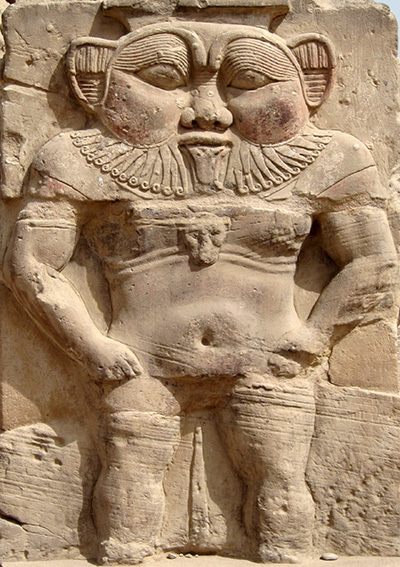
Bes relief, Dendera
The dwarf gods were wildly important household gods whose intimate cult surpassed possibly other deities in scope. Nonetheless, their presence in sacred architecture is lucidly signposted through several conventional holy uses. Bes-type figures often appear at the top of columns in temples, sometimes adjacent to the similar forward-facing Hathor columns beneath them. These embellishments are called typhonia, and with the context of the dwarves, they are particularly prominent in Nubian temples. Mammissi complexes showed the image of Bes himself directly.2, 5, 15
Bawiti
The Temple of Bawiti at the Bahariya Oasis dating to the last indigenous dynasty before the Persian conquest is sometimes called the Temple of Bes in the older parts of the Egyptological corpus, though modern scholars find this unsupportable given the primary element of the Bes-beings presence are in a minor chapel. Nonetheless, the related site at Ayn el-Muffteila contained a large Bes-type figure whose lower body is visible.5, 16
Bes Chambers of Saqqara
At the Anubeion in Saqqara, the unique Bes chambers existed. They are known as particular rooms excavated in the Anubieion, decorated with large terracotta wall reliefs of Bes-like being with a large phallus and a smaller female figure; they are usually interpreted as places for incubation, dream-oracles, fecundity, or possibly hosted pregnancy-related rites. The rooms do not survive.5
Abydos
Bes directly was said by Ammianus Marcellianus to have his own oracle during Roman times at Abydos related to letters and other requests which was already ancient by the 5th century. The oracle existed within the much older temple dedicated to the Pharaoh Seti I. Greek visitors and pilgrims recorded through graffiti that the worship of this oracle related to dreams and incubation, not dissimilar to that of Ascelpius' cult elsewhere. Why the divinatory cult of Bes was tied to Seti in particular is unknown.1, 5, 7, 17
Mammissi
As these figures were protective deities of childbirth, it is not shocking they appear in the the mammisi of temples, structures which also appeared rather late in Egyptian religion. Revealingly, Bes directly shows an enduring association with Isis and Horus. The function of Bes was to protect the Pharaoh as a divine child too. However, his' function in these areas is more ornamental than strictly active, according to the Glyptotek catalog.5, 7
V. Bes as Protector
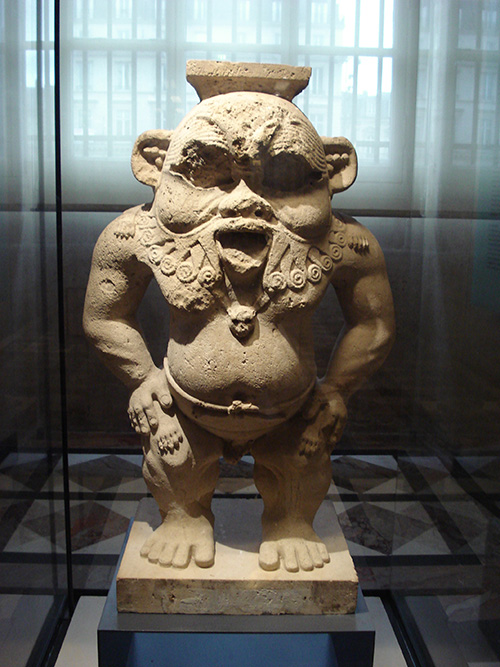
Bes-type entity, 379-341 BCE, Louvre
Bes-like deities are often invoked in Egyptian materials to protect children, and in the Ptolemaic period Bes became the formal head deity by name of this process. These entities are said to protect the young by frightening away evil spirits with their ferocious appearance, by fighting, strangling, or warding off dangerous serpents and bad spirits with weapons and in dancing and noisy music-making that drives away evil powers. They are often shown to be fierce and feline in nature, sometimes represented as cats.2, 7, 9
An example of Bes' ability to protect children is found in the Ptolemaic and Roman documents is found in the Greek Magical Papyri, especially PGM IV.1227–64, where an amulet text invoked “BES” and asked him to “protect N.” These figures were often portrayed in areas where the vulnerable needed deep religious and apoptropaic defense or relief through charms, talismans or cippi. This symbolism extended to Bes' role as a protector of the young among the gods themselves, as he is portrayed quite prolifically in the Dendera Temple on its stelae protecting the divine child Horus (Ihy).5, 9, 10
VI. Prophecy and Healing
Bes is understood to have been a god that dealt with incubatio and dreams from various historical pieces of evidence like the Greek Magical Papyri, graffiti from Abydos and the Bes Chambers at Saqqara. The PGM VIII, for example, has been interpreted as a dream oracle by scholars such as Martín Hernández. In that respect, he is similar to a variety of gods like Asclepius who dealt with the concept of healing through sleep, although Bes' function in this regard may have been protective.5, 10, 18
The testimony of Ammianus Marcellianus, referring to an episode of the Christian emperor Constantius in wanting to pursue inquisitions due to compromising letters, shows Bes to have been concerned with prophecy and oracles. The historian in his testimony claimed that "Besa" dealt with telling the future "in days of old" and was still honored with "ancient ceremonials". Letters were sent to Bes to be stored at his temple. Antagonists sending these petition-slips from the temple floor straight to the emperor appear to have enraged him enough to conduct a political purge, so whether at least some of the letters were pleas directed against those in power is likely.1, 5, 17
VII. Protector of Liminal States
Pregnant women appeared to call upon Bes for protection, a fact explaining the ubiquitous presence of the Bes-faces on resting chairs and on the Aha wands designed to be drawn to ritualistically protect newborns. His connection with newborns is also visible in the way he was portrayed in art, such as in a British Museum object where Bes cradles an infant figure, interpreted by the institution as representing protection at birth and the nurturing of the newborn child. Bes himself is baby-like in many ways.2, 9
Many of his functions appear to be related to guarding people in transitional and liminal stages of their lives, almost as a dam for their protection in the flow of dysregulated, maybe frightening times. Through his hardy fierceness, the dwarven god could repel all distress and transform dolors into a vehicle for joy.2, 9
VIII. Musical Imagery
The litany of Bes-like beings are often shown playing the tambourine or harp, and they have a perennial association with the joy of dance and music both in a religious and secular context. Bes appears in contexts linked with many festivities in Egypt Some depictions of female dancers and musicians show dwarf tattoos or the so-called Bes marks on the thighs; physical evidence for a Bes tattoo also does exist, though the actual tattooed mummy found with the mark has not been identified as a dancer.2, 7
Bes was especially associated with festive temple contexts involving musical appeasement of the gods, particularly rites connected with Hathor or the returning vengeful goddess, which probably showed the interplay of his instruments with the sistra. The merriment was religious to a large extent in character rather than being mere hedonism.5, 7
IX. Bes in the Cults of Other Gods
The Egyptians pressed the same bandy-legged, lion-faced form into the service of a whole family of guardian powers, so that the figure came to read less as the portrait of a single god than as a hieroglyph for protection itself. The type seems to have begun as a rearing lion that only gradually took on a dwarf's body, a shape bred at once for menace and for laughter. Its earliest homes were intimate ones: the bedchamber and the birth-stool, the amulet strung at an infant's throat, the ivory wand laid across a sleeping child. By the Late and Greco-Roman periods, Bes became formalized as a sacred god of the temples, taking his place among the great gods at the very hour of divine birth and lending his face to the theology of Hathor and of Horus.19, 20, 21
The Purpose of the Mammissi
Set at right angles to several of the last great temples stood a smaller chapel the Egyptians called the birth house, or mammisi, where the yearly mystery of the divine nativity was staged. At Dendera the child of the sanctuary was Ihy, the young sistrum-player born to Hathor; at Edfu the deity was Harsomtus, Hor-sema-tawy, "Horus who unites the Two Lands," reckoned the son of Horus of Behdet and Hathor of Dendera. Once a year a procession carried the goddess from the main temple to the birth house. In the open courtyard the priests mounted singing, dancing, and a dramatic re-enactment of the god's coming into the world. Around the capitals of the columns that ring these chapels marches Bes, posted there to keep the newborn deity from harm exactly as he watched over mortal children in their cradles.21, 22, 23
Horus on the Crocodiles
Some of that aspect of Bes took its most concentrated form on the magical stelae known as the cippi of Horus, the "stelae of Horus on the crocodiles." On their fronts the child Horus stands upon a pair of crocodiles and throttles the serpents, scorpions, and desert game gripped in his fists, and above his head, filling the gable of the stone, stares the frontal mask of Bes. The catalogue of the corpus records the Bes-mask in the gable as one of the defining marks of the whole class.
These stones were carved to be used in a variety of applications. Water poured over the images and over the spells cut around them was believed to soak up their power, and the charged liquid was then swallowed or washed across the body to cure the bite of a snake or the sting of a scorpion, so that image, incantation, and medicine acted as one. The grandest survivor of the type, the Metternich Stela of the reign of Nectanebo II, gathers the entire apparatus onto a single dark slab and remains the fullest witness we possess to how the child-god and his Bes-crowned guardian were made to heal.24, 25, 26
Among the Household of the Gods
Wherever the Egyptians rehearsed the perils of birth, Bes kept his company. On the walls of the birth houses and in the crowded registers of the healing stelae he stands beside Taweret and Isis, beside Khnum who shapes the child upon his potter's wheel and the goddesses who preside over the labour, a settled member of the household gathered around the vulnerable divine infant.21, 22
Bes by the Roman period had a face which peered from the religious life of the country from end to end, pressed onto temple columns, oracle chambers and the humblest of domestic shrines, one of the few Egyptian powers whose popularity outlasted the temples themselves given his last noted appearance on a jug from the 10th century CE.12, 27 The smallest of the gods endured the longest in worship.19, 27
X. Besas: the Magical Hellenistic Form
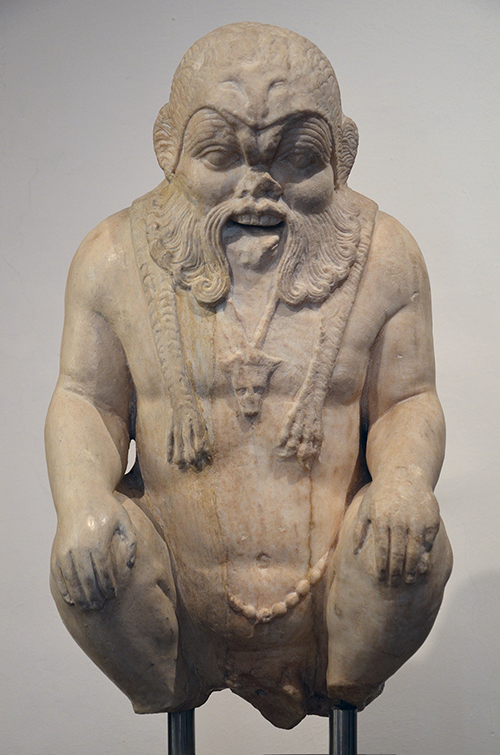
Bes, 1st century CE, Museo Barracco
The Greek Magical Papyri preserves a highly distinct and fierce form of Bes, alternatively named Besas, Bisis, Bis and so on. It is this form of Bes who seems to take on cosmological proportions. It creates lightning and breathes fire from its mouth, being so strong that even the winds fear him. The vision in the feet appears to speak of powers in the lower world.
ἐπικαλοῦμαί σε τὸν ἀκέφαλον θεόν
I invoke you, the headless god...
τὸν ἐπὶ τοῖς ποσὶν ἔχοντα τὴν ὅρασιν
the one who has vision in his feet...
ὁ ἀστράπων, ὁ βροντάζων..
“the lightning-flasher, the thunderer...
SM II 90 / GEMF 62
σὺ εἶ οὗ τὸ στόμα … κάεται / πῦρ …
You are he whose mouth burns / whose mouth is fire...
PGM VII / VIII / SM II 90 Bes invocation:
These texts repeatedly call Besas 'the Headless God'. The language used can sometimes be extreme and betray confusion typical of the PGM, as in a magical plea to Agathodaimon to influence someone in a dream by saying:
Besas will chop you up into pieces and give your flesh to the mangy dog to eat.
GEMF 15.190–207, quoted by Faraone
In Egyptian contexts from the same time period as the PGM corpus, Bes is often portrayed wielding dual-knives to protect children. Due to the prevalent amount of Hebrew material in the PGM, it is likely this understanding of the power behind Bes that influenced the depiction of the Behemoth in the Old Testament.28, 29
“mighty Headless One...
whom the winds fear..
the mighty one [who possesses] the immortal fire...
who begets and destroys...
PGM V.96–172
Bibliography:
- Van Oppen de Ruiter, Branko F., and Robert Steven Bianchi. “Under the Spell of Bes.” Introduction to Under the Spell of Bes, edited by Branko F. van Oppen de Ruiter and Robert Steven Bianchi. Wallasey: Abercromby Press, 2024.
- Van Oppen de Ruiter, Branko F. “Lovely Ugly Bes! Animalistic Aspects in Ancient Egyptian Popular Religion.” Arts 9, no. 2 (2020): 51. doi:10.3390/arts9020051.
- Buszek, Artur. “Dwarf Figurines from Tell el-Farkha.” Studies in Ancient Art and Civilization 12 (2008): 37–58. Relevant sections: Naqada dwarf figurines; Early Dynastic cultic deposits; Tell el-Farkha hippopotamus-tusk dwarf figurines.
- Mercer, Samuel A. B., trans. The Pyramid Texts in Translation and Commentary. New York: Longmans, Green, 1952. Relevant section: Utterance 516, Pyr. §1186a, where the old translation gives “Bes.”
- Volokhine, Youri. “Bès dans les temples égyptiens de l’époque gréco-romaine.” In Isis on the Nile: Egyptian Gods in Hellenistic and Roman Egypt. Proceedings of the IVth International Conference of Isis Studies, Liège, November 27–29, 2008, edited by Laurent Bricault and Miguel John Versluys, 233–55. Religions in the Graeco-Roman World 171. Leiden: Brill, 2010.
- Thesaurus Linguae Aegyptiae. “Bs,” Lemma ID d1786. In Thesaurus Linguae Aegyptiae, Corpus Edition 20, Web App Version 2.5.1, edited by Tonio Sebastian Richter and Daniel A. Werning. Berlin-Brandenburg Academy of Sciences and Humanities. Accessed June 16, 2026. Relevant data: Demotic divine-name lemma “Bes,” attested ca. 100 BCE–324 CE.
- Bagh, Tine, and Lise Manniche, eds. Bes: Demon God, Protector of Egypt. Copenhagen: Ny Carlsberg Glyptotek, 2021. Relevant sections: pp. 22, 26, on southern/Nubian origin theories, Bes’ ostrich-feather crown, and the Dendera pun “Bes has come into the world (bs) in Nubia.”
- Mackenzie, Donald A. Egyptian Myth and Legend. London: Gresham Publishing Company, 1907. Relevant section: discussion of Bes’ prominence in the Eighteenth Dynasty, possible introduction as early as the Twelfth Dynasty, and alleged importation from Somaliland.
- El-Kilany, Engy. “The Protective Role of Bes-image for Women and Children in Ancient Egypt.” Journal of Association of Arab Universities for Tourism and Hospitality 14, no. 2 (December 2017): 1–16. Relevant section: “His name,” reporting proposed links to Egyptian bs “flame,” bz “to introduce / to be initiated,” and Nubian besa “cat.”
- Pachoumi, Eleni. The Concepts of the Divine in the Greek Magical Papyri. Studies and Texts in Antiquity and Christianity 102. Tübingen: Mohr Siebeck, 2017.
- Kilani, Marwan. Vocalisation in Group Writing: A New Proposal. Lingua Aegyptia Studia Monographica 20. Hamburg: Widmaier, 2019. Relevant proof: table gives Egyptian bs / bA.sA > Coptic ⲃⲈⲥ, vocalized bˈeːs, glossed “God Bes”; cites Vycichl, Dictionnaire étymologique de la langue copte, 31, and Westendorf, Koptisches Handwörterbuch, 27.
- Charvát, Petr. “The Bes Jug: Its Origin and Development in Egypt.” Zeitschrift für Ägyptische Sprache und Altertumskunde 107, no. 1 (1980): 46–52. Relevant section: p. 51, on the Coptic-period Bes-jug from Tell Edfu in a tenth-century AD layer, citing Henne 1925, p. 21, pl. XXII.
- Birmingham Egyptology. “Origins.” In “Bes: Development of a Deity.” Eton Myers Project, Virtual Museum. Accessed June 19, 2026. https://more.bham.ac.uk/birminghamegyptology/eton-myers-project/virtual-museum/bes-development-of-a-deity/b-bes-the-origins/.
- Abd El-Basset, Mahmoud. “A Unique Bes Figurine from Al-Faw, Saudi Arabia.” Journal of the Faculty of Archaeology 14, no. 26 (2023): 385–403. doi:10.21608/jarch.2023.277049.
- Onderka, Pavel. “Bes in the Kingdom of Kush / Nubia” and “Bes and Typhonia in Kush / Nubia.” In Bes: Demon God, Protector of Egypt, edited by Tine Bagh and Lise Manniche. Copenhagen: Ny Carlsberg Glyptotek, 2021.
- Hawass, Zahi. “The Temple of Bes.” In Valley of the Golden Mummies, 168–73. Cairo and New York: American University in Cairo Press, 2000.
- Ammianus Marcellinus. History. Volume 1: Books 14–19. Translated by John C. Rolfe. Loeb Classical Library 300. Cambridge, MA: Harvard University Press; London: William Heinemann, 1935. Relevant section: Res Gestae 19.12.3–4, on the oracle of Besa at Abydos and the written petitions left in the shrine.
- Martín Hernández, Raquel. “Two Requests for a Dream Oracle: Two Different Kinds of Magical Handbook.” In Écrire la magie dans l’Antiquité: Actes du colloque international, Liège, 13–15 octobre 2011, edited by Magali de Haro Sanchez, 41–49. Collection Papyrologica Leodiensia 5. Liège: Presses Universitaires de Liège, 2015. Relevant section: “PGM VIII and the Request for a Dream Oracle of Bes,” on PGM VIII 64–110.
- Romano, James F. The Bes-Image in Pharaonic Egypt. 2 vols. PhD diss., New York University, 1989. Relevant sections: the Bes-image as a shared visual form used for numerous protective deities; its development from the Old Kingdom through the Greco-Roman period and its movement onto temple monuments.
- Romano, James F. “The Origin of the Bes-Image.” Bulletin of the Egyptological Seminar 2 (1980): 39–56. Relevant section: derivation of the Bes-image from the rearing lion and its gradual acquisition of a dwarf's body.
- Dasen, Véronique. Dwarfs in Ancient Egypt and Greece. Oxford Monographs on Classical Archaeology. Oxford: Clarendon Press, 1993. Relevant sections: Bes as protector of women in childbirth and of infants; the amulet and the apotropaic wand; Bes as dancer and hand-drummer and his company with Taweret and Hathor.
- Daumas, François. Les mammisis des temples égyptiens. Annales de l'Université de Lyon, 3e série, Lettres, fasc. 32. Paris: Les Belles Lettres, 1958. Relevant sections: the mammisi as birth house of the divine child; its architecture and decorative programme; the assembly of childbirth deities on its walls and columns.
- Institute for the Study of Ancient Cultures, University of Chicago. “Mammisi.” Tell Edfu Project. Accessed July 1, 2026. https://isac.uchicago.edu/research/projects/tell-edfu/mammisi. Relevant section: the annual procession celebrating the divine birth of Harsomtus, with public performances of singing and dancing and a dramatic re-enactment of the birth scene.
- Sternberg-el Hotabi, Heike. Untersuchungen zur Überlieferungsgeschichte der Horusstelen: Ein Beitrag zur Religionsgeschichte Ägyptens im 1. Jahrtausend v. Chr. 2 vols. Ägyptologische Abhandlungen 62. Wiesbaden: Otto Harrassowitz, 1999. Relevant section: the frontal Bes-mask in the gable (“Bes-Maske im Stelengiebel”) recorded as a defining feature of the Horus-stela corpus.
- Ritner, Robert K. The Mechanics of Ancient Egyptian Magical Practice. Studies in Ancient Oriental Civilization 54. Chicago: The Oriental Institute of the University of Chicago, 1993. Relevant sections: the activation of sacred images by libation; the water poured over the cippi and then drunk as a cure; the practical unity of magic, medicine, and religion.
- Scott, Nora E. “The Metternich Stela.” The Metropolitan Museum of Art Bulletin, n.s., 9, no. 8 (April 1951): 201–17. Relevant sections: the Metternich Stela as the largest and most complete of the cippi; its manufacture under Nectanebo II; the curative water poured over the stone.
- Frankfurter, David. Religion in Roman Egypt: Assimilation and Resistance. Princeton, NJ: Princeton University Press, 1998. Relevant section: p. 49, on the pervasiveness of the Bes-image across the popular and temple religion of Roman Egypt.
- Zellmann-Rohrer, Michael. “Notes on Magical Papyri (Part I).” Symbolae Osloenses 97, no. 1 (2023): 1–18. Relevant proof: SM II 90 / GEMF 62 as an invocation of Bes under names including “the headless god”; PGM VII and VIII as Bes dream-oracle parallels; Greek phrases ἐπικαλοῦμαί σε τὸν ἀκέφαλον θεόν, τὸν ἐπὶ τοῖς ποσὶν ἔχοντα τὴν ὅρασιν, ὁ ἀστράπων, ὁ βροντάζων; fiery-mouth variants.
- Betz, Hans Dieter, ed. The Greek Magical Papyri in Translation, Including the Demotic Spells. 2nd ed. Chicago: University of Chicago Press, 1992. Relevant proof: PGM V.96–172, the “Stele of Jeu,” with the Headless One as mighty, feared by winds, possessing immortal fire, causing lightning/thunder, and begetting/destroying. Use with Pachoumi for the Besas/headless-god assimilation.
- Faraone, Christopher A., and Sofía Torallas Tovar, eds. Greek and Egyptian Magical Formularies: Text and Translation. Vol. 1. California Classical Studies 9. Berkeley: Department of Ancient Greek and Roman Studies, University of California, Berkeley, 2022.