TEMPLE OF ZEUS
The Parthenon in a classical landscape

The Temple

Temple of Zeus

The Temple
Temple of Zeus: Welcome

The welcome to the Temple of Zeus and Zevism: the Ancient faith behind all Ancient religions, the Gods falsely branded demonic, the practices for opening the chakras, freedom of belief, and Dedication as the first step.

Read
Marble bust of Zeus

The Gods

The Ancient Gods

The Gods
Our Eternal Head God: Zeus, Eternal Truth & His Identities

The Truth about Zeus: the original, eternal Head God of humanity worshipped across every civilization on Earth under many names.

Read
The human form with the seven chakras

Meditation

Meditation Information

Meditation
Meditation Information

Encyclopaedia of meditation: power meditation, awareness practices, chakras, energy work, and the path to spiritual advancement and siddhis.

Read
A priestess holding a bowl and sacred branch

Magick

Magick & Theurgy

Magick
Magick & Theurgy

Magick & Theurgy: the powers of the mind and soul, built on power meditation. The Magick Section holds the Chthonic Powers and the Theurgy Section the Heavenly Powers, each from Beginning to Advanced with Divination and Information; General Information, Knowing the Powers, serves both.

Read
Philosophers gathered in the School of Athens

Teachings

Our Doctrines

Teachings
The Doctrines of Zeus

Sacred texts and doctrines of the ancient world, Egyptian, Greek, Sanskrit, Babylonian, Norse, Roman, and Japanese spiritual writings.

Read
A gathering in a classical hall

Community

The Temple of Zeus Community

Community
Personalities

People who historically have done great acts, are recognized as Zevist personalities who evolved mankind.

Read
Bookmark

24 min read

HECATE

author: High Priest Zevios Metathronos
co-authors: Novice Priest Karnonnos, Arcadia

Hieratic Information about Hecate
Divine Names
Hecate (Ἑκάτη)the Greek name of Antiquity
These hieratic names carry strong spiritual resonance and are recommended for summoning and invocation practices.
Divine Symbols
  • Crossroads
  • Torches
  • Triangle
  • Polecat
  • Dog
  • Graves
  • Threshold
Divine Numbers and Attributes
Sacred Numbers40, 50, 60
RunesThurisaz, Tiwaz, Sowilo (in order of importance)
Zodiac Sign of PowerAries
Sacred AnimalsThe Great Eagle, the Bull, the Hawk, the Serpent
ElementFire, Aether
Divine Forces
  • Magic
  • Darkness
  • Triplicity and Choice
  • Life and Death
  • Transitions
Important Titles
  • Enodia
  • Antaia
  • Propylaia
  • Kleidouchos
  • Trioditis
Names Across Civilizations
GreekHecate (Ἑκάτη)
RomanHecate

I. The Name

The Greek form is Ἑκάτη, also written Ἑκάτα in some dialectal or poetic forms. The name has often been connected with ἑκάς, “far off,” or with Ἑκατός, an epithet of Apollo meaning something like “the Far-Shooter” or “Far-Working One,” but the etymology is not secure. The grammarian Robert Beekes rejected a certain Greek derivation and treats the name as probably Pre-Greek, while Chantraine records the traditional Greek comparisons cautiously rather than as settled fact.1

Hesiod’s Theogony is the first supplied instance of her name. Hesiod names Ἑκάτη as the daughter of Asteria and Perses, and gives her an unusually exalted place among the divine powers, honored by Zeus and active across earth, sea, and sky. This makes Hesiod the earliest secure Greek source for the goddess by name.2

Because of this, the safest short explanation is that Hecate’s primary Greek name is Ἑκάτη, first securely attested in Hesiod, but its etymology remains uncertain. A comparison with ἑκάς or Ἑκατός is possible, especially because Hecate can be a distant, liminal torch-bearing power.3

Context Name of Hecate Attestation
Greek Ἑκάτη Hesiod, Theogony

Sources: Beekes, Robert S. P. Etymological Dictionary of Greek. Leiden: Brill, 2010, s.v. “Ἑκάτη”; Chantraine, Pierre. Dictionnaire étymologique de la langue grecque: Histoire des mots. Paris: Klincksieck, 1968–1980, s.v. “Ἑκάτη,” “ἕκας”;1 Hesiod. Theogony; Works and Days; Testimonia. Edited and translated by Glenn W. Most. Cambridge, MA: Harvard University Press, 2018, Theogony 411–452;2 Liddell, Henry George, Robert Scott, Henry Stuart Jones, and Roderick McKenzie. A Greek-English Lexicon. 9th ed. Oxford: Clarendon Press, 1940, s.v. “ἑκάς,” “Ἑκατός,” “Ἑκάτη.”3

II. Hecate

Hecate has long been considered a goddess of magic, darkness, and the ever-inscrutable crossroads, occupying perhaps one of the most devoted cults of worship among the Goddesses in modern times. Despite her tenebrous and dark nature, she remains beloved and respected by many practitioners of the magical arts across the world due to her rulership over all so-called witches. She has also long been a symbol of pagan worship as a whole for millennia, reigning supreme in the medieval imagination as the essence of everything antique and frightfully unknown to them.

Hecate is a strongly symbolic deity; the language and syllabary of her existence as a deity is communicated through visual cues, though she does have certain mythological roles and an impressive set of characterizations in the literature of Antiquity, particularly her presence in plays.

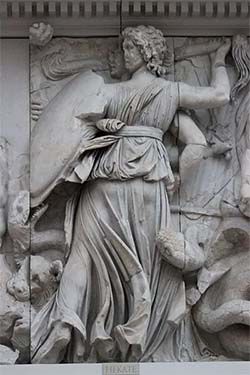
Her mythological role is shadowy. As the goddess of magic, Hecate mythologically defeated the fearsome giant Clytius during the Gigantomachy,1 who had absorbed all magic and rendered it ineffective. By setting his hair on fire with torches (an allegory for the opening of the Higher Chakras), she reestablished the use of sacred arts and the development of the soul for higher beings. Zeus thus bestowed upon her the eternal ability to govern what was unseen and occult. This scene is also shown on a frieze of the Pergamon Altar, making it visually supported.2

Hecate was strongly associated with Artemis above all other figures as her companion and servant, and her symbolism is representative of being the bridge and binder to the unconscious pure soul that Artemis governs. Such a role is deeply reflected in her name, 'the worker from afar,' which is a feminine form of a title that Apollo also possesses. Another primary mythological trope of Hecate is the assistance she lends to a distraught Demeter wandering the earth for nine days when Persephone is abducted and brought to Hades by the eponymous god of death, as Hecate is the only entity who can hear the maiden's desperate pleas from the shadowy abyss.3

Occasionally, she is shown guiding Persephone to and from the surface.4 In the Homeric Hymn to Demeter, upon Persephone's return to the surface, she embraces her and becomes her eternal attendant.3 This convention of Hecate in proximity to Demeter and Persephone is a distinctive theme in Greek visual art, although scholars warn that many images of Hecate may in fact be a torch-wielding Demeter.5 In the Odyssey, she becomes the owner of Queen Hecuba, who, for murdering a king, is being stoned to death by the locals and in her terror jumps off a cliff, transforming into a dog.4.5,6

Hesiod focuses on her role in the Titanomachy, where Hecate is depicted as a profoundly honored, powerful pre-Olympian goddess, uniquely respected by Zeus despite her Titan parentage. Daughter of Perses and Asteria, she holds supreme, widespread influence over earth, sea, and sky, aiding humans in war, games, farming, and fishing.7

Otherwise, Hecate's role is often elaborated in dramatic plays of the Classical period like those of Euripides and Sophocles where her occult and inscrutable qualities are still present in her characterization. Here, her conventions of sanctification and purification are introduced officially beyond subtext. Aeschylus gives a glimpse of an older and more archaic form of Hecate. In the extant Suppliant Women,, the Danaids pray that “Artemis-Hecate” watch over women in childbirth, and so Hecate is tied to civic welfare, female fertility, and protection. In a lost fragment (fr. 216)8,9

Aeschylus also has “Lady Hecate, before the portal of the royal halls,” which presents her as a threshold goddess. She also serves as a symbol of revenge, particularly in Euripides' plays; it is said the vengeful Medea works through her designs in the eponymous play, and she invokes her in the famous oath around lines 395–398, calling Hecate the goddess she worships most, her chosen helper, and the one who dwells “in the inmost recesses of my hearth.”10

In fear, the Trojan Women depicts Cassandra in a delirius vision calling upon Hecate to come and put her starlight upon a doomed night when being carried away by Menelaus, supposedly one of her main functions as an attendant of Aphrodite. In fragments of Sophoclean plays, Hecate is portrayed vividly in the Rhizotomoi (The Root-Cutters) where Medea is also a character. In fragment 535 of the lost play, Sophocles has a choral passage invoking “Hecate of the roads” and describing her with strong ritual imagery with her torch and spear, her sacred crossroads, oak, and coils of snakes.11,12,13

One of the most important functions of Hecate is that she is a goddess of Time and Space itself. Entry and exit are conditioned by her: this is why she was the divine patroness of city walls, thresholds, and boundaries of sanctuaries.14 Magic and its results are also encoded into reality by her command through the same principle, as it must be introduced into the world through uniquely unseen means. In governing Time and Space, she can be seen as a feminine counterpart of Khepri, yet, to a profound extent, also his opposite. She is also a deity of nourishment: like Hera and Aphrodite, she comes to the assistance of children, and like Agares, she serves the common people.

Her place of common worship was the crossroads or trivium, where Hecate was worshipped alongside the spirits of the dead. Curse tablets and offerings were often deposited as gifts to the Ggoddess. These roads symbolized the necessity of going backwards to retrace one's steps and the careful contemplation of what to do, in both life and death. The trivium also carries a meaning related to magic and the outcomes of a decision: there are always two ways in full view after a traveler has come through one path. The ambiguity of the crossroads reflects the twists and turns of life, the uncertainty of where to go next, and the importance of retracing one's movements. Liminality and boundaries were held to be important factors in her symbolism. Occasionally, Hecate was also associated with the quadrivium, or four-way crossroad, which posed a further allegory of going back and forth through evolution, with even greater ambiguity.

The Goddess was known to dwell with the souls of the dead as their guide and to have attendant spirits, the Lares and Manes (spirits of the dead), who were honored at compita (crossroad shrines). Crossroads were ritual zones for offerings to underworld deities, especially during the Parentalia or Lemuria festivals. These festivals were associated with ancestral ghosts and ghosts without kin, respectively, and Hecate was considered to be the commander of both.15

In Mesopotamia, similar beings called shiptu or shēlu operated in liminal spaces, city gates, edges of cemeteries, or crossroads, seen as contact points with the netherworld. Some of Hecate's concepts in mythology were contradictory, often deliberately so. She was held to be foul-smelling, rotting, and half-dead, yet also the most pristine, clean, and fastidious goddess in her approach to maintenance, even bearing the epithet 'brightly-coiffed,' which ironically partially reflects her immolation of Clytius through his hair. All of these symbols reflect her status as the symbol of purification; this is a major element in her eternal association with the Esbat, an auspicious time for beginning cleansing routines, and cycles of the Moon. This also relates to the recreation of the self through the activation of the pineal gland.

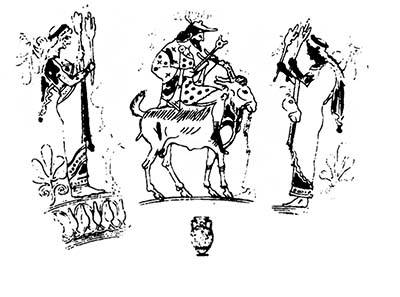
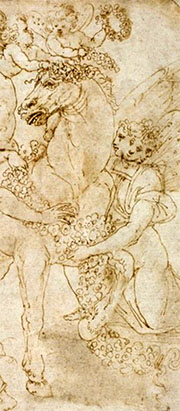
In classical sources, Hecate was also associated with anger, reflected in one of her names, Vrimo (Enraged). When Hermes attempted to violate her (an allegory for pushing unseen processes too far by the tactile, overly ambitious, and nervous mind),16 she snorted so violently that he ran away, coming to his senses. This episode was a common theme in mythological art:

Hecate Hermes
Hecate with Hermes

Her rage also related to preserving cleanliness, even at the cost of incurring embarrassment and scrutiny in others. To this extent, she was also associated with vengeance and black magic.17 In this respect, she encodes many of the decrees of Hera, Aphrodite, and Apollo.

III. Epithets

Epithet Meaning Domain
Hecate Enodia (Ἑκάτη Ἐνοδία) Hecate of the Road / Wayside Roads, liminal protection
Hecate Antaia (Ἑκάτη Ἀνταία) Hecate the Encountered Epiphany, fearful manifestation
Hecate Propylaia (Ἑκάτη Προπυλαία) Hecate Before the Gate Gate-guardianship, apotropaic protection
Hecate Kleidouchos (Ἑκάτη Κλειδοῦχος) Hecate the Key-Bearer Keys, cosmic thresholds, guarded passage
Hecate Trioditis (Ἑκάτη Τριοδῖτις) Hecate of the Three Ways Crossroads, triple paths
Brimo (Βριμώ) Formidable Dread power
Hecate Ourania (Ἑκάτη Οὐρανία) Hecate Heavenly Celestial reach, divine scope
Hecate Chthonia (Ἑκάτη Χθονία) Hecate of the Earth Earth, darker powers
Hecate Perseia (Ἑκάτη Περσεία) Hecate Daughter of Perses Genealogy, titan lineage
Hecate Nykteria (Ἑκάτη Νυκτερία) Hecate of the Night Night, darkness
Hecate Skylakitis (Ἑκάτη Σκυλακῖτις) Hecate of the Hounds Dogs, ghostly accompaniment, nocturnal presence
Hecate Basileia (Ἑκάτη Βασίλεια) Hecate the Queen Sovereignty, dread rule, divine authority
Hecate Tauropolos (Ἑκάτη Ταυροπόλος) Hecate Bull-Driving / Tauropolos Wild potency, fierce ritual force
Hecate Kourotrophos (Ἑκάτη Κουροτρόφος) Hecate Nurse of Children Child-rearing, protection of the young
Hecate Hegemone (Ἑκάτη Ἡγεμόνη) Hecate the Leader Guidance, procession, direction
Hecate Ouresiphoitis (Ἑκάτη Οὐρεσιφοῖτις) Hecate Who Haunts the Mountains Mountains, wilderness, roaming liminality

Orphic Hymns. Edited and translated by Apostolos N. Athanassakis and Benjamin M. Wolkow. Baltimore: Johns Hopkins University Press, 2013, Hymn 1 (To Hecate) 1, 6–8.,21 Sophocles. Fragments. Edited and translated by Hugh Lloyd-Jones. Loeb Classical Library 483. Cambridge, MA: Harvard University Press, 1996, fragment 311 Radt (Clytemnestra), “ἀνταία θεός.”,22 Karataş, Ayşe Sibel M. “The Temple Key as a Symbol of Priestly Authority.” Mythos 13 (2019): esp. discussion of LSAM 50, lines 25–26, 28–29, “παρ’ Ἑκάτῃ τῇ πρόσθεν πυλέων."23 Apollonius Rhodius. Argonautica. Edited and translated by William H. Race. Loeb Classical Library 1. Cambridge, MA: Harvard University Press, 2009, 3.861–62, 1211.4

IV. Hecate's Cult

It was said Hecate's cult grew out of locales across the sea from Greece. Her first attested cult is actually known to be from a city of Greek colonists in modern day Sicily named Selinous (modern day Selinunte),25 a particularly wealthy and powerful locale in Magna Graecia. However, many of her artefacts are present in Greece from an early period, such as pre-classical artefacts of Boetian origin. In Byzantium, her cult took on the dimensions of a civic protector and many temples to her proliferated. Hecate's importance to Byzantium was direct and pivotal, lasting until the time of Constantine and the Christian emprors, because she was also associated heavily with the city of Byzantium due to her protective guard over the city when faced with a dangerous menace.

Divine Heiress: The Virgin Mary And The Creation of Christian Constantinople, Vasiliki Limberis26

In Byzantium small temples in her honour were placed close to the gates of the city. Hecate's importance to Byzantium was above all as a deity of protection. When Philip of Macedon was about to attack the city, according to the legend she alerted the townspeople with her ever present torches, and with her pack of dogs, which served as her constant companions.

Hecate on Pergamon altar

The major cult center of Hecate was located in Lagina in Asia Minor, being the divine patroness of the Carians, strongly influenced by their representation of her as the Sun goddess named Arinna.27 Her cult was considered particularly important to the dwellers of the Asia Minor coastline5 and was the focus of several festivities. For example, choruses of thirty boys would be trained to sing her praises at various lunar cycles.28 One aspect of these rituals included a "Key-Carrying" ceremony, where a chorus of young girls would walk from Lagina to the powerful city-state of Stratonicea to declare their devotion. On their return, the gates would be opened by the girl carrying the key (the kleidophoros), and the religious festivities would begin. This ritual not only served as a political reminder that Stratonicea controlled Lagina, but also that Hecate controlled the keys to the underworld.2829 Carian temple friezes show Hecate assisting Zeus during his birth from Cronus.30 As said, the notorious city of Byzantium held Hecate as their patron goddess, believing she disoriented the progress of multiple invasions. Visions of her were said to watchfully protect the city spanning two continents, as if both sides of the Hellespont were her torches. Roman sources later personified Hecate as the key to Asia itself.31

Orphic Hymn to Hecate32

Εἰνοδίην Ἑκάτην κλήιζω τριοδίτιν ἐραννήν,

οὐρανίην χθονίην τε καὶ εἰναλίην κροκόπεπλον,

τυμβιδίην, ψυχαῖς νεκύων μετά βακχεύουσαν . . . . ἀγαλλομένην ἐλάφοισιν,

ταυροπρόσωπον, παντὸς κόσμου κλειδοῦχον ἄνασσαν,

ἡγεμόνη νύμφην κουροτρόφον οὐρσιφοῖτιν.

I invoke Hecate of the crossroads, lovely,

heavenly, earthly, and marine, saffron-robed, tomb-haunting,

rejoicing among the souls of the dead... rejoicing in deer,

bull-faced, queen who holds the keys of all the cosmos,

leader, nymph, nourisher of youths, mountain wanderer.

In addition, the nearby Samothracian Mysteries associated with the Zerynthian cave were known to have Hecate as an attendant deity.33 This set of initiatory practices was notoriously open to those of any kind of class, lifestyle, age, nationality or whatever other status. She was also represented as one of the main divinities involved in the Mystery at Eleusis.34

V. Triplicity

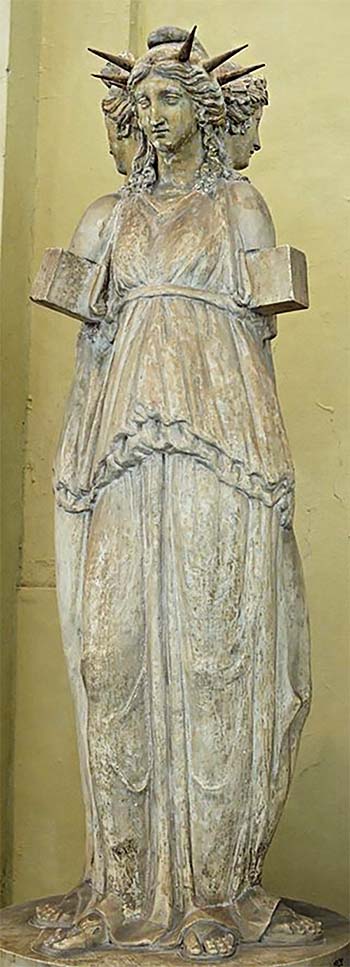
Hecate Chiaramonti
Hecate Chiaramonti, Roman copy of Greek original

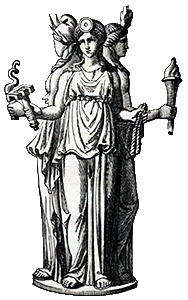
"Hecate possesses an extremely varied and elaborate set of symbols. She is three-bodied, sometimes with each iteration displaying different emotions. The triune imagery she conveys contains codes about the universe. There are a variety of triple concepts that Hecate is associated with, of which only some are: conception, planning, and execution; earth, sky, and sea;7 male, female, and union; the New Moon, the waxing Moon, and the waning Moon; and most importantly, creation, destruction, and maintenance. The three knots of the soul are also budged partially only by her command. Firstly, culturally and numerologically, the number three is the magic number.

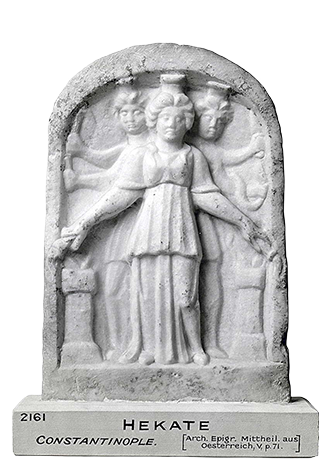
It was said the tradition of portraying Hecate in the form of a triple goddess originated with the great sculptor of divine forms, Alcamenes, as Pausanias attests.35 The general motif of a triple Hecate converging from a pole, known as a hekataion, was used at the shrines of crossroads as well as at the entrances to temples and even homes. This convention also spread into pottery and wall paintings. One thing this is evocative of is the trimester of pregnancy in women and the three major components of the uterus. Prior to modern imaging techniques, the conception of a baby was mysterious and scarcely understood. For those women seeking to conceive, Hecate was inquired of and strongly associated with the goddess of childbirth, Eileithyia, whose temple was placed adjacent to that of Hecate.35

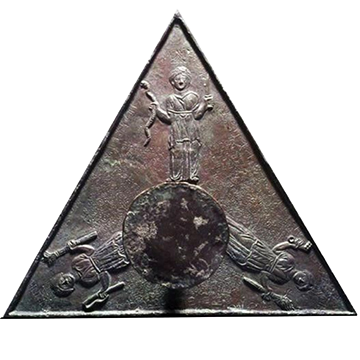
The trimesters of fetal development also relate to a larger allegory of human evolution. One of the symbols she is strongly equated with is the spiral triskelion and, by extension, the equilateral triangle.3637 For the triskelion (also a symbol of Thoth in its more active sense), this was equated with her ability to destroy, create, and maintain. She was also associated with 666, relating to the acquaintance of the higher self, and with the 60-degree angle.

Hecate Triangle

VI. Keys and Poisons

Like Abraxas, Hecate was known to hold keys, which is reflected in one of her titles, Kleidophoros (roughly "Key-Holderess"). Such keys held the designated recipe for practicing successful magic, but also the key to developing as a stronger being and to the boundary zone of the underworld itself.

She was associated with numerous poisonous and noxious plants like garlic,, aconite, possibly belladonna, mandrake (otherwise associated with Venus) and kinds of herbs often used in cosmetics, medicines and for subversive purposes, and Didorus Siculus' highly questionable account even claimed Hecate discovered these poisons while being a queen of the Tauric Chersonese; other authors show Medea crediting Hecate with picking the deadly herbs of the Colchian fields.38,39,40,41,42

Garlic as a noxious allium is surprisingly associated with cleansing properties, and can even be used to ward off severe infections like MRSA: the dualistic nature of garlic is much like the 'rotting' Hecate's oppositional symbolism as a primordial deity of soul cleansing. Wolfsbane or aconite was often used to manufacture poison arrows to kill wolves and crazed dogs; aconite was also used for assassination purposes. Belladonna leads to dilation of the eyes, a common trick to make oneself beautiful throughout the centuries, as if an act of immediate magic.

Hecate Familiar
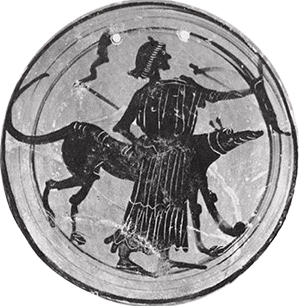
Hecate with dog, Museum der Universität Tübingen

VII. Canine, Animal Symbolism

Loyal dogs to their owners, particularly female dogs, are a symbol of Hecate, which Euripides describes as a sacred animal of hers.43 Dogs were used to dig up the mandrake plant, which was also used for both cosmetic and darker purposes. Female dogs can be erratic, emotionally sensitive, and independently minded, with a territorial edge toward other canines. Yet there is a sweeter and more contemplative side to them compared to their generally boisterous male counterparts, related to the psychic sensitivity of dogs. Their cycle of being in heat consists of proestrus, estrus, and diestrus.43,44

As an extension of the above concepts of motherhood, female dogs also fastidiously care for their young, who are extremely dependent on their mother and require a quiet environment to thrive. The faithfulness of dogs is also echoed in the canine myth. Lycophron claims that the dog following Hecate was Queen Hecuba of Troy, who had thrown herself into the sea in despair after seeing the bodies of her children and was transformed into a familiar due to Hecate's estimation of her loyalty. Much like with Anubis and Cerberus, the symbolism of the dog was suggestive of a faithfulness to life itself. Hecate is often depicted next to Cerberus, and one meaning of the keys she holds is to signal safe passage without being savaged by him.

The other major animals who were constantly by her side were European polecats, ancestors of modern ferrets. When Hera attempted to prevent the birth of Hercules by having the goddesses of childbirth (Eileithyia and the Fates) sit with crossed legs and fingers, Galanthis tricked them by shouting that the baby was born. The startled goddesses jumped up, breaking the spell, and Hercules was delivered. As punishment for her trickery, the goddesses turned Galanthis into a polecat.45

According to Antoninus, Hecate felt pity for her comrade and appointed the polecat as her sacred attendant or "sacred servant." Polecats pierce the skulls of other animals and leave them, still living, in their burrows for consumption. They are also silent and habitual occupiers of the dens of other animals, being known as one of the worst pests to farmers imaginable for their sneakiness. These animals also secrete a foul-smelling liquid to delineate their territory. Polecats are also far-seeing animals with exceptional vision and scent capabilities. Due to these behaviors, they were considered to be thoughtful yet malicious animals with an appropriate understanding of the past and future, suitable attendants for the Goddess of Time, who could put their powers to better use.

Another major animal is the lion,27 who serves as a companion for Hecate in deeply occult contexts, and the serpent, which is often represented growing out of her forearm or even her head. On vases and in statuary, Hecate was commonly represented carrying two torches and sometimes possessing dualistic symbolism. These torches represent the ida and pingala, but also carry a nuanced meaning of patiently finding one's way through the labyrinth of civilization, illusions, and distractions to arrive at the authentic higher self. Gripping the two torches requires balance: distraction and carelessness lead to the torches being snuffed out, and losing oneself in darkness.

VIII. Archetypal Witch in

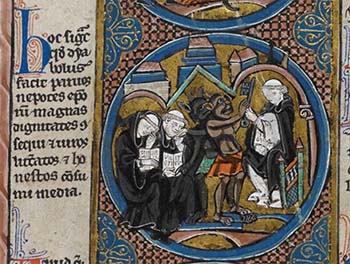
Hecate features in a wide variety of Christian writings that denounce her worship, and the worship of the trivium, as extremely dangerous and evil. Audoin in the 7th century warns against placing votive objects, while Byzantine sources indicate efforts to stamp out her worship as late as the 11th century at crossroads in Greece. She was also maligned due to her close association with Aphrodite in the form of Artemis. Consequently, she remained one of the most famous pagan Gods altogether during medieval times.46

Daemons with keys, Harley MS 1526
‘Daemons’ with keys, Harley MS 1526 f.4v

As Hera was more exclusively denounced by the Yehuboric in their circles, and the public worship of Aphrodite was torn down, while other goddesses became associated with symbols such as cats, Hecate functioned as a visible, human-bodied shorthand for goddesses in general, partially due to her ambiguous portrayal in surviving Greek and Roman works. The Christian imagination portrayed her as the patroness of all witches and the black mass. One of the most famous portrayals of her is in Macbeth, which both the playwright William Shakespeare and the master Bacon contributed to. The two writers were influenced by a recent religious tractate (Daemonologie) by King James.

He wrote a Puritanical treatise on the Witch of Endor, stating his fear of demonic forces and witches, asserting that magick was absolutely real and that the interpretation of many contemporary Protestants claiming it was not, was incorrect. The Weyward Sisters (commonly known as the Three Witches) function as Hecate’s servants, bringing visions to the evil-minded Macbeth and the ill-fated Banquo. They speak pointedly, in analogy to the Goddess’s contradictory attributes48

Macbeth, William Shakespeare48

Fair is foul, and foul is fair…

Although the play portrays Hecate as a force, it correctly shows her admonishing the Sisters for playing with Macbeth for their own amusement. Furious, she pledges to push Macbeth toward his destiny by her weapons and designs. In the end, he sees a vision of the children and wife of Macduff murdered at his command before he himself is cut down. The writers carefully portrayed Hecate as not merely deploying magic for the purpose of chaos, but for the purpose of drawing out evil, subtly contradicting the Jacobean perspective:

Hecate's speech in Macbeth, William Shakespeare48

He shall spurn fate, scorn death, and bear

His hopes ‘bove wisdom, grace, and fear.

And you all know, security

Is mortals’ chiefest enemy.

Hecate is also mentioned in A Midsummer Night’s Dream and King Lear. Alongsid Artemis, she is considered to be important to witches and modern practitioners of magic. A peculiar kind of modern testament to Hecate’s influence appears in many horror films or survival genre media, often in the personification of the ‘final girl,’ perhaps beginning with Britomart in The Faerie Queene (an allegory for Elizabeth I)51 and Mina Harker in Bram Stoker’s novel Dracula. Such girls and women in media must use their minds and observational skills and sometimes the powers of magic to outwit a murderous one stalking them or to survive in a dangerous environment that threatens to collapse on them. Many of these themes also overlap with the mythological trials of Psyche, a related goddess.49,50,51

Bibliography:

1 Beekes, Robert S. P. Etymological Dictionary of Greek. Leiden: Brill, 2010, s.v. “Ἑκάτη”; Chantraine, Pierre. Dictionnaire étymologique de la langue grecque: Histoire des mots. Paris: Klincksieck, 1968–1980, s.v. “Ἑκάτη,” “ἕκας.”

2 Hesiod. Theogony; Works and Days; Testimonia. Edited and translated by Glenn W. Most. Loeb Classical Library 57. Cambridge, MA: Harvard University Press, 2018. Theogony 411–452.

3 Liddell, Henry George, Robert Scott, Henry Stuart Jones, and Roderick McKenzie. A Greek-English Lexicon. 9th ed. Oxford: Clarendon Press, 1940, s.v. “ἑκάς,” “Ἑκατός,” “Ἑκάτη.”

4 Apollodorus. The Library. Vol. 1. Translated by James George Frazer. Loeb Classical Library 121. Cambridge, MA: Harvard University Press, 1921.

5 Staatliche Museen zu Berlin, Antikensammlung. The Pergamon Altar. Berlin: Staatliche Museen zu Berlin, Antikensammlung.

6 Homeric Hymns. Homeric Apocrypha. Lives of Homer. Edited and translated by Martin L. West. Loeb Classical Library 496. Cambridge, MA: Harvard University Press, 2003. Homeric Hymn to Demeter.

7 Metropolitan Museum of Art. “Terracotta Bell-Krater (Bowl for Mixing Wine and Water).” Accession record, The Met Collection.

8 Ronan, Stephen, ed. The Goddess Hekate: Studies in Ancient Pagan and Christian Religion & Philosophy. Vol. 1. Hastings: Chthonios Books, 1992.

9 Homer. The Odyssey. Translated by A. T. Murray, revised by George E. Dimock. Loeb Classical Library 104–105. Cambridge, MA: Harvard University Press, 1995.

10 Hesiod. Theogony; Works and Days; Testimonia. Edited and translated by Glenn W. Most. Loeb Classical Library 57. Cambridge, MA: Harvard University Press, 2018.

11 Aeschylus. Persians. Seven against Thebes. Suppliants. Prometheus Bound. Edited and translated by Alan H. Sommerstein. Loeb Classical Library 145. Cambridge, MA: Harvard University Press, 2009. Suppliant Women.

12 Aeschylus. Fragments. Edited and translated by Alan H. Sommerstein. Loeb Classical Library 505. Cambridge, MA: Harvard University Press, 2009. Fragment 216.

13 Euripides. Cyclops. Alcestis. Medea. Edited and translated by David Kovacs. Loeb Classical Library 12. Cambridge, MA: Harvard University Press, 1994. Medea.

14 Euripides. Trojan Women. Iphigenia among the Taurians. Ion. Edited and translated by David Kovacs. Loeb Classical Library 10. Cambridge, MA: Harvard University Press, 1999. Trojan Women.

15 Campbell, David A., ed. and trans. Greek Lyric I: Sappho and Alcaeus. Loeb Classical Library 142. Cambridge, MA: Harvard University Press, 1982. Fragment 23.

16 Sophocles. Fragments. Edited and translated by Hugh Lloyd-Jones. Loeb Classical Library 483. Cambridge, MA: Harvard University Press, 1996. Rhizotomoi fragments.

17 Johnston, Sarah Iles. Hekate Soteira: A Study of Hekate’s Roles in the Chaldean Oracles and Related Literature. American Classical Studies 21. Atlanta: Scholars Press, 1990.

18 Euripides. Helen. Phoenician Women. Orestes. Edited and translated by David Kovacs. Loeb Classical Library 11. Cambridge, MA: Harvard University Press, 2002. Helen.

19 Propertius. Elegies. Edited and translated by G. P. Goold. Loeb Classical Library 18. Cambridge, MA: Harvard University Press, 1990.

20 Lowe, J. E. Magical Hekate. Section cited: Hecate’s occult and animal symbolism.

21 Orphic Hymns. Edited and translated by Apostolos N. Athanassakis and Benjamin M. Wolkow. Baltimore: Johns Hopkins University Press, 2013. Hymn 1, To Hecate, lines 1, 6–8.

22 Sophocles. Fragments. Edited and translated by Hugh Lloyd-Jones. Loeb Classical Library 483. Cambridge, MA: Harvard University Press, 1996. Fragment 311 Radt, Clytemnestra, “ἀνταία θεός.”

23 Karataş, Ayşe Sibel M. “The Temple Key as a Symbol of Priestly Authority.” Mythos 13 (2019). Section cited: discussion of LSAM 50, lines 25–26, 28–29, “παρ’ Ἑκάτῃ τῇ πρόσθεν πυλέων.”

24 Apollonius Rhodius. Argonautica. Edited and translated by William H. Race. Loeb Classical Library 1. Cambridge, MA: Harvard University Press, 2009. 3.861–62, 1211.

25 New York University, Institute of Fine Arts. “Selinunte, Italy.” Archaeology Program site description.

26 Limberis, Vasiliki. Divine Heiress: The Virgin Mary and the Creation of Christian Constantinople. London: Routledge, 1994.

27 Bachvarova, Mary R. “Hecate: An Anatolian Sun-Goddess of the Underworld.” Working paper, 2010.

28 Stratonikeian decree. Sanctuary of Hecate at Lagina. Section cited: choruses and ritual activity associated with Lagina.

29 Strabo. Geography. Vol. 5, Books 10–12. Translated by Horace Leonard Jones. Loeb Classical Library 211. Cambridge, MA: Harvard University Press, 1928.

30 Lagina frieze with Hecate and Zeus Panamaros. Archaeological evidence from the Sanctuary of Hecate at Lagina.

31 Dionysius of Byzantium. Anaplus Bospori / Dionysii Byzantii De Bospori Navigatione quae Supersunt. Edited by Rudolf Güngerich. Berlin: Weidmann, 1927.

32 Orphic Hymns. Edited and translated by Apostolos N. Athanassakis and Benjamin M. Wolkow. Baltimore: Johns Hopkins University Press, 2013. Hymn 1, To Hecate.

33 Suda On Line: Byzantine Lexicography. Edited by David Whitehead et al. Section cited: entry on Zerynthia/Zerynthos and Hecate.

34 Aristophanes. Birds. Lysistrata. Women at the Thesmophoria. Edited and translated by Jeffrey Henderson. Loeb Classical Library 179. Cambridge, MA: Harvard University Press, 2000. Thesmophoriazusae.

35 Pausanias. Description of Greece. Vol. 1, Books 1–2. Translated by W. H. S. Jones. Loeb Classical Library 93. Cambridge, MA: Harvard University Press, 1918.

36 Betz, Hans Dieter, ed. The Greek Magical Papyri in Translation, Including the Demotic Spells. 2nd ed. Chicago: University of Chicago Press, 1992.

37 Plutarch. Moralia. Vol. 12. Translated by Harold Cherniss and William C. Helmbold. Loeb Classical Library 406. Cambridge, MA: Harvard University Press, 1957. On the Face Which Appears in the Orb of the Moon.

38 Theophrastus. Characters. Herodas. Cercidas and the Choliambic Poets. Edited and translated by Jeffrey Rusten and I. C. Cunningham. Loeb Classical Library 225. Cambridge, MA: Harvard University Press, 2003. Characters.

39 Diodorus Siculus. Library of History. Vol. 3, Books 4.59–8. Translated by C. H. Oldfather. Loeb Classical Library 340. Cambridge, MA: Harvard University Press, 1939.

40 Theophrastus. Enquiry into Plants. Vol. 1. Translated by Arthur Hort. Loeb Classical Library 70. Cambridge, MA: Harvard University Press, 1916.

41 Apollonius Rhodius. Argonautica. Edited and translated by William H. Race. Loeb Classical Library 1. Cambridge, MA: Harvard University Press, 2009.

42 Valerius Flaccus. Argonautica. Edited and translated by J. H. Mozley. Loeb Classical Library 286. Cambridge, MA: Harvard University Press, 1934.

43 Euripides. Fragments: Aegeus–Meleager. Edited and translated by Christopher Collard and Martin Cropp. Loeb Classical Library 504. Cambridge, MA: Harvard University Press, 2008. Peliades.

44 Josephus. The Jewish War. Vol. 3, Books 5–7. Translated by H. St. J. Thackeray. Loeb Classical Library 210. Cambridge, MA: Harvard University Press, 1928.

45 Antoninus Liberalis. The Metamorphoses of Antoninus Liberalis: A Translation with Commentary. Translated by Francis Celoria. London: Routledge, 1992.

46 Audoin. Vita Eligii. In Monumenta Germaniae Historica, Scriptores Rerum Merovingicarum. Section cited: prohibitions against votive practices at crossroads.

47 James VI and I. Daemonologie. Edinburgh: Robert Waldegrave, 1597.

48 Shakespeare, William. Macbeth. Edited by A. R. Braunmuller. The New Cambridge Shakespeare. Cambridge: Cambridge University Press, 1997.

49Shakespeare, William. A Midsummer Night’s Dream. Edited by Harold F. Brooks. Arden Shakespeare, 2nd series. London: Methuen, 1979. Section cited: 5.1.390, “By the triple Hecate’s team.”

50Shakespeare, William. King Lear. Edited by R. A. Foakes. Arden Shakespeare, 3rd series. London: Arden Shakespeare, 1997. Section cited: 1.1.112, Lear’s oath “by the mysteries of Hecate and the night.”

51Spenser, Edmund. The Faerie Queene. Edited by A. C. Hamilton. 2nd ed. Revised by Hiroshi Yamashita and Toshiyuki Suzuki. London: Routledge, 2001. Section cited: book 7, canto 7, stanza 47, on Hecate in Spenser’s mythological catalogue.