



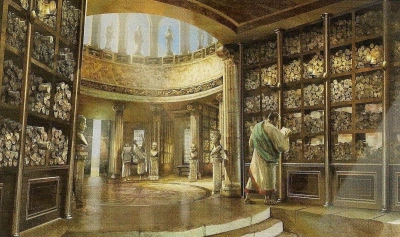
| Language / Culture | Name of Heracles | Attestation |
|---|---|---|
| Classical Greek | Ἡρακλῆς (Hēraklēs) | Homer, Hesiod, inscriptions (8th century BCE onward) |
38 min read
HERACLES
author: High Priest Zevios Metathronos
co-author: Novice Priest Karnonnos
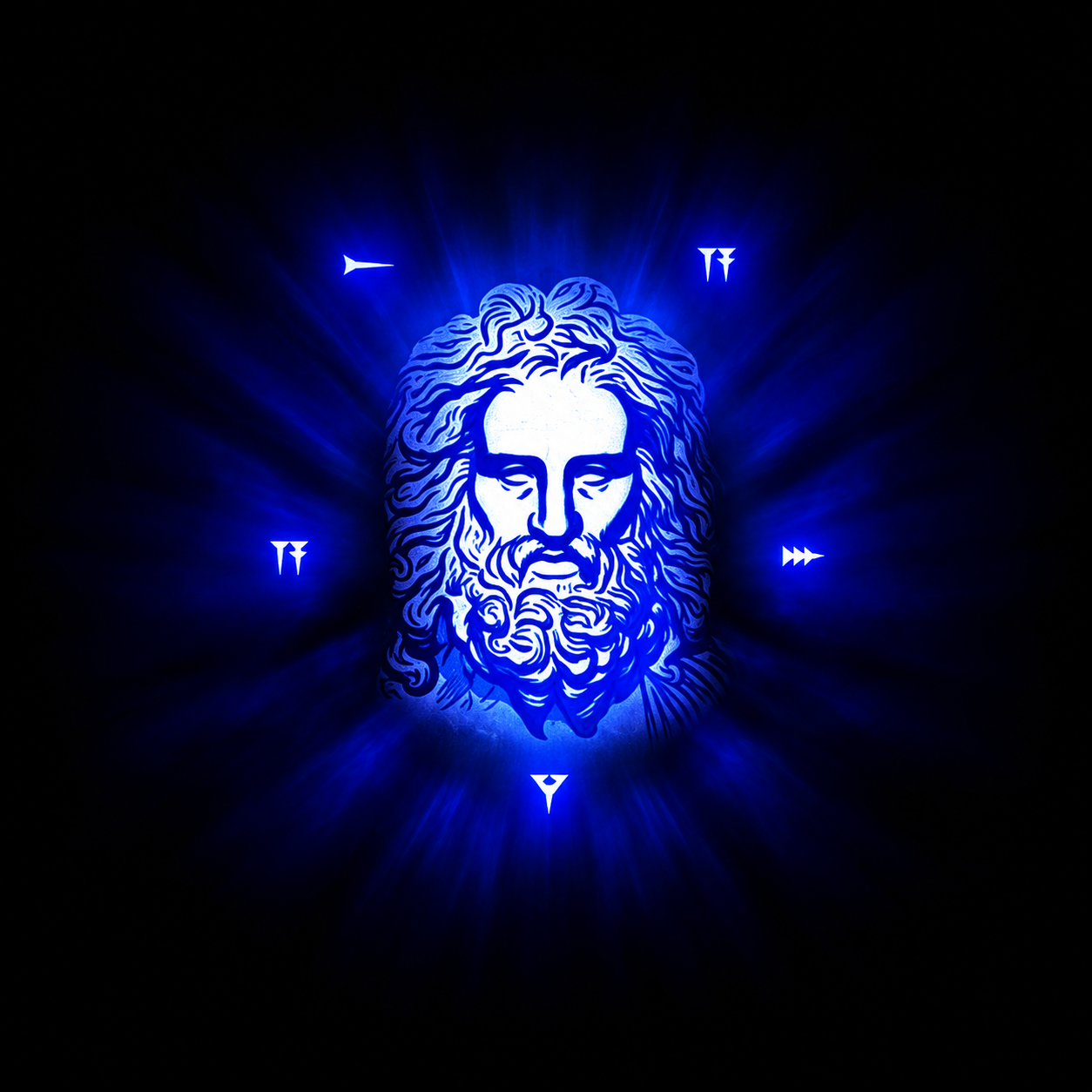
Hieratic Information about Heracles
| Divine Names | |
|---|---|
| Heracles (Ἡρακλῆς) | the ancient Hellenic name |
| These hieratic names carry strong spiritual resonance and are recommended for summoning and invocation practices. | |
| Divine Symbols | |
| |
| Divine Numbers and Attributes | |
| Sacred Numbers | 40, 50, 60 |
| Runes | Thurisaz, Tiwaz, Sowilo (in order of importance) |
| Zodiac Sign of Power | Aries |
| Sacred Animals | The Great Eagle, the Bull, the Hawk, the Serpent |
| Element | Fire, Aether |
| Divine Forces | |
| |
| Important Titles | |
| |
| Names Across Civilizations | |
| Greek | Heracles (Ἡρακλῆς ) |
| Roman | Hercules |
I. The Names of Heracles
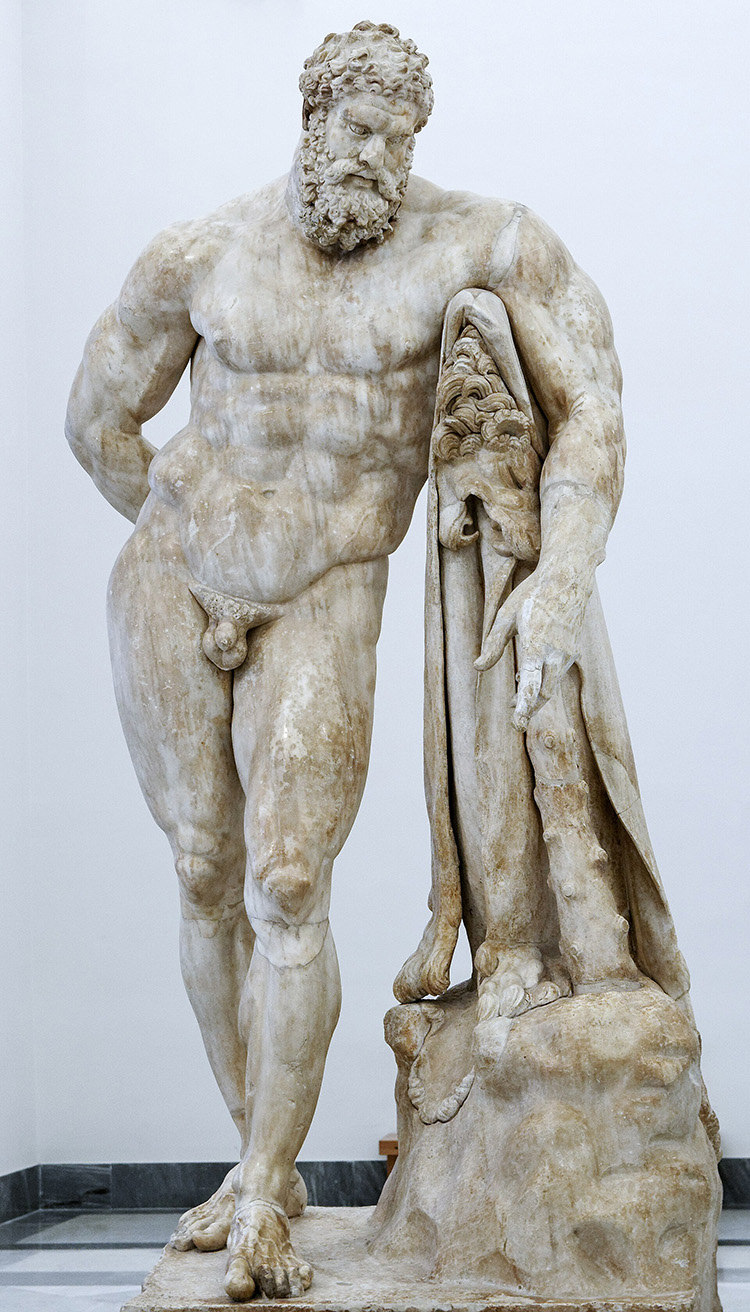
The name of Heracles (Ἡρακλῆς, epic Ἡρακλέης) means the glory of Hera, and this appellation, given the central antagonism of the vengeful goddess towards him in myth, has perplexed scholars for centuries, though most classical historians accept the derivation without demur. The industrious Diodorus Siculus writes that after Hera had sent the serpents against the infant, the Argives named him Heracles because he had gained kleos by reason of Hera, whereas he had earlier been called Alcaeus after his grandfather. Apollodorus preserves the same movement of names, adding that the child once called Alcides received the name Heracles from the Pythia at Delphi.
The ancients themselves were not of one mind. The Byzantine Etymologicum Magnum, compiled at Constantinople in the twelfth century CE, records that the name comes not from the glory that Hera bestowed, as many hold, but rather from the disrepute into which her attempts to destroy him brought the hero; the paradox is thus already ancient, that the persecutor names the persecuted. A further ancient derivation, harder to trace to any single securely identifiable source, connected the name instead to ἔρα in the sense of dutiful service, reading Heracles as the one defined wholly by the labors he performs under command.1,2,3
Modern philology focuses on on the first element with peculiar interest. Following Walter Pötscher, some scholars connect the name of Hera herself to ὥρα, the ripe season and by extension the year, so that the glory of Hera becomes the glory of the appointed time, and the lifelong quarrel of the hero with the goddess figures a struggle against time itself.4
The etymology of Hera remains genuinely disputed; Robert Beekes classes the divine name among the words of uncertain, probably Pre-Greek origin. Walter Burkert likewise treats the derivation as unsettled while granting that the hero and the goddess are bound in a single name. His original name, Alcaeus, was bestowed for his strength; the name he carries into eternity was bestowed by his enemy.5,6
Sources: Diodorus Siculus, Library of History 4.10, for the naming and the earlier name Alcaeus;1 the Etymologicum Magnum, for the disrepute derivation;3 Herodotus, Histories 2.44, for the identification with Tyrian Melqart;7 and Nancy Thomson de Grummond, Etruscan Myth, Sacred History, and Legend, for the Etruscan Hercle.8
II. Heracles in the Earliest Poetry
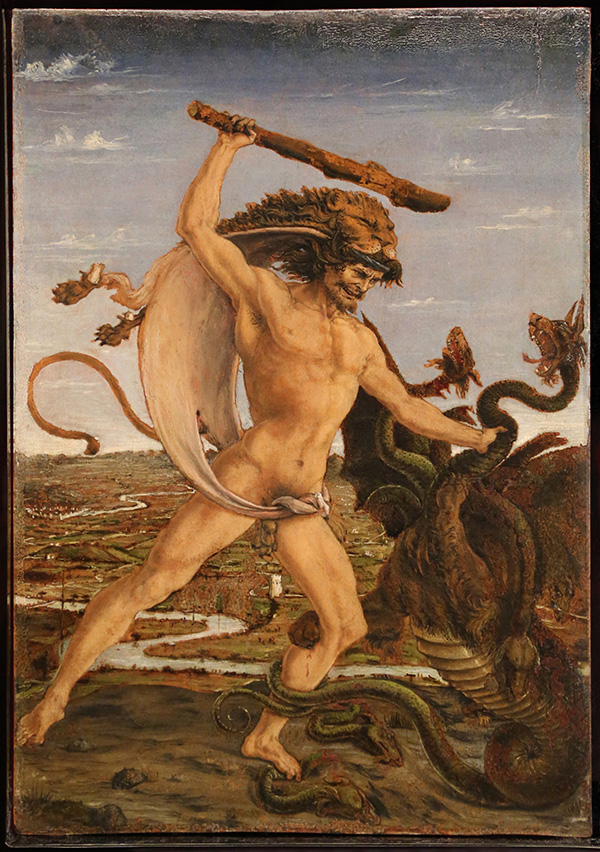
The Iliad
The Heracles of the Iliad is already a figure of the past, a paradigm invoked rather than a hero present. In the ninth year of the war Agamemnon confesses his blindness by recalling how Zeus was himself deceived on the day that mighty Heracles was to be born; the goddess Ate deluded the Father of Gods and Men, and cunning Hera hastened the birth of the feeble Eurystheus and held back the labor of Alcmene, so that the boastful oath of Zeus fell upon the lesser cousin. The sting of the tale is that the greatest of heroes lost, before he drew breath, the kingship his own father had promised him.
Homer knows too the violence of the hero against the very Olympians. Dione consoles the wounded Aphrodite by remembering that indomitable Heracles once struck Hera in the right breast with a three-barbed arrow, and that he wounded Hades among the dead at Pylos; even the Gods, Homer implies, were not beyond the reach of that bow. Yet the poet is unflinching about the hero's mortality. When Achilles is warned of his own death he answers that not even the might of Heracles escaped the common doom, dearest though he was to Lord Zeus, for fate and the grievous wrath of Hera subdued him.9
The Odyssey
In the underworld book of the Odyssey the wandering Odysseus meets the phantom of Heracles among the crowding dead, a shade terrible as advancing night with his bow forever bent; and the poet at once corrects himself with the most consequential sentence the hero ever received.10 The image of Heracles walks in Erebus, but the hero himself feasts among the immortal Gods and holds neat-ankled Hebe for his wife.10 Here for the first time the demigod is divided in two, the dark eidolon below and the deathless self above, and the whole later theology of his apotheosis is compressed into a single Homeric line.
The Homeric Hymn
The fifteenth Homeric Hymn, brief and grave, salutes Heracles as the son of Zeus and the mightiest of men upon the earth, whom fair-girdled Alcmene bore in Thebes of the seven gates.11 The hymn compresses the entire career into three movements: the wandering over land and sea beneath the yoke of Eurystheus, the many deeds accomplished and the much suffered, and the present rest in the beautiful house of snowy Olympus beside Hebe.11 The labor is stated as the precondition of the peace, and the sequence of the whole life is already fixed.
Hesiod
Hesiod gives the hero a cosmic frame. The Theogony sets him among the slayers of primeval monsters, loosing the eagle from the liver of Prometheus, cutting down the Lernaean Hydra whom white-armed Hera had reared, and destroying the Nemean Lion that Hera settled upon the hills to be a plague to men.
The same poem grants him at its close the reward that Homer only touches the margins of, a life among the immortals, untroubled and ageless for all his days, with Hebe the daughter of great Hera to wife. The pseudo-Hesiodic Shield adds the ferocious duel with Cycnus the son of Ares, and preserves in its proem the tale of Alcmene and the disguised Zeus. Hera makes the monsters and Heracles unmakes them.12,13
The Orphic Hymn and the Meaning for Initiates
The twelfth Orphic Hymn lifts the hero out of biography altogether and addresses him as a cosmic power. Heracles is hailed as an almighty Titan of shifting form, self-born, the archer who devours all things, the deliverer to whom mankind prays, and, most tellingly, as the father of time.14 The scholiastic tradition on the hymn reads the twelve labors as the twelve hours that run from each sunrise to each sunset, and the hymn itself sets Dawn and black Night upon the hero's head, so that the labors become the turning of the day and the year.14
Ἥρακλες ὀμβριμόθυμε, μεγασθενές, ἄλκιμε Τιτάν,
αἰολόμορφε, χρόνου πάτερ, ἀίδιέ τε καὶ εὔφρων.
Heracles mighty-hearted, great in strength, valiant Titan;
of shifting form, father of time, everlasting and kindly.
Orphic Hymn 12, to Heracles
For the initiate the meaning is plain and it is not the meaning of the marketplace. The hero who wins glory through Hera, the goddess of the ripe season, is the soul that masters time by passing through its whole circuit of toils and emerges deathless on the far side; his club is the arm that drives away the diseases and the savage cares of mortal life, and his twelve labors are the ascent of a single day from darkness into the resplendent light.14 To the crowd Heracles was strength; to the initiate he was the pattern of the soul that does not die.
III. The Epithets of the Deified Hero
Heracles held the rare double station of hero and God, and his cult titles record both the wandering laborer and the Olympian deliverer.15 Lewis Richard Farnell made this duality the centre of his study, observing that the Greeks sacrificed to Heracles now with the dark rites owed to a hero and now with the bright rites owed to a God, sometimes upon the same day and at the same altar.15 The Stoic Cornutus, whose allegory the later Platonists inherited, derived several of the titles from the hero's saving function, reading Alexikakos and Kallinikos as the offices of the reason that averts evil and conquers cleanly.16
| Epithet | Meaning | Domain |
|---|---|---|
| Heracles Alexikakos (Ἀλεξίκακος) | Averter of Evil | Protection, aversion of plague and harm |
| Heracles Kallinikos (Καλλίνικος) | Gloriously Victorious | Triumph, the victory cry of the games |
| Heracles Soter (Σωτήρ) | The Savior | Deliverance, civic protection |
| Heracles Kynosarges (Κυνόσαργες) | Of the White Dog | Athenian sanctuary of the nothoi |
| Heracles Buphagos (Βουφάγος) | The Ox-Eater | Gigantic appetite, sacrificial abundance |
| Heracles Melon (Μῆλον) | Of the Apples / Flocks | The Hesperides, pastoral increase |
| Heracles Dactylus Idaeus (Δάκτυλος Ἰδαῖος) | The Idaean Dactyl | Elis and Olympia, the elder Heracles |
| Heracles Palaimon (Παλαίμων) | The Wrestler | The palaestra, contests of strength |
| Heracles Ipoktonos (Ἰποκτόνος) | Slayer of Vine-Worms | Agriculture, aversion of pests |
| Heracles Mēkistēs (Μήκιστος) | The Tallest | Magnitude, heroic pre-eminence |
| Heracles Prodromos (Πρόδρομος) | The Forerunner | Roads, the leading of armies |
| Heracles Charops (Χάροψ) | The Fierce-Eyed | Boeotia, the descent to Hades |
Sources: Pausanias, Description of Greece, for the local cult titles at Athens, Olympia, Sikyon, and Boeotia;17 Cornutus, Greek Theology 31, for the allegory of Alexikakos and Kallinikos;16 and Lewis Richard Farnell, Greek Hero Cults and Ideas of Immortality, for the double cult of hero and God.15, 16, 17
IV. Temples and Shrines
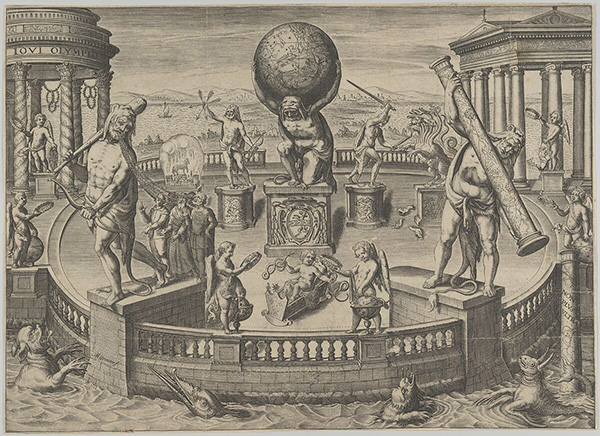
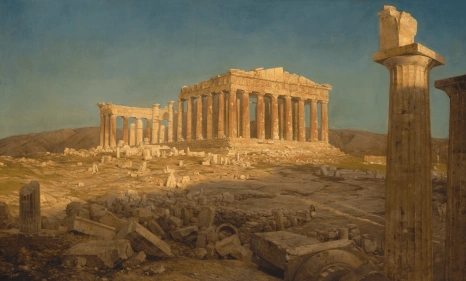
Heracles was worshipped across the whole Greek and Phoenician world, and four sanctuaries in particular reveal the range of the cult, from his Boeotian cradle to the pillars at the edge of the western sea. The pattern that emerges is instructive: where the Greeks found the hero, they built a hero-shrine, and where they found the Phoenician Melqart, they built a temple to a God.
Thebes
Thebes of the seven gates claimed the hero as her own son, and the sanctuary there was the chief Heracleum of central Greece. Pausanias describes the precinct with its gymnasium and stadium both named after the hero, the ancient house said to belong to Amphitryon, and cult images of high artistry, including a Heracles by Praxiteles and older figures besides.17 Here the Theban Iolaeia and Herakleia were celebrated, binding the hero to his nephew and charioteer Iolaus. The birthplace kept the memory of the mortal boy even as it honoured the God.
Athens
Outside the walls of Athens, near the Ilissos and the Diomeian gate, lay the Kynosarges, a grove, gymnasium, and sanctuary of Heracles whose name recalls an oracle of the white dog.17 The place was marked out for those of ambiguous birth: Plutarch reports that the aliens and the nothoi resorted there precisely because Heracles too had something foreign in him, being born of a mortal mother.18 Altars stood to Heracles and to Hebe his bride, and a shared altar to Alcmene his mother and Iolaus his helper.17 The half-Olympian was the fitting patron of the half-citizen.
Thasos
On the northern island of Thasos stood a temple that Herodotus judged older than any Greek shrine of the hero. Sailing in pursuit of the truth, Herodotus found at Thasos a temple of Heracles founded by the Phoenicians five generations before the birth of the Greek hero, and he assumed that the Thasians had first worshipped the Tyrian God and only later adopted Heracles the son of Amphitryon. The sanctuary was excavated between 1932 and 1934 by Marcel Launey, whose study remains the foundation for the cult; the Thasians themselves dedicated a colossal bronze Heracles at Olympia, ten cubits high, holding a club and a bow.7,17,19
Gades
At the far western limit of the known world, beyond the Pillars that bore the hero's name, rose the most famous of all his sanctuaries. The Temple of Hercules Gaditanus at Gades, the modern Cádiz, was in origin the temple of Tyrian Melqart, perhaps founded as early as the eighth century BCE, and it flourished in turn under Phoenician, Carthaginian, and Roman lords. Strabo describes its situation and its rites at the mouth of the ocean, and later Romans, Hannibal and Caesar among them, came to sacrifice at the threshold of the western sea.20
V. His Origins
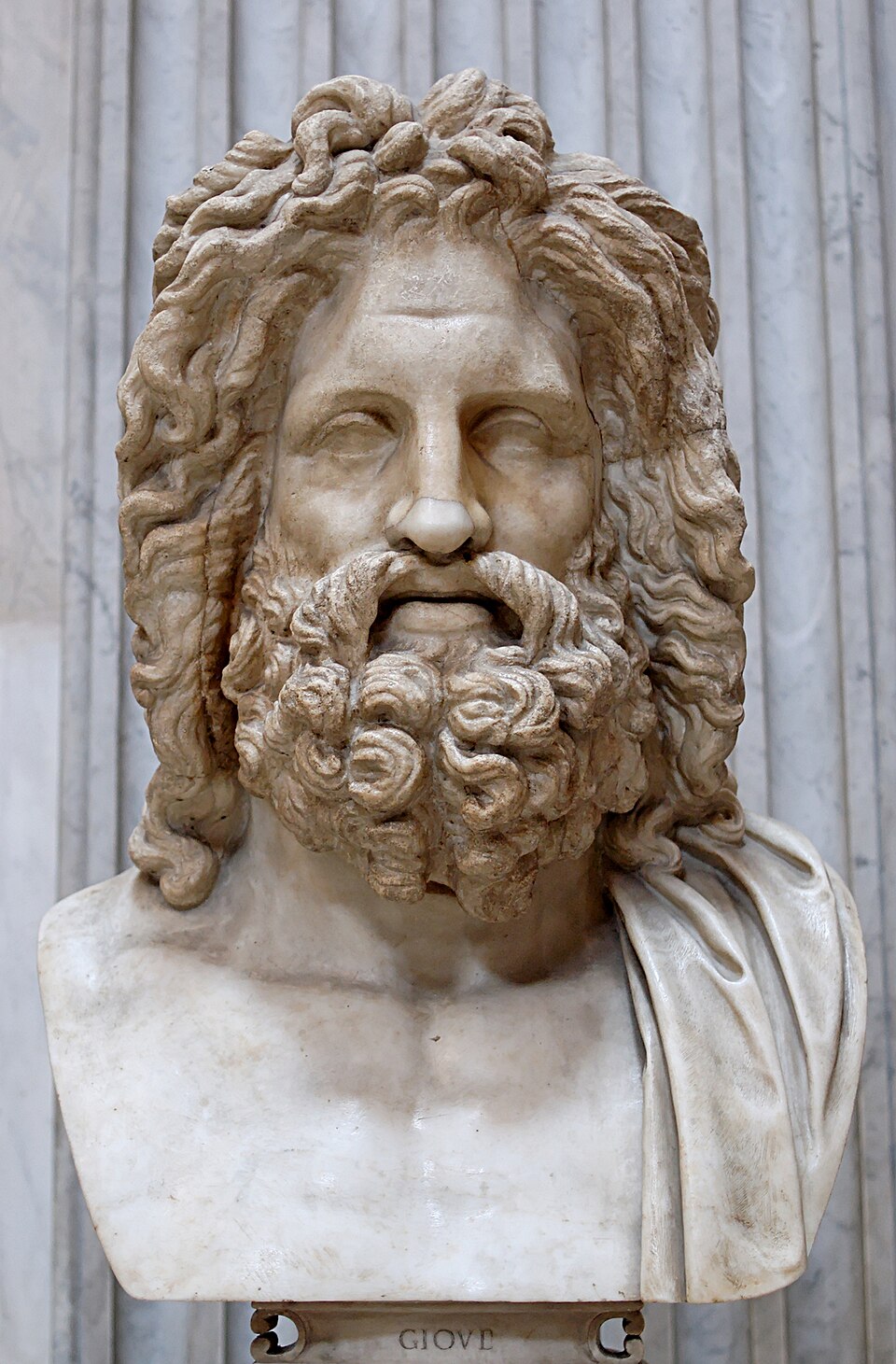
Heracles is the most beloved of the demigods, being as it were one of the few mortals to reach starry Olympus itself. As the veritable Son of Zeus, known also to the Etruscans as Hercle and to the Romans most famously as Hercules, his name became a by-word for strength and masculine power that remains embedded in the Western consciousness two thousand years after his heyday, and his labors against terrifying monsters furnish some of the most famous episodes of Greco-Roman myth, which have continually inspired the written epics for generations of men. In antiquity too, Heracles was among the most popular of the gods, and his symbolic status of divine heroism wedded to ultimate power made royalty anxious to be placed in his midst.
Beneath this virtuous symbolism, however, lies a code for the Magnum Opus, the pursuit of apotheosis, the forging of oneself into godhood. Emma Stafford has traced how thoroughly the hero saturated ancient life, from the humblest apotropaic image set at a doorway to the dynastic propaganda of kings who styled themselves his descendants. The usual biographical details set his descent from Perseus, sometimes as the great-grandson of that primordial hero of Greece, so that the soon-to-be-born hero stands to inherit the kingdom. The strong man of the crowd and the initiate's paradigm of ascent are the same figure, read at two depths.8,2,21
VI. The Epics of Heracles
The mythological career of Heracles came down through several distinctive and rather divergent narrative accounts. The primary source that many classical authors take as definitive is the Heracleia, or Deeds of Heracles, a long epic of two books by Peisander of Rhodes, of which the majority is lost. Another Heracleia, ascribed to Panyassis of Halicarnassus, ran supposedly to fourteen books; Victor Matthews, editing the fragments, reckons Panyassis among the last of the true epic poets.
Those were scarcely the only ones. Pherecydes of Athens wrote a substantial prose account of the hero's childhood, and Herodorus of Heraclea composed an epic of some seventeen books; both survive only in the citations gathered by Robert Fowler among the early Greek mythographers. These works are largely lost. The longest continuous account to reach us is the historical compendium of the tireless Diodorus Siculus, while the handbook of Apollodorus envelops most of the competing traditions into a single ordered narrative.1,2,22,23
VII. The Birth and the Contest for the Kingdom
The biographical details outline Heracles' descent from Perseus, sometimes as his great-grandson, the inheritor of the primordial hero of Greece, so that the soon-to-be-born hero stands to inherit the kingdom.2 The Iliad claims that Hera delayed his birth.9 In the settled tradition, Heracles is a twin delivered alongside Iphicles, and the rest of the parentage myth is stable. For Hesiod, Zeus lies with his mother Alcmene of the Perseid line in the form of her husband Amphitryon, and Iphicles alone is the son of the mortal father.13
Pindar's first Nemean Ode broadens the scene considerably as Hera sends serpents against the newborn twins. The infant Heracles strangles them, whereupon the seer Tiresias announces the child's future greatness and his appointed part in the Gigantomachy. In the twenty-fourth Idyll of Theocritus the same night is dramatised at length, and the household is given occult instructions to ward off the enraged mother goddess. The account of Apollodorus gathers up most of these strands, though it should be noted that Hesiod does not mention the serpents being sent by Hera, and neither does Pherecydes.2,24,25,26
In most versions Hera plans to obstruct the birth so that his feeble cousin Eurystheus may gain the kingdom instead, and the plan is foiled by the maiden Historis or Galanthis, who is turned into a weasel for her trouble. Nonetheless Heracles is born after his cousin and stands second in line to the throne. In both the Iliad tradition and Apollodorus the oath of Zeus is that the next heir of the Perseid house shall be king, and the wording is broad enough to be exploited; Hera wins by making the formula fall upon Eurystheus. The sting of the story is that Heracles loses the kingship Zeus meant for him, and the twin Iphicles, never the target of the boast, has no part in the contest.2,9,17
VIII. The Antagonism of Heracles and Hera
The quarrel that gives the hero his name is the engine of his whole legend. Diodorus explains that Hera pursued Heracles from the womb out of jealousy at the infidelity of Zeus, delaying his birth, sending the serpents, and at last driving him to the crime that necessitated the labors.1 Euripides gives that crime its most terrible form: the goddess dispatches Lyssa, the spirit of madness, and the maddened Heracles slaughters his own children, so that the labors become an expiation and the persecutor is revealed as the maker of the very glory she meant to deny.27
Yet the antagonism conceals a stranger intimacy. A widespread tradition held that Heracles was briefly set to the breast of the sleeping Hera, and that the milk which spurted forth when the infant bit down became the Milky Way across the heavens; the same nursing was said to have made him immortal.1 Eratosthenes and Hyginus preserve the celestial version, in which the galaxy itself is the trace of the hero's contact with his enemy.28, 29 The goddess who labors to kill him is the goddess whose milk deifies him.
Above all, the Gods needed him. The oracle preserved by Apollodorus and echoed by Pindar declared that the Olympians could not overcome the earth-born Giants without the aid of a mortal, and Heracles was that mortal, loosing his arrows beside Zeus in the Gigantomachy.2, 25 The reconciliation was therefore written into the cosmos from the first. Hera made war on Heracles for a lifetime; heaven could not be saved without him.
IX. The End of Heracles
The death of the hero is among the most harrowing in Greek poetry, and Sophocles made of it the tragedy of the Trachiniae. In some of the myths like this, the dying centaur Nessus, shot through by Heracles for assaulting his wife Deianeira at the river, had persuaded the ill-starred woman to keep his clotted blood as a charm to secure her husband's love. When Deianeira fears the loss of Heracles to the captive Iole, she smears the blood upon a festal robe and sends it to him by the herald Lichas, not knowing that the centaur's blood is poisoned with the venom of the Lernaean Hydra.30
The poison works upon the flesh of the hero as fire works upon metal. Apollodorus and Diodorus recount how the robe clings and burns, how Heracles in agony flings the innocent Lichas into the sea, and how Deianeira, learning the truth, takes her own life. Ovid rendered the scene with pitiless detail, the sweat that boils, the sinews that hiss, the marrow that melts, as the strongest of men is undone by a gift given in love. The invincible body, which no lion's tooth nor giant's blow could pierce, is dissolved from within.1,2,31
At the last the hero commands his own end. Upon the summit of Mount Oeta in Trachis he raises a great pyre of oak and wild olive, lays himself upon it, and begs that it be kindled; when none will do the deed, the young Philoctetes lights it in exchange for the hero's bow and arrows, and the flames rise. Seneca, in the Hercules Oetaeus, gives the burning hero a Stoic serenity, untroubled amid the fire. What the flames consumed, and what they left, the initiate alone was permitted to understand.2,32
X. The Neoplatonic Heracles
The philosophers read the Herculean cycle as the itinerary of the soul. The Stoic allegory, transmitted by Cornutus, had already made Heracles the logos or universal reason that pervades all things and gives them strength, and Heraclitus the Allegorist, in his Homeric Problems, glossed the several monsters as the vices and errors that the sage purges from the world in his passage through it. This inheritance the Platonists received and raised to a higher power.16,33
Plotinus fastened on the Homeric image of the divided hero. In the Enneads he twice invokes the shade of Heracles that walks in Hades while Heracles himself dwells among the gods, using it to distinguish the lower active self, the eidolon that retains the memory of its deeds, from the true self that has ascended beyond memory into the intelligible. The hero of the underworld is the image of the practical life; the hero of Olympus is the soul that has become what it contemplates. Homer, for Plotinus, had drawn the map of the psyche in a single verse.34
The fullest allegory is that of Olympiodorus. Expounding the eschatological myth of the Gorgias, the Alexandrian master turns to the last of the labors and unfolds it as the whole doctrine of purification:
Hercules is reported to have accomplished his last labor in the Hesperian regions, signifying that,
having vanquished an obscure and terrestrial life, he afterwards lived in truth and resplendent light.
Olympiodorus, On Plato's Gorgias
He who in the present state vanquishes the corporeal life as far as he can, Olympiodorus continues, through the exercise of the cathartic virtues, passes in reality to the Fortunate Isles of the soul and lives surrounded with the splendours of truth proceeding from the sun of the Good. The journey to the golden apples in the far west becomes the passage of the philosopher out of the tenebrous world of generation into the light of the intelligible. The labor that fetches the fruit of immortality is the labor of the soul upon itself.35
Proclus supplies the metaphysical scaffolding as his ordered scale of the virtues, ascending from the natural and the ethical through the political and the cathartic to the contemplative and at last the theurgic, describes precisely the ladder that Heracles climbs from the strength of the body to the deification of the soul. Proclus held that full allegory belongs to the myths of the gods and not to those of mere heroes, and Heracles is exactly the hero who becomes a God, which is why he alone among the heroes bears the whole weight of the ascent. The labors are the perpetual motion of every initiate's soul toward the light.36,37,38
XI. Festivals Associated with Heracles
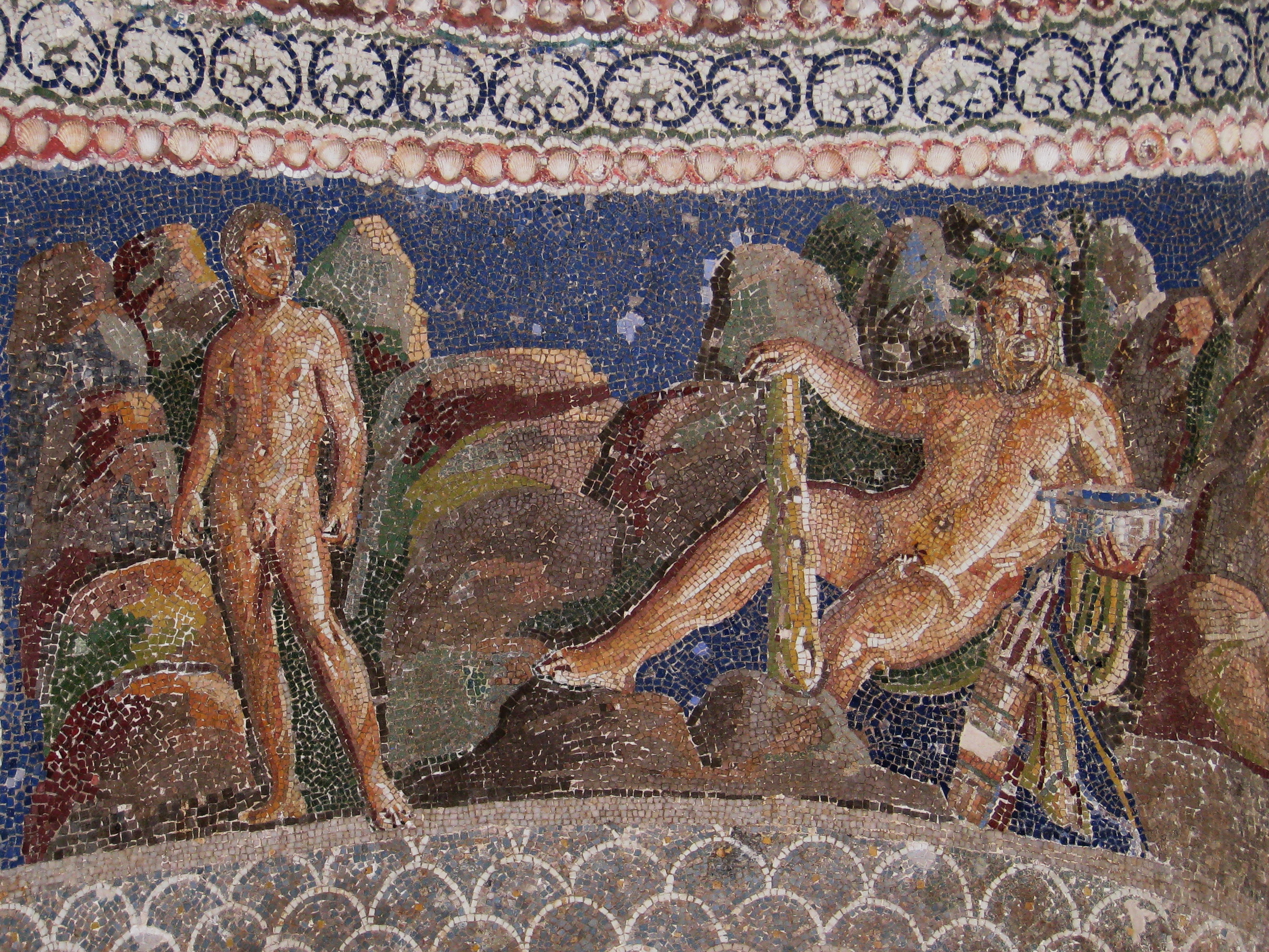
The Herakleia were celebrated in many places and with many characters, from solemn commemorations of the hero's death to raucous athletic contests. The Suda notes that of the numerous Attic Herakleia the Athenians esteemed two above the rest, the festival at Marathon and the festival at Kynosarges. The most curious rites, however, were provincial, and preserved in them a memory of the hero's own disguises and trials.39
| Herakleia | Place | Description | Character | Attestation |
|---|---|---|---|---|
| Herakleia en Kynosargei | Athens (Kynosarges) | Commemorative | Death of the hero, priests drawn from the nothoi | Suda; Plutarch (2nd Metageitnion) |
| Marathonian Herakleia | Marathon | Agonistic | Athletic contests | Suda; Pindar |
| Iolaeia | Thebes | Agonistic | Games honoring Heracles and Iolaus | Pausanias; Pindar |
| Sikyonian Herakleia | Sikyon | Dual Sacrifice | Two days, hero and deity | Pausanias 2.10.1 |
| Coan Herakleia | Antimacheia, Cos | Rite of Inversion | Priest sacrifices in women's dress, recalling the hero's disguise | Plutarch, Greek Questions 58 |
Sources: the Suda, for the pre-eminence of the Marathonian and Kynosargean Herakleia;39 Plutarch, Life of Themistocles 1.2, for the nothoi at Kynosarges;18 Pausanias, Description of Greece 2.10.1, for the Sikyonian double sacrifice instituted by Phaestus;17 Plutarch, Greek Questions 58, for the transvestite rite on Cos;40 Pindar, Odes, for the athletic festivals;25 and H. W. Parke, Festivals of the Athenians, for the Attic calendar.41
XII. The Twelve labors
I. The Nemean Lion
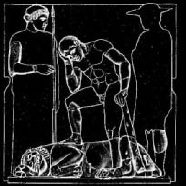
The first labor that Heracles is sent to accomplish is the Lion of Nemea, described in passing by Pindar as destroyed by the hero in the vicinity of the area, skulking beneath the shady primeval mountains of Primus. Theocritus in his Idyll describes it as a scourge bringing terror to man and beast alike, while Diodorus Siculus claims it a gigantic beast that cannot be wounded by iron, bronze, nor stone; Apollodorus calls it invulnerable, a fitting first choice for the attempt of Eurystheus to be rid of his kinsman.25, 26, 1, 2 In most accounts the lion is the child of Typhon, the scourge of the Gods. Hyginus, however, calls it a monster which the moon goddess Luna nourished in a two-mouthed cave, and Apollodorus shares that description of its lair.42, 2 The Idyll has Heracles pin its hind paws and strangle it after his arrows fail; Apollodorus has him chase it with a club, block one of the two entrances, and choke it where it cannot escape; Diodorus has it strangled in a cleft.26, 2, 1
The wearing of the lion's pelt as a cloak or hide is a convention that supposedly begins with the Rhodian epics of Peisander, though Athenaeus asserts by contrast that the poet Stesichorus invented it; Diodorus, Euripides, and Hyginus have him take the pelt as a protection against subsequent labors.22, 43, 1, 27, 42 According to Eratosthenes in his Catasterisms, the lion is taken up into the heavens by Zeus and crowned as Leo, which Seneca portrays in his Hercules Furens quite dramatically with a poetic view of the constellation.28, 44 Depictions of the Nemean Lion are ancient, though not especially popular, and were not adopted as a standard costume for Heracles until around 550 BCE.
II. The Lernaean Hydra
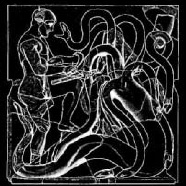
The Hydra of Lerna is the next pursuit given to Heracles. Most variations agree, and the story of Apollodorus is typically the complete account. The Hydra, a terrifying beast of the swamp, ravages the land with its nine heads, one of them immortal. Assisted by his nephew Iolaus, Heracles first shoots flaming arrows to force it out, then strikes off the eight heads; when the immortal one regenerates into further splitting heads, he changes tactics, and the quick-thinking Iolaus cauterises the neck-stumps with firebrands so that the heads cease to sprout.2 In this account Hera sends a giant crab to disrupt the hero, and it bites his foot; according to Hyginus in his Astronomica, the crab is killed and set among the stars as Cancer, accompanying the Lion.2, 29
Diodorus Siculus gives a similar story but omits the crab. Hyginus in his Fabulae, however, claims it was Minerva who guided the hero to slay the monster, and in most Roman versions Iolaus is absent.1, 42 The Lernaean Hydra is among the most popular scenes of the labors on Greek pottery, and its presence on cultural artefacts is one of the most ancient sets of recognisable divine imagery in Europe, with some vases depicting the scene dated remarkably early.2 In the Euthydemus 297c, Socrates compares the debate-technique of the sophists to the Hydra: cut off one head and many more heads of argument spring up.44 By the classical age the Hydra could already stand for self-multiplying refutation, a problem that proliferates under attack.
III. The Ceryneian Hind
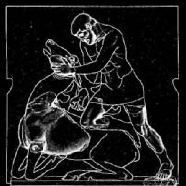
The third labor turns from slaughter to patience. Eurystheus commands the capture of the Ceryneian Hind, a deer with golden horns and hooves of bronze that was sacred to Artemis, and Heracles, unwilling to wound or kill a creature of the huntress, pursues it for a full year across the north.2 Pindar, in the third Olympian, sends the hero after the hind as far as the land of the Hyperboreans, whence he brings back the wild olive that will shade the victors at Olympia.25 Callimachus knows the same golden-horned deer among the creatures that Artemis first hunted upon the Parrhasian hill.45 When at last he takes it, Heracles placates the offended Artemis by pleading necessity, and carries the living animal to Mycenae. The labor that requires no killing is the longest of them all.
IV. The Erymanthian Boar
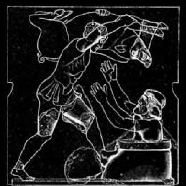
The fourth labor is the capture alive of the great boar that ravaged the slopes of Mount Erymanthus. Diodorus and Apollodorus tell how Heracles drove the beast from its thicket into deep snow, bound it, and bore it back upon his shoulders, so terrifying Eurystheus that the king hid himself in a great bronze jar sunk in the earth. On the way to the hunt occurs the tragic episode of the centaurs: the hero is entertained by Pholus and opens the communal wine of the centaurs, whose scent maddens the herd; in the ensuing fight Heracles wounds the wise and immortal Chiron by mischance with an arrow steeped in Hydra's venom, and the incurable pain drives Chiron at last to surrender his immortality. The comic image of the king in the jar conceals a bitter truth: even the hero's triumphs sow ruin among his friends.1,2
V. The Augean Stables
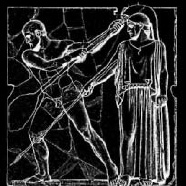
For the fifth labor Eurystheus intends humiliation, ordering the hero to cleanse in a single day the filth of the vast herds of Augeas, king of Elis. Heracles bargains for a tithe of the cattle, then breaches the walls of the yard and turns the rivers Alpheus and Peneus through it, so that the water carries away the dung. Augeas, learning that the deed was done at the command of Eurystheus, refuses the promised payment, and the quarrel bears famous fruit: Pausanias and Pindar record that Heracles later made war on Elis and, from the spoils, founded the Olympic Games and marked out the sacred precinct of Zeus at Olympia. The labor of the dunghill gives birth to the greatest festival of the Greeks.1,2,17,25
VI. The Stymphalian Birds
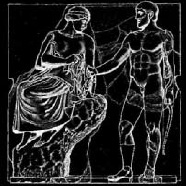
The sixth labor is the rout of the man-eating birds that infested the marsh of Stymphalus in Arcadia. The reeds were too deep for the hero to wade and too thin to bear his weight, until Athena furnished him with bronze castanets forged by Hephaestus; the clash of the krotala startled the birds into the air, and Heracles brought them down with his arrows. Pausanias when visiting the temple of Stymphalian Artemis, describes the sanctuary and the images of the birds carved beneath its roof, and reports the local belief in ravening fowl of the eastern deserts. The lesson is one of ingenuity: where strength cannot reach, the well-made instrument prevails.2,17
VII. The Cretan Bull
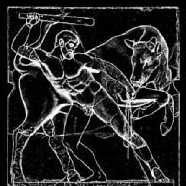
The seventh labor carries the hero overseas to Crete, to master the great bull that Poseidon had sent from the waves, the same beast that had sired the Minotaur upon Pasiphae. Apollodorus and Diodorus tell how Heracles overpowered the bull and shipped it living to the mainland, where he showed it to Eurystheus and then set it free.2, 1 The liberated animal wandered north to the plain of Marathon, and there, as Pausanias notes, it became the Marathonian Bull that the young Theseus would afterwards slay.17 The hero's labor thus becomes the raw material of another hero's fame.
VIII. The Mares of Diomedes
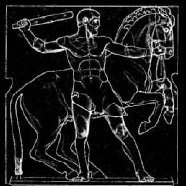
For the eighth labor Heracles sails to Thrace to seize the four man-eating mares of Diomedes, a savage son of Ares who fed his horses on the flesh of unlucky guests. In the account of Apollodorus the hero overcomes the grooms, and when Diomedes gives chase Heracles feeds the tyrant himself to his own mares, whose hunger is sated and their fury tamed.2, 1 Euripides, in the Alcestis, has the hero pause in this very labor to wrestle Death at the tomb of the queen and restore her to her husband, so that the taming of the mares is framed by the greater conquest of death.46 The punishment fits the crime: the maker of monsters is devoured by his own.
IX. The Belt of Hippolyta
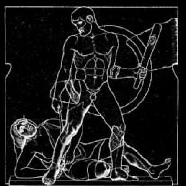
The ninth labor is undertaken for a woman, the daughter of Eurystheus, who desired the war-belt of Hippolyta, queen of the Amazons and daughter of Ares. Heracles sails to the land of the Thermodon, and the Amazon queen, charmed by the hero, is willing to yield the belt freely, until the implacable Hera, disguised among the women, spreads the rumour that the strangers mean to carry off their queen.2, 1 The Amazons take up arms, Hippolyta is slain in the confusion, and Heracles bears away the belt over the body of the queen who would have given it. Hera turns even a bloodless errand into a battlefield.
X. The Cattle of Geryon
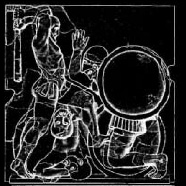
The tenth labor drives the hero to the western edge of the world, to the island of Erytheia beyond the ocean stream, where the three-bodied giant Geryon pastured his red cattle under the herdsman Eurytion and the two-headed hound Orthus. Hesiod had already named the monstrous herdsman in the Theogony, and Stesichorus devoted a whole lyric Geryoneis to the giant's fall.12, 47 Apollodorus and Diodorus recount how Heracles, sailing in the golden cup of Helios, slew the hound, the herdsman, and at last Geryon himself, and drove the cattle home across the world; at the strait between the continents he set up the two Pillars of Heracles to mark the limit of his wandering, which Strabo locates at Gades.2, 1, 20 On the Italian leg of the return the hero slays the fire-breathing robber Cacus, an episode Virgil weaves into the Aeneid as the origin of the Ara Maxima at Rome.48 The herdsman of the sunset yields his cattle to the hero of the dawn.
XI. The Apples of the Hesperides
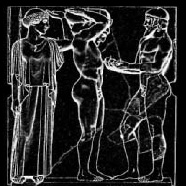
The eleventh labor is the theft of the golden apples that grow in the garden of the Hesperides at the western verge, the wedding gift of Gaia to Hera, guarded by the maidens and the sleepless serpent Ladon. Hesiod places the tree and its nymphs beyond glorious Ocean, and Euripides sings of the singing maidens of the west whom the hero sought.12, 27 The mythographer Pherecydes preserved the detail, followed by Apollodorus, that Heracles did not pluck the fruit himself but persuaded Atlas to fetch it while he shouldered the sky in the Titan's place, then tricked the Titan into taking back his burden.24, 2 Along the way he wrestles the earth-born Antaeus, who cannot be thrown while he touches his mother the earth, and frees Prometheus from his rock. This is the labor that Olympiodorus reads as the soul's passage into the light, and the fruit it wins is the fruit of immortality.35
XII. Cerberus
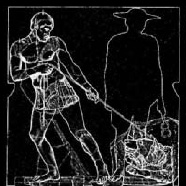
The twelfth and greatest labor is the descent to the house of Hades to fetch the hound Cerberus, the guardian of the dead. Homer already knew the tale, and makes the shade of Heracles recall how, by the will of Eurystheus, he was sent to bring up the dog of the underworld with the guidance of Hermes and Athena.10, 9 Before he dares the descent, Apollodorus and Diodorus relate, Heracles is purified and initiated into the Mysteries at Eleusis, for the road of the dead is no place for the unhallowed.2, 1 In the underworld he frees Theseus from the chair of forgetfulness, and Bacchylides gives the meeting with the shade of Meleager, which moves the hero to tears and to the marriage that will destroy him.49 Hades grants the hound on condition that the hero master it without weapons, and Heracles drags Cerberus into the light of day, shows it to the cowering Eurystheus, and returns it to the dark.2 The last labor is the conquest of death itself, and it is therefore the threshold of the apotheosis.
XIII. The Apotheosis
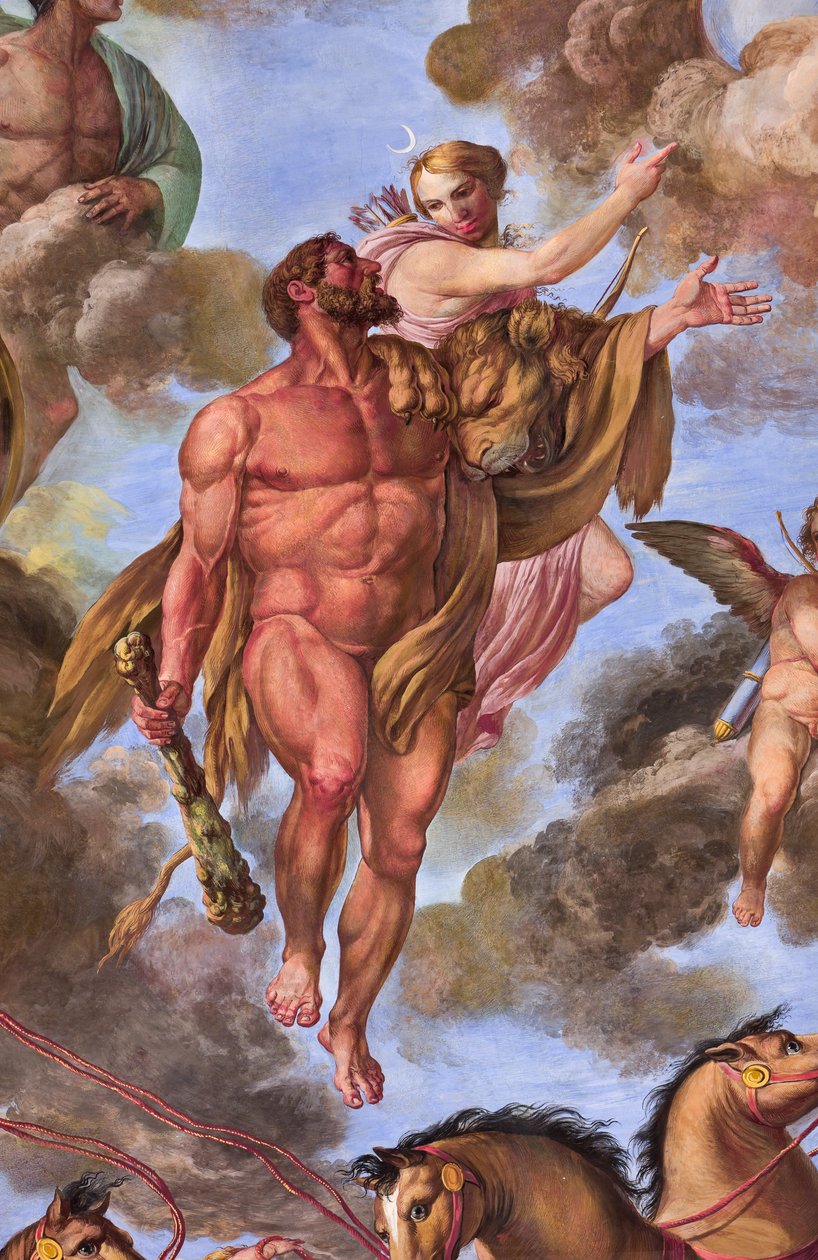
Upon the pyre of Oeta the two natures of the hero were at last divided. Diodorus relates that when the flames had consumed all that Heracles took from his mortal mother Alcmene, the portion he took from his immortal father Zeus was carried up untouched to the company of the Gods, so that the fire which seemed to destroy him in truth refined him.1 What the Odyssey had glimpsed and Plotinus had expounded, the burning made real: the eidolon fell away, and the deathless self ascended.
Heaven received him with a reconciliation as strange as the enmity it ended. Diodorus records a rite in which Hera, adopting the hero as her own, drew him beneath her robe and let him fall to the ground in imitation of a true birth, so that the goddess who had labored to kill him became, in ceremony, his mother; and the marriage to Hebe, her own daughter and the cup-bearer of eternal youth, sealed the peace. Hesiod had promised as much, granting the hero an ageless life among the immortals, and Pindar set the same prophecy in the mouth of Tiresias over the cradle: after the toils, endless peace. The name is fulfilled at the last; the glory of Hera is won from Hera herself.1,2,12,25
The Greeks never resolved, and never wished to resolve, the doubleness they had discovered in him. Herodotus, weighing the Egyptian and Phoenician evidence, concluded that the wisest of the Greeks sacrificed to Heracles under two names and two rites, to the one as an immortal Olympian and to the other as a departed hero, and Emma Stafford has shown how tenaciously that double cult persisted through the whole of antiquity.7, 21 He is the shade in the meadow and the bridegroom on Olympus, the strong man of the crowd and the pattern of the initiate. Heracles is the mortal who became a God, and the myth is the record of how a soul is made deathless.
Sources and Bibliography
- Diodorus Siculus. Library of History, Book 4. Translated by C. H. Oldfather. Loeb Classical Library 303. Cambridge, MA: Harvard University Press, 1935. 4.8–4.39. For the naming of the hero and the earlier name Alcaeus, the fullest continuous narrative of the labors, the death on Oeta, and the reconciliation and rebirth under Hera.
- Apollodorus. The Library. Translated by James George Frazer. 2 vols. Loeb Classical Library 121–122. Cambridge, MA: Harvard University Press, 1921. 2.4.5–2.7.7. For the renaming by the Pythia, the Perseid descent, the canonical order of the twelve labors, and the death and translation of the hero.
- Etymologicum Magnum. Edited by Thomas Gaisford. Oxford: Oxford University Press, 1848. S.v. Ἡρακλῆς. For the Byzantine derivation of the name from disrepute rather than from the glory of Hera.
- Pötscher, Walter. Hera: Eine Strukturanalyse im Vergleich mit Athena. Darmstadt: Wissenschaftliche Buchgesellschaft, 1987. For the connection of the name of Hera with ὥρα, the ripe season and the year.
- Beekes, Robert S. P., with Lucien van Beek. Etymological Dictionary of Greek. 2 vols. Leiden Indo-European Etymological Dictionary Series 10. Leiden: Brill, 2010. S.vv. “Ἥρα,” “Ἡρακλῆς.” For the classification of the name of Hera as of uncertain, probably Pre-Greek, origin.
- Burkert, Walter. Greek Religion. Translated by John Raffan. Cambridge, MA: Harvard University Press, 1985. For the unsettled etymology of Hera and the double character of Heracles as hero and God.
- Herodotus. Histories. Translated by A. D. Godley. 4 vols. Loeb Classical Library 117–120. Cambridge, MA: Harvard University Press, 1920–1925. 2.44 (Tyre and Thasos); 4.8 (Geryon in the west); 5.63 (the Herakleion at Alopekai). For the identification of Heracles with Tyrian Melqart and for the double cult of hero and immortal.
- de Grummond, Nancy Thomson. Etruscan Myth, Sacred History, and Legend. Philadelphia: University of Pennsylvania Museum of Archaeology and Anthropology, 2006. For the Etruscan Hercle attested on engraved bronze mirrors and dedications.
- Homer. The Iliad. Translated by A. T. Murray, revised by William F. Wyatt. 2 vols. Loeb Classical Library 170–171. Cambridge, MA: Harvard University Press, 1999. 5.392–404 (the wounding of Hera and Hades); 18.117–119 (the mortality of Heracles); 19.95–133 (the delayed birth and the loss of the kingdom); and 8.362–369 (the fetching of Cerberus).
- Homer. The Odyssey. Translated by A. T. Murray, revised by George E. Dimock. 2 vols. Loeb Classical Library 104–105. Cambridge, MA: Harvard University Press, 1995. 11.601–627. For the shade of Heracles in Erebus while the hero himself dwells among the Gods with Hebe.
- The Homeric Hymns and Homerica. Translated by Hugh G. Evelyn-White. Loeb Classical Library 57. Cambridge, MA: Harvard University Press, 1914. Hymn 15, to Heracles the Lion-Hearted. For the compressed career of wandering, labor, and rest on Olympus.
- Hesiod. Theogony. Translated by Glenn W. Most. Loeb Classical Library 57. Cambridge, MA: Harvard University Press, 2006. 313–318 (the Hydra), 326–332 (the Nemean Lion), 287–294 and 979–983 (Geryon), 526–534 (the eagle of Prometheus), 215–216 and 333–335 (the Hesperides), 950–955 (the marriage to Hebe and the immortal life). For the cosmic framing of the hero's monsters and his final deification.
- Hesiod. Shield of Heracles. In The Shield, Catalogue of Women, Other Fragments, translated by Glenn W. Most. Loeb Classical Library 503. Cambridge, MA: Harvard University Press, 2007. For the duel with Cycnus and the proem on Alcmene and the disguised Zeus.
- The Orphic Hymns. Edited and translated by Apostolos N. Athanassakis and Benjamin M. Wolkow. Baltimore: Johns Hopkins University Press, 2013. Hymn 12, to Heracles. For the hero as almighty Titan, self-born, father of time, and deliverer, and for the reading of the twelve labors as the hours of the day; Greek text also in W. Quandt, Orphei Hymni (Berlin: Weidmann, 1955).
- Farnell, Lewis Richard. Greek Hero Cults and Ideas of Immortality. Oxford: Clarendon Press, 1921. For the double cult of Heracles as hero and God and the survey of his cult titles.
- Cornutus. Greek Theology (Compendium of the Traditions of Greek Theology). Chapter 31. Translated in George Boys-Stones, L. Annaeus Cornutus: Greek Theology, Fragments, and Testimonia. Atlanta: Society of Biblical Literature Press, 2018. For the Stoic allegory of Heracles as the pervading logos and the derivation of the saving epithets.
- Pausanias. Description of Greece. Translated by W. H. S. Jones and H. A. Ormerod. 5 vols. Loeb Classical Library 93, 188, 272, 297, 355. Cambridge, MA: Harvard University Press, 1918–1935. 1.19.3 (the Kynosarges), 2.10.1 (the Sikyonian Herakleia), 5.1.9–10 (Olympia and Elis), 5.25.12 (the Thasian dedication), 8.22.4–7 (Stymphalus), 9.11 and 9.23.1 (Thebes and the Iolaeia). For the local cults, temples, and festivals of the hero.
- Plutarch. Life of Themistocles. In Plutarch's Lives, vol. 2, translated by Bernadotte Perrin. Loeb Classical Library 47. Cambridge, MA: Harvard University Press, 1914. 1.2. For the resort of the nothoi and aliens to the gymnasium of Heracles at Kynosarges.
- Launey, Marcel. Le sanctuaire et le culte d'Héraclès à Thasos. Études Thasiennes 1. Paris: De Boccard, 1944. For the excavation and cult of the Herakleion of Thasos.
- Strabo. Geography, Book 3. Translated by Horace Leonard Jones. Loeb Classical Library 50. Cambridge, MA: Harvard University Press, 1923. 3.5.3–6. For the Temple of Hercules Gaditanus at Gades and the Pillars of Heracles.
- Stafford, Emma. Herakles. Gods and Heroes of the Ancient World. London: Routledge, 2012. For the saturation of ancient life by the hero, the dynastic and apotropaic uses of his image, and the persistence of the double cult.
- West, Martin L., ed. and trans. Greek Epic Fragments: From the Seventh to the Fifth Centuries BC. Loeb Classical Library 497. Cambridge, MA: Harvard University Press, 2003. For the testimonia and fragments of the Heracleia of Peisander of Rhodes and of Panyassis of Halicarnassus.
- Matthews, Victor J. Panyassis of Halikarnassos: Text and Commentary. Mnemosyne Supplement 33. Leiden: Brill, 1974. For the fourteen-book Heracleia of Panyassis and its place in the epic tradition.
- Fowler, Robert L. Early Greek Mythography. 2 vols. Oxford: Oxford University Press, 2000–2013. For the fragments of Pherecydes of Athens (FGrHist 3) on the hero's childhood and the Hesperides, and of Herodorus of Heraclea (FGrHist 31).
- Pindar. Olympian Odes, Pythian Odes and Nemean Odes, Isthmian Odes. Edited and translated by William H. Race. 2 vols. Loeb Classical Library 56–485. Cambridge, MA: Harvard University Press, 1997. Nemean 1 (the serpents and the prophecy of Tiresias), Olympian 3 (the hind and the Hyperborean olive), Olympian 10 (the founding of the Olympic Games). For the birth, the labors, and the athletic festivals.
- Theocritus. Idyll 24 (Heracliscus). In Theocritus, Moschus, Bion, edited and translated by Neil Hopkinson. Loeb Classical Library 28. Cambridge, MA: Harvard University Press, 2015. For the infant hero, the strangling of the serpents, and the household's occult defences against Hera.
- Euripides. Heracles. In Euripides, Volume III, edited and translated by David Kovacs. Loeb Classical Library 9. Cambridge, MA: Harvard University Press, 1998. For the madness sent by Hera through Lyssa, the slaughter of the children, the lion's pelt as protection, and the singing maidens of the Hesperides.
- Eratosthenes. Catasterismi. Edited by Jordi Pàmias and Klaus Geus; translated in Theony Condos, Star Myths of the Greeks and Romans. Grand Rapids: Phanes Press, 1997. For the catasterism of the Nemean Lion as Leo and for the celestial version of the Milky Way.
- Hyginus. Astronomica. Translated by Mary Grant, in The Myths of Hyginus. Lawrence: University of Kansas Press, 1960. 2.23 (Cancer, the crab of the Hydra) and 2.24 (Leo). For the catasterisms of the labors.
- Sophocles. The Women of Trachis (Trachiniae). Edited and translated by Hugh Lloyd-Jones. Loeb Classical Library 21. Cambridge, MA: Harvard University Press, 1994. For Nessus, the poisoned robe, Deianeira, and the agony of the hero.
- Ovid. Metamorphoses. Translated by Frank Justus Miller, revised by G. P. Goold. 2 vols. Loeb Classical Library 42–43. Cambridge, MA: Harvard University Press, 1977–1984. 9.1–272. For the death of the hero, the burning robe, and the ascent from the pyre.
- Seneca. Hercules Furens and Hercules Oetaeus. In Seneca: Tragedies, edited and translated by John G. Fitch. 2 vols. Loeb Classical Library 62–78. Cambridge, MA: Harvard University Press, 2002–2004. For the constellation of Leo in the Hercules Furens and the Stoic serenity of the hero upon the pyre of Oeta.
- Heraclitus. Homeric Problems. Edited and translated by Donald A. Russell and David Konstan. Writings from the Greco-Roman World 14. Atlanta: Society of Biblical Literature, 2005. 33–34. For the allegorical reading of the labors as the purgation of vice by the wandering sage.
- Plotinus. Enneads. Translated by A. H. Armstrong. 7 vols. Loeb Classical Library 440–468. Cambridge, MA: Harvard University Press, 1966–1988. 1.1.12 and 4.3.27–32. For the shade of Heracles in Hades as the image of the active self, distinct from the true self that has ascended to the Gods.
- Olympiodorus. Commentary on Plato's Gorgias. Translated by Robin Jackson, Kimon Lycos, and Harold Tarrant. Philosophia Antiqua 78. Leiden: Brill, 1998. Greek text: Olympiodori in Platonis Gorgiam commentaria, edited by L. G. Westerink. Leipzig: Teubner, 1970. On the eschatological myth (523a–527a). For the last labor in the Hesperian regions read as the soul's passage from the terrestrial life into the light through the cathartic virtues; the passage is preserved and translated by Thomas Taylor in A Dissertation on the Eleusinian and Bacchic Mysteries.
- Marinus. Proclus, or On Happiness. Translated by Mark Edwards, in Neoplatonic Saints: The Lives of Plotinus and Proclus by Their Students. Liverpool: Liverpool University Press, 2000. For the ordered scale of the virtues, from the natural to the theurgic, by which the soul is assimilated to the divine.
- Proclus. The Theology of Plato. Edited by H. D. Saffrey and L. G. Westerink, Proclus: Théologie platonicienne, 6 vols. Paris: Les Belles Lettres, 1968–1997; English translation by Thomas Taylor, The Six Books of Proclus on the Theology of Plato. London, 1816. For the doctrine of the divine orders and the principle that allegory belongs properly to the myths of the Gods.
- Sallustius. On the Gods and the World. Edited and translated by Arthur Darby Nock, Sallustius: Concerning the Gods and the Universe. Cambridge: Cambridge University Press, 1926. For the maxim that the myths concern things that never happened yet always are.
- Suda. Edited by Ada Adler, Suidae Lexicon, 5 vols. Leipzig: Teubner, 1928–1938; translated in the Suda On Line. S.vv. Ἡράκλεια and Ἡράκλειον ἐν Διομείοις. For the pre-eminence of the Marathonian and Kynosargean Herakleia among the Attic festivals.
- Plutarch. Greek Questions (Quaestiones Graecae) 58. In Plutarch's Moralia, vol. 4, translated by Frank Cole Babbitt. Loeb Classical Library 305. Cambridge, MA: Harvard University Press, 1936. For the rite at Antimacheia on Cos in which the priest of Heracles sacrifices in women's dress.
- Parke, H. W. Festivals of the Athenians. Aspects of Greek and Roman Life. London: Thames and Hudson, 1977. For the place of the Herakleia in the Athenian calendar and the cult at Kynosarges.
- Hyginus. Fabulae. Translated by Mary Grant, in The Myths of Hyginus. Lawrence: University of Kansas Press, 1960. 30 (the labors) and 34 (the Hydra with Minerva's guidance). For the Roman recension of the labor cycle and the two-mouthed lair of the lion.
- Athenaeus. The Learned Banqueters (Deipnosophistae). Translated by S. Douglas Olson. Loeb Classical Library. Cambridge, MA: Harvard University Press, 2006–2012. 12.512e–513a. For the attribution to Stesichorus of the invention of the hero's lion-skin costume.
- Plato. Euthydemus. Translated by W. R. M. Lamb. Loeb Classical Library 165. Cambridge, MA: Harvard University Press, 1924. 297c. For the comparison of the sophists' self-multiplying arguments to the heads of the Hydra.
- Callimachus. Hymn 3, to Artemis. In Callimachus, Lycophron, Aratus, translated by A. W. Mair. Loeb Classical Library 129. Cambridge, MA: Harvard University Press, 1921. Lines 100–109. For the golden-horned Ceryneian Hind among the first quarry of Artemis.
- Euripides. Alcestis. In Euripides, Volume I, edited and translated by David Kovacs. Loeb Classical Library 12. Cambridge, MA: Harvard University Press, 1994. For the hero wrestling Death at the tomb while journeying to fetch the mares of Diomedes.
- Davies, Malcolm, and Patrick J. Finglass, eds. Stesichorus: The Poems. Cambridge Classical Texts and Commentaries 54. Cambridge: Cambridge University Press, 2014. For the fragments of the Geryoneis on the death of the three-bodied giant.
- Virgil. Aeneid, Book 8. Translated by H. Rushton Fairclough, revised by G. P. Goold. Loeb Classical Library 63–64. Cambridge, MA: Harvard University Press, 1999. 8.185–275. For the slaying of Cacus and the founding of the Ara Maxima at Rome during the return with the cattle of Geryon.
- Bacchylides. Ode 5. In Greek Lyric, Volume IV: Bacchylides, Corinna, and Others, edited and translated by David A. Campbell. Loeb Classical Library 461. Cambridge, MA: Harvard University Press, 1992. For the meeting of Heracles with the shade of Meleager in the house of Hades.