Bibliography:
1 Allen, James P., trans. The Ancient Egyptian Pyramid Texts. 2nd ed. Writings from the Ancient World 38. Atlanta: SBL Press, 2015. Pyramid Text 222.
2 Faulkner, Raymond O. A Concise Dictionary of Middle Egyptian. Oxford: Griffith Institute, Ashmolean Museum, 1962. Page 188, s.v. “ḫpr,” “come into being, become.”
3 Editors of Encyclopaedia Britannica. “Khepri.” Encyclopaedia Britannica. Last revised by Alicja Zelazko.
4 Cooney, Kathlyn M. “Scarab.” In Willeke Wendrich, ed., UCLA Encyclopedia of Egyptology 1, no. 1 (2008). Sections cited: scarab amulets and scarab symbolism.
5 Van Ryneveld, Maria Magdalena. The Presence and Significance of Khepri in Egyptian Religion and Art. MA diss., University of Pretoria, 2007. Sections cited: Khepri, scarab amulets, funerary amuletic protection, and Opening of the Mouth contexts.
6 Mercer, Samuel A. B., trans. The Pyramid Texts. New York: Longmans, Green, 1952. Utterance 257.
7 Mercer, Samuel A. B., trans. The Pyramid Texts. New York: Longmans, Green, 1952. Utterance 587.
8 Allen, James P., trans. The Ancient Egyptian Pyramid Texts. Edited by Peter Der Manuelian. Writings from the Ancient World 23. Atlanta: Society of Biblical Literature, 2005. Pyramid Text 222 / Unis Spell 155.
9 Allen, James P., trans. The Ancient Egyptian Pyramid Texts. Edited by Peter Der Manuelian. Writings from the Ancient World 23. Atlanta: Society of Biblical Literature, 2005. Pyramid Text 600.
10 Allen, James P., trans. The Ancient Egyptian Pyramid Texts. Edited by Peter Der Manuelian. Writings from the Ancient World 23. Atlanta: Society of Biblical Literature, 2005. Neith Spell 6 / Pepi I Spell 567.
11 Faulkner, R. O., trans. The Ancient Egyptian Coffin Texts. Vol. 1, Spells 1–354. Warminster: Aris & Phillips, 1973. Coffin Text 307.
12 Allen, Thomas George, ed. The Egyptian Book of the Dead: Documents in the Oriental Institute Museum at the University of Chicago. Oriental Institute Publications 82. Chicago: University of Chicago Press, 1960. Sections cited: becoming and solar rebirth language.
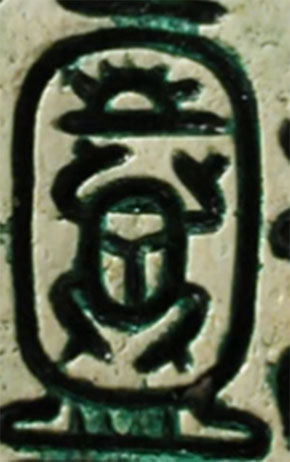
13 Klotz, Dieter. “Two Curious Orthographies for Khepri.” Égypte Nilotique et Méditerranéenne 3 (2010): 67–75. Section cited: orthographies and titular formulae for Khepri.
14 Hornung, Erik. The Ancient Egyptian Books of the Afterlife. Translated by David Lorton. Ithaca, NY: Cornell University Press, 1999. Sections cited: dawn and solar afterlife material associating Khepri with the morning manifestation of Re.
15 Breasted, James Henry. Development of Religion and Thought in Ancient Egypt. New York: Charles Scribner’s Sons, 1912. Section cited: hymn passage, “Khepri in the midst of his barque, / Who commanded and the gods became.”
16 Budge, E. A. Wallis, trans. The Book of the Dead: The Papyrus of Ani in the British Museum. London: British Museum, 1895. Section cited: hymn to Re/Khepri, “Hail to you who comes as Khepri, Khepri who created the gods.”
17 Lenzo, Giuseppina. The Greenfield Papyrus: Funerary Papyrus of a Priestess at Karnak Temple (c. 950 BCE). British Museum Publications on Egypt and Sudan 15. Leuven: Peeters, 2023. Sections cited: Khepri as self-created and rising in the eastern horizon.
18 Wikimedia Commons. “QV66 Khepri Tomb of Nefertari entrance.jpg.” Object-description text. Section cited: “Khepri, who resides in his boat, the Great God.”
19 Minas-Nerpel, Martina. Der Gott Chepri: Untersuchungen zu Schriftzeugnissen und ikonographischen Quellen vom Alten Reich bis in griechisch-römische Zeit. Orientalia Lovaniensia Analecta 154. Leuven: Peeters, 2006. Sections cited: Khepri’s textual and iconographic evidence from the Old Kingdom to the Graeco-Roman period.
20 Institute for the Study of Ancient Cultures, University of Chicago. “A Khepri ‘My Scarab.’” January 27, 2015.
21 Mercer, Samuel A. B., trans. The Pyramid Texts. New York: Longmans, Green, 1952. Utterance 600, §§1652a–c: Atum-Khepri, rising as the hill/benben, and the temple of the phoenix in Heliopolis.
22 Gaber, Amr. “The Ten Dead Deities of the Temple of Dendera.” Zeitschrift für Ägyptische Sprache und Altertumskunde 142, no. 1 (2015): 27–40. Sections cited: Dendera temple contexts.
23 Klotz, Dieter. “Two Curious Orthographies for Khepri.” Égypte Nilotique et Méditerranéenne 3 (2010): 67–75. Sections cited: Edfu and late temple orthographies for Khepri.
24 Schweizer, Andreas. The Sungod’s Journey through the Netherworld: Reading the Ancient Egyptian Amduat. Edited by David Lorton. Foreword by Erik Hornung. Ithaca, NY: Cornell University Press, 2010. Sections cited: the Amduat and the solar journey through the Netherworld.
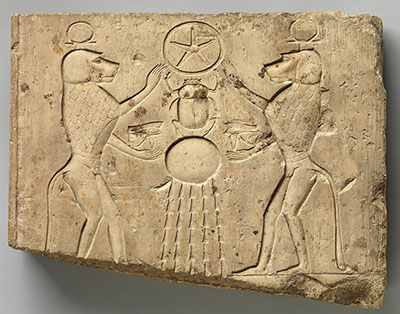
25 Metropolitan Museum of Art. “Relief Panel Showing Two Baboons Offering the Wedjat Eye to the Sun God Khepri, Who Holds the Underworld Sign.” The Met Collection. Sections cited: object description and iconography of baboons hailing/offering to Khepri.
26 Institute for the Study of Ancient Cultures, University of Chicago. “A Khepri ‘My Scarab.’” January 27, 2015. Sections cited: scarab and Khepri symbolism.
27 Hornung, Erik. Conceptions of God in Ancient Egypt: The One and the Many. Translated by John Baines. Ithaca, NY: Cornell University Press, 1982. Sections cited: Khepri, solar theology, and the solar triad.
28 Museo Egizio. “Amduat Papyrus of Shepeset-heryt, Turin Papyrus Cat. 1783.” Museo Egizio Papyrus Collection. Sections cited: Amduat papyrus witness and twelfth-hour solar rebirth context.
29 Allen, Thomas George, ed. The Egyptian Book of the Dead: Documents in the Oriental Institute Museum at the University of Chicago. Oriental Institute Publications 82. Chicago: University of Chicago Press, 1960. Spell 30B.
30 EBSCO. “Scarab Artifact.” EBSCO Research Starters: Religion and Philosophy. Sections cited: scarab artifact symbolism and material culture.
31 Okasha, Alaa. “The Scarabs of King Amenhotep III.” Minia Journal of Tourism and Hospitality Research 1, no. 1 (June 2016). Sections cited: Amenhotep III scarab production and royal scarabs.
32 Krauss, Rolf. Astronomische Konzepte und Jenseitsvorstellungen in den Pyramidentexten. Wiesbaden: Harrassowitz, 1997. Sections cited: astronomical concepts and afterlife symbolism in the Pyramid Texts.