




| Language / Culture | Name of Surya | Attestation |
|---|---|---|
| Vedic Sanskrit | सूर्यर (Surya) | Rigveda (c. 1500–1200 BCE) |
| Chinese | 日天 (Ritian) | Yixing (725 CE) |
| Japanese | 日天 (Nitten) | Shōtoku Taishi denryaku (917 CE) |
33 min read
SURYA
author: High Priest Zevios Metathronos
co-author: Novice Priest Karnonnos
Hieratic Information about Surya
| Divine Names | |
|---|---|
| Surya (सूर्यर) | the ancient Vedic name |
| These hieratic names carry strong spiritual resonance and are recommended for summoning and invocation practices. | |
| Divine Symbols | |
| |
| Divine Numbers and Attributes | |
| Sacred Numbers | 40, 50, 60 |
| Runes | Thurisaz, Tiwaz, Sowilo (in order of importance) |
| Zodiac Sign of Power | Aries |
| Sacred Animals | The Great Eagle, the Bull, the Hawk, the Serpent |
| Element | Fire, Aether |
| Divine Forces | |
| |
| Important Titles | |
| |
| Names Across Civilizations | |
| Vedic | सूर्यर (Surya) |
| Chinese | 日天 (Ritian) |
| Japanese | 日天 (Nitten) |
I. The Name of Surya
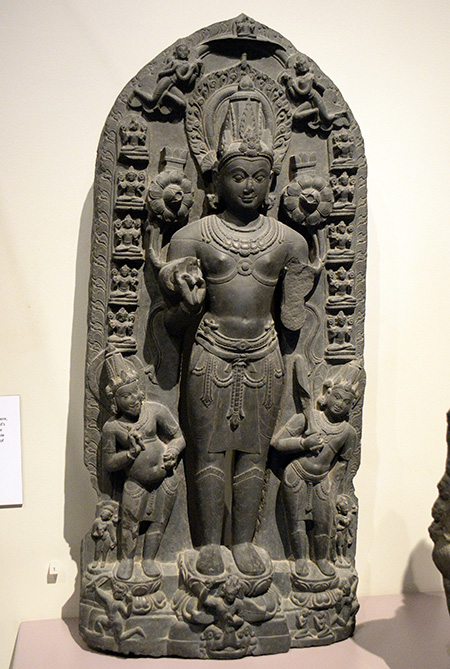
Surya simply means 'Sun' in Sanskrit, being analogous to the theonym Helios in Greek or Sol in Latin. The use of the word as a theonym is ambiguous in the Rigveda, because it refers to both the Sun as a physical force and the god himself in different passages.1, 2
The Proto-Indo-European base of the word is presumed to be *sóh₂wl̥, passing into n *súHar in Proto-Iranian and then becoming the Sanskrit word Surya. Other forms of this Proto-Indo-European root became the Lithuanian 'saulo' and the Latin form 'sol'. The weak form is सूर् (sur). His name also appears to be related to the word saura which denotes anything solar in Sanskrit.3, 4, 1
Yāska’s Nirukta was cited to be the classical traditional derivation: "sūryaḥ sarter vā suvater vā svīryater vā", in English: “Sūrya [may be derived] from sarter, or from suvater, or from svīryater.” These words point to motion and traversal of the sky. Sūrya is the one deity who goes across it. Suvater as a verb points to impelling, arousing, or bringing forth; this agrees with Arthur Macdonell’s discussion of the root behind the similar solar deity Savitr, who believes the function of the theonym is stimulation, arousal and rendering something to be alive.5, 2, 1
The Nirukta supports the name being based on motion by quoting solar verses from the Vedas, especially Rigveda 1.50.1, where the rays carry Surya upward “for all to see,” and Ṛrigveda 1.115.1.5, 6
It is within the Rigveda where Surya is first used as a theonym itself.2, 6 He may be referred to as Shuriash in a Kassite king-name from the 1500s BCE Middle East where a variety of Vedic gods were worshipped, but modern scholarship treats this as ambiguous.7
Surya entered Chinese as Ritian in the Mahāvairocana-sūtra Classical Chinese translation by Yixing.8 In Japanese, he entered through the Shōtoku Taishi denryaku in the early tenth century CE.9
Sources: Monier-Williams; Macdonell; Mayrhofer; Watkins; Yāska; the GRETIL/Aufrecht text of the Ṛgveda; Brinkman on the Kassite Šuriaš problem; DILA on the Chinese T0848 Mahāvairocana-sūtra translation; and Kotobank on the Shōtoku Taishi denryaku.
II. Surya in the Vedas
Rigveda
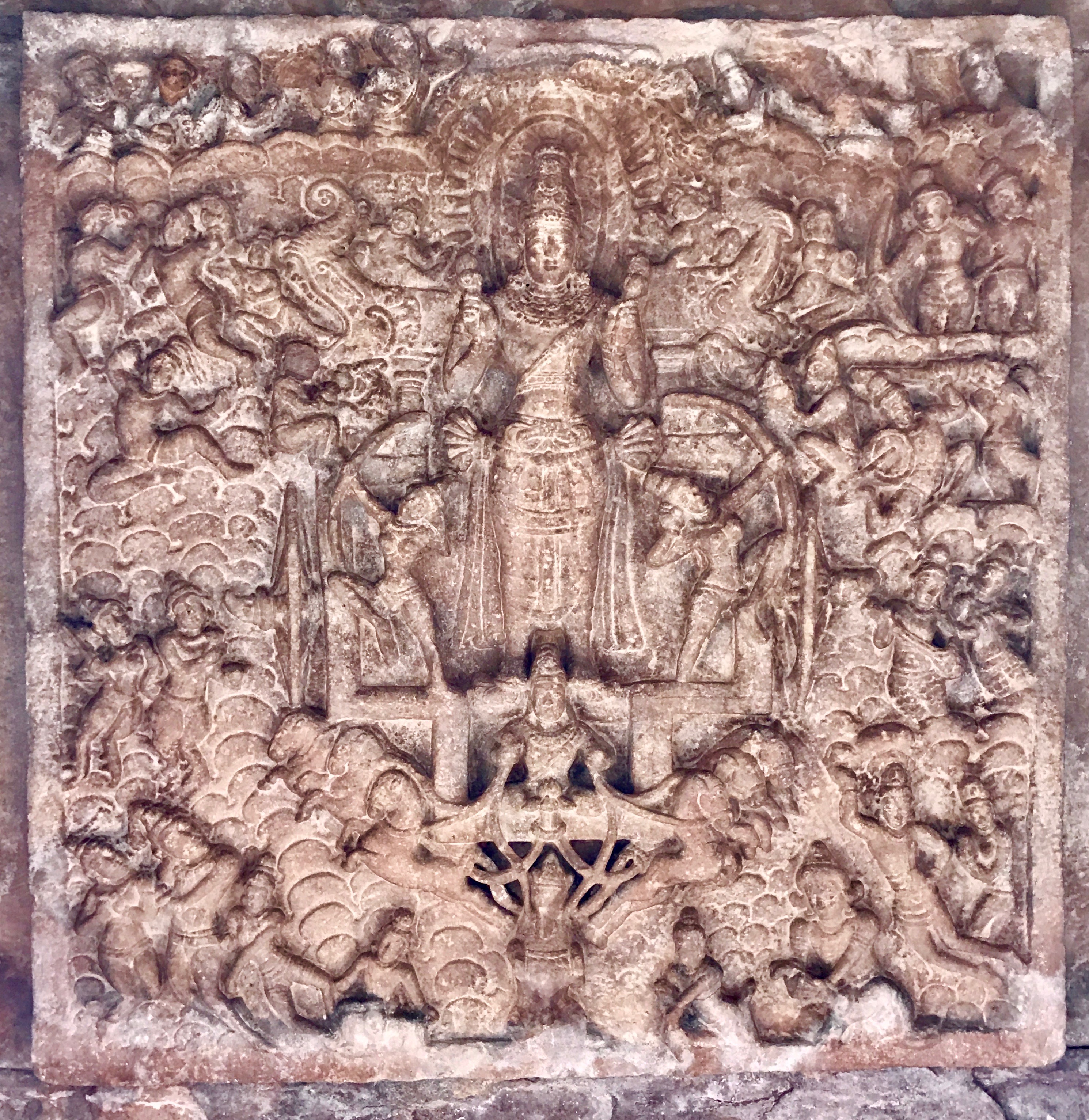
The sun god Surya is present in the Rigveda as its powerful illuminating force. There is a persistent thread through the sacred text that shows the deity and the Sun to weave in and out of representation. The hymn-like 1.50 is clearly a reference to the deity; it effuses that he is “the God who knows all that lives,” is “all-beholding,” is “the maker of light,” and is “God among the Gods.” He rides forth with seven steeds on his chariot; launched by prisms of rays, he is indomitable as he moves seamlessly between the divine firmament and man.10, 11
The Rigveda states that the incarnate Sun illuminates the world. He easily drives away the stars and the darkness each morn. Therefore just as he sets the day's margin, Surya from his great shining height grants eternal and everlasting victory over enemies. Unlimited in his perception, he uses the universal eye of Varuna to observe man and his progress from afar.10
There is a further elaboration on this theme. Surya can himself be the eye of Varuna, Mitra and the fire deity Agni. He generates divine form and manifests it so the first two deities may behold it. The Svarbhanu episode shows this: Surya is attacked by the Asura Svarbhanu, representing the eclipse, who covers him with darkness. All creatures become bewildered. Indra defeats the asura's magic, and the sage Atri discovers Surya hidden in gloom; the latter then restores or establishes the eye of Surya in heaven.10, 11
Surya is also shown to be the leader and controller of the Adityas, a group of six to eight divine and holy beings. Later, this number increases to twelve. In hymn 7.99 of the Rigveda, Indra-Vishnu creates the sun with his discus a vestige of the golden orb.10, 2
The Rigveda is far from being just a creation myth or cosmology about the physical sun. The text gives directives about how the soul must function, illustrated in the stories of deities helped by sages. The poet also curiously asks Surya to cure the ailments of the heart and the liver in vanquishing death, rooting his divine powers in those parts of the body.10, 11
Ushas, the dawn goddess, is associated with Surya as the one he pursues in love.2, 10
Samaveda
The fifth Samurvedic hymn from the third chapter, an interpolation of Rigveda Book 10, is famous in being dedicated to Surya. He is named as the bright god who can drink the Soma, giving the initiate unbroken and endless life. The ninth hymn is also important to the god. Aditya, as Surya is known, is the high priest par excellence among the gods, possessing an unconquerable and divine light.10, 12
May the bright God drink glorious Soma-mingled meath, giving the sacrifices lord unbroken life
He who, wind-urged, in person guards our offspring well, nourishes them with food and shines o'er many a land.
Radiant, as high Truth, cherished, best at winning strength, Truth based upon the statute that supports the heavens,
He rose, a light that kills Vritras and enemies, best slayer of the Dasyus, Asuras, and foes.
This light, the best of lights, supreme, all conquering, winner of riches, is exalted with high laud.
All-lighting, radiant, mighty as the Sun to see, he spreadeth wide unshaken victory and strength.
V. Sūrya, Samaveda, paraphrasing Rigveda 10.170.1–3, trans. Griffin10, 12
In context, the Samaveda also affirms the convention of Surya rising upward to meet gods, heroes and sages, such as when the sun does so to accompany Indra himself.12
Yajurveda
Interpolating Rigveda 1.50.1, the White Yajurveda again treats Surya as the god of omniscience, knowing all that lives under his rays. It describes his cosmic role in a similar way to the Rigveda; he rises, reveals himself to all, he then becomes the eye of Agni, Varuna and Mitra, fills heaven, earth, and midspace, and implacably does stand as the shining soul of both the moving and unmoving world. In this, however, is a hint that Surya is perhaps not just the observable sun.13, 10
The Krishna Yajurveda relays about one of his unique qualities. Agni and Surya are treated as the great vehicles of sight. Men are said to see by the eye of Agni in bursts of flame, while Surya's sempiternal sun, ceaselessly bright and strong, is the eye of the gods themselves.14
Atharvaveda
The Atharvaveda changes some of the qualities of the Rigvedic paean to Surya while again reusing Rigvedic verses. Again his qualities to see and know all are emphasised strongly. He is also given a cosmological role of illuminating all the worlds and spheres, not just the one we see. It calls him Aditya, but shows him as Rohita, the ruddy one, entering a kingdom, expanding its powers.10, 15
The rest of the thirteenth Atharvaveda expands Surya's role as being a depositor of divine function: he is Savitr, Indra, Dhatr, Vayu, Aryaman, Varuna, Rudra, Agni and Yama. It says the gods become single in him. It places the moon and all the asterisms under his control, and makes him both born from cosmic principles and the source from which those same principles are born. Surya is almost treated as a deity-within-a-deity.15
III. The Epithets of Surya
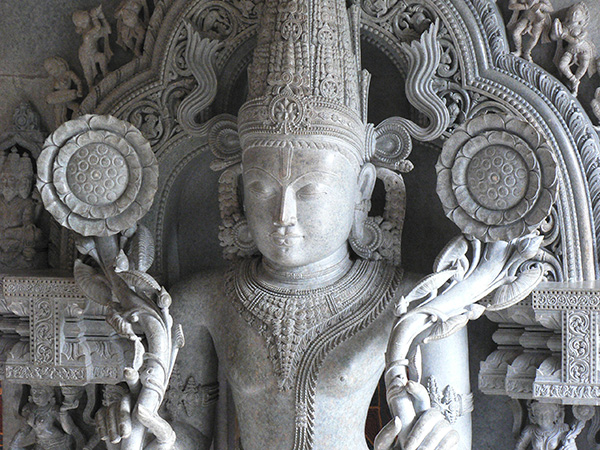
Surya is often conflated with Mitra and Savitr who are seen as aspects of him.1, 2, 15
| Cult Title / Epithet | Meaning | Domain |
|---|---|---|
| Āditya (आदित्य) | Son of Aditi | Divine lineage, solar sovereignty, all-seeing order |
| Rohita (रोहित) | The Red One | Atharvavedic rising sun, royal power, cosmic growth |
| Ravi (रवि) | The Sun | Later solar devotion, Navagraha worship |
| Vaivasvat (विवस्वत्) | Maker of Light | Illumination, Aditya |
| Bhāskara (भास्कर) | Maker of Light | Illumination, revelation, radiant divine power |
| Divākara (दिवाकर) | Maker of the Day | Daylight, time, daily cosmic rhythm |
| Arka (अर्क) | Ray | Solar heat, healing, ritual offering, Saura worship |
| Bhānu (भानु) | Radiance | Luminosity, brilliance, visible manifestation |
| Mārtaṇḍa (मार्तण्ड) | Aditi’s solar son | Āditya lineage, birth and death, cosmic time |
| Vivasvat / Vivasvān (विवस्वत् / विवस्वान्) | The shining one | Solar ancestry, life-force, radiant progenitorship |
| Pūshan (पूषन्) | Nourisher | Feeding, protection, guidance, sustaining life |
| Mitra (मित्र) | Friendy | Solar friendliness, covenant |
| Khaga (खग) | Sky-Goer | Solar path through heaven, celestial motion |
| Gabhastimān (गभस्तिमान्) | Possessed of rays | Ray-power, solar emission, illumination of the worlds |
| Marīcimān (मरीचिमान्) | Possessed of rays | Radiance, emanation, extension of sunlight |
| Saptāshva/Saptasapti (सप्ताश्व/सप्तसप्ति) | Seven-horsed/Of Seven Steeds | Solar chariot, cosmic movement |
| Sahasrāṃśu (सहस्रांशु) | Thousand-Rayed | Boundless brilliance, many-rayed solar splendour |
| Hiraṇyagarbha (हिरण्यगर्भ) | Golden Embryo | Cosmic seed, creation, golden solar source |
| Dvādasātman (द्वादशात्मन्) | Twelve-formed | Twelve Ādityas, months |
| Jagaccakshus (जगच्चक्षुस्) | Eye of the world | Cosmic sight, witness, revelation of beings |
| Karmasākshin (लोकसाक्षिन्) | Witness of Deeds | Omniscience |
| Tamisrahā (तमिस्रहा) | Destroyer of Darkness | Dispelling night |
| Grahapati (ग्रहपति) | Lord of the Planets | Solar sovereignty |
Sources: Monier Monier-Williams, A Sanskrit-English Dictionary (Oxford: Clarendon Press, 1899), relevant entries for Āditya, Rohita, Ravi, Sūrya, Savitṛ, Bhāskara, Divākara, Arka, Bhānu, Mārtāṇḍa, Vivasvat, Pūṣan, Mitra, Khaga, Gabhastimān, Marīcimān, Saptāśva, Sahasrāṃśu, Hiraṇyagarbha, Dvādaśātman, Jagaccakṣus, Sākṣin, Tamisrahā, Tamobhedin, and Grahapati1. Ṛgveda, “Rig Veda. Mandala 1. Sukta 50,” digital text with Devanagari and transliteration, Sri Aurobindo site, accessed June 29, 202616; Ṛgveda, “Rig Veda. Mandala 1. Sukta 115,” digital text with Devanagari and transliteration, Sri Aurobindo site, accessed June 29, 202617; Ṛgveda, “Rig Veda. Mandala 10. Sukta 72,” digital text with Devanagari and transliteration, Sri Aurobindo site, accessed June 29, 202618; William Dwight Whitney, trans., Atharva-Veda Saṃhitā: Translated with a Critical and Exegetical Commentary, revised and edited by Charles Rockwell Lanman, 2 vols., Harvard Oriental Series 7–8 (Cambridge, MA: Harvard University, 1905), especially Atharvaveda Śaunaka 13.1–4 on Rohita, Āditya, and Sūrya15; Vālmīki, Rāmāyaṇa, Yuddhakāṇḍa, sarga 105, “Āditya Hṛdayam,” Sanskrit text at SanskritDocuments.org, based on the Gita Press edition and encoded by M. Giridhar, accessed June 29, 202619; Amarasiṃha, Nāmaliṅgānuśāsana [Amarakośa], Kāṇḍa 1, Svargavarga, “Sun (54),” 1.3.231–241, GRETIL digital text, accessed June 29, 202620;
IV. The Temples of Surya
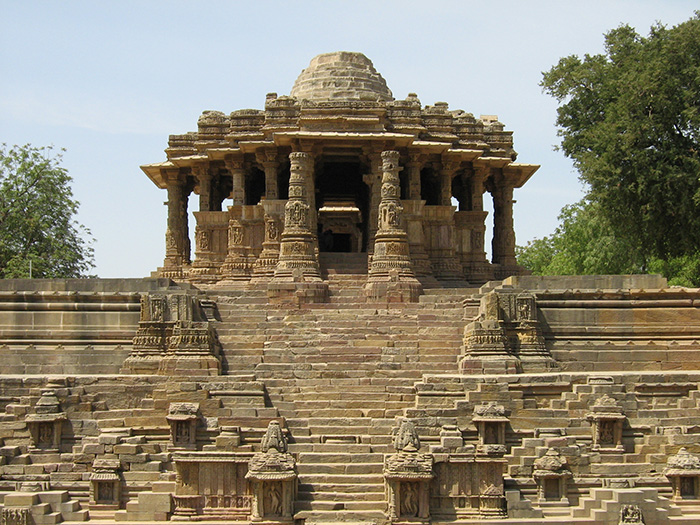
Rigvedic gods were altar gods according to much of the evidence and did leave much presence of temples. However, beginning in the first five centuries BCE and during the first millennium AD, a variety of very important Sun temples dedicated to Surya began to envelop the Indian landscape.21, 22
Prevalence of the Sun temples with their orientation towards the rising sun may be connected to these developments of the first century strongly Vedic beliefs per se, though this is contentious. Many of them were targets of Muslim vitriol during the invasions of India.22, 23
One particularly unique aspect of Surya's worship is the prevalence of holy complexes in caves, such as his depiction in the Bhaja Caves of the 2nd century BCE.24
Deo
The most famous temple used to this day is located in Deo in the province of Bihar in India. It is said Vishvakarma built the temple within a day, and the temple may date back to the seventh century BCE according to oral tradition. An inscription from 1437 is the first fully written attestation. The nearby Surajkund (Lake of the Sun) is associated with the sun god.25, 26, 27
To this day, the temple is famous for its annual Chhath festival celebration. Thousands of the devoted from Bihar and pilgrims from other regions visit the temple to offer worship and rites to Surya himself. The temple exists as an incredible ancient inheritance to the god.25, 28
Konark
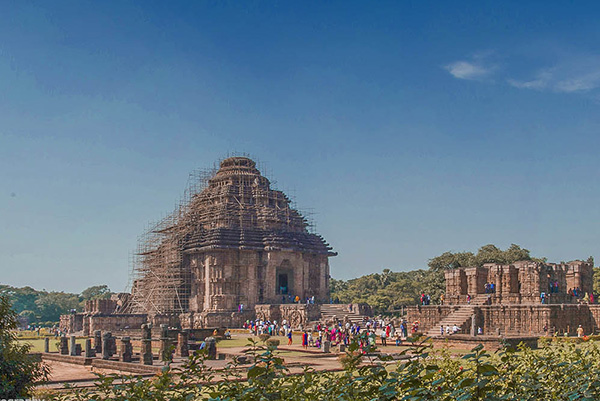
Konark (Kainapara) is probably the most famous Sun Temple of them all. The temple is attributed to king Narasingha Deva I of the Eastern Ganga dynasty about 1250 CE who commissioned the design to resemble a giant chariot of the sun god. The soaring height of the sikhara that does not survive was a marvel for its time, being 200ft tall. Depictions of the Navagrahas in statuary and other facets of its statues are both noted and highly praised.29, 30, 31
The Sun Temple is the culmination of Kalingan temple architecture, with all its defining elements in complete and perfect form. A masterpiece of creative genius in both conception and realisation, the temple represents a chariot of the Sun God, with twelve pairs of wheels drawn by seven horses evoking its movement across the heavens. It is embellished with sophisticated and refined iconographical depictions of contemporary life and activities. On the north and south sides are 24 carved wheels, each about 3 m in diameter, as well as symbolic motifs referring to the cycle of the seasons and the months. These complete the illusionary structure of the temple-chariot. Between the wheels, the plinth of the temple is entirely decorated with reliefs of fantastic lions, musicians and dancers, and erotic groups. Like many Indian temples, the Sun Temple comprises several distinct and well-organized spatial units. The vimana (principal sanctuary) was surmounted by a high tower with a shikhara (crowning cap), which was razed in the 19th century. To the east, the jahamogana (audience hall) dominates the ruins with its pyramidal mass. Sun Temple, Konârak, UNESCO29
The site is now known as one of the masterpieces of sacred engineering on earth. It is also, curiously, one of the few Hindu temples where any construction records written in Sanskrit survived. These were found in the Odia script in the form of palm leaf manuscripts that were discovered in a village in the 1960s. The official employed by the king was known as Shiva Samantaraya Mahapatra, while the architect was the skilled Bisu Maharana.31, 32
Konark functioned as an extremely important religious center up until the 1500s as noted by Mughal observers, but it was abandoned for reasons that remain unclear. One theory is that a Muslim general, Kalapahad, attacked the temple in the mid 1500s. The sikhara of the temple seemingly fell in the 18th century, since palm manuscripts show it still standing in the 17th.23, 31, 33
Multan
The Multan Sun Temple in present day Pakistan was known as one of the greatest across India. The Chinese scholar Xuanzhang attested to its opulence with its gem studded golden idol. Arab writers also spoke of its extreme opulence, stating that the Umayyad Caliphate extracted thirteen thousand and two hundred mans of gold from Multan, primarily from the temple.34, 35
The local Hindus and Buddhists, however, continued to furnish the temple with artefacts of great wealth. The Muslim rulers of the area seemingly leveraged the site's existence to prevent local Hindu rulers from opposing them.35
Istakhri described a very wealthy temple in the most populated part of Multan. The idol of Surya was draped in red leather other than the eyes, being studded with gems. The idol wore a crown of gold and sat in a "quadrangular position" on a brick throne under the cupola with fists in the gyan mudra, rested on its knees. The Sun Temple was likely demolished during the 11th century and replaced by an Ismaili Shia mosque, but a similar temple was functioning during Jean de Thévenot's travels in 1666. After this, the temple was likely destroyed by a Muslim ruler, but no one in 1853 could identify the site.35, 36, 37, 38
Suryanar
Another great Sun Temple that still is involved in active worship is the Suryanar Kovil in Tamil Nadu. As a sacred complex, the Dravidian-style site is a prestiguous site for all of the Navagrahas who receive wide worship in southern India; the site is the site dedicated to the Sun out of nine temples. There are three separate shrines to each of the planetary deities. The site consists of a five-tier rajagopuram, being ornate in structure.
The present masonry structure was built during the reign of Kulottunga Choladeva (1060–1118 CE) in the 11th century with later additions from the Vijayanagar period. The myth of the temple involves Shiva lifting a curse on the six planetary deities, and correspondingly the temple still hosts six daily rituals.39, 40, 41
Other Areas
Surya has a wide variety of extant temples in Nepal. Another curiosity is an ancient Chinese temple of the Sanxingdui culture dated to 1600BCE near Chengdu, dating to around the Rigveda. It shows a chariot-riding sun god with attributes similar to that of the Vedic Surya or the Greek Helios.42, 43, 44, 45
V. The Sun as Guide of Kings
The cult of Surya was connected to that of ancient kings, some of whom were proactive in building the various types of Sun Temples above.22, 46 Scripture itself expounded upon the idea that Surya teaches dharma and even yoga in its royal manner to the kings of India. The Bhagavad Gita shows that Krishna taught the imperishable yoga first to Surya, Surya in his epithet Vivasvān taught it to Manu, and Manu to Ikshvaku, the legendary king. This makes the Sun the first recipient, the great transmitter of sacred knowledge into the royal line.
श्रीभगवानुवाच
इमं विवस्वते योगं प्रोक्तवानहमव्ययम् ।
विवस्वान्मनवे प्राह मनुरिक्ष्वाकवेऽब्रवीत् ॥ ४.१ ॥
एवं परम्पराप्राप्तमिमं राजर्षयो विदुः ।
स कालेनेह महता योगो नष्टः परन्तप ॥ ४.२ ॥
The Blessed Lord said:
“I taught this imperishable yoga to Vivasvān. Vivasvān taught it to Manu, and Manu spoke it to Ikṣvāku.
Thus received through succession, the royal seers knew it; but over a long time here, that yoga was lost, O scorcher of foes.”
Bhagavad Gita 4.1-4.246
King Rama is also instructed to worship Surya in the battle with the vicious Ravana to grant victory in the Ramayana. Telling, the Gupta kings of the great medieval empire enveloping most of India began to use Surya's name Aditya as a suffix in their names; they had names like Vikramaditya, Mahendraditya, Kramaditya, Bāladitya, and Dvadashaditya.19, 47, 48
The archeological record shows several associations of Surya with kingship from a very early point. A particular case is that of Skandagupta whose copper plate from 465CE recorded Surya as a protector of the people, a great deity who cleaves away darkness and restores consciousness to the diseased. It records too a Brahmin donor, Devavishnu, investing an endowment with an oilmen’s guild so that oil would be supplied perpetually to the Sun temple established by merchants.47, 49
A similar inscription called the silk-weavers inscription records an earlier devotion to the Sun Temple. The inscription says the silk-weavers built a lofty, peerless temple of the bright-rayed Sun during the reign of Kumaragupta and under the protection of king Bandhuvarman of the Aulikara dynasty. What the inscription reveals is that guilds could also be overseen under a royal aegis to accomplish this.47
The Gwalior stone inscription of Mihirakula, from the king’s fifteenth regnal year, records the establishment of a Sun temple by Matrceta. The inscription praises Surya as a protector and dispeller of darkness, and says the temple was made for the merit of the donor, his parents, and those dwelling on the mountain through the king’s favor. The Kashmiri king Lalitaditya Muktapida is strongly associated with solar royal monumentality. The Rajatarangini work shows this royal connection to the Martanda temple and the later chronology also records royal grants to an Aditya shrine.47, 50, 51
In the Khmer Empire of modern day Cambodia, it was Suryavarman II who built the world-famous complex of Angkor Wat, arguably the most famous temple on earth beside the Parthenon. Other Khmer rulers like Udayādityavarman II of the thirteenth century were named likewise. Solar symbolism was also used in that royal lineage far outside of India where an Old Khmer oath inscription, K.292/1, dated 933 Shaaka, attests to Shri Sūryyavarmmadeva. It records officials swearing loyal service to him. The K.292/1 uses the phrase candrāditya, “Moon and Sun,” in the curse formula, meaning the oath is cosmically witnessed for as long as Moon and Sun endure.52, 53
VI. Surya's Imagery in Early Buddhism
The context of Buddhism enveloped Surya in its cosmological understanding, but as with many Vedic deities, it subordinated them to the Buddha himself. Nonetheless, much of the early visual material of the sun god appears to relate to a Buddhist context.54
The Suriya Paritta is used in Buddhism because the Buddhist tradition uses the episode of being captured by Rahu (eclipse) to render his protective mantra a surya devaputta, a deliverance from protection, well-being and a deliverance from its dangers, which modern Theraveda Buddhism still uses in ritual.55
In later Buddhist art and tantric contexts, Surya is absorbed into Buddhist mandalas and their retinues. Himalayan Art Resources summarizes him as a Sun-god belonging to the broader Indian religious world, found in multiple Indian traditions, and notes that surviving Surya mandalas “primarily belong to the Newar Buddhist religion of Nepal.” In Tibetan Buddhism Sūrya is rarely central, but appears as a retinue deity in Carya and Yoga Tantra mandalas.56, 57
These traditions came over to China and Japan. In China, he is called Ritian (日天). His statue exists in Mahavira Hall of Chinese Buddhist temples, along with the other devas. Japan also adopted his symbolism in a Buddhist guis, where Surya is treated as one of the twelve door guardians and given the name Nitten (日天, Sun-God).58, 59, 60
VII. Sun Symbolism
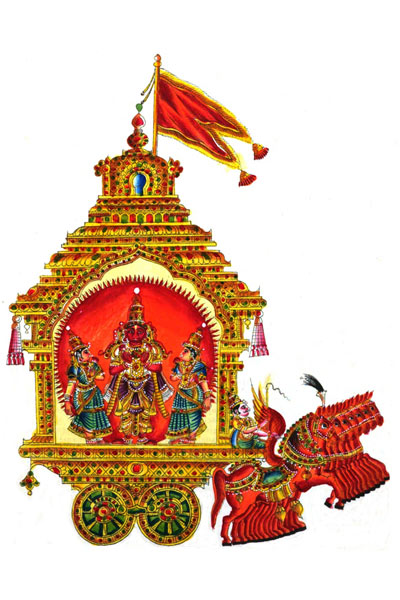
Ancient depictions of Surya in temples take two forms: one form is the charioteer of four to seven horses, which some believe in form to be influenced by the Hellenistic symbolism of Helios due to the presence of the solar god in Greco-Indian depictions bearing heavy influence. The other is Surya being the center of the ubiquitous Navagraha reliefs where he usually appears in a sequence of seven to twelve deities. Surya himself is often placed oriented towards the sunrise.24, 54, 29, 61
नासाललाटजङ्घोरुगण्डवक्षांसि चोन्नतानि रवेः ।
कुर्यादुदीच्यवेषं गूढं पादादुरो यावत् ॥
बिभ्राणः स्वकररुहे बाहुभ्यां पङ्कजे मुकुटधारी ।
कुण्डलभूषितवदनः प्रलम्बहारो वियद्गवृतः ॥
कमलोदरद्युतिमुखः कञ्चुकगुप्तः स्मितप्रसन्नमुखः ।
रत्नोज्ज्वलप्रभामण्डलश्च कर्तुः शुभकरोऽर्कः ॥
One should make Ravi’s nose, forehead, shanks, thighs, cheeks, and chest prominent;
one should make him in northern dress, covered from the feet up to the breast.
Bearing two lotuses in his own hands, with his two arms, wearing a crown;
with his face adorned by earrings, wearing a long hanging necklace, and wrapped in the viyaṅga/girdle. [note: some rescensions explain this as "surrounded by sky"]
With a face bright like the inside of a lotus, protected by a coat or cuirass,
smiling and pleasant-faced, and with a halo shining with jewels:
Arka brings good fortune to the maker.
Brihat Samhita 57.46–48, c. 500CE62
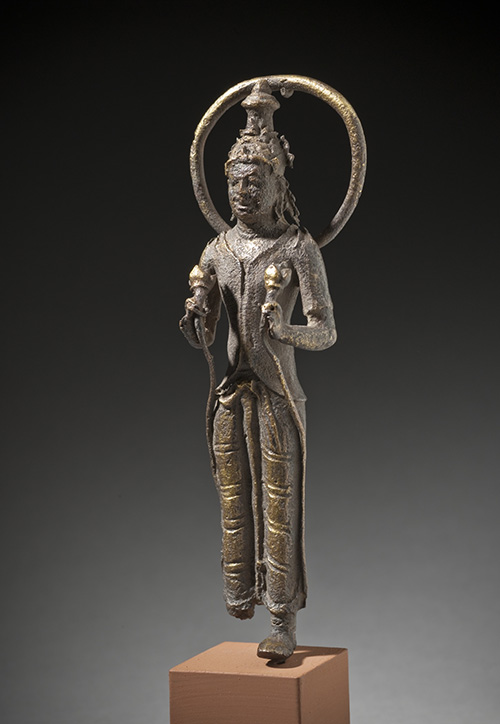
As is shown above and as shown by the bejewelled descriptions of the idols present in temples, the depiction of Surya in art was of no small consequence. The statue simply had to match the grandeur of how the Sun of the Vedas was articulated in verse. The Vishnudharmottara Purana from a similar period gives similar instructions, elaborating to portray him as bearded, surrounded by his servants Dandin (bearing shield and spear) and Pingala (who is to hold pen and paper), and to represent him in armor. 62, 63
This account also states Surya is to be accompanied by a lion-standard, his sons Revanta, Yama, and the two Manus, the planets, four wives, and a one-wheeled chariot with seven horses driven by Aruna the great charioteer. Other style guides offer similar advice. Some recommend that he must be portrayed with invisible feet due to the Sun's hovering nature above ground. Ancient sources extrapolate that Surya is sindura red (the color of anatto powder).63
Modern depictions of Surya as a Navagraha often represent him in the center, similar to those depictions of ancient temples, riding a four or seven-horse chariot with the sun behind him. His mount has an orange standard. He is either depicted with luminescent skin or red skin like the pomegranate flower, one of his symbols, as Śrītattvanidhi specifies in their 19th century style guide.61, 64, 65
Occasionally in art, Surya is represented with his two queens, Nikshubha and Rajni. Tantra-forms of Surya represent him with imagery linked to meditation, ritual and prayer like the khatvanga and shakti, the rosary and skulls that link him to Shiva's iconography.63, 66
VIII. Festivals
The word for Sunday in Indian languages (Ravivara) is named for Surya. Numerous festivals to Surya exist in India to this day. As mentioned, the Chtath of Bihar revolves around the god, but the Pongal or Makara Sankaranti is the most widely celebrated Hindu festival dedicated to him. These are harvest related festivals that celebrate his role as overseer of humanity itself.28, 67
The Chttath festival of Bihar is a purification rite lasting four days, involving Nahay Khay, Kharna, Sanjhiya Arghya and the Usha Arghya. The devotees bathe in a river, they bring water home, clean the house and enforce purity. On the second day, a day-long fast is observed and fruit and kheer are distributed to the followers. On the third day, devotees gather at ponds and rivers. Before sunrise, devotees return to the water and offer arghya to the rising sun, then break the fast and they give prasad.28, 68
The Pongal festival of Tamil Nadu operates in a similar four day schematic, again fixating on cleansing the home in the first days, with the main part of the Surya symbolism occuring on the the second day. The gift of Pongal is given to Surya on the second day. The core symbol of the overflowing, boiling pot is taken to be symbolic of Suryas powers, representative of powers and successes in the agricultural sphere.67, 69
Ratha Saptami is a more temple-centred Surya festival. At Arasavalli Suryanarayana Swamy Temple in Andhra Pradesh, it is the temple’s most important festival and a day dedicated to Lord Sūrya. Samba Dashami in Odisha is a more household-oriented Sūrya rite, often connected with health and the Sāmba legend. Women rise before sunrise, prepare dishes, and offer them to the Sun God for family members.70, 71
IX. The Multiplicity of Sun Gods
In Indian culture, there is scarcely only one solar deity. Surya can be taken to represent 'all' solar deities combined as the sheer representation of the Sun's power. Agni, Savitr and Mitra, however, also represent the Sun in different capacities.2, 15
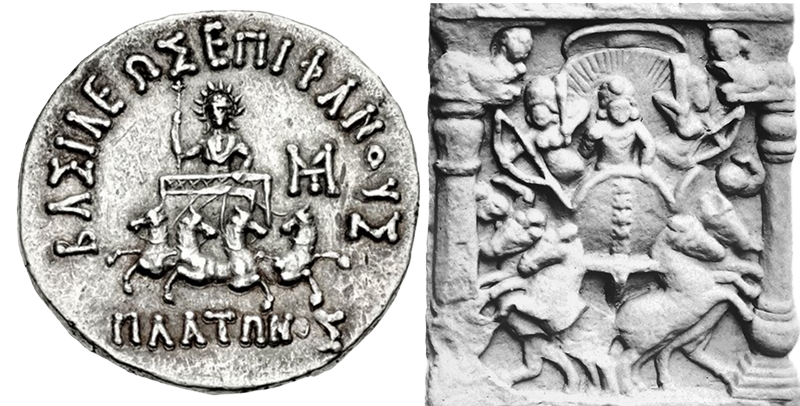
The Greeks seemingly equated Surya with Helios. The Greco-Bactrian and Indo-Greek connection has therefore been discussed less simplistically as a simple borrowing of Surya from Helios. Rather it is a possible transmission of solar iconography. The historian Osmund Bopearachchi has argued that several Gandharan or Bactrian-associated objects, especially so-called trays or palettes, show a syncretic visual language in which Greek Helios imagery was used to express Indian Surya themes. In these objects, a Greek-style solar charioteer appears together with Indian female figures or asuras, producing an image that is neither purely Greek nor purely Vedic, but Indo-Greek.72, 73
Early Indian Surya imagery is not identical to later medieval Hindu images. One of the oldest surviving monumental depictions, on the Bodh Gaya railing, shows Surya in a one-wheeled chariot drawn by four galloping horses, with Aruṇa as charioteer and the dawn goddesses Ushas and Pratyusha shooting arrows against darkness. This four-horse chariot is especially suggestive when compared with the Greek quadriga of Helios. Another early Indian example, a Shunga-period ivory from Bengal, also shows Surya to be in a chariot with attendants. These early forms show him in a dynamic solar vehicle, closer in spirit to the travelling Helios than to the later static temple icon.24, 54, 73
The appearance of Surya with armor is sometimes commented upon by Indians as seeming strangely foreign. The Greek and Central Asian inheritance and correspondence of the god perhaps explains why this ancient iconography existed.74, 75
X. The Suryayae Mantra
The Suryayae mantra is used by the Temple of Zeus. It is one of the twelve-solar name mantras and in modern Hindu beliefs, is taken to be the head of those.
ॐ ह्रां ह्रीं ह्रौं सः सूर्याय नमः
oṃ hrāṃ hrīṃ hrauṃ saḥ sūryāya namaḥ
The astrological worship books such as the Mantra Mahodadhi of the 16th century list solar mantras that are called Ravi mantras. The Agni Purana 73 (ह्रां ह्रीं सः सूर्याय नमः, hrāṃ hrīṃ saḥ sūryāya namaḥ) and its solar sadanga sequence (ह्रां ह्रीं ह्रूं ह्रें ह्रों ह्र, hrāṃ hrīṃ hrūṃ hreṃ hroṃ hraḥ) is the partial textual inheritance of the full Sun mantra used on the Planetary Squares page.76, 77
XI. The Worship of Surya in Indonesia
In Indonesia, Surya was worshipped as Batara, the god of great benevolence and gift-giving. Beliefs from Bali credit Batara as being one of the wisest students of Shiva, being the guru of the Gods, a role often given to Brihaspati elsewhere. Balians often worship Surya as Shiva Raditya, Shiva having absorbed the sun in aspect.78, 79
There are unique aspects to Surya's mythology in Indonesian belief. He interacts much with Anoman (Hanuman) who blames Surya for his wife and mother-in-law being cursed. Anoman's magic causes the clouds to cover the entire sky before the incident is resolved amicably. As with the Hindu beliefs, many of the progeny of the Gods come from Surya and his wife Sanjna in this belief system, including the death god Yama and the spirit of Saturn, Sani (Shani).78, 79, 80
XII. King of the Navagrahas, Leader of Adityas
Surya, as the indomitable Sun, is the natural leader of the Navagrahas or planetary spirits. He occupies this position both in religious treatise since the start of recorded Indian civilization and in astrological-occult matters.77, 81 He is also the leader of the holy beings, the Adityas, whose forces are consulted in Indian myth again and again.2, 15
Ancient and modern astrological works treat him as both the Sun's planetary spirit and the head of the sign, Leo (Simha).81, 82
Sources and Bibliography
- Monier-Williams, Monier. A Sanskrit-English Dictionary. Oxford: Clarendon Press, 1899. Entries cited: Sūrya, saura, Āditya, Rohita, Ravi, Savitṛ, Bhāskara, Divākara, Arka, Bhānu, Mārtāṇḍa, Vivasvat, Pūṣan, Mitra, Khaga, Gabhastimān, Marīcimān, Saptāśva, Sahasrāṃśu, Hiraṇyagarbha, Dvādaśātman, Jagaccakṣus, Sākṣin, Tamisrahā, Tamobhedin, and Grahapati.
- Macdonell, Arthur Anthony. Vedic Mythology. Grundriss der Indo-Arischen Philologie und Altertumskunde 3.1.A. Strassburg: Karl J. Trübner, 1897. Sections cited: Sūrya, Savitṛ, Mitra, Ādityas, dawn, and the Rigvedic solar gods.
- Mayrhofer, Manfred. Etymologisches Wörterbuch des Altindoarischen. 3 vols. Heidelberg: Carl Winter, 1992–2001. Entries cited: Sūrya and related Indo-Iranian solar vocabulary.
- Watkins, Calvert. The American Heritage Dictionary of Indo-European Roots. 3rd ed. Boston: Houghton Mifflin Harcourt, 2011. Root cited: Indo-European solar root behind Sanskrit Sūrya, Latin sol, and related forms.
- Yāska. The Nighaṇṭu and the Nirukta. Translated by Lakshman Sarup. Delhi: Motilal Banarsidass, 1967. Sections cited: Nirukta’s derivations of Sūrya and quotations of solar Vedic passages.
- Ṛgveda. “Rgveda.” Based on Theodor Aufrecht, ed., Die Hymnen des Rig Veda. 2nd ed. Bonn: Adolph Marcus, 1877. Digitized by Barend A. van Nooten and Gary B. Holland; revised by Detlef Eichler. GRETIL digital text. Accessed June 28, 2026.
- Brinkman, John A. “Kassiten.” In Reallexikon der Assyriologie und Vorderasiatischen Archäologie, vol. 5, 464–473. Berlin: Walter de Gruyter, 1976–1980. Sections cited: Kassite divine names, Šuriaš, and the ambiguity of Indo-Aryan comparisons.
- DILA Buddhist Studies Authority Database. “T0848 大毘盧遮那成佛神變加持經.” Record for the Śubhakarasiṃha 善無畏 and Yixing 一行 translation, dated 725 CE. Accessed June 30, 2026.
- Kotobank. “聖徳太子伝暦.” In 改訂新版 世界大百科事典 and related reference entries. Accessed June 30, 2026.
- Griffith, Ralph T. H., trans. The Hymns of the Rigveda. 2nd ed. Benares: E. J. Lazarus, 1896. Sections cited: Ṛgveda 1.50, 1.115, 2.33.4, 5.40, 7.99, 10.37, 10.72, and 10.170.
- Jamison, Stephanie W., and Joel P. Brereton, trans. The Rigveda: The Earliest Religious Poetry of India. 3 vols. Oxford: Oxford University Press, 2014. Sections cited: Rigvedic Sūrya, Svarbhānu, Atri, Ādityas, dawn, and solar healing.
- Griffith, Ralph T. H., trans. The Hymns of the Sāmaveda. Benares: E. J. Lazarus, 1895. Sections cited: V. Sūrya and Sāmavedic reuse of Rigvedic solar hymns.
- Griffith, Ralph T. H., trans. The Texts of the White Yajurveda; or, Vājasaneyi Saṃhitā. Benares: E. J. Lazarus, 1899. Sections cited: Vājasaneyī Saṃhitā solar passages adapting Ṛgveda 1.50 and related Sūrya material.
- Keith, Arthur Berriedale, trans. The Veda of the Black Yajus School Entitled Taittiriya Sanhita. 2 vols. Harvard Oriental Series 18–19. Cambridge, MA: Harvard University Press, 1914. Sections cited: Agni, Sūrya, sight, and the eye of the gods.
- Whitney, William Dwight, trans. Atharva-Veda Saṃhitā: Translated with a Critical and Exegetical Commentary. Revised and edited by Charles Rockwell Lanman. 2 vols. Harvard Oriental Series 7–8. Cambridge, MA: Harvard University, 1905. Sections cited: Atharvaveda Śaunaka 13.1–4 on Rohita, Āditya, Sūrya, the gods becoming one in him, and solar sovereignty over cosmic powers.
- Ṛgveda. “Rig Veda. Mandala 1. Sukta 50.” Digital text with Devanagari and transliteration. Sri Aurobindo site. Accessed June 29, 2026.
- Ṛgveda. “Rig Veda. Mandala 1. Sukta 115.” Digital text with Devanagari and transliteration. Sri Aurobindo site. Accessed June 29, 2026.
- Ṛgveda. “Rig Veda. Mandala 10. Sukta 72.” Digital text with Devanagari and transliteration. Sri Aurobindo site. Accessed June 29, 2026.
- Vālmīki. Rāmāyaṇa. Yuddhakāṇḍa, sarga 105, “Āditya Hṛdayam.” Sanskrit text at SanskritDocuments.org, based on the Gita Press edition; encoded by M. Giridhar. Accessed June 29, 2026.
- Amarasiṃha. Nāmaliṅgānuśāsana [Amarakośa]. Kāṇḍa 1, Svargavarga, “Sun (54),” 1.3.231–241. GRETIL digital text, input by Avinash Sathaye and Pramod S. V. Ganesan. Accessed June 29, 2026.
- Gonda, Jan. Vedic Ritual: The Non-Solemn Rites. Leiden: Brill, 1980. Sections cited: domestic, household, and altar-based Vedic ritual settings.
- Meister, Michael W., M. A. Dhaky, and Krishna Deva, eds. Encyclopaedia of Indian Temple Architecture. Vol. 2, Part 1, North India: Foundations of North Indian Style. Princeton: Princeton University Press, 1988. Sections cited: early Hindu temple architecture and Sūrya temple forms.
- Eaton, Richard M. “Temple Desecration and Indo-Muslim States.” In Essays on Islam and Indian History, 94–132. New Delhi: Oxford University Press, 2000. Sections cited: medieval attacks on temples and political-religious contexts of destruction.
- Fo Guang Shan Institute of Humanistic Buddhism. “Bhaja Cave 18: Figures Riding a Horse Chariot and an Elephant.” Encyclopedia of Buddhist Arts. Accessed June 30, 2026.
- Government of Bihar, Department of Tourism. “Deo Sun Temple, Aurangabad.” Official tourism page. Accessed June 30, 2026.
- O’Malley, L. S. S. Bihar and Orissa District Gazetteers: Gaya. Calcutta: Bengal Secretariat Book Depot, 1906. Sections cited: Deo, Surajkund, and local Sun-temple traditions.
- Government of Bihar, Aurangabad District. “Deo Sun Temple.” Official district website. Accessed June 30, 2026.
- Government of India, Ministry of Tourism. “Chhath Puja.” Utsav Portal. Accessed June 30, 2026.
- UNESCO World Heritage Centre. “Sun Temple, Konârak.” Accessed June 30, 2026.
- Mitra, Debala. Konarak. New Delhi: Director General, Archaeological Survey of India, 1968. Sections cited: history, architecture, and iconography of the Konark Sun Temple.
- Boner, Alice, Sadasiva Rath Śarmā, and Rajendra Prasad Das. New Light on the Sun Temple of Konarka: Four Unpublished Manuscripts Relating to Construction History and Ritual. Varanasi: Chowkhamba Sanskrit Series Office, 1972. Sections cited: palm-leaf construction records, Śiva Sāmantarāya Mahāpātra, Bisu Mahārāṇa, and later temple history.
- Donaldson, Thomas E. Konark. New Delhi: Oxford University Press, 2003. Sections cited: Konark architecture, sculptural program, and construction traditions.
- Behera, Karuna Sagar. Konarak: The Heritage of Mankind. New Delhi: Publications Division, Government of India, 1996. Sections cited: later history, abandonment, Kalapahad traditions, and the fall of the sikhara.
- Beal, Samuel, trans. Si-Yu-Ki: Buddhist Records of the Western World. 2 vols. London: Trübner, 1884. Sections cited: Xuanzang on Multan and the gem-studded golden Sun idol.
- Wink, André. Al-Hind: The Making of the Indo-Islamic World. Vol. 1, Early Medieval India and the Expansion of Islam, 7th–11th Centuries. 2nd ed. Leiden: Brill, 1997. Sections cited: the Multan Sun Temple, its wealth, Arab rule, and the political use of the idol.
- Elliot, H. M., and John Dowson, eds. The History of India, as Told by Its Own Historians. Vol. 1. London: Trübner, 1867. Sections cited: Arabic and Persian accounts of Multan, including al-Iṣṭakhrī and related geographers.
- Sachau, Edward C., trans. Alberuni’s India. 2 vols. London: Kegan Paul, Trench, Trübner, 1910. Sections cited: al-Bīrūnī on the Multan Sun idol and the later state of the sanctuary.
- Thévenot, Jean de. The Travels of Monsieur de Thevenot into the Levant. Part III. London: H. Clark, 1687. Sections cited: Thévenot’s report of a Sun temple functioning near Multan in 1666.
- TN Temples Project. “Viswanathar / Suryan, Suryanar Koil, Thanjavur.” Last modified February 22, 2025. Sections cited: Suryanar Kovil, Sūrya/Navagraha worship, and temple history.
- RealIndia. “Navagraha Temples, Suryanar Kovil.” Accessed June 30, 2026. Sections cited: Suryanar Kovil, the Navagraha shrine complex, and temple worship.
- Dinamalar Temple. “Sri Suriyanar Temple, Suriyanarkoil, Thanjavur.” Accessed June 30, 2026. Sections cited: Suryanar Temple, Kulottunga Chola construction tradition, later additions, temple myth, and daily rituals.
- Slusser, Mary Shepherd. Nepal Mandala: A Cultural Study of the Kathmandu Valley. 2 vols. Princeton: Princeton University Press, 1982. Sections cited: Nepalese Sūrya temples, solar images, and Newar religious landscape.
- Archaeological Institute of America. “The Many Faces of the Kingdom of Shu.” Archaeology Magazine. Accessed June 30, 2026. Sections cited: Sanxingdui chronology and ritual objects.
- Hong Kong Palace Museum. “Sun-Shaped Object.” Gazing at Sanxingdui: New Archaeological Discoveries in Sichuan. Exhibition label. Accessed June 30, 2026.
- Flad, Rowan K., and Pochan Chen. Ancient Central China: Centers and Peripheries along the Yangzi River. Cambridge: Cambridge University Press, 2013. Sections cited: ancient Shu, Sanxingdui archaeology, and ritual culture.
- Vyāsa. The Bhagavad Gītā. Translated by Winthrop Sargeant. Albany: State University of New York Press, 2009. Sections cited: 4.1–4.2 on Vivasvān, Manu, Ikṣvāku, and royal transmission of yoga.
- Fleet, J. F. Corpus Inscriptionum Indicarum. Vol. 3, Inscriptions of the Early Gupta Kings and Their Successors. Calcutta: Government of India, 1888. Sections cited: Skandagupta, Mandasor silk-weavers, and Mihirakula/Gwalior solar inscriptions.
- Altekar, A. S. The Gupta Empire. Varanasi: Motilal Banarsidass, 1954. Sections cited: Gupta royal names and Āditya suffixes.
- Sircar, D. C. Select Inscriptions Bearing on Indian History and Civilization. Vol. 1. Calcutta: University of Calcutta, 1965. Sections cited: Skandagupta, copperplate material, guild endowments, and Sun-temple donations.
- Kalhaṇa. Rājataraṅgiṇī. Translated by M. A. Stein. 2 vols. Westminster: Archibald Constable, 1900. Sections cited: Lalitāditya Muktāpīḍa, Mārtaṇḍa, and royal grants to Āditya shrines.
- Kak, Ram Chandra. Ancient Monuments of Kashmir. London: India Society, 1933. Sections cited: Mārtaṇḍa Sun Temple and royal solar monumentality in Kashmir.
- Cœdès, George. The Indianized States of Southeast Asia. Edited by Walter F. Vella. Translated by Susan Brown Cowing. Honolulu: East-West Center Press, 1968. Sections cited: Suryavarman II, Udayādityavarman, and Sanskritic royal culture in Cambodia.
- Pou, Saveros, and Philip N. Jenner. Old Khmer Inscriptions. Honolulu: University of Hawai‘i Press, 1992. Sections cited: K.292/1, Śrī Sūryavarmmadeva, and candrāditya oath formula.
- Dehejia, Vidya. Early Buddhist Rock Temples: A Chronological Study. London: Thames and Hudson, 1972. Sections cited: early Buddhist visual contexts for Sūrya imagery and rock-cut settings.
- “Sūriya Sutta: The Sun Deity’s Prayer for Protection (SN 2.10).” Translated by Piyadassi Thera. Access to Insight. Accessed June 30, 2026.
- Himalayan Art Resources. “Buddhist Deity: Surya, God of the Sun.” Accessed June 30, 2026. Sections cited: Sūrya in Newar Buddhist mandalas and Tibetan Buddhist retinues.
- Walters Art Museum. “Mandala of Surya, the Sun God.” Object record. Accessed June 30, 2026. Sections cited: Nepalese Buddhist Sūrya mandalas and attendants.
- Getty, Alice. The Gods of Northern Buddhism: Their History, Iconography and Progressive Evolution through the Northern Buddhist Countries. Oxford: Clarendon Press, 1914. Sections cited: Sūrya, Ritian/Nitten, and the devas of Northern Buddhism.
- National Institutes for Cultural Heritage. “Nitten (Skt. Sūrya).” e-Museum. Accessed June 30, 2026.
- Kyoto National Museum. “Nitten (Surya).” Masterpieces of the Kyoto National Museum. Accessed June 30, 2026.
- Rao, T. A. Gopinatha. Elements of Hindu Iconography. 2 vols. Madras: Law Printing House, 1914–1916. Sections cited: Navagrahas, Sūrya, Dandin, Pingala, wives, chariot, and iconographic forms.
- Varāhamihira. Bṛhat Saṃhitā. Translated by M. Ramakrishna Bhat. Delhi: Motilal Banarsidass, 1981. Section cited: Sūrya image-making instructions, including northern dress, lotuses, crown, armor, halo, and auspicious image.
- Viṣṇudharmottara Purāṇa. Part III. Translated by Priyabala Shah. Baroda: Oriental Institute, 1958. Sections cited: Sūrya image-making, attendants, armor, wives, sons, chariot, and color.
- Philadelphia Museum of Art. “Surya, the Sun God.” Object record. Accessed June 30, 2026. Sections cited: Sūrya’s boots, lotus flowers, attendants, wives, and seven-horse chariot.
- Kṛṣṇarāja Woḍeyar III. Śrītattvanidhi. Vol. 3. Mysore: Oriental Research Institute, University of Mysore, 2004. Section cited: Grahanidhi/Navagraha and Sūrya imagery.
- Srivastava, V. C. Sun-Worship in Ancient India. Allahabad: Indological Publications, 1972. Sections cited: Sūrya’s wives, ritual forms, tantric solar iconography, and later image traditions.
- Tamil Nadu Tourism Development Corporation. “Pongal Festival.” Tamil Nadu Tourism. Accessed June 30, 2026.
- NDTV. “Chhath Puja Date 2025: Check Nahay Khay, Kharna and Arghya Dates, Rituals and Significance.” Accessed June 30, 2026.
- Government of India, Ministry of Tourism. “Pongal.” Utsav Portal. Accessed June 30, 2026.
- Sri Suryanarayana Swamy Vari Devasthanam, Arasavalli. “Festivals in Sun God Temple.” Official temple website. Accessed June 30, 2026.
- Tripathy, Rabindra Kumar. “Samba Dasami in Odishan Culture.” Odisha Review, January 2013. Sections cited: Samba Dashamī, household offerings, women rising before sunrise, and prayers to the Sun God.
- Sick, David H. “Mit(h)ra(s) and the Myths of the Sun.” Numen 51, no. 4 (2004): 432–467. Sections cited: Surya, Helios, Mithra, and solar correspondences.
- Bopearachchi, Osmund. “From Indian Sūrya to Mithra-Hélios: Image Transmission in Space and Time.” Paper presented at “India and Central Asia in the 1st Millennium,” Collège de France, Paris, June 5, 2019. Sections cited: Gandhāra palettes, toilet trays, Greek Helios, Iranian Mithra, Indian Sūrya, and Indo-Greek visual syncretism.
- Cleveland Museum of Art. “Surya, the Sun God.” Object record. Accessed June 30, 2026. Sections cited: Sūrya’s tunic, boots, Central Asian riding dress, and foreign-looking iconography.
- Virginia Museum of Fine Arts. “Surya.” Object record. Accessed June 30, 2026. Sections cited: armor, boots, and early/medieval Sūrya iconographic conventions.
- Mahīdhara. Mantra Mahodadhi. Edited by Mahāprabhulāla Gosvāmi. Varanasi: Chowkhamba Sanskrit Series Office, 1985. Sections cited: Ravi/Sūrya mantras and twelve solar name-mantras.
- Agni Purāṇa. Translated by N. Gangadharan. 2 vols. Delhi: Motilal Banarsidass, 1984–1987. Sections cited: chapter 73, Sūrya mantra material, ṣaḍaṅga sequence, and Navagraha worship.
- Hooykaas, C. Religion in Bali. Leiden: Brill, 1973. Sections cited: Sūrya, Śiva-Rāditya, Balinese solar worship, and priestly ritual contexts.
- Zoetmulder, P. J. Kalangwan: A Survey of Old Javanese Literature. The Hague: Martinus Nijhoff, 1974. Sections cited: Batara Surya and Old Javanese Hindu-Buddhist mythology.
- Singaravelu, S. A Comparative Study of the Sanskrit, Tamil, Thai and Javanese Versions of the Story of Rama. Kuala Lumpur: University of Malaya Press, 1968. Sections cited: Anoman/Hanuman and Javanese Rāmāyaṇa mythic transmission.
- Varāhamihira. Bṛhat Jātaka. Translated by N. Chidambaram Iyer. Madras: Theosophical Publishing House, 1885. Sections cited: planetary rulership, the Sun, and Leo/Siṃha.
- Rao, Bangalore Suryanarain, trans. Brihat Parasara Hora Sastra. Bangalore: B. V. Raman, 1963. Sections cited: the Sun as graha and lordship of Siṃha/Leo.