





4 min read
Bastet: The Abrahamic Inversion
author: High Priest Zevios Metathronos
co-author: Novice Priest Karnonnos
The grimoires turned Bastet into the president Haagenti, and this page reads Her symbols back out of the slander. No God is to be invoked by a blasphemous name; Bastet is approached as Bastet, by Her own eternal name.
The Ointment Jar
The references to Bastet's powers in the Bible are vague. One snide reference to her powers actually occurs in Matthew 26:6-13 when the Nazarene figure is about to be sent to die1:
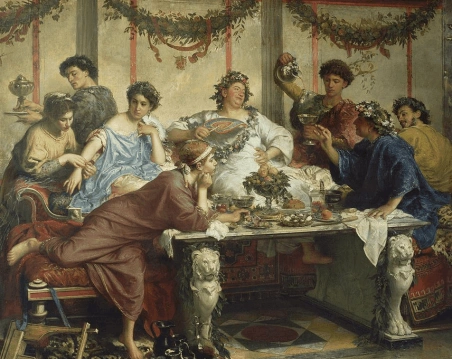
While Jesus was in Bethany in the home of Simon the Leper, a woman came to him with an alabaster jar of very expensive perfume, which she poured on his head as he was reclining at the table. When the disciples saw this, they were indignant. “Why this waste?” they asked. “This perfume could have been sold at a high price and the money given to the poor. Aware of this, Jesus said to them, “Why are you bothering this woman? She has done a beautiful thing to me. The poor you will always have with you, but you will not always have me. When she poured this perfume on my body, she did it to prepare me for burial. Truly I tell you, wherever this gospel is preached throughout the world, what she has done will also be told, in memory of her. Matthew 26:6-13
This reference is designed to show he has achieved the prerequisite for immortality. The ointment jar of alabaster was associated with Ra and the solar vehicle, enacted entirely through Bastet's symbolism. There is an alchemical code to what is said here.
Haagenti
Bugan est ung grant roy qui faict home saige
et faire touz manieres de metaulx muer en quelconque
maniere que on vieult, l’eau muer en vin ou
en huille; et a XXXIIII legions.
Johann Weyer, Pseudomonarchia daemonum
Haagenti probably appears as Bugan in the Livre des espritz of the sixteenth century, where the demon is described as a great king rendering men wise. He is alchemical, causing metals to be changed however one wishess, changing water to wine or oil. The transmutation is based on Bastet's refinement of lower order things into ecstatic and holier material. The use of oil is rooted in ointment. Making men wise speaks to the occupation of Bastet in refining the initiate.2
Later by Johann Weyer's manuscript, he becomes Haagenti, a corrupted name, possibly based on the Greek root ἅγ- (-hag meaning 'holy') and genti-, Latin for 'of the nations'. Here he assumes a bull-like form with the wings of a griffin. The taurine form is likely a reference to Ptah, the husband of Bastet and Sekhmet. The griffin in Ptolemaic Greco-Egyptian symbolism was used to signify Horus or Ra-like solar powers. He takes on a human face to make men wise.
Haagenti magnus Præses: ut taurus videtur,
habens alas gryphi: sed assumpta facie humana,
reddit hominem ingeniosum in quibuslibet:
cuncta metalla in aurum transmutat, aquam in vinum
& ediverso. Tot legionibus imperat, quot Zagan.
Johann Weyer, Pseudomonarchia daemonum
Beginning with Rudd's combination of demonology and Agrippa's angelic dissemination, Haagenti is opposed by the angel Mihael (not to be confused with Michael), who rather tellingly represents love, fertility, protection and premonitions. The connection of Mihael to Psalm 98:2 is connected to the savior powers of Ra and Bastet.
Bibliography:
- The Holy Bible: New International Version. Grand Rapids, MI: Zondervan, 2011. Relevant passage: Matthew 26:6–13.
- Boudet, Jean-Patrice. “Les who’s who démonologiques de la Renaissance et leurs ancêtres médiévaux.” Médiévales 44 (2003): 117–140. Relevant edition of Livre des esperitz, §30, “Bugan.”
- Weyer, Johann. Pseudomonarchia daemonum. In De praestigiis daemonum, 5th ed. Basel: Oporinus, 1577.
- Rudd, Thomas. The Goetia of Dr Rudd: The Angels & Demons of Liber Malorum Spirituum seu Goetia Lemegeton Clavicula Salomonis. Edited by Stephen Skinner and David Rankine. Sourceworks of Ceremonial Magic. Singapore: Golden Hoard Press, 2007. Relevant sections: introduction to the Shem-ha-Mephorash angelic control of the Goetic spirits; Haagenti, spirit 48; angelic seal and Psalm correspondence.
- Skinner, Stephen, and David Rankine, eds. The Goetia of Dr Rudd: The Angels & Demons of Liber Malorum Spirituum seu Goetia, Lemegeton Clavicula Salomonis. London: Golden Hoard Press, 2007;
- Lenain, Lazare-Républicain. La science cabalistique, ou l’art de connaître les bons génies qui influent sur la destinée des hommes. Amiens: Chez l’auteur, 1823. Relevant entry: “48°. Mihael,”.