The welcome to the Temple of Zeus and Zevism: the Ancient faith behind all Ancient religions, the Gods falsely branded demonic, the practices for opening the chakras, freedom of belief, and Dedication as the first step.
Magick & Theurgy: the powers of the mind and soul, built on power meditation. The Magick Section holds the Chthonic Powers and the Theurgy Section the Heavenly Powers, each from Beginning to Advanced with Divination and Information; General Information, Knowing the Powers, serves both.
Bastet's name is very ancient indeed; she is also known as Bast. The oldest variation occurs possibly as far back as the 2nd Dynasty. In Spell 508 of the Pyramid Texts of the Old Kingdom, related to the 6th Dynasty, Bastet is referred to as a mother who provides milk: sd.n sw mwt.f BAstt, ‘My mother Bastet has nursed me’.1,2
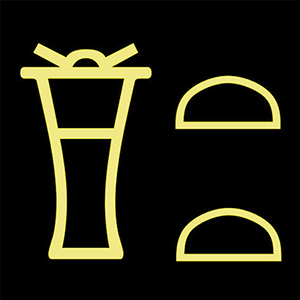
The hieroglyphs 𓎯𓏏𓏏 show Bastet's presence, but there are some significant variations. Her name is made up of the ointment jar hieroglyph (the bas) and two hieroglyphs for bread, signifying a feminine ending. Her name may also derive from bꜣs ("fire, heat") + the feminine suffix -t, connecting her to the protective fire of the Eye of Ra.
The Phoenicians wrote her name as 𐤀𐤁𐤎𐤕 ('bst), which is found both in a name from Carthage and an inscription elsewhere.3,4,5
Sources: Raffaele, An Unpublished Early Dynastic Stone Vessel Fragment with Incised Inscription Naming the Goddess Bastet (2005); Pyramid Spell 508 (6th Dynasty, 2300–2181 BCE); Minunno, Human-divine Relations in Personal Names from the Tophet of Carthage (2024); KAI 49(34).1,2,4,5
II. The Cat Goddess
Bastet was an incredibly beloved Egyptian goddess who rules over joy, power, the family and aspects of the solar. In Egypt, she was an incredibly important deity, not just in day-to-day domestic life and as a patron deity of safety in the home but in all matters related to celebration of life, cosmic order, children, societal order, warfare, statehood and occult knowledge that rules over refinement of base matter. Her functions were so varied that even now Bastet is one of the most recognizable symbols of Egyptian civilization to resonate down the ages, and she still is synonymous with all feline life.
She first apppears in the very ancient Pyramid Texts as said above, being a wetnurse to the Pharaoh. There are also the inscriptions PT 1310: “The heart of Meryra [Pepi I] is Bastet”; and PT 892, an obscure passage involving Bastet. Djedefa refers to her as his mother in a royal context: '‘ir.n.f m mnw.f n [mwt.f] BAstt’. These kinds of formulae from the Old Kingdom show that she was a goddess already strongly associated with the retinue of the Pharaohs, as shown by particular artefacts displaying her seated upon a throne, and the conflation of Hathor and Bastet in roles already existed. The cult at Bubastis was prominent enough for Pepi I to record making specific offerings to it.2,6
In the Coffin Texts of the Middle Kingdom, Bastet is treated as the firstborn of the primordial god Atum, making her a very high member of the divine retinue. As with Hathor, she becomes identified with the Eye of Horus, while in CT 955 she says: “I am Sekhmet, Bastet the beloved.” It appears Bastet's characteristic as a goddess who fights serpents is rooted in this corpus.7,8
From the Middle Kingdom onwards, her cult continued to be popular, but other than being identified with the slayer of Apep in cat form and being conflated with Sekhmet in the Book of the Heavenly Cow episode of the enraged Hathor, she is not considered to have any particular widely surviving mythology of her own. An exception is the Brooklyn 47.218.84 papyrus,9,10 an identification of Bastet with Horit, the female Horus.
"In the recently published 26th Dynasty mythological papyrus Brooklyn 47.218.84, which contains aetiological myths for the nomes of the Delta, we find several myths... Bubastis. Concerning Bastet who is in Bubastis: This is the efflux when she came forth as Horit on the eastern mountain of Heliopolis. The blood came forth from her and it transformed into turquoise."
Papyrus Brooklyn 47.218.84 (26th Dynasty)10
III. The Epithets of Bastet
Epithet
Meaning
Domain
Bꜣstt nb.t Bꜣst.t
Bastet, Lady of Bubastis
Primary cult, Delta temple
Bꜣstt ꜥꜣ.t nb.t Bꜣst.t
Bastet the Great, Lady of Bubastis
Royal evocation, metropolis
Bꜣstt nb.t pr-nsr.t
Bastet, Lady of the Shrine
Naos cult
Bꜣstt nb.t ꜥnḫ-tꜣ.wy
Bastet, Lady of Ankhtawy
Memphis cult
Sources: Rosenow, The Naos of ‘Bastet, Lady of the Shrine’ from Bubastis (2008); Booth, Bastet and the Sacred Landscape of the Nile Delta (2018); Teeter, Demotic Dictionary Project (1996); Onderka, Inscribed Canopic Jars in the Czech Collections (2022).11,12,13,14
IV. The Temples of Bastet
Per-Bastet (Bubastis)
Bubastis Temple remains, present day
Her cult center was located in Per-Bastet (Bubastis in Greek) in Lower Egypt, thirty miles from modern Cairo. The temple complexes of Bubastis were associated with fertility rites and celebrations of life. Per Bastet had particular prominence since during the ancient 22nd Dynasty, it even functioned as the capital of Egypt itself, and the hieratic complexes were considerably expanded in scope. To any visitor, the temple complexes had a holy, very arcane kind of shimmer.
Bastet's annual festival in Bubastis was among the most popular in Egypt with nearly a million (700,000) people attending it at any given point it was held, according to the high priest Herodotus. The excavations at Bubastis revealed a substantial and well-provided sanctuary resort of Bastet, set within a sacred landscape that included canals and other water installations. The cult prominence of Bubastis seems to have reached a major height after 1000 BCE, especially under the Twenty-Second Dynasty, whose rulers treated Bubastis and Bastet with particular favor.
These rulers enlarged and embellished the temple of Bastet, with Osorkon II especially associated with major building activity there. The cult at Bubastis did not just celebrate the great cat goddess, but other feline deities such as Sekhmet and others.15,16,17,18
By the same account, it was known to Herodotus as one of the most beautiful temples in the world:
"Temples there are more spacious and costlier than that of Bubastis, but none so pleasant to behold. It is after the following fashion. Except at the entrance, it is surrounded by water: for two canals branch off from the river, and run as far as the entrance to the temple: yet neither canal mingles with the other, but one runs on this side, and the other on that. Each canal is a hundred feet wide, and its banks are lined with trees. The propylaea are sixty feet in height, and are adorned with sculptures (probably intaglios in relief) nine feet high, and of excellent workmanship. The Temple being in the middle of the city is looked down upon from all sides as you walk around; and this comes from the city having been raised, whereas the temple itself has not been moved, but remains in its original place.
Quite round the temple there goes a wall, adorned with sculptures. Within the inclosure is a grove of fair tall trees, planted around a large building in which is the effigy (of Bast). The form of that temple is square, each side being a stadium in length. In a line with the entrance is a road built of stone about three stadia long, leading eastwards through the public market. The road is about 400 feet (120 m) broad, and is flanked by exceeding tall trees. It leads to the temple of Hermes."
Herodotus, Histories 2.137–13816
Per-Bastet's beauty elevated the soul. Her temples demonstrate her relationship to gods such as Ra, as she was seen as an emissary of her father. Archeologists have found inscriptions to Bastet in Bubastis that indicate how she was perceived, since unlike Sekhmet, many of Bastet's roles seemed to relate to spiritual matters and not regal ones involving the machinery of power, lending her worship to the intimacy of the Naos and small chapels:
"King of Upper and Lower Egypt, lord of the Two Lands... (I) have come to you Bastet, lady of the [shrine], one who gives his arms supporting the ones who shine/the shining ones(?) (= stars), one to whom transfiguration (Ax.w) is given in heaven through (xr) Re."
Inscription from the Naos of Bastet11
V. Festivals
It is well attested in Egyptology that Bastet's cult had a large amount of festivals and celebrations. This has been traditionally buttressed by a significant amount of records detailing the planning of these festivals and, as stated, Herodotus' historic remarks observing the gigantic scope of the one that he witnessed in Bubastis, which has come down to us as one of the most highly detailed and florid accounts of any divine celebration in Antiquity.
Herodotus also directly calls Artemis "Bubastis", making the dedication of this festival to any other goddess highly unlikely, nonetheless, he did not date the festival enough to securely identify it with any Egyptian recorded variant. Many of the dates below are from the New Kingdom era onwards; they may not necessarily reflect the most ancient practices.
Bastet Ritual Days
Calendar
Occurrences
Importance
Date Recorded
First festival
I Peret, day 20
Going forth, appearance of Bastet
"the going forth of Bastet who protects the two lands"
c. 1244–1163 BCE
Second festival
I Peret, day 29
Riverine festival of Bastet
"river festival of Bastet..."
c. 1186–1155 BCE
Third festival
IV Peret, day 4
Festival of Bastet
"Chewing onions for Bast"
c. 1186–1155 BCE
Third/fourth festival
IV Peret, day 5
Appearance of Bast in her boat
Processional manifestation
c. 664–525 BCE
Mut-Isheru Bastet-Sekhmet
IV Akhet, day 15–16
Eye of Ra worship
Temple complex worship
7 March 238 BCE
Great Procession
II Shemu, day 1–5
Great procession of Bastet
Lasted five days (Canopus Decree)
7 March 238 BCE
Great Bubastis (Herodotus)
Unknown
Wine, music, two sexes rowing, mass festivities
Great holiday of Artemis
c. 440s–420s BCE
Sources: Herodotus, Histories [2.37] (Artemis at Bubastis); Hardy, Archaeoastronomy 26 (2001); Karev, Variant Presentations in the Ptolemaic Sacerdotal Decrees (2008); University College London, Festivals in the Ancient Egyptian Calendar; Champollion, Monuments de l’Égypte et de la Nubie (1889).16,19,20,21,22
VI. Hieroglyphs
The occult name behind Bastet means 'she who is anointed and (in return) she anoints', hence the Hieroglyph of her name is always represented with an ointment jar18. There is also a code inside her name with the feminine double t (tet), represented by the two bread Hieroglyphs, meaning 'she who anoints via the Power of Thoth'.
VII. Cat Symbolism
In occult terms, Bastet rules over many aspects of distinction symbolized by the cat. While they are independent animals, cats possess a complex social order,23 which they fiercely enforce at all times. Cats also cannot be commanded to love any being and generally 'claim' whomever they choose. This symbolism aligns with the anointing ointment Bastet has at her disposal, because her powers of discernment are absolute: she is an aristocratic goddess promoting excellence in the true sense of the word.
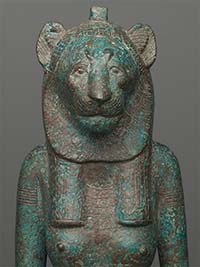
Bastet in lioness form
Bastet's warlike form as a lioness refers to her fierceness as an adversary24, her superlative levels of power. In addition to protecting the home, she also maintained the nation, the greater cultural home. In this form of the goddess, the symbolism emphasizes the proactive work of the collective of lionesses to uphold the pride that is the basis for any true choice and liberty, the apostasis of Sekhmet in defense of the realm and in the proper use of power represents this too.
While dogs guard against external threats, with this symbolism being tied to both Cerberus and Anubis, cats eliminate all sources of disease and decay within the home and farmstead. They sometimes also warn against fire. The Egyptian lady's job was to ensure the household was orderly, also to be vigilant in overseeing her children for signs of distress, danger or disease.
This was one of the reasons Bastet was invoked by women so strongly throughout the centuries. Vermin especially posed a danger to children, and these animals were used in Egypt to guard against the dissipation of new life, so cats were used to extensively hunt the vermin of the Nile with great effect. Yet just as a cat exterminates vermin and a mother cares for her children, Bastet's role in a divine sense is to ensure that the spiritual initiates who have passed through the gate are monitored and kept free of disease, internal chaos, and ignorance. As grain grows to feed the multitude when freed from pests, so does the soul of the Zevist serve the many when it is cultivated with proper care.25,26
The climbing ability of cats also relates to her as cats will not hesitate to climb upwards. They also exercise balance and judgement in jumping and can slip through gaps by manipulating their bodies like water. There exists an adversarial and anxious nature to these animals suggestive of taking care not to be too sure in one's convictions and to be able to move on if necessary. As the daughter of Ra, Bastet was also associated with the purifying, perpetually rising and lowering powers of the independent Sun for these reasons, among others.
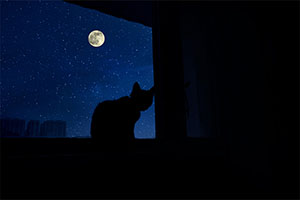
Beyond the more obvious reason that this relates to the ability to confront unforeseen threats, the exceptional ability of cats
to see well in the dark serves as an allegory for being able to see inside one's soul in order to wring out unknown
possibilities. The acolyte must unlock and unify with the unconscious (female) side of the soul; they must wield the ability to
traverse different dimensions as a cat slips in and out of the night. Bastet represents many facets of this process of change
and aspects of spiritual secrecy that she revealed only to her chosen acolytes; due to these things, she was equated with certain aspects of Artemis by the Greeks.
Cats were considered exceptionally holy in Ancient Egypt27, tied to the health of the farming civilization adjacent to the
Nile's waters. Deliberate violence
against a cat was punishable by death. Expensive embalming procedures for cats were often pursued which is another
indication of the popularity of Bastet. In Beni Hasan, a single cemetary with hundreds of thousands of cat remains was
found.
Bastet represented the form of invincible feminine consciousness, the subtle caregiving required to keep the Great Work under control. Cats always functioned as guardians of granaries, temples, and laboratories alike.28 Their generally silent nature demonstrates the need for thoughtful repose in the Zevist initiate and to keep quiet about what quickly brings envy and chatter.
Since feline creatures represent guardians of places in Egyptian thought, the purpose of Bastet as the divine cat is to guard the household chamber, the zone of proper being that Nephthys properly represents, from all forms of decay. She deviates from Sekhmet in representing a softer and more playful form of divine expression.
VIII. The Physiology of Cats
To further understand Bastet, we should further understand cats. In the ancient sands of Egypt, our goddess Bastet transitioned from a fierce lioness into the domestic cat to bring temple-grade protection into the sanctuary of the home.18,29
She offered us a "Small Bastet" a living, breathing regulator designed to guard our thresholds and keep the "evil spirits" of stagnant stress and chaos from settling in our private spaces. This reflects the ancient struggle where the cat is shown slaying Apep, the serpent of chaos. In this way, the cat is the ultimate enemy of entropy, preventing the inner light of the soul and home from being swallowed by disorder.30
One can see the blueprint of this spiritual technology. A cat’s fur acts as a sophisticated grounding rod, using the triboelectric effect (the science of static) to manage the room's energy. Their fur functions as a biological "anode," pulling in the jagged, positive ions created by stress and electronic static. This is most noticeable as they move and when they are petted.31
Science shows that their fur is ranked at the extreme top of the triboelectric scale. While a dog’s fur is relatively neutral, a cat's coat is a high-power positive terminal that pulls in the chaotic static of a room. This is why cat fur has been used as the literal 'gold standard' for explaining how electricity flows through the physical world according to a research university in Illinois.32
By absorbing chaotic or static energy, cats help to neutralize the atmosphere with negative ions, which are known to improve our mood and the air we breathe. They act as resident engineers, making sure the home never feels heavy or stagnant. This is a major aspect of how Bastet transforms as a goddess.33
This cleansing process finds its voice in the purr. Far more than a sound of contentment, the purr is a vibrational broadcast. Science confirms that cats purr between 25 and 150 Hertz, a range medically proven to heal bone and tissue, reduce inflammation, and balance the heart through frequency.34,35 Spiritually, this vibration acts like a tuning fork, forcing the "noise" of a stressful room to settle into a state of deep peace. Even their spines play a part; biologically, they are liquid-smooth for movement, but spiritually, they act as a primary antenna that allows the cat to stay flexible and open to the flow of energy.
Their vision serves as the "Watchman of the Threshold." While our sight is narrow, cats see into the ultraviolet spectrum, witnessing energy flows we cannot.36,37
In the physical world, it helps them see in the dark, like a retroreflector. It takes in the UV light (etheric) and bounces it back out. This is why cat eyes "glow" in the dark, they are literally radiating the light they have collected and refined. While science notes that this "shining layer" allows cats to see in near-total darkness by reflecting light back through the retina. This allows them to detect subtle "shifts" in the environment, perceiving a spectrum of reality.38
Their vertical-slit pupils are literal geometric portals shaped like the Vesica Piscis. This shape is a physical lens that can read information beyond the physical world. When an advanced cat stares into a corner, it is as if they are "pinning" a distortion in the air, using their eyes like projectors to hone in on the atmosphere and keep the spiritual boundaries of your sanctuary intact.
Every part of the cat serves the whole. Their whiskers are logarithmic spirals that detect tiny pressure changes,39,40 and their tails act as variable tuning rods,41 as seen in different species, to balance the equilibrium, navigate the world, and attune to resonances. By flicking or sweeping the tail, they balance the room’s polarity and ground any excess "voltage."
They mirror our goddess and her divine functions. To live with a cat is to walk with a silent guardian who ensures your home remains a vibrant sanctuary for your soul.
The domestic cat was not an "accident" of evolution, it was a precise miniaturization, their creation attuned to a frequency that can exist within the intimate walls of a human home or temple; hence, domestication. A cat doesn't just live in a home, it consecrates it. They maintain the spiritual boundaries that Bastet first established in the Great Temple.42
By dwelling in our homes, they continue the work of Bastet, using their unique biology to keep our living spaces clear and peaceful. To understand the science of a cat is to see our goddess still at work today, ensuring that our homes remain true sanctuaries.
IX. Motherhood
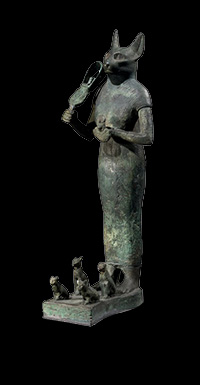
So in a domestic guise, she ruled over the protection of the home and the cultivation of new life, as well as vigilance against the night and darkness.43 As a powerful Goddess, women frequently called on Her powers during pregnancy and in difficult situations for her protection and guidance. Bastet, like Isis and Hathor, was equated very strongly with motherhood44 and nourishment of the young, which is why she is commonly represented in statuary with kittens.
During the New Year's celebrations, Bastet's name was often invoked on celebratory flasks45 and was associated with a gift of cats or kittens to another household.
X. Sistrum
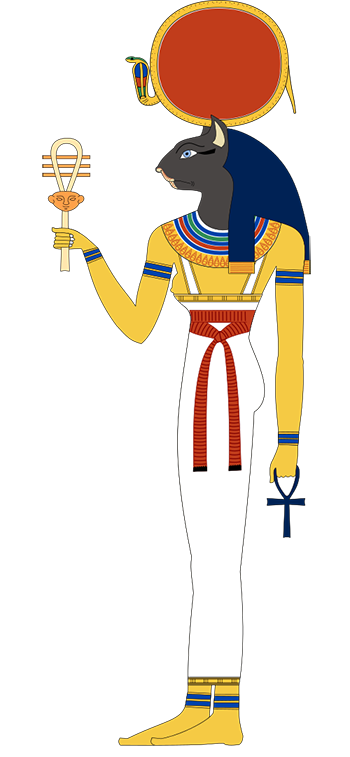
Like Hathor, Bastet is the wielder of the sistrum which is also associated strongly with Isis and Hathor. The three strings of the sistrum represent the three channels of the soul and the necessary prerequisite for power to be wielded carefully in pursuing immortality. The sound it makes also represents a sound similar to the rush that coincides with rumbling, surging, and exceptionally bright power that hits one's consciousness when advancement occurs. This sound also parallels the purring and hissing sound of cats. The pacification of Sekhmet into returning to being Hathor is also shown through Bastet's gentle symbolism.46
The sistrum, similar to how modern bells have distinct patterns, would be played in a manner of processions by women familiar to Egyptians. Some of these sound patterns, lost to the sands of time, would be evoked in the imagery itself of Bastet holding the instrument.
In statues, Bastet is often represented holding a leonine aegis to her Middle Chakra, while her other arm holds a sistrum upwards. This shows the balance between aggression and approval inherent to any true protection. It also serves as a
reminder to consort with the right things and to not let corrupted people enter into one's heart, lest you surrender your power and endanger the vulnerable in the process. She is often represented with an Ankh,47 which represents her fierce guardianship of life. Sistra were often used in ritual processions to keep evil influences away.47,48,49
XI. Alabaster
Alabaster, a type of mineral and rock, is associated with Bastet. The original name was synonymous with the vessels of Bastet herself, which passed into Ancient Greek as ἀλάβαστρος wares. Jars made from alabaster were typically used to represent her symbolism, along with other objects such as amulets, brooches, plaques and vases.50 Some alabaster objects in travertine form found at her sites are rendered in the shape of a cat with highly distinct eyes.51
XII. Plague Bringer; Serpent Destroyer
The fierce side of Bastet is first present in the Coffin Texts, to a large extent, where she is invoked as a destroyer of serpents. The enforcement of her decrees in relation to cosmic order is absolute.
Her destruction of the snake of chaos and entropy, Apep, symbolized the Egyptian state's acuity to overcome chaos, hence she was invoked by Pharoahs for protection. Ra was also represented as destroying Apep in the form of a male cat, while Bastet likewise maintained order by allowing the dawn to come each day. In turn, Bastet rules over the maintenance of time and is the dispositor of time as an emissary of Isis.
On a mundane level, her functions often concerned health and medicine. The cleanliness routines of cats and fastidious care they take to remove their own pollutants parallels the upkeep of spiritual cleansing required of advancement and the necessity of removing debris from the soul for the serpent to ascend and emerge. The symbolism of Bastet is not a coy matter, it is a code, one that deeply deals with alchemical forces of changing the base nature of a being to pure gold.
XIII. The Priesthood of Bastet
The priesthood of Bastet was a vast and powerful force, especially during the 22nd Dynasty when Bubastis became one of the most important centers in Egypt. As Daniela Rosenow’s research shows, the Great Temple was built like a sacred island, set in a depression and surrounded by water.
The priests were its devoted guardians, caring for this holy place not only as a sanctuary for prayer, but as a living heart for the whole Delta region, a place where the divine and everyday life flowed together.
At the center of their daily service was the Daily Office, the sacred morning ritual of awakening and tending to the Goddess. At dawn, the High Priest would break the clay seal of the inner shrine. The Stolists, masters of the Divine Wardrobe, would then carefully purify the sacred statue with incense and water before dressing her in four colors of fine linen, white for purity, blue for the sky, green for rebirth, and red for the protective fire of the sun.
As “Lady of the Ointment Jar,” Bastet was deeply connected to sacred perfumes. The priests managed a thriving sacred apothecary, creating and offering the Seven Sacred Oils, including Hekenu (oil of praise) and Set-heb (festival oil) and other divine scents. These fragrant rituals, often linked to her son Nefertem, filled the temple with sweet aromas that were believed to keep the Goddess gentle and bring harmony to the land.
The Wab-priests, known as the “Pure Ones,” supported this work by following strict rules of cleanliness, shaving their bodies and bathing several times a day in sacred pools so they could enter the inner sanctum with pure hearts. The Lector Priests gave voice to the rituals, reciting sacred words from scrolls so every action and chant flowed in perfect harmony with Ma’at. Even through the night, the priests kept watch with the Ritual of the Four Candles, standing at the four corners of the sanctuary to protect the Solar Spark of Bastet until dawn.
One of their deepest responsibilities was caring for the sacred cats, who were seen as living embodiments of Bastet. They oversaw large catteries, tending to the breeding, feeding, and medical care of thousands of cats. When the cats passed, the priests mummified them with love and buried them in the vast underground catacombs. These feline necropolises became a kind of permanent prayer library, where pilgrims could offer a mummified cat as a lasting message to the Goddess. Through this sacred work, the priesthood turned personal devotion into something powerful and enduring.
The clergy were also the heart behind the Great Festivals that drew hundreds of thousands of people. These joyous celebrations included boat processions on the Nile, constant music from sistra and flutes, feasting, and “festivals of drunkenness” meant to delight and soothe the Goddess and keep chaos at bay. The priests guided the crowds, distributed food and wine, and timed the hymns and offerings with care. Through these events, Bastet’s warm, protective presence spread across the land, blessing everyone with joy, fertility and abundance.
Beyond their spiritual duties, the priesthood held real political and economic power. During the Third Intermediate Period, when kings from Bubastis raised Bastet to national importance, her clergy became influential statesmen. They managed large lands, collected taxes, and helped keep northern Egypt strong.
They also oversaw a thriving industry of votive bronze cat statues, allowing ordinary people to carry Bastet’s protection into their own homes. The temple’s unique island design, surrounded by canals, let them welcome pilgrims and trade while protecting the sacred space.
Through their loving service, from the intimate morning rituals of dressing and anointing the Goddess, to the care of her sacred cats, the grand festivals, and the wise handling of economic and political matters, the priesthood of Bastet kept her alive in the hearts of the people. They were not just temple servants. They were the hands that helped divine love, daily devotion, and communal abundance flow together in beautiful harmony.52,53
Sources and Bibliography
Raffaele, Francesco. "An Unpublished Early Dynastic Stone Vessel Fragment with Incised Inscription Naming the Goddess Bastet." Cahiers Caribéens d'Égyptologie 7–8 (2005): 27–46.
Allen, James P. The Ancient Egyptian Pyramid Texts. Writings from the Ancient World 23. Atlanta: Society of Biblical Literature, 2005.
H. te Velde, “Bastet,” in Dictionary of Deities and Demons in the Bible Online, ed. Karel van der Toorn, Bob Becking, and Pieter W. van der Horst (Leiden: Brill).
Minunno, Giuseppe. Human-divine Relations in Personal Names from the Tophet of Carthage, What’s in a Divine Name?, 2024
KAI 49(34), "BST" cited in Krahmalkov, Charles R. Phoenician-Punic Dictionary, Studia Phoenicia XV, Uitgeveru Peeters en Department Oosterse Studies, Peeters, Leuven, 2000
Raffaele, Francesco. “An Unpublished Early Dynastic Stone Vessel Fragment with Incised Inscription Naming the Goddess Bastet.” Cahiers Caribéens d’Égyptologie 7–8 (2005): 263–86.
Faulkner, R. O., trans. The Ancient Egyptian Coffin Texts. Vol. 2, Spells 355–787. Warminster: Aris & Phillips, 1977. See CT 378, CT 652.
Darnell, John Coleman. “The Apotropaic Goddess in the Eye.” Studien zur Altägyptischen Kultur 24 (1997): 35–48.
Abdel-Raziq, Abdalla. “A New Look at the Goddess Bastet Bronze Statue at Zagazig University Archaeological Museum.” Ḥawliyat al-Ittiḥād al-ʿĀmm lil-Āthāriyyīn al-ʿArab: Dirāsāt fī Āthār al-Waṭan al-ʿArabī 14, no. 14 2011
Jørgensen, Jens Blach. “Myths, Menarche and the Return of the Goddess.” In Lotus and Laurel: Studies on Egyptian Language and Religion in Honour of Paul John Frandsen, edited by Rune Nyord and Kim Ryholt, 135–146. Copenhagen: Museum Tusculanum Press, 2015
Daniela Rosenow, “The Naos of ‘Bastet, Lady of the Shrine’ from Bubastis,” Journal of Egyptian Archaeology 94 (2008): 247–66
Charlotte Booth, “Bastet and the Sacred Landscape of the Nile Delta,” in Remote Sensing in the Nile Delta: Spatio-Temporal Analysis of the Holocene Landscape and Its Archaeological Sites (Vienna: Austrian Academy of Sciences Press, 2018), quotation of the Edfu inscription
Emily Teeter, “Demotic Dictionary Project,” in The Oriental Institute 1995–1996 Annual Report (Chicago: Oriental Institute of the University of Chicago, 1996), 89–91
Pavel Onderka, “Inscribed Canopic Jars in the Czech Collections,” Annals of the Náprstek Museum 43, no. 2 (2022): 155–72 [4]
Schipper, Bernd U. “Wenamun, Sheshonq, and Byblos: Egypt and the Levant in the Tenth Century BCE.” Journal of Egyptian History 17, no. 1: 1–24, 2024
Herodotus, Histories [2.37] (Artemis at Bubastis) [2.60] (Great Bubastis festival). ed. C. Hude, Oxford Classical Texts, 3rd ed., 1927; trans. A.D. Godley, Loeb Classical Library, 1920
Lange-Athinodorou, Eva. “The Goddess Bastet and the Cult of Feline Deities in the Nile Delta.” American Research Center in Egypt. https://arce.org/resource/goddess-bastet-and-cult-feline-deities-nile-delta/.
Hardy, Patty A. “The Cairo Calendar as a Stellar Almanac.” Archaeoastronomy 26 (2001): 43–55.
Karev, Ella. “Variant Presentations in the Ptolemaic Sacerdotal Decrees.” Academia.edu, 2018
University College London. “Festivals in the Ancient Egyptian Calendar.” (Third/fourth festival) Digital Egypt for Universities. London: UCL, n.d. See “Month 4 (8th month of 12 in year)
Champollion, Jean-François. Monuments de l’Égypte et de la Nubie: Notices descriptives conformes aux manuscrits autographes rédigés sur les lieux. (Boat) Vol. 2. Edited by Jacques-Joseph Champollion-Figeac. Paris: F. Didot frères, 1889
Crowell-Davis, Sharon L. “Social Organization in the Cat: A Modern Understanding.” Journal of Feline Medicine and Surgery 18, no. 9 (2016): 717–726. “Social Behavior of Cats.” Merck Veterinary Manual
Pinch, Geraldine. Egyptian Mythology: A Guide to the Gods, Goddesses, and Traditions of Ancient Egypt. Oxford: Oxford University Press, 2002
EBSCO. “Bastet (Deity).” Research Starters: Social Sciences and Humanities. Accessed 2026
Malek, Jaromír. The Cat in Ancient Egypt. London: British Museum Press, 1993
Pongrácz, Péter. “Cats Are (Almost) Liquid! Cats Selectively Rely on Body Size Awareness When Negotiating Short Openings.” iScience 27, no. 11 (2024):
Wilkinson, Richard H. The Complete Gods and Goddesses of Ancient Egypt. London: Thames & Hudson, 2003, 178
Barbash, Yekaterina. “Cats, Bastet and the Worship of Feline Gods.” American Research Center in Egypt. Accessed July 31, 2026. https://arce.org/resource/cats-bastet-and-worship-feline-gods/.
Crespi, Sarah, and David Grimm. “Linking Cat Domestication to Ancient Cult Sacrifices, and Watching Aurorae Wander.” Science Magazine Podcast, April 17, 2025. Podcast audio. https://www.science.org/content/podcast/linking-cat-domestication-ancient-cult-sacrifices-and-watching-aurorae-wander.
Morris, Amanda. “Why Petting Your Cat Leads to Static Electricity.” Northwestern Now, September 18, 2024. https://news.northwestern.edu/stories/2024/september/why-petting-your-cat-leads-to-static-electricity.
StudyFinds Analysis. “Electric Discovery! Scientists Reveal Why Petting Cats Leads to Static Shock.” StudyFinds, September 28, 2024. https://studyfinds.com/why-petting-cats-static-shock/.
Chakraborty, Ishita, Lizhi Sun, and Chao-Sung Lai. “Dual-Energy Harvesting Using Recycled Cat Fur and α-Fe₂O₃ Nanoparticles for Self-Powered Photodetection and Human-Pet Health Care.” IEEE Sensors Journal 25, no. 21 (2025): 39737–39744. https://doi.org/10.1109/JSEN.2025.3612504.
Knight, John. “Is a Cat’s Purr Actually Helpful to Our Bones?” Hand and Wrist Institute. Accessed July 31, 2026. https://handandwristinstitute.com/blog/is-a-cats-purr-actually-helpful-to-our-bones/.
Muggenthaler, Elizabeth von. “The Felid Purr: A Healing Mechanism?” Journal of the Acoustical Society of America 110, no. 5 supplement (2001): 2666. https://doi.org/10.1121/1.4777098.
Douglas, R. H., and G. Jeffery. “The Spectral Transmission of Ocular Media Suggests Ultraviolet Sensitivity Is Widespread among Mammals.” Proceedings of the Royal Society B: Biological Sciences 281, no. 1780 (2014): 20132995. https://doi.org/10.1098/rspb.2013.2995.
Lewis, Tanya. “Cats and Dogs May See in Ultraviolet.” Live Science, February 19, 2014. https://www.livescience.com/43461-cats-and-dogs-see-in-ultraviolet.html.
Panthera. “The Spooky Science of Glowing Eyes in Cats.” October 24, 2024. https://panthera.org/blog-post/spooky-science-glowing-eyes-cats.
Luo, Yifu, Chris S. Bresee, John W. Rudnicki, and Mitra J. Z. Hartmann. “Constraints on the Deformation of the Vibrissa within the Follicle.” PLOS Computational Biology 17, no. 4 (2021): e1007887. https://doi.org/10.1371/journal.pcbi.1007887.
Walker, Charlotte, Catherine J. Vierck Jr., and Clifford J. Woolf. “Balance in the Cat: Role of the Tail and Effects of Sacrocaudal Transection.” Behavioural Brain Research 91, no. 1–2 (1998): 41–47.
Sauer, Nicholas. “Cats: The Archeological Site!” Carnegie Museum of Natural History. Accessed July 31, 2026. https://carnegiemnh.org/cats-the-archeological-site/.
British Museum. “Ancient Egyptian Gods and Goddesses.”
Metropolitan Museum of Art. “Bastet.” Late Period–Ptolemaic Period, 664–30 B.C. Accession no. 2015.500.4.19. New York: Metropolitan Museum of Art.
Málek, Jaromír. The Cat in Ancient Egypt. London: British Museum Press, 1993; Rummel, Ute. “The StA-Garment of Horus: An Example of Integrating the Foreign King into the Egyptian Belief System.”
Metropolitan Museum of Art. “Bastet Holding Sistrum.” Late Period–Ptolemaic Period, 664–30 B.C. New York: Metropolitan Museum of Art
Hart, George. The Routledge Dictionary of Egyptian Gods and Goddesses. 2nd ed. London: Routledge, 2005, s.v. “Bastet.”
Metropolitan Museum of Art. “Bastet Holding an Aegis.” Late Period–Ptolemaic Period, 664–30 B.C. New York: Metropolitan Museum of Art
Richter, Barbara A. The Theology of Hathor of Dendera: Aural and Visual Scribal Techniques in the Per-Wer Sanctuary. PhD diss., University of California, Berkeley, 2012,
Metropolitan Museum of Art. “Oval Plaque with Blessing Related to Bastet.” Third Intermediate Period or Late Period, 664–30 B.C. New York: Metropolitan Museum of Art
Metropolitan Museum of Art. “Cosmetic Vessel in the Shape of a Cat.” Middle Kingdom ca. 1990–1900 BCE. New York: Metropolitan Museum of Art
Wahlberg, Nina May. “Goddess Cults in Egypt between 1070 BC and 332 BC.” PhD diss., University of Birmingham, 2002.
Rosenow, Daniela. “The Great Temple of Bastet at Bubastis.” Egyptian Archaeology 32 (2008): 11–13.
Further reading (not cited in text):
Snorri Sturluson. Edda. Translated and edited by Anthony Faulkes. London: Everyman, 1987, Gylfaginning 24; Toplak, Matthias S. “The Warrior and the Cat: A Re-Evaluation of the Roles of Domestic Cats in Viking Age Scandinavia.” Current Swedish Archaeology 27 (2019): 153–180.
Prehal, Brenda. “Freyja’s Cats: Perspectives on Recent Viking Age Finds in Þegjandadalur, North Iceland.” Paper presented at the Annual Meeting of the Society for American Archaeology, Sacramento, CA, 2011; Toplak, Matthias S. “The Warrior and the Cat: A Re-Evaluation of the Roles of Domestic Cats in Viking Age Scandinavia.” Current Swedish Archaeology 27 (2019): 153–180.